Farcaster does not have a native token, nor is it a Ponzi scheme. It is simply a good product built by excellent developers.
Authored by: ZENECA
Translated by: DeepTechFlow
Recently, Farcaster has become a hot topic in the cryptocurrency field. However, there is a clear lack of understanding about Farcaster from the outside world. Here, I will attempt to explain what Farcaster is.
I want to start by stating that I know many of you may be extremely tired of the "decentralized social" (DeSo) and "social finance" (SoFi) fields, especially after what happened with Friend Tech in the past few months. As someone who once wrote a 5000-word article about Friend Tech and told you it was almost certain to collapse, I hope I have gained some of your trust and time to try to explain why Farcaster is different.
Friend Tech focused almost entirely on finance, with only a slight involvement in social and decentralization. Farcaster, on the other hand, focuses almost entirely on social and decentralization, with only a slight involvement in finance.
Farcaster does not have a native token, nor is it a Ponzi scheme. It is simply a good product built by excellent developers.
So, what is Farcaster, what is Warpcast, why is it now attracting so much attention, and how can you get involved?
What is Farcaster?
Farcaster is a fully decentralized social media protocol.
You may ask, what does "fully decentralized" mean?
In the words of co-founder Varun Srinivasan:
If two users can find each other and communicate, even if other parts of the network want to prevent it, the social network can achieve full decentralization.
This means that users can always reach their audience, which is only possible when developers can build many clients on the network. If there is only one client, it can stop communication between users.
Sounds good, right? Indeed!
Imagine if Twitter was built on a decentralized protocol. If you have ever been dissatisfied with how things work: the ads you see, the content you see, the terrible algorithms, the money you pay for Twitter Blue every month, etc. If someone could create a new client with the same users and content as Twitter, but with different approaches to ads, content, algorithms, and subscriptions, wouldn't that be great?
If your account would never be banned, wouldn't that be great?
Or, if you are a developer or someone operating a business on Twitter, Facebook, or YouTube, if companies couldn't arbitrarily revoke API access or change ad rules, completely ruining your hard work and leaving you helpless, wouldn't that be great?
If you were sure you wouldn't be abandoned like that, wouldn't that be great?
This is basically how Farcaster works.
Because the protocol is decentralized enough, it means any developer can build applications to interact with the protocol.
If you (as a user) don't like it, you can try another one, and another one, or more (I will share some current clients for you to check out below). If you really hate them (but still want to use the protocol) and have enough determination, you can create your own protocol.
The existence of this product is very important!
Do you know how much power large social media companies have? How they influence our thoughts, opinions, emotions, elections, and everything by changing what we see in our feeds? This is a big, scary, and dangerous issue.
Farcaster offers a solution. It provides a way to shift power back to the people, rather than holding it in the hands of companies. What it does for social media is similar to what cryptocurrency does for finance (and other things). Not surprisingly, it uses blockchain as the foundation to achieve all of this.
This is what true, enduring, decentralized social media looks like. Not a Ponzi scheme factory like Friend Tech, but a good technology that can be openly built, participated in by anyone, and built upon, resistant to censorship and permissionless.
This is what true, enduring decentralized social media looks like. Not a Ponzi scheme factory like Friend Tech, but this—good technology, open to build upon, available for anyone to participate in and build upon. Resistant to censorship, permissionless. All the features we love about cryptocurrency, now applied to social media.
Decentralized social media is the future. It is bound to be important, and better for end users. Mass adoption will take time, as this is still a concept that is too complex and unfamiliar for most people. But this is the future, and Farcaster is ready to become a strong competitor in bringing decentralized social to the world.
One final note about Farcaster: one of the methods it uses to prevent a large amount of spam is to require each account to pay a small amount of funds to purchase storage space. The current annual fee is $7. I have heard people say, "Since Farcaster is so decentralized, why does Warpcast still require me to pay a fee?" It is worth noting that Warpcast is currently subsidizing fees for approximately 20 countries/regions globally, allowing many users to use it for free.
What is Warpcast?
If you have heard of Farcaster, you may have also heard of Warpcast. You may also be very confused about the difference between them.
In simple terms: Farcaster is a decentralized protocol, and Warpcast is an application built on top of it.
Warpcast is just one of the many applications built on the protocol, making it easy for people to interact with the protocol.
Recently, there have been many complaints on Twitter about people claiming that Farcaster is not decentralized because some people have had difficulty creating accounts on Warpcast.
This is like saying Bitcoin is not decentralized because it's difficult to open an account on Coinbase.
Warpcast is built by the same team that developed Farcaster and is currently the most popular client, hence the understandable confusion. However, it is still a centralized company, a team of about 12 people, who are developing some software to make it easier for all of us to interact with the underlying decentralized protocol.
As the application gains popularity, they are experiencing some growing pains, which is why some people are having trouble registering accounts with them. I believe things will smooth out soon (but if the issues persist, you can always use a different application).
With that said, let's take a look at some of the applications you can use now.
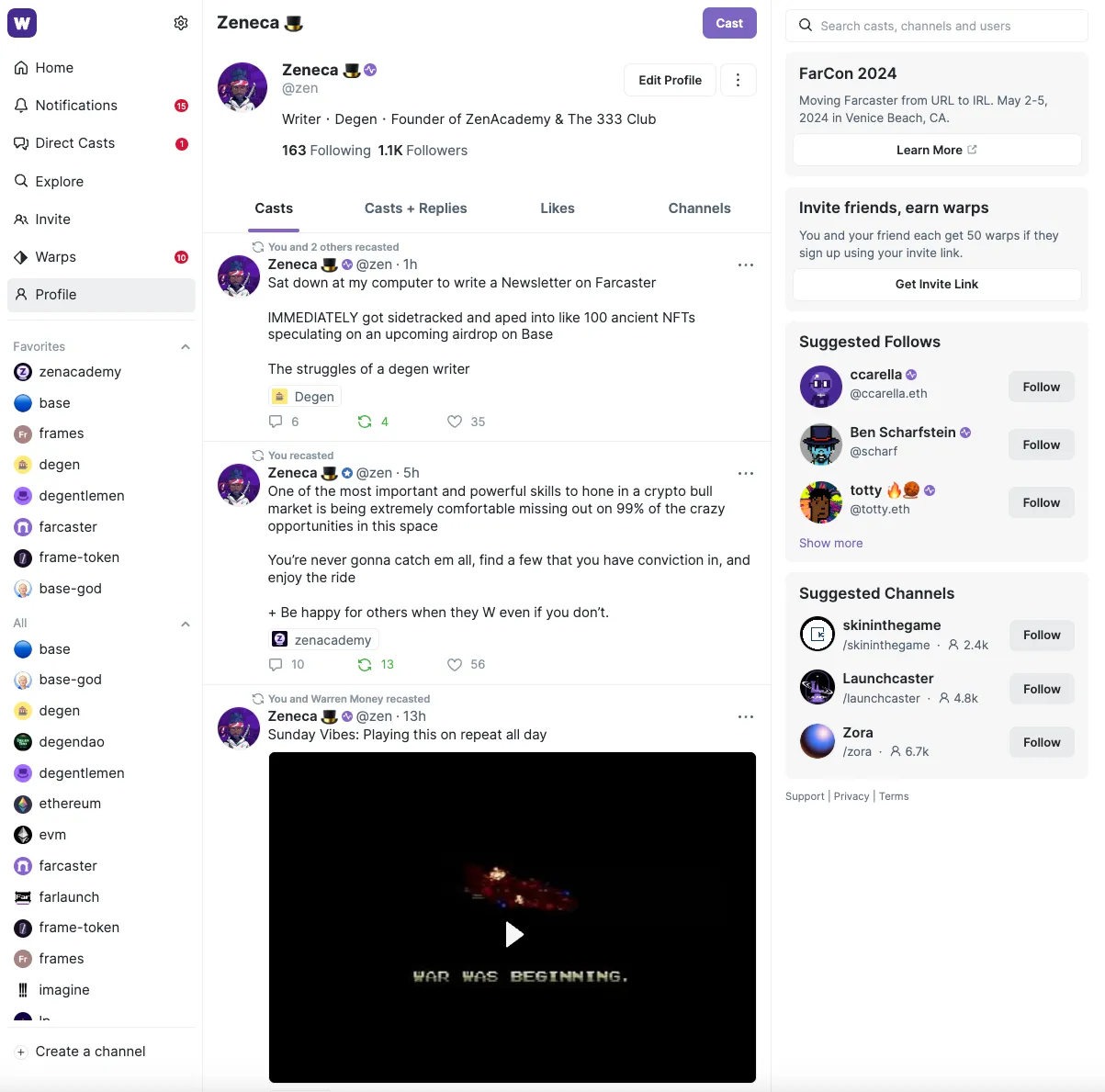
Starting with Warpcast, it is basically a Twitter/X clone, so it makes many people feel familiar and comfortable. This is what my profile page looks like:
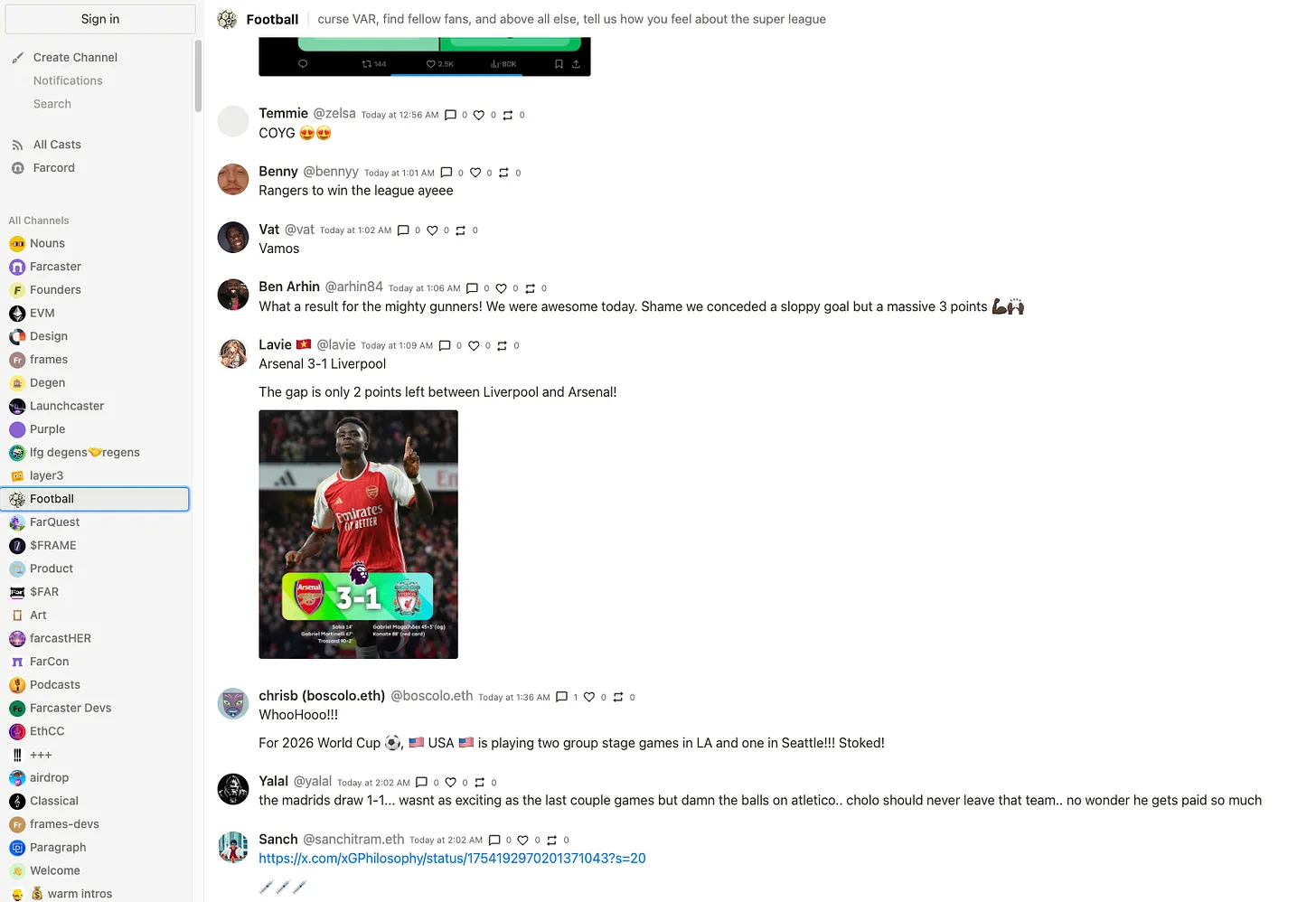
This is Farcord, a Discord-style application (remember, these all use the same account and all the same content):
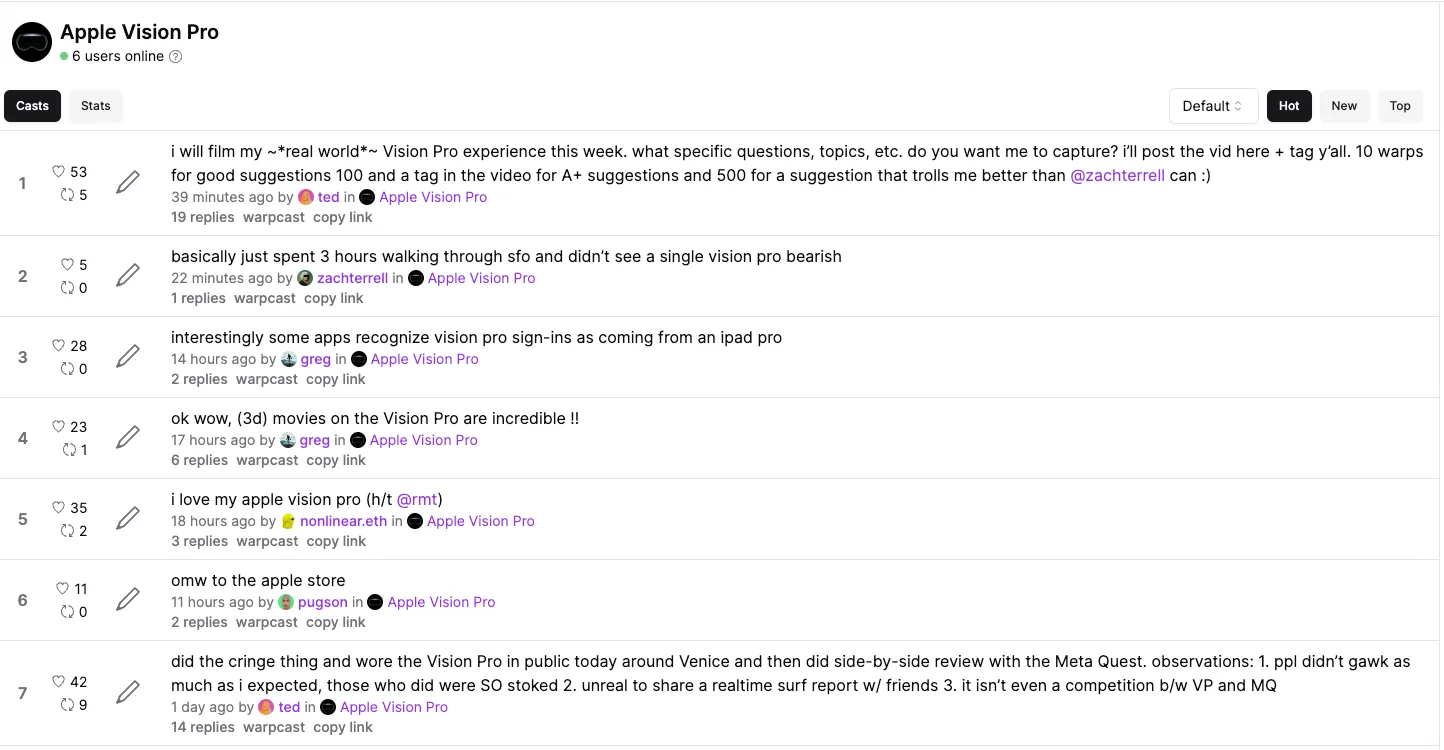
This is an app called Flink, a Reddit-style application:
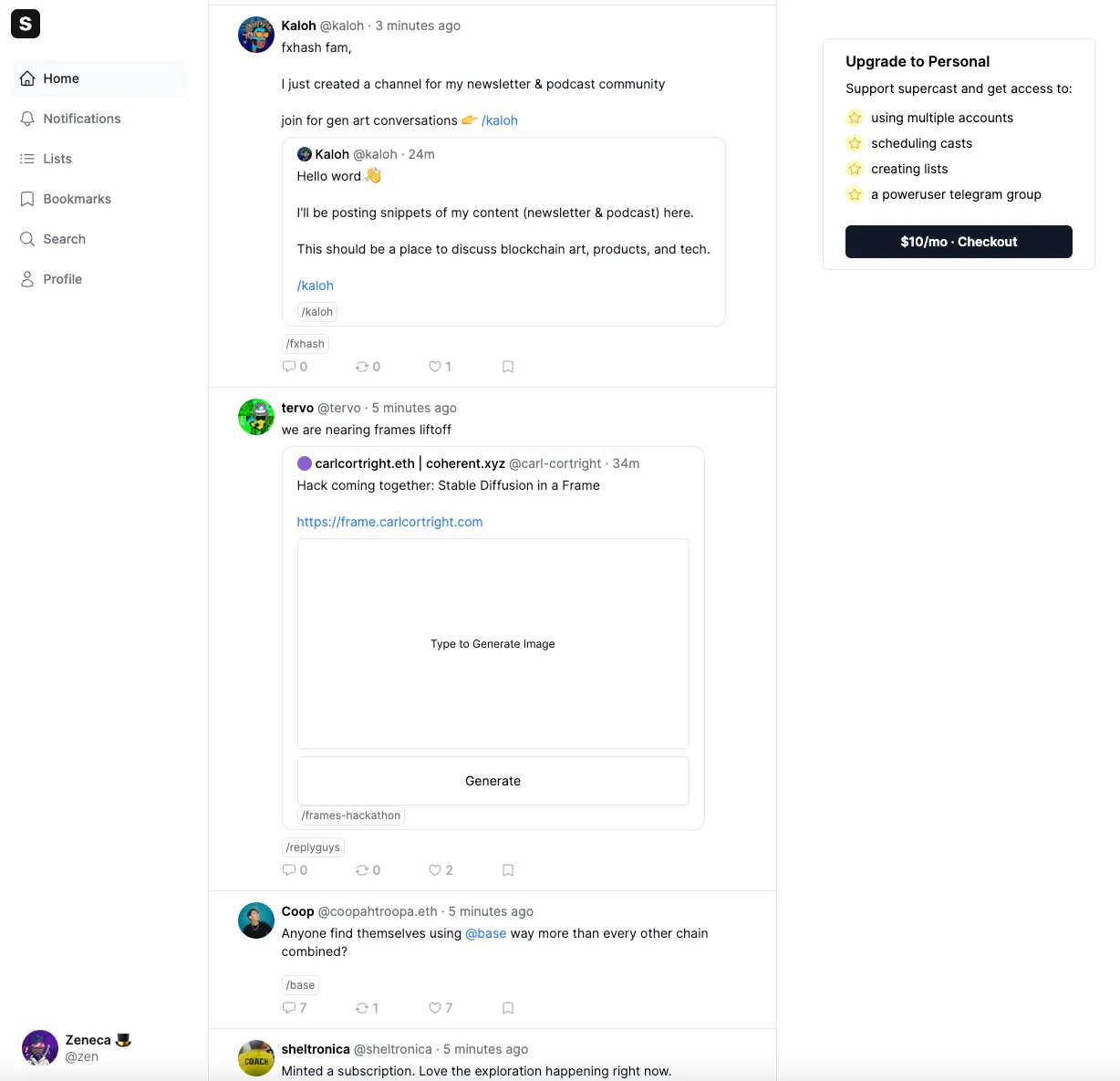
This is Supercast, another Twitter/X-style interface. Its feature is that by default, your feed will display posts from the people you follow in reverse chronological order. It also has a subscription model for more advanced users:
There are more applications available.
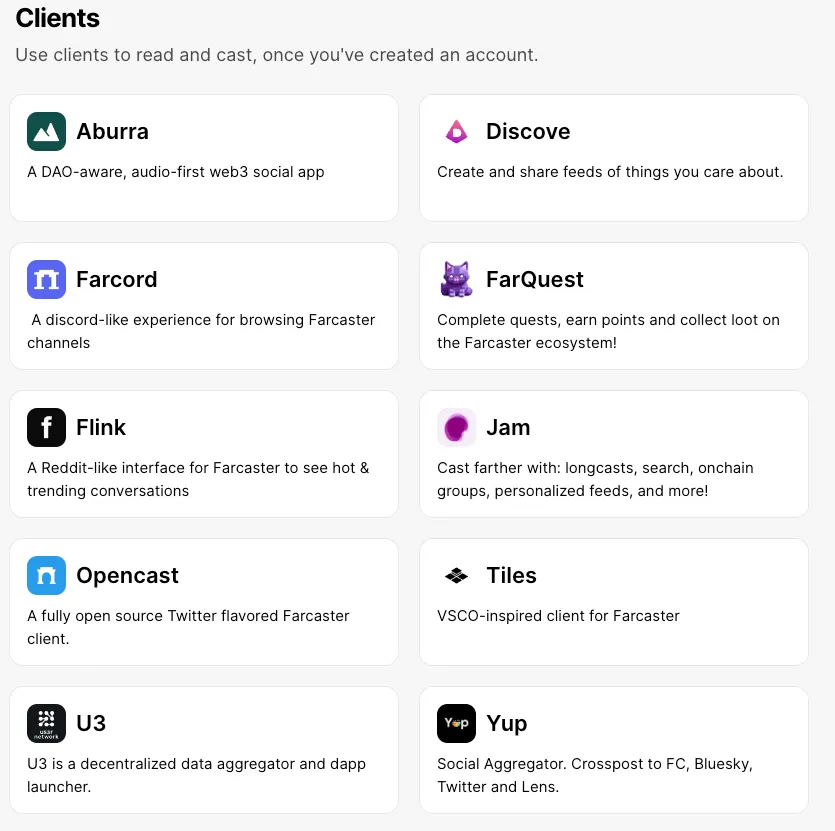
It's thriving, and developers are building. And from now on, things will only get better.
You might be thinking, "Well, this is cool, but it's really hard to overthrow existing social media platforms."
You're right, it is. I'm not sure the short to mid-term goal, plan, or even hope is to overthrow any platform, and I'm not sure it's necessary. Twitter doesn't have to die for Farcaster to succeed. We can have a world with Facebook, Twitter, YouTube, Instagram, TikTok, Snapchat, and Farcaster. Well, how do we do that?
Quoting co-founder Varun Srinivasan again:
- Successful social networks are typically built around a new communication infrastructure. Facebook has walls, Twitter has 140-character tweets, Snapchat has ephemeral messages. There's enough that can be done with decentralized identity, blockchain, and zk-proofs that there are probably many novel ways waiting to be discovered. Decentralized social networks should explore this to attract users. Offering a product experience that doesn't exist yet is far more compelling than cloning existing networks.
We are still in the very early stages of Farcaster. If you can't see how it will surpass X by being a clone of X, your perspective is too small. It might not happen. It's hoping to be a social network in its own way, and it's hoping to do it in a novel and unique way.
As the world adopts web3, we will see novel and exciting new ways of decentralized social media.
Why is it so hot right now?
Farcaster has been around since 2021. It was launched by Dan Romero and the aforementioned Varun Srinivasan, and has been growing slowly and steadily, mainly attracting developers and the most core cryptocurrency and decentralization enthusiasts.
Last week, they launched a feature called "Frames":
Frames allow people to build small apps within casts
They are essentially small, interactive iframes embedded within casts, hence the name. Like casts, handles, and channels, Frames work in any Farcaster client
Frames can support anything from video games to voting, to blockchain explorers, to mints, to purchases, to prediction markets, and anything else
Frames are just a canvas, and developers will figure out how to paint on it.
This may seem like a small thing if you're not a developer, but being able to build small apps within a social media platform/feed is actually a big deal. It unleashes a lot of creativity and innovation possibilities.
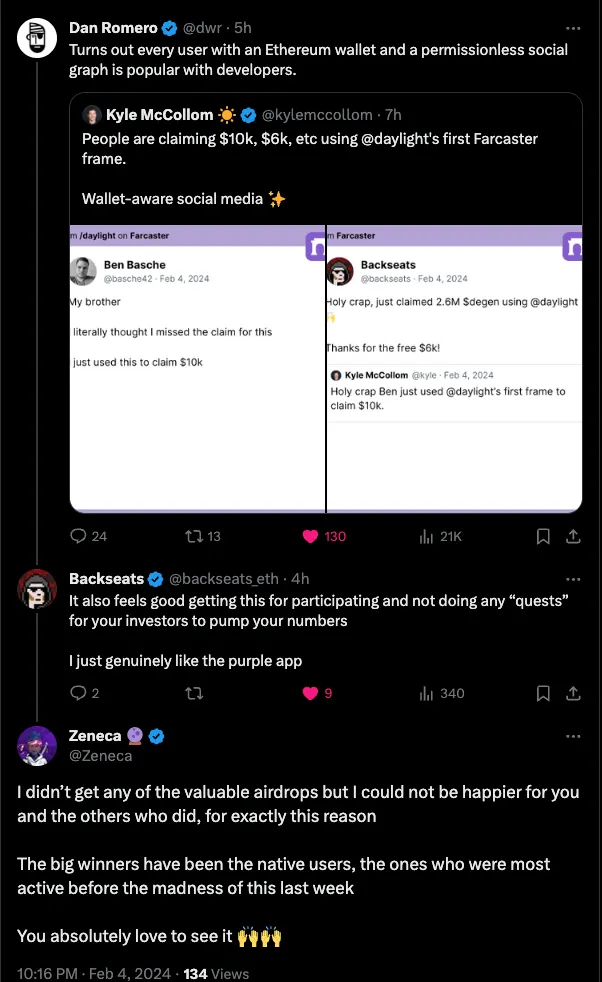
As a result, Frames caught the attention of Crypto Twitter. Some Frames offer free mints, minting directly from your feed with one click. Some Frames offer free token claims, claiming directly from your feed with one click, and sending directly to your connected ETH wallet.
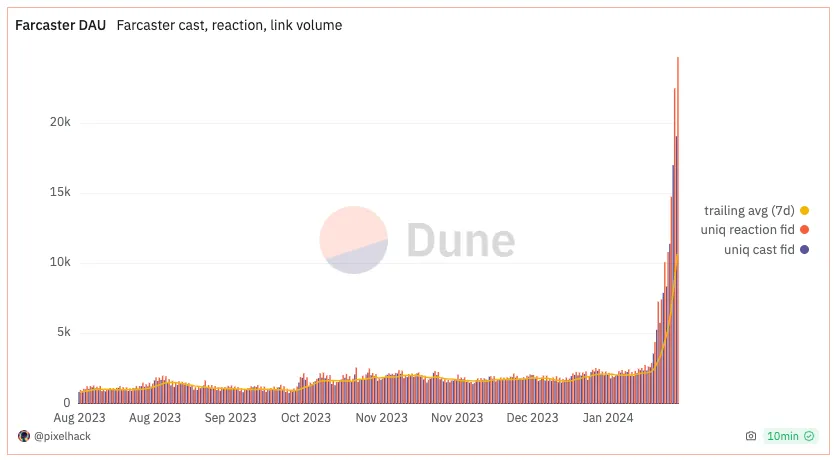
If Crypto Twitter likes one thing, it's airdrops. If there's another thing they like, it's making money. Well, Farcaster has sparked attention and activity around these two things. Early protocol users have been rewarded handsomely, with many receiving tokens worth four to five figures just for being early active users.
The result is an increase in active users:
As for airdrops, the following post sums up my feelings. It's great to see airdrops finally rewarding real users, not just those who pay attention to airdrops:
Frames attracted developers, and token speculation attracted degen.
Farcaster now has a vibrant community. It's fun, exciting, and feels really great.
It looks like $DEGEN (a token on the Base Chain) is the token of choice for most. This is not Farcaster's official token, and it's not backed by VCs.
It has been fairly distributed to users in a good "bottom-up" way. It's a community token, has been airdropped to users, and will continue to be airdropped to users. If you want to know how to get involved, their website has more details.
The benefit of a permissionless protocol is that anyone, if willing, can choose to integrate the token. NFT minting, airdrops only to DEGEN holders, DAOs formed around the token, games formed around the token, and more have already appeared in DEGEN.
It's not just DEGEN that's having a moment; it seems the entire Base (L2) ecosystem is thriving due to Farcaster's adoption. Developers, degens, and creators are all merging in the Farcaster frenzy.
Another such grid is Base God ($TYBG), whose first commandment is: Thou shalt respect community members, for all $TYBG and Base Gods holders are equal.
Their mission is commendable, and so is their second commandment: Thou shalt be onchain. Create content, tweet, build onchain apps, or any other content, and push it onchain, that's the way of the Onchain Disciple.
They are educating people on how to transact onchain, and trading through Memes. It's this kind of lighthearted activity that can make heavy and complex things like decentralized social media fun and accessible to more people (not just developers).
Also, if I've learned one thing as a crypto trader, it's don't fight them. I actually have a good amount of TYBG and DEGEN.
But, with good things come bad things. Not all is airdrops and roses. You can imagine with countless users flocking to Farcaster now, trying to catch the next airdrop, there's now a lot of spam and more noise in the protocol. As each client tries to figure out how best to handle this, the cleanup is underway.
At least, Warpcast is better today than it was yesterday, as they've made some algorithm adjustments.
If you don't like it, there are many other clients to try.
How to get involved
I think the easiest way to get involved right now is through Warpcast. To create an account (via Warpcast), you'll need to download the app. Scan the QR code (or click here).
Depending on where you live, you may need to pay a small fee to get started and running. I know this is a barrier to entry, and it's not insignificant for many people around the world.
Once you have an account and log in, I suggest going to Settings → Connect Addresses → Connect, and linking one of your Ethereum addresses to your account. This will allow you to do things like interact with NFT minting or token airdrops from Frames, and display NFTs on your profile.
I also suggest joining some channels and start interacting with people. Follow your interests and connect with others. Good things usually happen when people do this sincerely. I have a few recommended communities:
ZenAcademy, be sure to join the Zen community
Farcaster, the first good channel to join, lots of activity
Reply Guys, a friendly community welcoming newcomers from Crypto Twitter
Base, interact with the builder community on Base
The Yellow Collective, a club supporting and empowering artists and creatives
Degen, if you like meme coins and being a degen, this is the place for you
As you get more comfortable with Farcaster, you can check out some other apps built on Farcaster.
I hope you understand by now. I hope you understand why Farcaster is different from most other decentralized social attempts we've seen in the crypto space so far. Most importantly, Farcaster is not a Ponzi scheme!
免责声明:本文章仅代表作者个人观点,不代表本平台的立场和观点。本文章仅供信息分享,不构成对任何人的任何投资建议。用户与作者之间的任何争议,与本平台无关。如网页中刊载的文章或图片涉及侵权,请提供相关的权利证明和身份证明发送邮件到support@aicoin.com,本平台相关工作人员将会进行核查。


