Frames provides canvas, and developers draw content on it.
Author: Cobo Argus
Abstract: For Web 3 to succeed, it needs to do at least two things: one is to provide encryption native features that Web 2 does not have, and the other is to make users basically unaware of the existence of the blockchain. Frames achieves both of these.
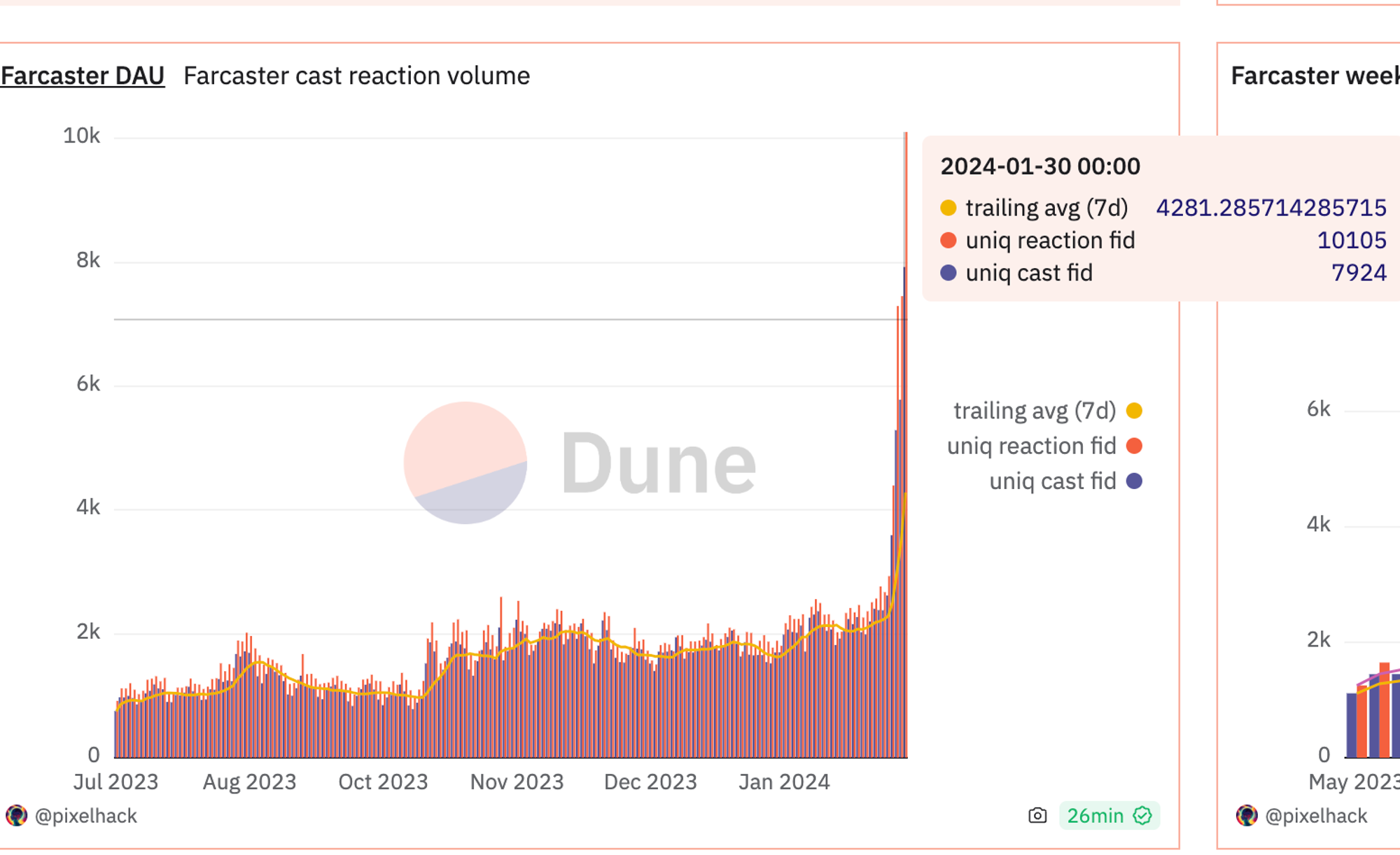
Decentralized social platform Farcaster, led by a16z, recently launched a new feature "Frames", sparking an unprecedented wave of application development and bringing a new high in DAU. Unlike most hotspots in the encryption industry, this time Farcaster attracted mainly developers, which in turn promoted more interaction with end users, and even gained recognition and praise from Silicon Valley startup mentor Paul Graham.
What is "Frames"?
Before understanding Frames, let's get to know Farcaster.
Farcaster is a decentralized social network founded by Dan Romero and Varun Srinivasan.
Farcaster itself is a protocol, just like the underlying protocol SMTP of email. Farcaster is responsible for storing user handles, casts (Farcaster's version of tweets), and other interactive behaviors (such as likes and retweets). For end users, a client similar to Warpcast needs to be built to access this social network.
The client is the interface for users to access the information flow. Nowadays, the term "client" is no longer used, because in most modern centralized social networks, the protocol and the client are the same thing. Twitter used to have clients like Tweebot, Tweetdeck, and Twitterific, until it closed API access, ending the era of clients. Now, Twitter is just Twitter (or, you can also call it by its new name X).
The Farcaster team built their official client Warpcast, but third-party developers are also encouraged to develop their own clients. Anyone can build a client for free on top of Farcaster, using Farcaster's data but providing a different frontend experience. a16z crypto lists a series of general and vertical clients in the Awesome-farcaster repository, including Supercast, Yup, Searchcaster, Launchcaster, Kiwi News, and Casthose.
A few months ago, Farcaster introduced a new feature - channels, which organize conversations based on topics, similar to Douban's groups or Reddit's subreddits. Currently, any user is allowed to pay WARP to create different topic channels.
What is Frames?
Last Friday, Farcaster launched Frames, allowing the construction of small applications within casts (tweets).
True to its name, Frames is a small interactive iframe embedded in casts, supporting users to embed custom interactive operations in the published content, such as voting, galleries, surveys, prediction markets, etc. Users can participate in interactions directly in the Farcaster information flow without the need to redirect to a third-party platform. Opening a Frames is like opening the door to another application, allowing other applications to access the user directly. From the perspective of Web 2, it seems no different from embedding one website into another using iframe>, but the difference lies in the fact that the shared state of the blockchain makes this embedded experience as native as the application itself.
Compared to Web 2, Frames provides a new Web 3 primitive, a simple way for Y applications to run when users are in X applications, with almost no need for additional coordination between X and Y. The interoperable identity and transaction records of the blockchain, as well as seamless handling of currency and digital ownership, make it possible for cross-consumer applications to have a real and universal user operation graph, something that not even the peak period of Facebook could achieve.
At the underlying logic level, each interaction operation is an EdDSA key signature operation of the Farcaster user, thus supporting automatic identity verification, compatible with all other Farcaster clients, and without the risk of losing funds.
Unprecedented wave of Frames development
Frames provides canvas, and developers draw content on it.
Just 5 days after its launch, this seemingly simple feature has already sparked an incredible creativity among developers, such as directly minting NFTs in the Farcaster feed stream, directly subscribing to newsletters in the Farcaster feed stream, and directly claiming faucet test coins in the Farcaster feed stream, generating art, text adventure games, an app that automatically checks for unclaimed airdrops, supporting token payment for on-chain shopping carts and checkout processes, and creating wallets and tipping directly through the command line. The Farcaster frames developer hackathon in New York is still in full swing.
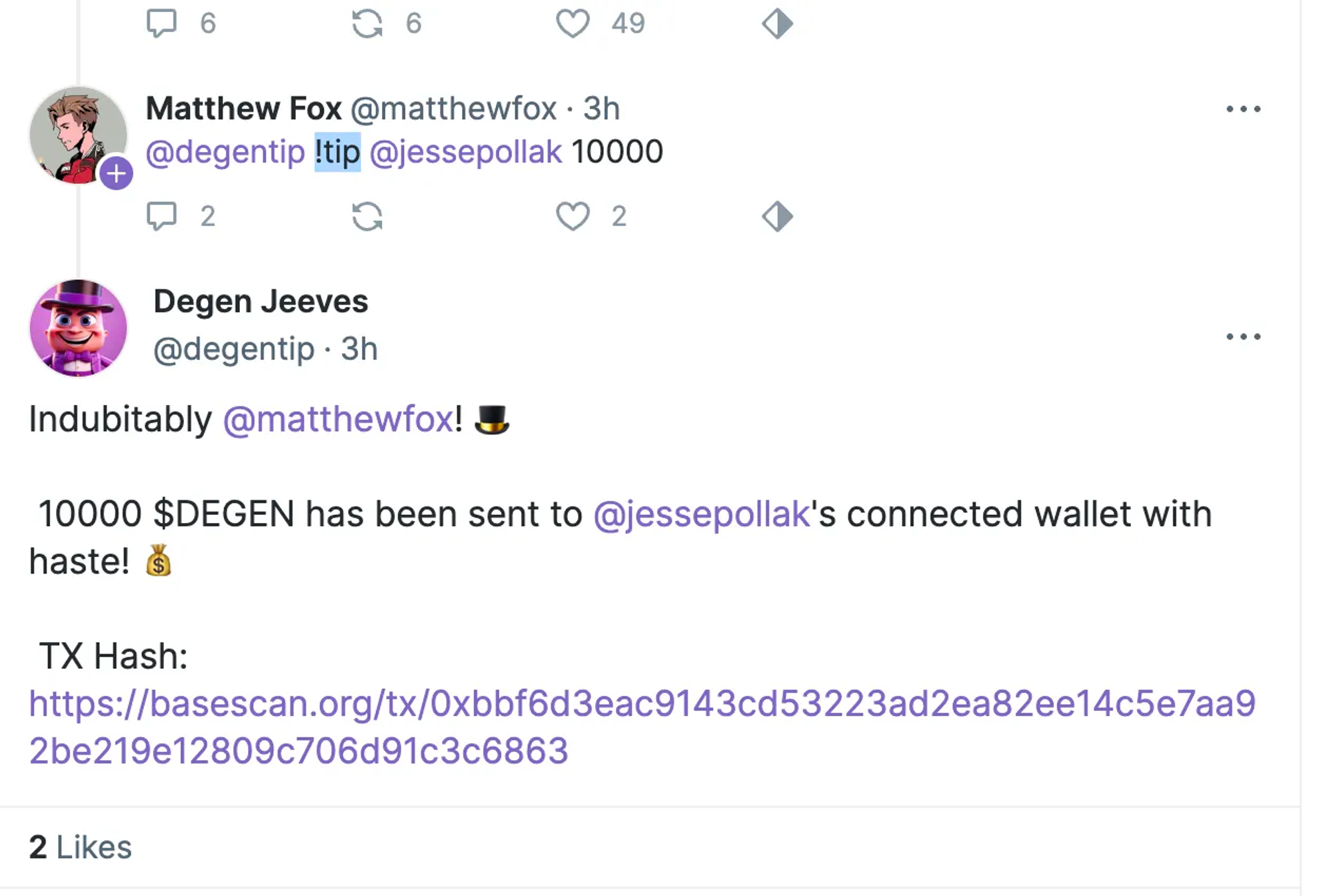
Degen Jeeves is an automated $DEGEN bot, which can directly tip specific amounts of $DEGEN tokens to specific Farcaster users based on command line instructions, and before tipping, you need to use !create to automatically create a base wallet.
Farcaster community token $DEGEN
In fact, the key reason for Farcaster's new high in DAU is the recent launch of the community token $DEGEN's second round of airdrops.
$DEGEN is the token initiated from the degen channel on Farcaster, and in the recent second round of Airdrop, users earn Farcaster points by receiving tips from others. Each Farcaster user (who has posted at least 3 original casts) can receive an initial tipping allowance, the amount of which depends on the ratio of replies/tweets. To tip a specific post, simply comment "amount +$DEGEN" below, for example, "420 $DEGEN". Tipping in specific channels will receive a greater airdrop weight. Since the start of the second round of Airdrop, the $DEGEN token price has increased by 230%. Due to this distribution method leading to widespread airdrop farming, $DEGEN developers are working on an automatic detection system.
$DEGEN is by far the most successful meme coin to emerge from Farcaster, and it belongs to a truly community-driven meme project. The fair distribution, grassroots atmosphere, bottom-up expansion, and organic community growth, along with the loose unofficial DAO organization and build, give it a natural integration-friendly advantage. Developers on Farcaster have conducted various experiments around $DEGEN, showcasing a rare consumer use case in the encryption industry.
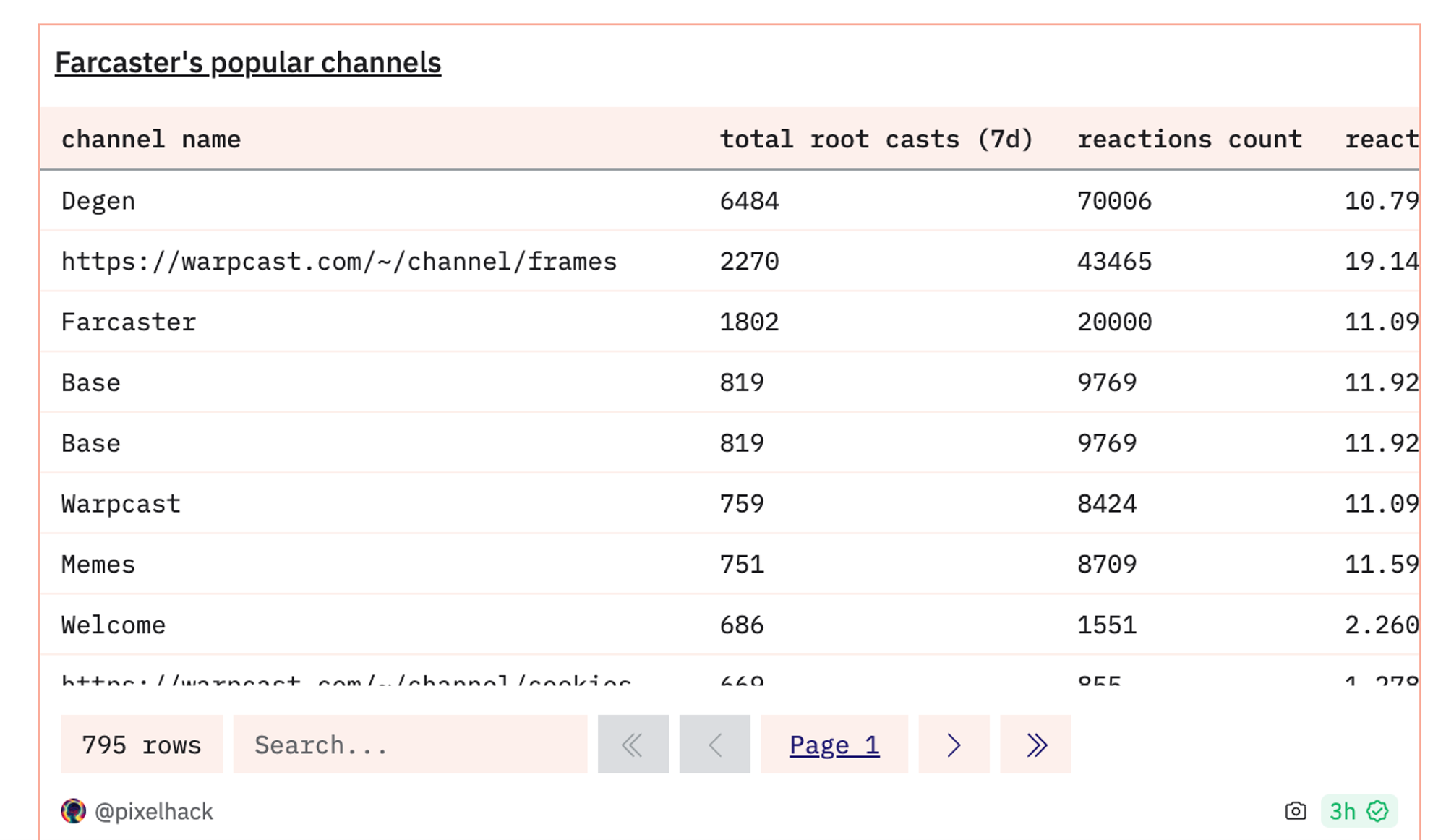
Today, as the central hub of social interaction within Farcaster, Degen has become the most active channel on Farcaster, representing the Degentlemen and Degentlewomen community contributing to Degen's DAU. Data shows that $Degen is the most active channel on Farcaster, even surpassing the total of all other topic channels.
It can be said that by creating Frames, Farcaster provides a seamless native encrypted social network experience on top of the blockchain, an experience that makes users almost unaware of the existence of the blockchain. While Twitter, under Musk's leadership, faces increasing criticism for its restrictions on third-party developers, on the other hand, Farcaster provides a mobile-first, distribution (cold start) friendly, and encryption-native development experience without the need for permission, showing the true potential of "Farcaster will flip Twitter".
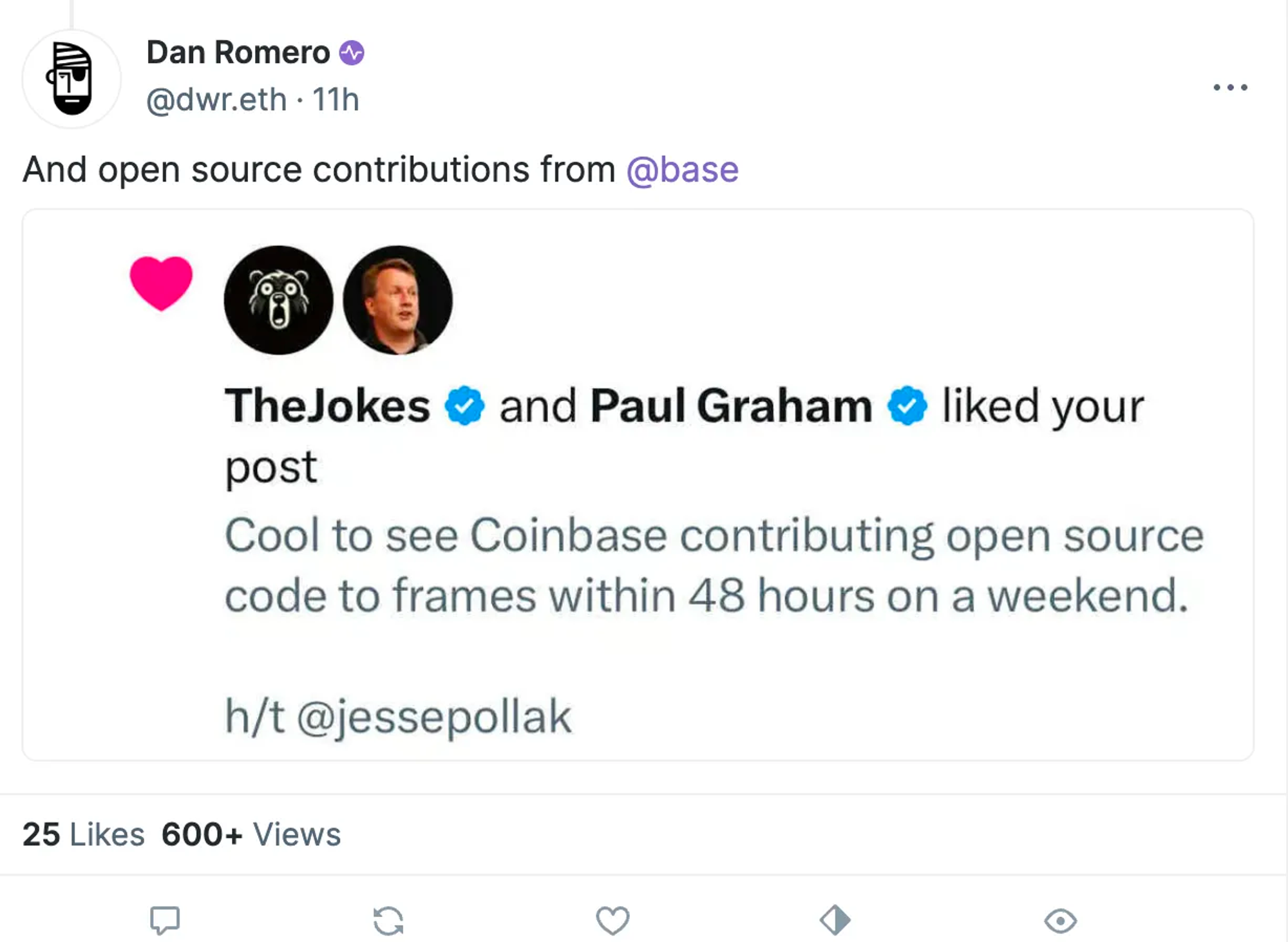
Like the Silicon Valley startup godfather Paul Graham, who sees the long-term value of Farcaster, because it is not only about the future of the encryption industry, but also appears precious for the increasingly closed internet.
Hopefully, Farcaster will bring us closer to the original vision of the World Wide Web.
免责声明:本文章仅代表作者个人观点,不代表本平台的立场和观点。本文章仅供信息分享,不构成对任何人的任何投资建议。用户与作者之间的任何争议,与本平台无关。如网页中刊载的文章或图片涉及侵权,请提供相关的权利证明和身份证明发送邮件到support@aicoin.com,本平台相关工作人员将会进行核查。


