In October 2023, LayerZero established a cross-chain bridge for stETH issued by Lido, allowing it to be cross-chained to BNB Chain and Avalanche.
LayerZero had sought approval from the governance organization Lido DAO, but deployed the cross-chain bridge before the organization formally approved it. While this is not technically a violation, it is not entirely unprecedented—Lido has established various cross-chain bridges, not all of which waited for community voting before being launched. However, some members of the Lido DAO community believed that LayerZero's marketing approach was inappropriate, as they felt that LayerZero was attempting to impersonate an official Lido partner without DAO approval. A member posted on the Lido DAO governance forum, stating: "Announcing undecided events is disrespectful to the DAO and a clear sign of lack of seriousness."
At the time, a statement signed by a series of cryptocurrency infrastructure providers indicated that LayerZero was improperly leveraging the first-mover advantage to "lock in" users ahead of competitors. Lido strategic advisor Hasu stated on the Lido DAO forum: "By unilaterally deploying cross-chain bridges and marketing them as official, it seems to be pressuring the DAO to avoid liquidity fragmentation. By attracting users through this marketing, it restricts other cross-chain bridge proposals and puts the DAO, Lido stakers, and participating chains in a difficult position."
As more and more blockchains emerge, cross-chain "interoperability" becomes crucial, and cross-chain bridges are key infrastructure required for cross-chain interoperability to function properly. However, these services are also prone to issues, which is why it is crucial where protocols grant them recognition.
Lido's recognition of stETH is seen as an important milestone for interoperability providers, with its TVL reaching $20.8 billion, ranking first among DeFi protocols according to DeFi Llama's data.
On January 17th of this year, Lido DAO initiated a temperature check vote for the developers of the wstETH cross-chain bridge to BNB Chain, with options including Axelar & Wormhole, Chainlink CCIP, LayerZero, and Hyperlane. Ultimately, Axelar & Wormhole garnered 81.1% support, Chainlink 14.1%, and LayerZero only 4.7%.
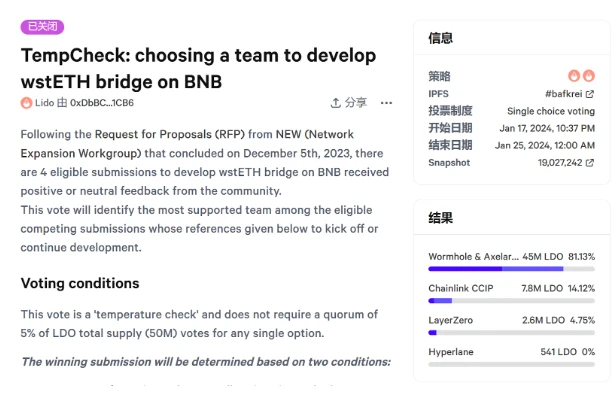
Following the upcoming formal vote, Axelar & Wormhole will soon become the "official" service provider for stETH cross-chaining to BNB Chain.
Sergey Gorbunov, CEO of Interop Labs (developer of Axelar), stated in an interview with CoinDesk: "The Axelar and Wormhole teams have decided to collaborate to effectively combine the security of the two networks and provide effective security for cross-chain ETH LST."
Gorbunov stated that Axelar and Wormhole aim to prevent "service provider ossification," where service providers use their first-mover advantage to permanently solidify their position in protocol infrastructure. The cross-chain approach of Axelar and Wormhole is open-source and scalable, and according to the choice of the Lido Foundation, backend extensions may be made to support other cross-chain bridge providers. This composability is one of the distinguishing features of the open-source approach in the Axelar + Wormhole proposal, which other proposals cannot replicate, and this "flaw" led to the one-sided nature of the voting results.
Axelar stated that the cross-chain bridge initially only supports BNB Chain, with the possibility of expansion to other EVM chains in the future.
Robinson Burkey, Chief Business Officer of the Wormhole Foundation, stated: "In my view, this is more than just a regular governance vote; it becomes more about principles rather than just technology. Token holders are able to support the best choices that align with the protocol's interests based on their own preferences. If you deprive token holders of this power, you are gradually undermining the fundamental principle of decentralization."
免责声明:本文章仅代表作者个人观点,不代表本平台的立场和观点。本文章仅供信息分享,不构成对任何人的任何投资建议。用户与作者之间的任何争议,与本平台无关。如网页中刊载的文章或图片涉及侵权,请提供相关的权利证明和身份证明发送邮件到support@aicoin.com,本平台相关工作人员将会进行核查。