Original | Odaily Planet Daily ( @OdailyChina )
Author | jk
On June 12, 2026, SpaceX debuted on NASDAQ with an issuance price of $135 per share, trading under the ticker symbol SPCX, raising as much as $75 billion, setting a record for the largest IPO fundraising in history. After opening, SPCX's share price briefly surged above $170, an increase of over 25% from the issuance price, igniting market sentiment with this trillion-dollar-level IPO feast.
However, on the same day that traditional financial markets celebrated SpaceX's debut, the cryptocurrency industry attempted a large-scale first experiment to open up IPO channels for retail investors through a tokenization framework, but it ended in a collective "failure": Bybit, Binance, and Bitget Wallet successively announced the cancellation of events and full refunds; users of Kraken, previously deemed the most reliable, found that regardless of their investment amounts, most ended up with only about 4.2786 shares as a symbolic "basic" allocation.
What is xStocks? The product logic of tokenized IPOs
The core infrastructure that encountered issues in this incident is xStocks, a tokenized equity framework issued by Backed Assets (JE) Limited, a subsidiary of Kraken's parent company Payward Services.
xStocks tokens are designed to correspond 1:1 with underlying real shares, with the actual stocks custodied by regulated brokers.
Previous activities were extremely popular
Kraken launched SpaceX IPO Access on June 5, with the token code SPCXx, open for subscription to certified users in over 110 regions. Bybit followed on June 7 with the IPO Express product, designating this SpaceX IPO as the first offering, with an indicative price of 135 USDC plus a 5% underwriting fee, a minimum subscription of 100 USDC per user, allowing up to 50 subscription orders.
Binance then launched SPCXx subscription activities under the name "First IPO Campaign", while Bitget Wallet also offered a similar product through the xStocks framework on Solana, with an initial quota of $3 million, quickly expanding to $13 million due to strong demand, and oversubscribed by four times within 30 minutes.
Everything collapsed on the listing day: xStocks unable to deliver underlying shares
SpaceX officially landed on NASDAQ on June 12, raising $75 billion, with an implied valuation of $17.5 trillion.
However, on the same day, various crypto platforms issued announcements: xStocks received far fewer underlying share allocations from underwriters than expected, and could not deliver sufficient amounts to the platform as demanded.
Bitget's official statement on X read: “The xStocks team did everything possible to secure allocations, but ultimately failed to deliver as expected.”
Bybit also confirmed on X: Due to xStocks' inability to deliver underlying assets, Bybit did not receive any allocation of SpaceX shares, and all subscription funds will be automatically refunded 100% to the original accounts, with approximately 10% annual interest compensation rewards offered to eligible participating users.
Binance, Bitget, and Bybit then announced the cancellation of activities and full refunds, while promising additional compensation to affected users.
On-chain data shows that Binance's SPCXx subscription attracted approximately $557 million in USDC subscription commitments from 27,689 wallet addresses within 28 hours of its opening, with over 81% of addresses making single subscriptions not exceeding $20,000, while 114 addresses each pledged at least $500,000. After announcing the event cancellation, the exchange's official statement announced full refunds of the locked USDC and airdropped space in total value of $1 million in bStocks SpaceX tokens (SPCXB) to all participating users, expected to be credited by June 18.
Kraken, the associated exchange of xStocks, had a similarly disappointing situation. Community feedback showed that users who successfully subscribed on Kraken received a fixed amount of only 4.2786 SPCXx tokens regardless of their investment size: converted at the issuance price of $135, that amounts to approximately $578-$606, with the remaining funds fully refunded. Kraken has not officially confirmed this figure yet.
Meanwhile, some users from mainland China who received allocations reported that the app page indicated that trading SpaceX stock shares was not allowed due to regional issues, meaning that the 4 shares obtained from the subscription may not be sellable.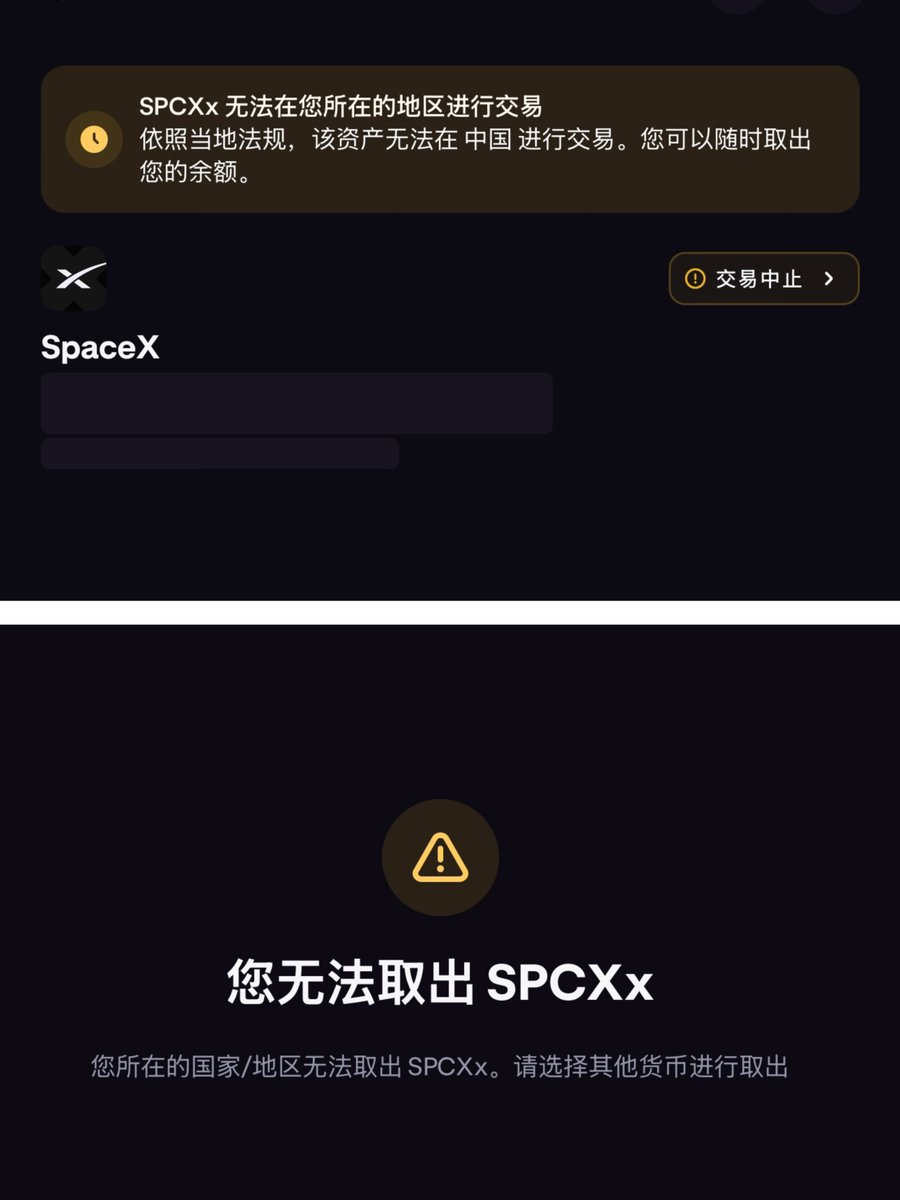
Kraken explained in its support page that the allocation rights for IPO quotas belong to the underwriters, and can be distributed proportionally, randomly, hierarchically, or based on relationships, and that it is normal for a high demand environment to produce partial or even zero allocations.
User complaints flood social media: “The IPO subscription was a waste of time”
After the incident escalated, a large number of users shared their experiences and complaints on X (formerly Twitter) within the Chinese community.
Kraken user @joeylu0627 detailed his experience: “For me, I invested 200,000 U, ultimately receiving 4.2786 shares of SPCX (valued at about $700), with the remaining amount refunded. Fortunately, I didn't lose money; I just made a tiny profit off a large investment…”
User @jijioulei33190 used stronger language: “Whether it’s 1000 U or 100,000 U, everyone gets 4.2 shares of SpaceX… Chinese users got the shares, I **can’t trade them, I can only buy but not sell?”
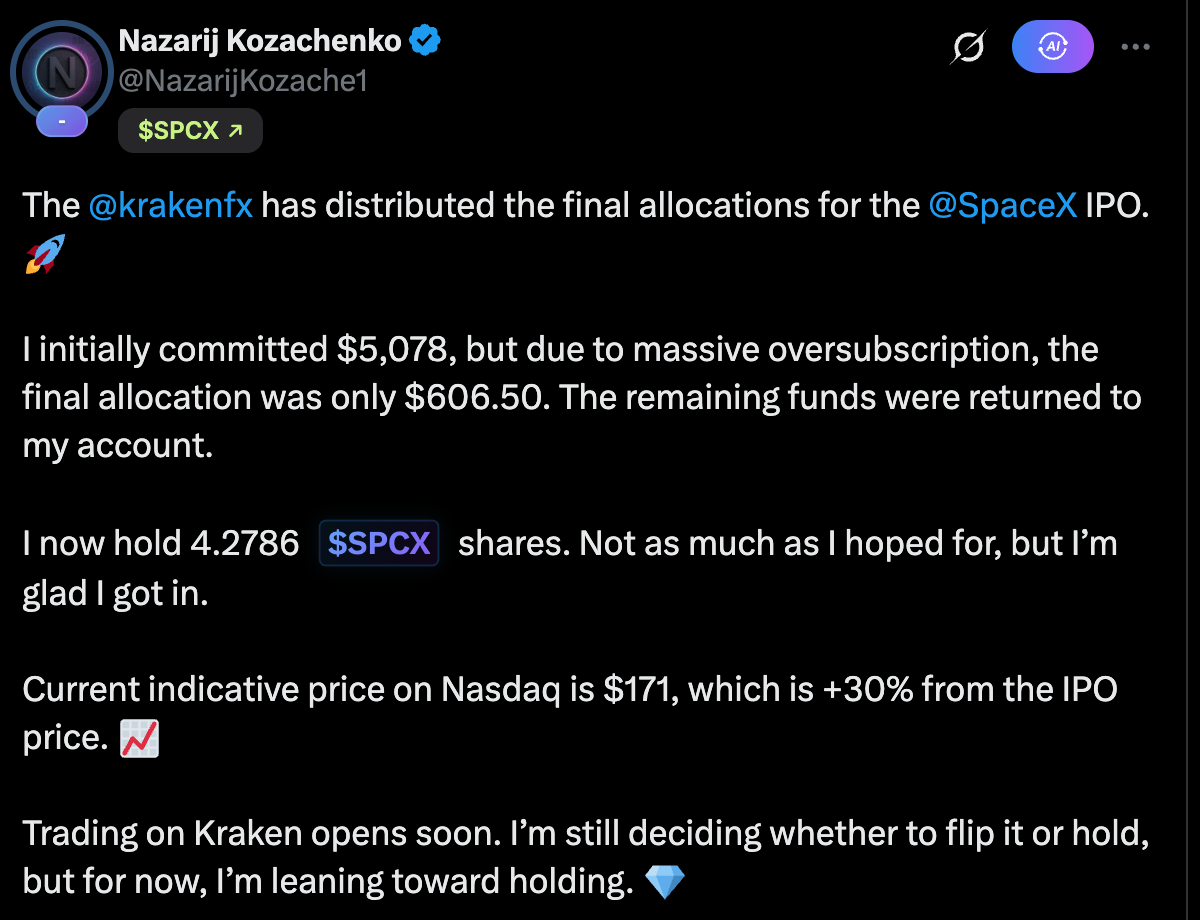
Overseas user who received a quota of 606 U
@MengLayer (Chen Xiaomeng) shared a screenshot of trading SPCXx back to USDC on Kraken Pro with the caption: “1 million to subscribe, made 60 U, I’m really amazing.” He also quoted another user's complaint: “Refunds happen if it goes up, you only get it if it goes down.”
Some users speculated that it could even mean “The shares' value went up, so they privately swallowed the users' shares.”
Cases of successful IPOs on a few platforms
Not all crypto platforms ended in refunds. In this general failure of tokenized IPOs, few platform users successfully received shares and achieved a profit.
One positive case worth noting is BitMart: Its IPOPrime product successfully secured real SpaceX IPO allocation from the underwriters, with official announcements and multiple users sharing allocation results on X, stating that the platform expected a winning rate of about 40%; this figure is much higher than the actual allocation ratios of other platforms at the same time, and stocks were directly issued to user accounts, with remaining funds automatically refunded, without any lock-up period restrictions. User @DesiCryptoHub stated that BitMart's allocation rate allowed participants "to have a higher actual winning probability than most competing platforms," listing this opportunity as one of the most noteworthy cases of crypto IPOs this year.
Gate.io also had actual share distribution. User @px521com2 detailed his IPO subscription bill: "Subscribed 5786 dollars through Zhi Ma (Gate) → refunded 5557 dollars → sold for 268 dollars, earning 39 dollars; adding the portion from Kraken, I netted 127 dollars today. Given today's market where '90% of people are complaining,' to pick up 127 dollars, I'm quite satisfied." Compared to Kraken's "average of 4.2 shares" fixed quota, Gate's proportional distribution mechanism provided some users with relatively more flexible actual profit space.
Some MSX users also successfully participated. The platform opened Pre-IPO subscriptions at around 119 USDC before SpaceX's official listing, effectively entering below the issuance price. MSX's social media manager @Jing_MSX posted on the same day while traveling: “Before bed, I saw $SPCX surge over 20% on its Nasdaq debut, SpaceX was my first MSX Pre-IPO project, with a subscription price of 119 U.”
Failed first large test, future of the model is uncertain
Kraken emphasized that the insufficient allocations were due to the underwriters' distribution decisions, rather than any technical or operational issues with the platform.
In other words, the issue isn’t whether these tokenized stocks can be issued, settled, or displayed on-chain, but that crypto platforms do not truly possess the upstream resources of IPO allocations.
SpaceX's 5.556 billion shares were issued at $135 per share, raising about $75 billion, setting a global record for IPO fundraising. With extremely high retail subscription enthusiasm, the aggregated demand from crypto platforms significantly exceeded the actual allocations they could secure from the traditional underwriting system.
In this SpaceX IPO feast, most retail investors in the crypto industry ultimately could not join the table. The first large-scale trial of "on-chain IPOs" exposed a more realistic problem: the demand side may have been ready, but the supply side remains in the hands of the traditional financial system. As long as the sources of allocation, underwriting relationships, and asset delivery capabilities are not connected, even the smoothest on-chain entry will be unlikely to change the position of ordinary retail investors in the IPO allocation chain.
免责声明:本文章仅代表作者个人观点,不代表本平台的立场和观点。本文章仅供信息分享,不构成对任何人的任何投资建议。用户与作者之间的任何争议,与本平台无关。如网页中刊载的文章或图片涉及侵权,请提供相关的权利证明和身份证明发送邮件到support@aicoin.com,本平台相关工作人员将会进行核查。


