Author: flowie, ChainCatcher
Editor: Marco, ChainCatcher
After the craze of inscriptions, Bitcoin Layer2s are expected to take on the responsibility of promoting the prosperity of the Bitcoin ecosystem.
Currently, Bitcoin Layer2 is showing a momentum similar to the flourishing of Ethereum Layer2, attracting a large number of entrepreneurs. In addition to the well-known Lightning Network, Liquid Network, Stacks, and other Layer2 protocols in the Bitcoin ecosystem, a large number of new projects claiming to be Bitcoin Layer2, such as B² Network, BEVM, Dovi_L2, Map Protocol, have emerged one after another.
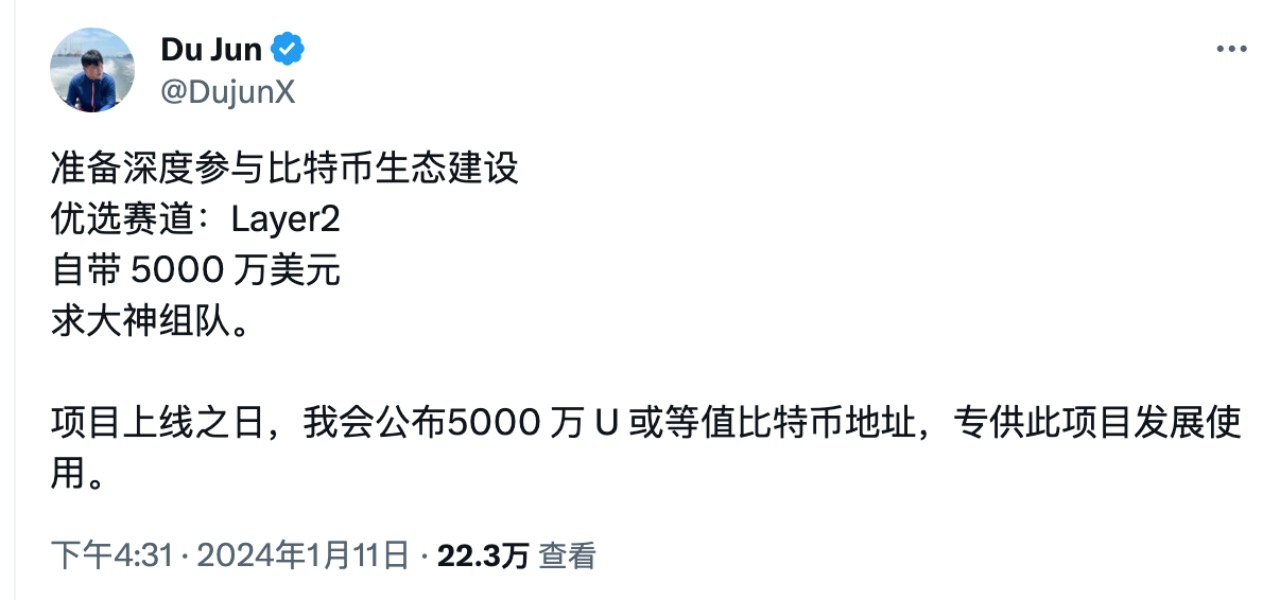
Du Jun, co-founder of ABCDE Capital and Huobi, stated that he will deeply participate in the construction of the Bitcoin ecosystem with 50 million US dollars, and Bitcoin Layer2 is the preferred track.
Bitcoin Layer2 has also seen a financing boom and has been favored by investors.
Recently, the Bitcoin Layer2 network Bitfinity completed a $7 million token financing at a valuation of $130 million, with participation from Polychain Capital and others.
Domo, the founder of Bounce Finance and Brc-20, participated in the angel round financing of Nubit, a Bitcoin data availability layer. Some crypto users see Nubit as the "Celestia" of the Bitcoin ecosystem.
After the inscriptions created a new way of asset issuance, how will Bitcoin Layer2s expand more functions and ecology beyond payments for the Bitcoin network, and whether they can replicate the prosperity of Ethereum Layer2.
ChainCatcher has systematically sorted out the current Bitcoin Layer2 solutions, representative projects, and their progress. The article is divided into two parts, with the first part "Bitcoin Layer2 Flourishing, Overview of 6 Mainstream Protocols" introducing the progress of the leading Bitcoin Layer2 protocols; this article is the second part, mainly outlining the overview of 20 early Bitcoin Layer2 projects.
20 Early Bitcoin Layer2 Projects Worth Paying Attention to
In mid-2023, Ethereum founder Vitalik suggested in a Twitter Space discussion about the Bitcoin ecosystem that Bitcoin should not only be used as a payment method, but also needs scaling solutions like Plasma or ZK Rollup. Optimism and Arbitrum are two successful Rollups that can serve as case studies for Bitcoin.
Looking at some of the Bitcoin Layer2 projects that have emerged in the past two years, many projects have indeed adopted expansion solutions such as Rollup. At the same time, many projects also emphasize compatibility with EVM. In addition, there are also some Bitcoin Layer2 projects that integrate AI narratives.
1. Rollup
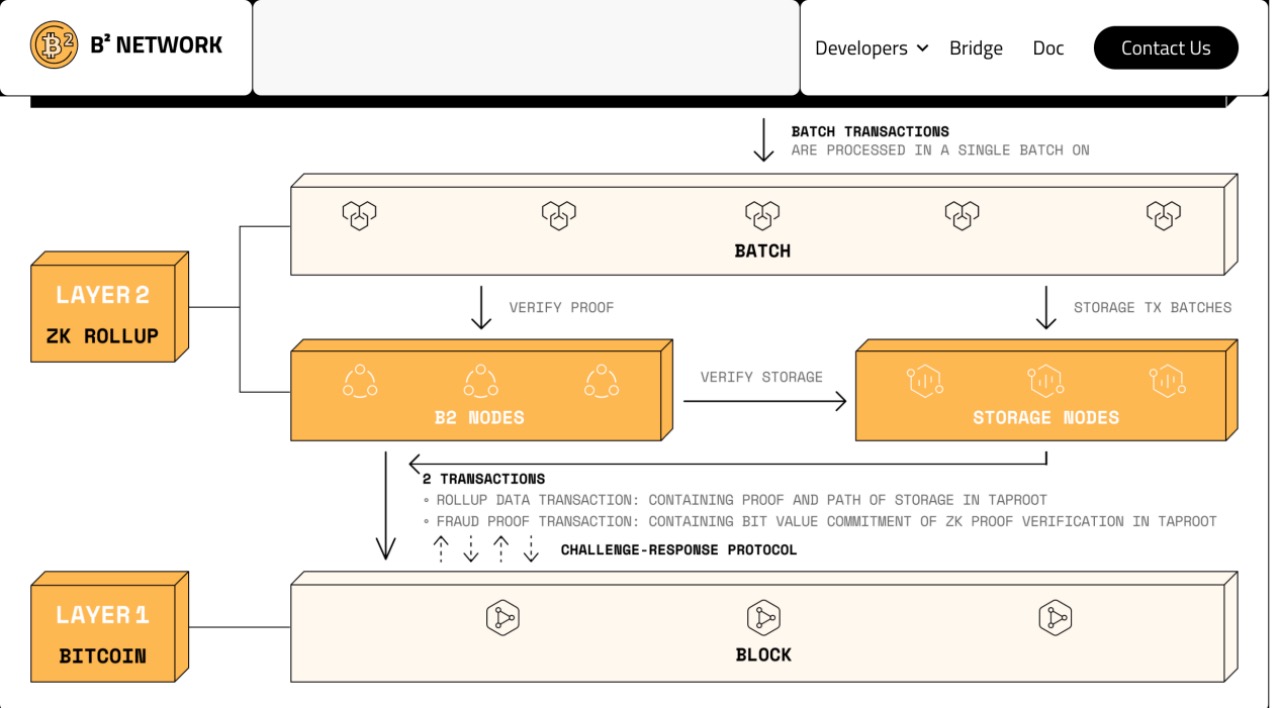
Established in 2022, B² Network is a Bitcoin Layer2 network based on ZK-Rollup, compatible with EVM, and capable of seamless deployment of DApps for EVM ecosystem developers.
B² Network participated in the November 2023 ABCDE Bitcoin ecosystem project roadshow and ultimately received investment. According to ABCDE, the core members of the B² Network technical team are active members of mainstream Web3 open source communities such as Ethereum, Bitcoin, Cosmos, and Sui, and have received multiple grants. The team is proficient in Web3 Infra products such as blockchain Layer1, Layer2, cross-chain, and account abstraction, with mature engineering capabilities.
On December 18, 2023, B² Network announced the launch of the Alpha testnet MYTICA for partners and opened recruitment for ecosystem developers. Partners and developers can deploy DApps on the B² Network testnet.
The cross-chain protocol Meson of the B² Network ecosystem has deployed the stablecoin USDC on the B² Network Alpha testnet. Meson is a cross-chain protocol that focuses on fast, stable, secure, and low-fee circulation of mainstream digital assets such as ETH, BNB, USDC, and USDT between the B² Network and over 30 mainstream public chains.
On January 3, B² Network announced a $1 million donation plan to incentivize ecosystem builders.
BL2 (BL2T)
BL2 is a Bitcoin ZK-Rollup Layer2 based on the VM general protocol and the modular blockchain Celestia's DA layer, introducing ZK-Rollup to Bitcoin and implementing multi-node ZK verification on the Layer2 network, supporting inscriptions chain backup and cross-chain.
BL2 launched the BRC-20 token $BL2T, with a total supply of 21 million, used for BTC network L2 governance, with 20% for fixed gas destruction. On January 8, BL2 conducted an IDO on Turtsat at a price of 30 Sats (approximately 0.013U).
Established in 2022, Chainway is a blockchain infrastructure company focused on Bitcoin, Ethereum, and zero-knowledge technology. Chainway has developed Bitcoin ZK Rollup, browser extension tool OrdinalSafe, and zk tool Proof of Innocence.
Chainway recently announced on its official social media that it plans to launch the Bitcoin ZK Rollup mainnet in 2024 and establish the Bitcoin ZK Rollup community.
Established in 2023, Bison is a Bitcoin-native zk-rollup that can improve transaction speed and implement advanced features on native Bitcoin. Developers can use zk-rollup to create innovative DeFi solutions such as trading platforms, lending services, and automated market makers.
Bison also participated in the ABCDE Bitcoin ecosystem project roadshow. According to the introduction, the Bison solution uses zero-knowledge proofs and Ordinals for fast and secure transactions. All data is anchored back to Bitcoin to enhance security. Bison can achieve 2,200 transactions per second at a cost of 1/36 of Bitcoin.
The Bison team includes contributors to Starknet's own code.
- Rollux
Rollux was established in 2023 and developed by the Layer1 blockchain Syscoin (SYS). It is an Optimistic rollup equivalent to EVM, inheriting the security of Bitcoin's mining network and Syscoin's Layer 1 data availability.
It was reported that Syscoin announced a $20 million ecological development fund from the cryptocurrency exchange MEXC in June 2022.
Rollux launched its mainnet in June 2023 and plans to transition from Optimistic Rollup to ZK-based Rollup. Rollux has not yet introduced a new token and is using Syscoin as the Gas token.
- BOB
BOB (Build On Bitcoin) was founded in 2020 and is an EVM rollup stack with native Bitcoin support. It allows developers to build decentralized applications on top of Ordinals, Lightning, and Nostr.
BOB has already launched a public testnet, which is currently running on the Sepolia Ethereum testnet. According to BOB's official roadmap, BOB will integrate Bitcoin's security through PoW staking and upgrade Optimistic Rollup to ZK proof.
- Hacash.com
Hacash.com was founded in 2022 and proposes a solution that establishes state channels and implements multi-layer expansion, unlike side chains and simple OP/ZK Roll-ups. It aims to achieve one-way transfer of Bitcoin on Layer1 without changing user private keys, transferring Bitcoin to the Hacash chain, and completing payment operations through state channels deployed on Layer2. The team also envisions a Layer3 to achieve ecological expansion.
- BeL2
BeL2 is a Bitcoin Layer2 launched by the Layer1 blockchain Elastos (ELA). It is a BTC Rollup that allows Bitcoin to execute smart contracts and irreversible digital protocols. It also allows users to stake their Bitcoin and earn rewards when interacting with applications built on BeL2.
- Libre
Libre, established in 2022, is a Bitcoin L2 sidechain dedicated to expanding Bitcoin's performance by improving its speed and availability. The mainnet was launched on July 4, 2022, and shortly after, Libre conducted an airdrop of 10 million LIBRE tokens, with only 277,000 tokens claimed. Libre also released a test version of the BRC20 Dex and a mobile app for user convenience.
- Nubit
Nubit, founded in 2023, is a data availability layer for the Bitcoin ecosystem, aiming to change the way transactions are processed on the Bitcoin network. The development team, Riema, has proposed BRC-1310, a specialized Bitcoin native data availability standard. Nubit announced angel round financing from Bounce Finance and Brc-20 founder domo on January 4.
- x.TAI
x.TAI is a Bitcoin Layer2 network based on AI encryption algorithms. It announced the release of the second-layer inscriptions chain xTAI Network based on its XRC20 protocol in December 2023. However, x.TAI has not yet released the details as scheduled and has not provided a new timeline.
- AiPTP (ATMT)
AiPTP, established in 2023, is a decentralized AI network based on blockchain. It will build a dual L2 network for Bitcoin, including a Bitcoin L2 with a POS mechanism (tentatively AIS) to support AIPTP's training models, and a Bitcoin L2 with a PoW mechanism (tentatively AIW) to support AIPTP's inference models. Bitcoin and ATMT can be cross-chain circulated among the three chains.
- BEVM
BEVM, established in 2023, is a decentralized Bitcoin L2 compatible with EVM. It allows BTC to cross-chain to the second layer in a decentralized manner from the Bitcoin mainnet, leveraging technologies such as the Schnorr signature algorithm brought by the Taproot upgrade. All DApps running in the Ethereum ecosystem can run on BTC Layer 2 and use BTC as Gas due to BEVM's compatibility with EVM.
On November 29, 2023, BEVM released its whitepaper.
BEVM has currently launched the ChainX testnet. The 2023 BEVM testnet annual data shows a total transaction volume of 2.77 million, a total of 55,000 active addresses, a TVL of 119.56 BTC (approximately $5.09 million), and a total bridge capacity of $11.53 million for round-trip Ethereum L2. Recently, the first inscription protocol Bevscriptions was launched on the BEVM testnet and processed 3 million transactions in 6 hours, with a TPS of around 150.
In December 2023, the first phase of the Odyssey event was launched and has now ended. BEVM founder Gavin (@gguoss) stated that the second phase is expected to start on January 15 and will invite 10-20 ecological projects to participate. The second phase will be named after the location where Satoshi Nakamoto mined the first BTC block, "Helsinki," instead of using "Odyssey."
Currently, the BEVM ecosystem includes over 20 projects such as the BTC full-chain DEX OmniSwap and the decentralized signature protocol Bool Network.
Dovi (DOVI)
Dovi, established in 2023, is a Bitcoin Layer2 compatible with EVM smart contracts. In November 2023, Dovi officially released its whitepaper. The whitepaper introduces Dovi's integration of Schnorr signatures and MAST structure to enhance transaction privacy, optimize data size, and verification processes. It also provides a flexible framework for issuing various asset types beyond Bitcoin and achieving cross-chain asset transfers.
KuCoin Labs announced strategic investment in Dovi in December 2023, and its native token DOVI was listed on the KuCoin exchange on December 12 of the same year. The distribution of DOVI tokens follows a fair release model, with 15 million tokens claimed within 4 hours of listing. As of January 15, the fully diluted market value of DOVI is approximately $9.4 million. Users can currently stake DOVI on the official website to earn rewards.
The next step for Dovi is to release the testnet, establish a developer community and ecosystem support, and launch Dovi V1.
ZeroSync, established in 2022, aims to extend Bitcoin through zero-knowledge proofs (ZK-Proofs, ZKP). Its main application is to enable almost real-time synchronization and verification of the blockchain for all nodes on Earth through the Blockstream satellite. At the end of 2023, ZeroSync team member @lucidLucky released the first chain state proof in space via the @Blockstream satellite.
ZeroSync is based on STARK proof and will use the Cairo language created by StarkWare. ZeroSync will be launched in three consecutive stages: header chain proof, assumed valid chain proof, and full chain proof, with the first two prototypes already completed. The ZeroSync Toolkit will also provide tools for Bitcoin developers to apply zero-knowledge proofs to their own products and services. The development of ZeroSync has received sponsorship and support from StarkWare, OpenSats, Spiral, and geometry.
On October 9, 2023, the project leader of ZeroSync, Robin Linus, published a whitepaper titled "BitVM: Compute Anything On Bitcoin," sparking widespread discussion about enhancing the programmability of Bitcoin. BitVM, short for "Bitcoin Virtual Machine," aims to allow developers to run complex contracts on Bitcoin.
MAP Protocol, established in 2019, is a Bitcoin Layer2 for peer-to-peer cross-chain interoperability. The MAP protocol leverages Bitcoin's security mechanisms to seamlessly interact with assets and users from other public chains. It enhances network security and achieves BRC20 cross-chain capabilities.
MAP Protocol recently announced strategic investments from DWF Labs and Waterdrip Capital.
It is noted that MAP and MAPO are the native tokens of MAP Protocol, and they are the same token but use different ticker symbols to distinguish the chains they belong to. On December 18, 2023, MAP Protocol announced a large-scale token burn, totaling 133,886,020 MAP/MAPO tokens, accounting for 5.9% of the circulating supply. As of January 15, the fully diluted market value of MAP is approximately $260 million.
Tectum, established in 2017, is a distributed ledger protocol management platform. Its ecosystem includes Tectum Blockchain, Tectum Wallet, Tectum Token (TET), Tectum SoftNote, and the 3FA identity authentication app.
Tectum SoftNote is a non-custodial Bitcoin Layer2 that can scale Bitcoin transactions to hundreds of thousands or even over a million transactions per second.
The native token of Tectum is TFT, which can be used to mint SoftNote, pay reduced merchant fees, mint T12-20 standard project tokens, and access other Tectum/CrispMind products. Currently, TET has launched mainnet staking. As of January 15, the fully diluted market value of TFT is $275 million.
Bitfinity (formerly InfinitySwap), established in 2021, is a Bitcoin Layer 2 network based on Internet Computer and EVM compatibility. Previously, InfinitySwap aimed to make BTC collateral mainstream through AMM and was referred to as the "Uniswap" of the Internet Computer (ICP) blockchain network.
Recently, Bitfinity completed a $7 million token financing at a valuation of $130 million, with participation from Polychain Capital, ParaFi Capital, Dokia Capital, and Draft Ventures. In 2021, Bitfinity also received a $1.5 million seed round financing from Polychain, a16z Crypto, Internet Computer, Dfinity, and Draft Ventures.
Currently, Bitfinity is in the testnet phase, and the mainnet launch date has not been announced.
BitBolt Network is a Bitcoin Layer2 network that utilizes account abstraction and threshold ECDSA technology, dedicated to Bitcoin payments and the Ordinals ecosystem. BitBolt enables users to conduct Bitcoin transactions at lightning speed while ensuring low transaction fees and the utilization of smart contract functionality. BitBolt Network has launched on the Thunder testnet.
In July 2023, BitBolt Network conducted an IDO, but the team later stated that the IDO did not reach the goal of raising 3 BTC, so they decided to refund the addresses that participated in the IDO.
DFS Network is a Bitcoin Layer2 network that announced the launch of its mainnet on January 1 and started mining its mainnet token DFS on January 3. The initial version of the DFS Network mainnet is very simple, including features such as swap, liquidity mining, on-chain social circle, node voting, and mainstream BRC20 inscription cross-chain deposit and withdrawal transactions.
According to official information, DFS is the mainnet token of DFS Network, which will be used for dex fee buyback and burn in addition to mainnet governance. The total supply of DFS is 10 million, with 1 million DFSN distributed fairly on the BTC chain and 2.5 million DFS distributed fairly on the EOS chain, which will be airdropped to DFS Network at a 1:1 ratio, and the remaining 6.5 million will be fairly released through liquidity mining. The relationship between DFSN and DFS is 1 DFS = 1 DFS, 1 DFSN = 1 DFS + 1 meme (BRC-20). 0.05% of the swap fee will be used to burn DFS.
免责声明:本文章仅代表作者个人观点,不代表本平台的立场和观点。本文章仅供信息分享,不构成对任何人的任何投资建议。用户与作者之间的任何争议,与本平台无关。如网页中刊载的文章或图片涉及侵权,请提供相关的权利证明和身份证明发送邮件到support@aicoin.com,本平台相关工作人员将会进行核查。


