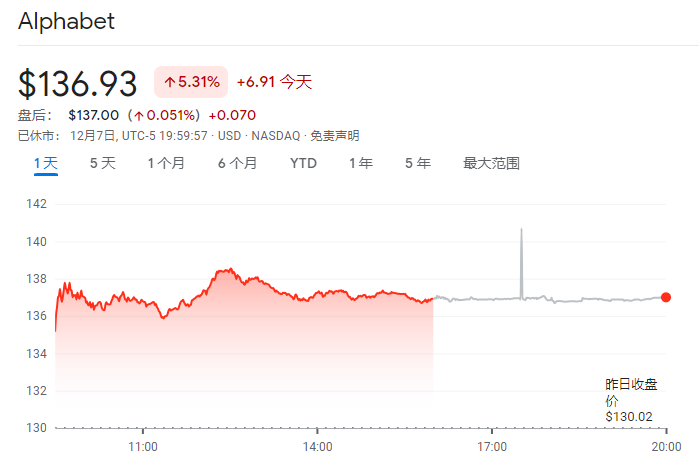
- The stock price of Google's parent company Alphabet soared by 5.3% at Thursday's close, as Wall Street cheered the launch of its AI giant model Gemini;
- This series of grand blueprints has driven Google's market value to surge by over $80 billion in just one day on Thursday, almost equivalent to the current valuation of the unlisted OpenAI.
Source: 财联社

Image Source: Generated by 无界 AI
Google's parent company Alphabet's stock price surged by 5.3% at Thursday's close, as Wall Street cheered the launch of its AI giant model Gemini, and believed that this model, claimed to be the "largest and strongest" in Google's history, will help narrow or even completely erase the gap between it and OpenAI, supported by Microsoft.
For a long time, Google has been regarded as a leading company in the field of artificial intelligence research. However, last November, OpenAI's ChatGPT became popular in the tech industry as soon as it was launched, allowing Microsoft to take the lead in the AIGC field with a large investment, leaving Google in the shade.
But now, this powerful model called Gemini is Google's latest attempt to showcase its AI capabilities.
Google stated on Wednesday that the company will provide customers with a range of AI programs based on Gemini. Google claims that this model can handle various media, from audio to video, and this is an important development as users meet a wider range of needs through chatbots.
The search engine giant will also use these algorithms to support its in-house product Bard, which competes with ChatGPT, and mobile features that can run without a network connection.
Google stated that in a series of tests based on industry standards, the most powerful version of Gemini Ultra outperformed OpenAI's GPT-4 technology. After testing with a specific group of customers, this version is expected to be widely available to software developers early next year.
This series of grand blueprints has driven Google's market value to surge by over $80 billion in just one day on Thursday, almost equivalent to the current valuation of the unlisted OpenAI, which is generally estimated to be between $80 billion and $90 billion.
Undoubtedly, the market's enthusiastic welcome for the release of Gemini contrasts sharply with Google's Bard chatbot release in February this year. At that time, Google's inaccurate information shared in promotional videos and the company's release event failing to leave a deep impression led to a nearly $100 billion market value evaporation.
Google vs. Microsoft: Who will win the battle of brilliance?
Google's stock price has risen by over 50% this year, significantly outperforming the Nasdaq Composite Index, but lagging behind some tech peers, including Microsoft, the largest investor in OpenAI.
GPT-4, released by OpenAI in March this year, was widely considered the most powerful AI system on the market. Major companies such as Morgan Stanley and Salesforce use it to build chatbot applications. A paid subscription version of ChatGPT, driven by GPT-4, is priced at $20 per month.
In comparison, according to Similarweb's data, Bard has a global monthly visit volume of about 220 million, far behind ChatGPT's user base, which is almost eight times that of Bard. OpenAI has also developed a mobile ChatGPT app, which Google has not yet taken this step.
In the competition for AI-driven cloud computing revenue, Google has always lagged behind Microsoft. In the quarter ending in September this year, Google Cloud's growth rate slowed to its lowest point in nearly three years, which pales in comparison to the continuously rising growth rate of Microsoft Azure.
To drive sales of AI-based products, Microsoft has mainly targeted large enterprises already using its software services, while Google has turned to startups. However, analysts say that what is unfavorable for Google is that in times of economic uncertainty, startups have been cutting expenses.
However, with the release of Gemini, Google may gradually turn the tide in those unfavorable situations. Analysts at JPMorgan stated, "Google is starting to address investors' concerns about the high cost of generative AI innovation and GenAI model operation by combining different models of Gemini."
In a report, analysts at Macquarie wrote, "The release of Gemini comes at an interesting time, as OpenAI users have been complaining that updates to the GPT model may affect its output quality. If Google really launches a model that can beat GPT-4, this will help consolidate user and developer support for Google."
Just two weeks ago, OpenAI had just reappointed a new CEO and new board members, barely drawing a line under a period of turmoil for the startup. This internal struggle prompted some customers to start evaluating other AI providers.
In terms of P/E ratio, Microsoft's stock price is currently about 30.68 times Wall Street's average earnings expectations for the next 12 months, while Alphabet, Google's parent company, has a forward P/E ratio of 19.59 times. From this perspective, Google's stock price seems to have more upside potential.
"Some people may criticize Google for being late to the game in the field of artificial intelligence. (But) they want to do it right, and they clearly see a huge opportunity," said Ken Mahoney, CEO of Mahoney Asset Management.
Mahoney pointed out, "Companies develop in different ways, but one of the best ways is to provide more solutions or products to the same customer base, and I believe that's what Google is doing with Gemini."
免责声明:本文章仅代表作者个人观点,不代表本平台的立场和观点。本文章仅供信息分享,不构成对任何人的任何投资建议。用户与作者之间的任何争议,与本平台无关。如网页中刊载的文章或图片涉及侵权,请提供相关的权利证明和身份证明发送邮件到support@aicoin.com,本平台相关工作人员将会进行核查。


