Let's take a look at the widespread application and potential impact of AI / LLM in the field of cryptocurrency.
Author: DEFI EDUCATION / Source: https://defieducation.substack.com/p/ai-in-defi?utm_source=%
Translation: Plain Language Blockchain
As you may have seen on Twitter, we are very interested in the current AI / LLM field. While there is still much room for improvement in accelerating research, we see its potential.
Large Language Models (LLM) are fundamentally changing the way non-technical participants interact, understand, and contribute to the cryptocurrency industry.
Previously, if you didn't know how to program, you would feel completely lost. Now, large language models like chatGPT bridge the gap between complex programming languages and everyday language. This is crucial because the cryptocurrency industry is mainly dominated by individuals with technical expertise.
If you encounter content that you don't understand, or if you think a project is intentionally obscuring the true nature of its underlying systems, you can ask chatGPT and get quick, almost free answers.
DeFi is democratizing access to finance, and large language models are democratizing access to DeFi.
In today's article, we will present some ideas about how we think large language models may impact DeFi.
1. DeFi Security
As we have pointed out, DeFi is changing financial services by reducing friction and indirect costs, and replacing large teams with efficient code.
We have detailed the development direction of DeFi. DeFi:
Reducing Friction Costs - Fuel Costs Will Eventually Decrease
Reducing Indirect Costs, as There Are No Physical Locations, Only Code
Reducing Labor Costs, You've Replaced Thousands of Bankers with 100 Programmers
Allowing Anyone to Provide Financial Services (e.g. Loans and Market Making) DeFi is a more streamlined operating model that does not rely on intermediaries to execute.
In DeFi, "counterparty risk" is replaced by software security risk. Protecting your assets and facilitating your trades involves continuous risk from external threats attempting to steal and exploit funds.
AI, especially LLMs, plays a crucial role in automating the development and auditing of smart contracts. By analyzing code repositories and identifying patterns, AI (over time) can discover vulnerabilities and optimize the performance of smart contracts, reducing human errors and increasing the reliability of DeFi protocols. By comparing contracts with a database of known vulnerabilities and attack vectors, LLMs can highlight areas of risk.
One area where LLMs have already proven to be a feasible and accepted solution to software security issues is in helping to write test suites. Writing unit tests may be tedious, but it is an important part of software quality assurance that is often overlooked due to the rush to market.
However, there is also a "dark side" to this. If LLMs can help you audit code, they can also help hackers find ways to exploit code in the encrypted open-source world.
Fortunately, the crypto community is full of white hats and has a bounty system that helps mitigate some of the risks.
Cybersecurity professionals do not advocate "ensuring security through obfuscation." Instead, they assume that attackers are already familiar with the system's code and vulnerabilities. AI and LLMs can help automatically detect insecure code at scale, especially for non-programmers. The number of smart contracts deployed daily exceeds what humans can audit.
This is where platforms like Rug.AI come in, providing you with an automated assessment of new projects for known code vulnerabilities.
Perhaps the most revolutionary aspect is the ability of LLMs to help write code. As long as the user has a basic understanding of their needs, they can describe what they want in natural language, and LLMs can translate these descriptions into functional code.
This lowers the barrier to creating blockchain-based applications, allowing a wider range of innovators to contribute to the ecosystem.
This is just the beginning. We personally find that LLMs are better suited for refactoring code or explaining the purpose of code to beginners, rather than for entirely new projects. Providing context and clear specifications to your model is crucial, otherwise there is a risk of "garbage in, garbage out."
LLMs can also help those who do not understand programming by translating smart contract code into natural language. Perhaps you don't want to learn to program, but you do want to ensure that the code of the protocol you are using aligns with the protocol's promises.
While we doubt that LLMs can replace high-quality developers in the short term, developers can use LLMs to give their work another round of scrutiny.
In conclusion? Cryptocurrency has become simpler and more secure for all of us. Just be careful not to rely too heavily on these LLMs. They can be overconfident at times. The ability of LLMs to fully understand and predict code is still evolving.
2. Data Analysis and Insights
When collecting data in the cryptocurrency space, you will eventually come across Dune Analytics. If you haven't heard of it yet, Dune Analytics is a platform that allows users to create and publish data analysis visualizations, primarily focusing on the Ethereum blockchain and other related blockchains. It is a useful and user-friendly tool for tracking DeFi metrics.
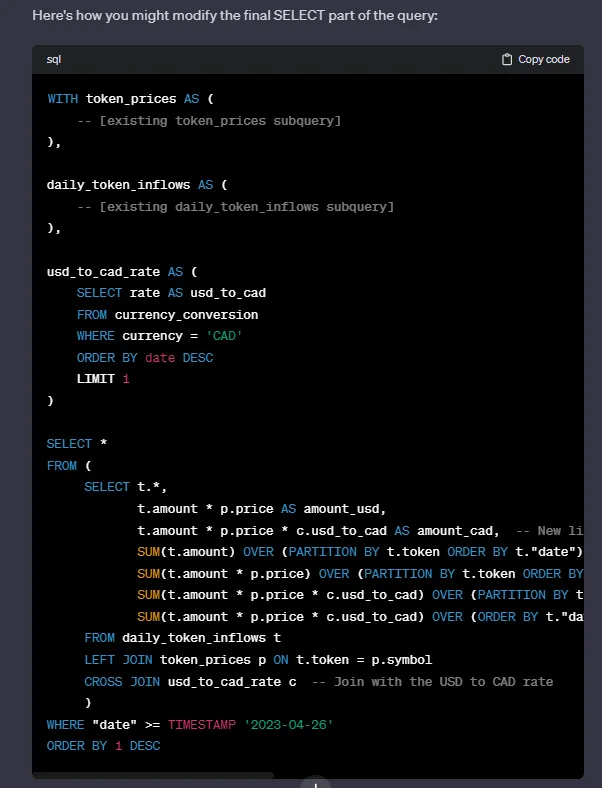
Dune Analytics already has GPT-4 functionality, which can interpret queries in natural language.
If you are confused about a query or want to create and edit a query, you can turn to chatGPT. Note that providing some sample queries in the same conversation will improve its performance, and you will still want to learn to verify chatGPT's work. However, this is a good way to learn while asking, similar to asking a mentor.
LLMs significantly lower the barrier to entry for non-technical cryptocurrency participants.
However, in terms of insights, LLMs are disappointing in providing unique insights. In complex, rational financial markets, do not expect LLMs to provide the correct answers. If you are someone who acts on intuition and gut feeling, you will find that LLMs fall far short of your expectations.
However, we have found an effective use case - checking for obvious things that may have been overlooked. You are unlikely to find non-obvious or contrarian insights, which can actually yield returns. This is not surprising (if someone developed AI that could bring super high market returns, they wouldn't release that part to the wider public).
3. "The Disappearance of Discord Managers?"
In the cryptocurrency space, managing a group of enthusiastic but demanding users for a popular project is one of the most underappreciated and painful tasks. Many of the same common questions are asked repeatedly, sometimes incessantly. This seems like a pain point that should be easily addressed by LLMs.
LLMs also show some accuracy in detecting self-promotional messages (spam). We expect this can also be used to detect malicious links (or other hacker behavior). Managing a busy Discord group with thousands of active members and regularly posting information is indeed difficult, so we look forward to some Discord bots supported by LLMs to provide assistance.
4. "Wild Ideas"
A common occurrence in the cryptocurrency space is the introduction of meme-based currencies based on trends. These range from persistent memes like DOGE, SHIB, and PEPE, to random currencies that disappear within an hour based on the day's trending words (mostly scams, which we avoid participating in).
If you have access to the Twitter Firehose API, you can track cryptocurrency sentiment in real time and train an LLM to identify trends, then use humans to interpret the subtle differences. A simple application example is that when a viral moment occurs, you can launch meme currencies based on sentiment analysis.
Perhaps there are ways to build a budget version sentiment scraper that monitors a subset of popular cryptocurrency influencers across multiple social media channels without the cost and bandwidth of dealing with "rocket launch" type API data sources.
LLMs are well-suited for this because they can understand context deeply (parsing irony and sarcasm online to derive real insights). This LLM companion will evolve and learn alongside the crypto industry, where most of the action is discussed on crypto Twitter. The crypto industry provides a unique environment for LLMs to capture market opportunities through its open debate forums and open-source technology.
However, to avoid being fooled by deliberate social media manipulation, this technology needs to be more sophisticated: grassroots movements, undisclosed sponsorships, and network water armies. In another article, we cover an interesting third-party research report that suggests some entities may be deliberately manipulating social media to increase the value of crypto projects related to FTX/Alameda.
NCRI analysis shows that bot-like accounts occupy a significant proportion (about 20%) of online discussions mentioning FTX-listed currencies.
This bot-like activity foreshadows the activity of many FTX currencies in the data sample.
Following the promotion of FTX, the activity of these currencies becomes increasingly unreal over time: the proportion of unreal, bot-like comments steadily increases, accounting for about 50% of the total discussion volume.
免责声明:本文章仅代表作者个人观点,不代表本平台的立场和观点。本文章仅供信息分享,不构成对任何人的任何投资建议。用户与作者之间的任何争议,与本平台无关。如网页中刊载的文章或图片涉及侵权,请提供相关的权利证明和身份证明发送邮件到support@aicoin.com,本平台相关工作人员将会进行核查。


