Author: Loopy, Odaily Star Daily
Today, native USDC officially entered the Cosmos ecosystem, and Circle officially announced that CCTP has been integrated into the Noble chain. The Noble chain is a chain within the Cosmos ecosystem, and its main purpose is to introduce stablecoins to the Cosmos ecosystem.
Currently, after the deployment of CCTP, the Circle Cross-Chain Transfer Protocol (CCTP) went live on Noble's testnet on November 3 and is expected to go live on the mainnet on November 28.
This development was completed through a collaboration between Circle, Noble, and the dYdX team, with the aim of facilitating the transfer of USDC to the dYdX chain across different networks. While the primary purpose is for dYdX, thanks to the convenient IBC cross-chain, this will undoubtedly benefit the entire Cosmos ecosystem. This feature will introduce USDC into Cosmos in a simple, convenient, and secure manner.
Nathan Cha, the head of dYdX's market, stated that a key principle of DeFi is to improve accessibility for all users, and dYdX is very pleased to see this collaboration.
For Cosmos users, what sets CCTP apart from other cross-chain bridges and stablecoins? This can be traced back to CCTP's unique "burn - mint" mechanism.
Unique "Burn - Mint" Mechanism
CCTP, or Cross-Chain Transfer Protocol, is an official permissionless cross-chain bridge introduced by Circle.
Unlike common bridges, CCTP does not use the typical "lock - mint" model, but instead employs a "burn - mint" model.
In the more mainstream "lock - mint" mechanism, the bridge protocol establishes liquidity pools on both chains, allowing tokens to flow between different chains by locking tokens on one chain and minting tokens on the target chain.
Due to the USDC contract's permissions being controlled by Circle, third-party bridges cannot mint native USDC. CCTP, on the other hand, can burn native USDC on the original chain and mint an equivalent amount of native USDC on the target chain.
After the cross-chain transfer, CCTP will burn USDC on the original chain. Subsequently, Circle will provide evidence, including observing and proving the transaction of burning USDC on the original chain. The original chain application needs to request a "signature proof" from Circle to proceed with the burning, and only after obtaining the "signature proof" can it authorize the minting of the specified amount of USDC on the target chain. Once minted, the USDC will be sent to the recipient's wallet address.
Throughout this process, there is no liquidity pool, nor are there billions of funds locked up. This process optimizes capital efficiency and liquidity experience. Importantly for users, receiving USDC on different chains results in native USDC, directly provided by Circle with USD backing, eliminating concerns about the USDC on the target chain being unanchored from the native USDC on the original chain.
In terms of applications, Circle's main use cases include trading, lending, payments, NFTs, and gaming, such as cross-chain swaps, cross-chain deposits, and cross-chain NFT purchases.
No Liquidity Pool, Is Cross-Chain More Secure?
In the traditional "lock - mint" cross-chain model, the drawbacks are evident. To maintain a 1:1 price peg of two tokens in the pool, LP providers need to provide liquidity, and the large amount of locked tokens in the pool becomes a prime target for hackers.
Odaily Star Daily previously reported on the ten largest cross-chain bridge attacks in history. In March 2022, the Ronin Network's cross-chain bridge was attacked, resulting in a total loss of up to 624 million USD, marking the largest cross-chain bridge theft in history. According to Chainalysis, cross-chain bridge attacks in 2022 alone have caused over 2 billion USD in losses.
Furthermore, the "lock - mint" model naturally divides the two ends of the bridge into the "original chain" and "target chain," with tokens on both sides being native assets and bridge assets, respectively. A large amount of minted tokens and native assets are not the same. If the bridge encounters security issues, the assets minted on the target chain will face the risk of becoming unanchored.
In the "pGALA event" in November 2022, the GALA token deployed on the Ethereum mainnet did not encounter any issues. However, the pNetwork cross-chain bridge experienced security issues, resulting in massive inflation of pGALA issued and minted on the BNB Chain. 1 pGALA on the BNB Chain no longer had the corresponding support of 1 GALA on Ethereum, causing pGALA to plummet to zero.
For asset issuers, the problem of fragmented liquidity across chains also affects the use of assets. (CCTP's documentation indicates that this is Circle's primary concern - "unifying liquidity across the entire ecosystem.")
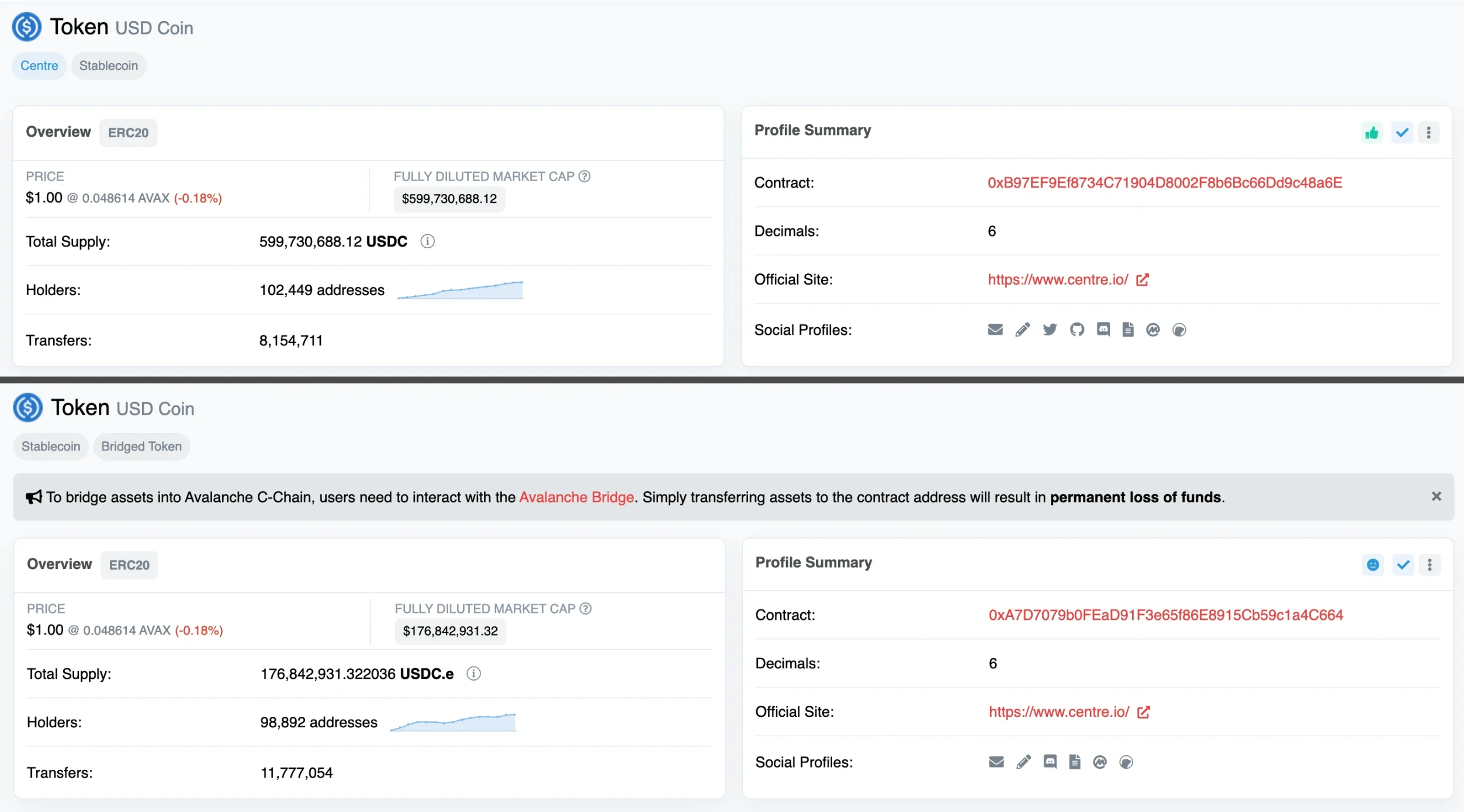
For example, on Avalanche, there are currently two mainstream USDC tokens. 599 million USDC issued by Circle, with contract suffix "8a6E," and 176 million USDC.e issued and minted by the official Avalanche bridge, with contract suffix "C664."
For users, the experience of using these two types of USDC is no different, both valued at 1 USD and usable on major DEXs. Interestingly, if a user holds both types of USDC, their wallet will display both types of tokens. In Avalanche's DeFi world, the multitude of trading pairs composed of these two different USDC tokens creates confusion, leading users to inadvertently engage in inefficient "exchange one USDC for another" transactions.
Having two types of USDC on the same chain is a more intuitive manifestation of fragmented liquidity. This fragmentation becomes even more pronounced when placed in a broader multi-chain ecosystem.
To use USDC across multiple chains, a large amount of non-native USDC is issued by bridges. Meanwhile, the native USDC is locked as LP in liquidity pools. This locking mechanism undoubtedly sacrifices a significant amount of capital efficiency.
Generally, mainstream bridges require a large amount of tokens to be locked on both ends of the bridge to provide sufficient liquidity. While these tokens can support daily transactions, their long-term presence in LP pools reduces the tokens available in the market. Roughly speaking, to support the cross-chain flow of a portion of tokens, a considerable amount of funds needs to be locked in the pools, rendering them effectively unusable.
This undoubtedly has a certain impact on various parties in the crypto world, with cross-chain bridges being the first to be affected. Stablecoins are among the most traded assets in major cross-chain bridges. CCTP's entry may have a strong impact on the market share of traditional cross-chain bridges.
In addition to existing interoperability protocols, LPs may not welcome the arrival of CCTP. The locking model of traditional cross-chain bridges requires a large amount of LPs to provide funds, and stablecoin cross-chain LP provisioning has always been a low-risk way to earn income on major cross-chain bridges.
The Stablecoin Dilemma in Cosmos
The deployment of CCTP on Noble is a significant event worth noting for both Cosmos and Circle. Interestingly, dYdX, seemingly unrelated, is actually one of the proactive collaborators in the protocol's deployment.
Seemingly unrelated, dYdX stands to benefit greatly from the native deployment of USDC. In June 2022, dYdX announced its move to the Cosmos ecosystem and will implement the migration in the upcoming dYdX V4 version. This marks the first time a well-known Ethereum-native DeFi application has chosen to migrate.
However, after entering the Cosmos ecosystem, dYdX faces a dilemma similar to most applications within the ecosystem - a lack of stablecoins.
Odaily Star Daily found that many major CEXs do not support stablecoin deposits and withdrawals on the Cosmos network. As an on-chain exchange, dYdX undoubtedly has a significant demand for stablecoins. The abundant stablecoin liquidity between the Cosmos and EVM ecosystems undoubtedly provides significant assistance to dYdX.
Prior to the collapse of Terra, the Cosmos ecosystem's internal demand for stablecoins heavily relied on Terra's algorithmic stablecoin UST. After UST "reset," the Cosmos ecosystem suffered a significant blow. Subsequently, the native stablecoin for Cosmos has remained vacant.
Although Cosmos has Axelar-crossed USDC, USDT, and USDC issued through the Nomad bridge, these tokens are not native, and in the context of frequent security incidents, the security reputation of cross-chain bridges is not as robust as that of native issued tokens. Additionally, the liquidity of stablecoins issued by different cross-chain products is fragmented due to inconsistent mapping formats.
It wasn't until June of this year that Tether officially announced the issuance of native USDT through the Kava network. This move filled the gap for stablecoins in the thriving and long-standing Cosmos ecosystem.
With both USDT and USDC entering the Cosmos network, the collaboration between Circle, Noble, and dYdX appears to be a mutually beneficial win for all three parties. For the Cosmos ecosystem, the completion of this "last puzzle piece" in the form of stablecoins may lead ATOM to a more promising future in the near term.
免责声明:本文章仅代表作者个人观点,不代表本平台的立场和观点。本文章仅供信息分享,不构成对任何人的任何投资建议。用户与作者之间的任何争议,与本平台无关。如网页中刊载的文章或图片涉及侵权,请提供相关的权利证明和身份证明发送邮件到support@aicoin.com,本平台相关工作人员将会进行核查。


