The smart wallet-as-a-service stack of Particle Network adopts a modular design to help developers easily design user-friendly DApps, becoming a major driving force for industry innovation.
Original Title: "Announcing Smart Wallet-as-a-Service: Elevating ERC-4337 with Modular Infrastructure"
Authors: Carlos Maximiliano Cano, Ethan Francis, Particle Network
Translation: Babywhale, Foresight News
Account Abstraction (AA) is a "gamble" for Web3 to solve user experience issues.
Currently, the Web3 industry is seeking better products to compete with traditional products. In this context, Account Abstraction (AA) has emerged, which can assist in the construction of complex business scenarios and applications, providing a better experience for end users and greater flexibility for developers.
AA is a significant improvement over the existing Externally Owned Account (EOA) framework and dominates the EVM ecosystem. However, the adoption of AA must be guided through decentralized, organic growth, without a direct roadmap to achieve it.
At the same time, WaaS tools allow end users to quickly create and manage wallets using only Web2 credentials. They also simplify the interaction with DApps by directly signing and performing other activities within the application. In addition, thanks to some technical solutions (such as Particle Network's MPC-TSS), these wallets can also achieve non-custodial and security simultaneously.
Current WaaS tools are a separate, direct solution for seamlessly integrating users into Web3. However, Particle Network believes that incorporating AA into WaaS products is a way to accelerate the application of account abstraction, enhance developers' ability to develop better applications, and upgrade the Web3 infrastructure.
Therefore, we are pleased to introduce the Smart Wallet-as-a-Service Modular Stack of Particle Network, dedicated to providing developers with maximum flexibility in implementing AA in their applications. To introduce this product, let's first understand the motivation for launching this product and the existing features of WaaS tools. Then, we will introduce the features of the smart WaaS modular stack and the benefits it can bring to developers and the entire ecosystem.
Deficiencies of the EOA Framework
To better demonstrate the differences between EOA-centric WaaS tools and Particle Network's Smart Wallet-as-a-Service Modular Stack, it is necessary to first understand the possibilities brought by AA and how the EOA framework limits these possibilities.
The fundamental problem with the EOA framework is that it cannot meet the needs of advanced logic or multi-step programs in application scenarios, which is crucial for complex applications. For developers, this means repetitive coding, inability to determine how users interact with their DApp, and a steep learning curve that is prone to errors.
AA solves these challenges through programmability, enabling transactions to automatically respond to on-chain events, executing routine multi-signature authorizations to enhance security, and enabling more flexible and secure user authentication protocols directly within the wallet infrastructure. For developers, this also means a more flexible experience.
Currently, developing the following complex scenarios in DApps within the EOA framework is impractical, but AA makes it possible:
DeFi Aggregator: These aggregators can perform various functions, such as allowing users to interact with multiple platforms simultaneously, setting repeat interaction strategies with these platforms, and using multiple types of tokens simultaneously in activities, and more. If the user experience is attractive enough and fiat currency inflow and outflow are fully realized, AA opens up the possibility for non-custodial, fully decentralized gas-free platforms to replace centralized platforms.
P2P Microtransaction-Driven Social and Media Platforms: Even in a low-fee L2 environment, EOA can make interactions with social platforms feel cumbersome. AA can optimize this situation, making long-awaited designs a reality, such as P2P microtransaction platforms where viewers make small payments to creators based on viewing time.
X-to-Earn, Gaming, and Income Democratization Platforms: AA can facilitate interaction and enable seamless transactions through session keys, making it ideal for scenarios that require continuous, rapid transactions. Therefore, "X-to-Earn" and Web3 gaming experiences can become more practical and easier to engage users. In this environment, income democratization platforms that reallocate fees and income to users and token holders can also thrive.
In terms of the adoption of AA, ERC-4337 is a key achievement as it implements runnable AA applications. However, since ERC-4337 has not yet been recognized at the protocol level, the development of AA largely depends on the community's decentralized organic guidance. In this case, WaaS tools can play a key role in accelerating this process, and can even serve as an intermediate step for some recommended methods, such as voluntary migration (EIP-7377).
WaaS Tools and Transition to AA Mode
WaaS tools enable developers to focus on designing better experiences and more easily handle the underlying Web3 infrastructure. They achieve this by improving the user setup and wallet usage experience, but as we explain in this article, they can do much more. WaaS tools currently can:
- Simplify the process of creating wallets for users when they first log into Web3, allowing them to seamlessly transition using Web2 credentials.
- Simplify the transaction signing process by directly signing within the application.
- Provide developers with a modular stack to implement the required functionality in their DApp. This can include built-in customization tools to achieve the desired look and feel, as well as practical adaptability.
As the EVM ecosystem seeks to upgrade to the AA framework, WaaS tools native to AA implementation can accelerate this process. To fully grasp this approach, it is crucial to understand the key differences between native AA implementation and non-native AA implementation at the WaaS level.
Non-Native Account Abstraction Implementation
In a non-native implementation, EOA WaaS providers act as signers (owners) of smart accounts. In this design, signers rely on third-party applications to interact with specific smart accounts. Then, signers manually verify the interactions of smart accounts accessible through the WaaS service. This may require manual initialization of accounts and sometimes the need to build/sponsor/push user operations, etc.
Please refer to the example of initializing smart accounts using a non-native AA solution.
Native Account Abstraction Implementation
The native implementation of AA functionality supports both users and developers. For Particle Network, this means allowing end users to choose between using EOA or smart accounts within the wallet. In this design, EOA remains the signer of the smart account, but the allocation and unification of these two accounts are handled by the WaaS provider. In our native implementation, smart accounts are immutable when used in applications with Particle Network's smart wallet-as-a-service stack. Compared to non-native implementations, this brings a more simplified experience and creates space for network effects.
For developers, the native implementation is more natural and simple. Particle Network's AA SDK can automatically handle account initialization, build user operations, and other prerequisites, eliminating the common requirement for manual user operations and smart account management when using numerous third-party AA stack components.
For examples of implementations using Particle Network's AA SDK, please refer to this link.
Native AA WaaS as a Widely Adopted Driver
Given that AA is currently in an experimental stage, MetaMask and other market leaders are unable to integrate this technology on a large scale due to their scale. Therefore, WaaS services currently have the greatest momentum and a direct path to implementing these features, thanks to their position as leaders in user-oriented solutions. With smooth user guidance and native support, WaaS tools are crucial for the adoption of Web3.
Native support also means that WaaS tools provide an ideal framework for developers to explore how to integrate AA into their tools. This opens the door for modularization, allowing developers to decide:
- Their target smart account implementation
- Which bundlers to use
- Whether to insert other third-party tools
Considering the unique role that WaaS tools play in accelerating the adoption of AA in Web3 user experience, we believe that smart WaaS is a natural evolutionary step. In our vision, these tools can enable developers to optimize their DApps through AA, allowing them to iterate faster in both quantity and quality, driving innovation, and ultimately attracting more users to use Web3 products. Considering all the factors we mentioned, the adoption timeline for AA may look like the following graph:
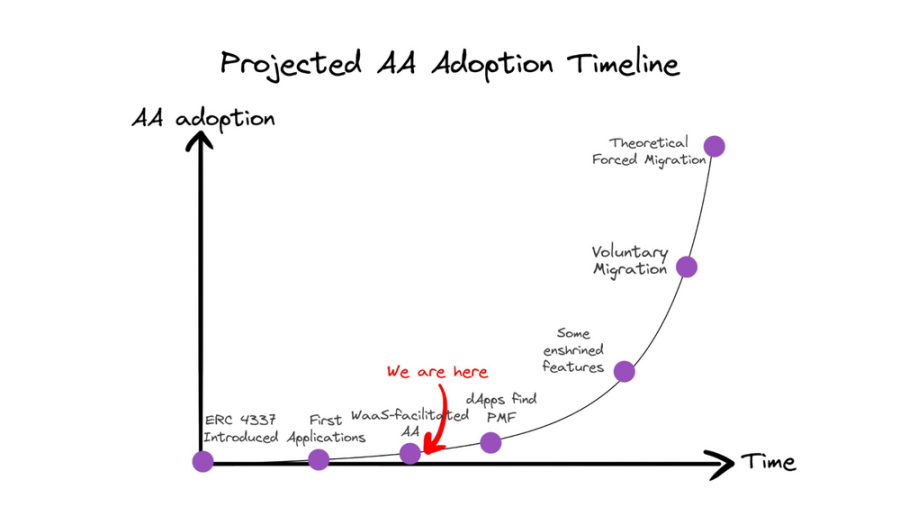
Possible AA adoption curve. In an ideal scenario, not only the adoption rate of AA will increase, but also new users of Web3 will increase correspondingly.
Particle Network's Smart Wallet-as-a-Service Modular Stack
In light of all the points discussed above, Particle Network's smart wallet-as-a-service modular stack is working to create an end-to-end adoption of AA, enabling developers to build ERC-4337 AA implementations for the next generation of Web3 experiences. Particle Network aims to create a flexible experience for developers, allowing them to interact natively with AA while directly binding to Particle Network's WaaS instance.
Particle Network's smart WaaS aims to provide developers with all the possibilities of "WaaS+AA" in their applications, regardless of their complexity, functionality, backend implementation, etc. Ultimately, this enables them to choose the services and tools that best suit their application's needs. Regardless of how developers specifically intend to implement AA in a given application, we have built the necessary modules to fully leverage Particle Network's AA-SDK's ERC-4337 on any level of the underlying technology stack.
When building our smart WaaS stack, we consider the following to be crucial:
Seamless use through WaaS and non-custodial key management: Particle Network's existing WaaS implementation has MPC-TSS private key management capabilities. Combined with social authentication, this ensures that end users can join quickly and securely—regardless of their familiarity with Web3.
Leveraging the flexibility of AA without affecting application complexity: This enables developers to develop a variety of applications, fully leveraging the functionality of AA. Particle Network's AA-SDK supports programmatically interacting with smart accounts in a very familiar way, such as familiar transaction structures, building, and account management patterns, all seamlessly handled by the SDK. This means that AA can be used without complex operations, using Particle Network's WaaS for onboarding and account management, and then adopting AA operations using Particle Network's AA SDK, in conjunction with WaaS.
Modularizing AA through WaaS implementation: Particle Network's AA SDK allows developers to handle AA in a modular way, easily inserting their preferred smart account implementations, Bundlers, Paymasters, etc. As a WaaS provider, Particle Network also supports the adoption of AA applications at any point, even if they did not originally use our AA SDK. Therefore, even non-native AA applications can leverage Particle Network's WaaS for adoption. This creates a fully customizable development experience for native and non-native applications.
The following image shows Particle Network's AA modular solution and overall implementation:
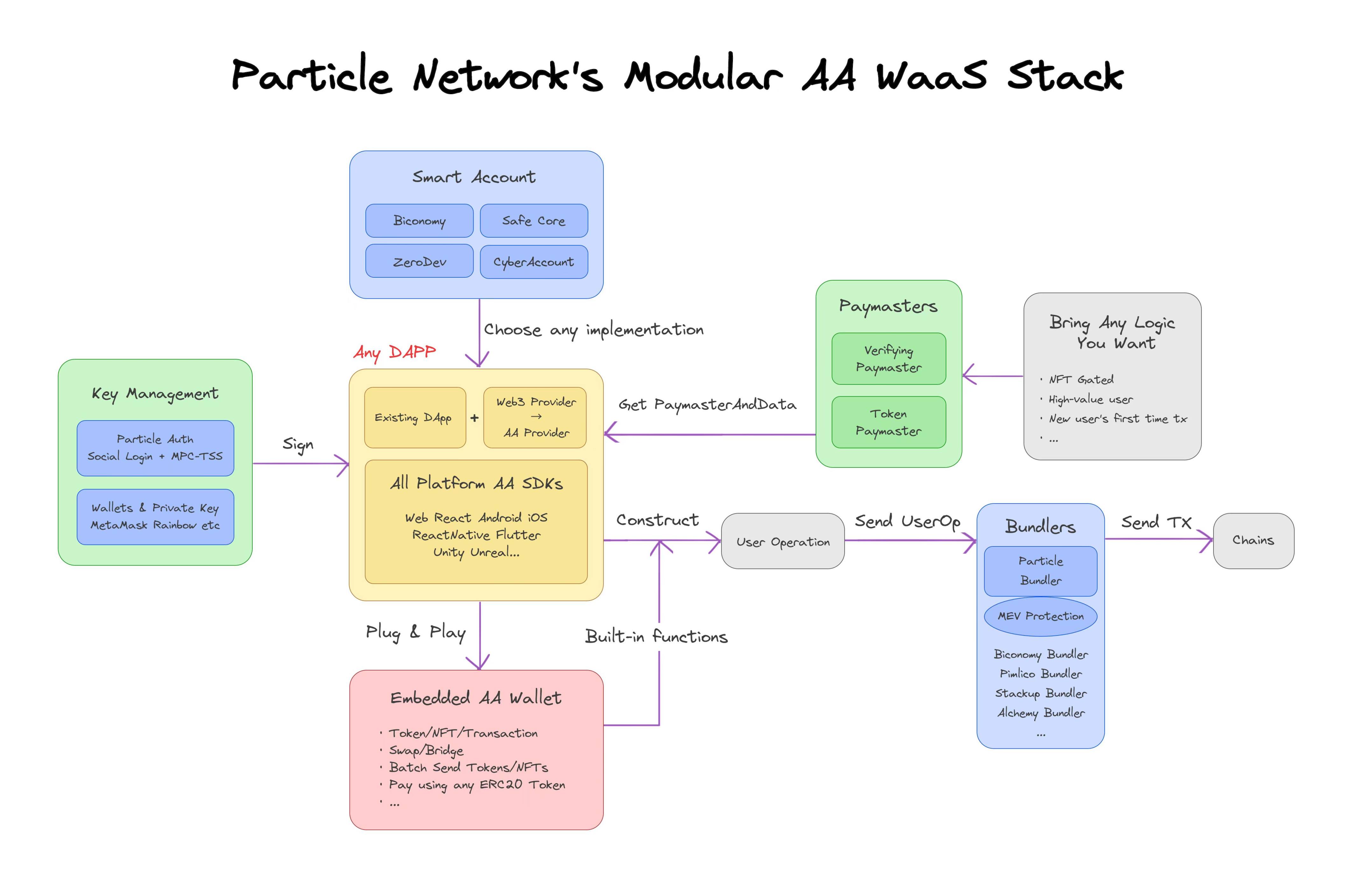
Particle Network's modular stack
To delve deeper into this modular stack, you can watch a tutorial provided by Ethan Francis from the Developer Relations Department below, to learn how to develop applications with minimal code (he provides an example of gasless implementation). In this video, Ethan uses our native AA SDK with built-in Biconomy support. You can also view the example code from the video at this link.
As AA is a nascent field with multiple smart account implementation options, introducing a comprehensive modular stack ensures that developers have greater flexibility. Modularization means they can also insert their preferred components, while remaining friendly to developers with less customization requirements.
Infrastructure Components of Particle Network's AA Stack
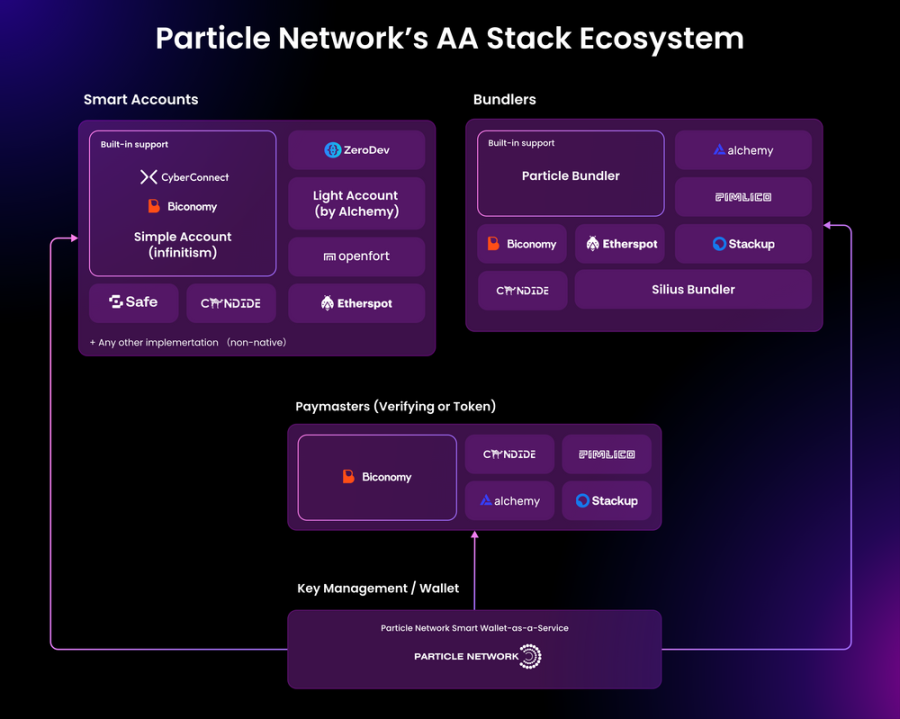
Particle Network's AA stack ecosystem is about to launch built-in support for more implementations.
Currently, Particle Network officially supports the use of Biconomy's smart accounts for developers and users. However, to promote inherent modularity and cross-compatibility within the entire ecosystem, Particle Network will allow users and developers to choose the specific smart account implementations they want to use in our SDK and user interface, providing an advanced solution that does not automatically default to a single provider.
Particle Network's native modular AA support (through the native SDK, Particle Network's RPC, etc.) is powerful in itself, but due to Particle Network's nature as a WaaS provider, it also has inherent cross-compatibility with other AA stack providers.
Here are a few examples of using the Particle Network protocol stack:
- Account management, Paymaster, and UserOp construction using Particle Network's AA SDK, and pushing through Pimlico's bundler
- Account management using Particle Network's AA SDK, then manually constructing user operations, sponsorships, and pushing through Pimlico's Bundler and Paymaster (Demo)
- Using an EOA derived from our WaaS as a signer in another smart account implementation, and choosing a Bundler and Paymaster
Particle Bundler
Particle Network has also developed proprietary Paymaster and Bundler. Particle Network's Bundler is fully open-source and facilitates scalable and reliable ERC-4337 interactions. In fact, Particle Bundler has facilitated tens of thousands of transactions on public chains through the partner program, enabling account abstraction on opBNB, Scroll Sepolia, and Combo Testnet.
Particle Bundler simplifies user transactions by managing smart account nonces and automatically batching user operations. It streamlines the deployment of new chains with a single command, supporting more chains within five minutes. For developers, it provides features such as bundler signer configuration, automatic replenishment, and monitoring alerts. The Bundler efficiently handles high workloads, ensuring fast transaction processing. With robust infrastructure support, it maintains operational stability under various conditions.
Key features of Particle Bundler include support for standard RPC, configurable signers, multi-chain support, duplicate user operations, concurrent processing of user operations, integration with gas oracles, and a management system for multiple Bundler signers. The Bundler also automatically replenishes the balance of bundler signers, retries failed transactions, and provides accurate transaction details in the presence of MEV. More detailed information can be found in their open-source announcement.
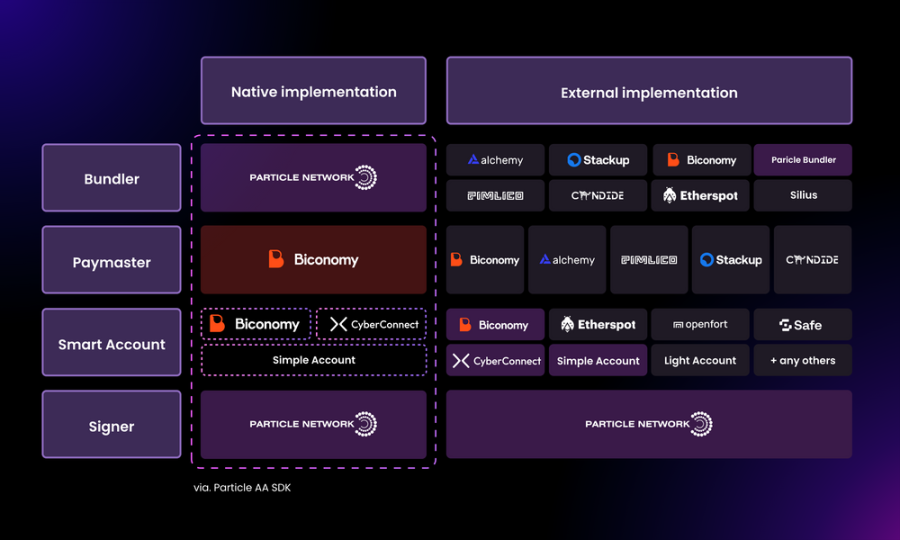
Internal and external implementations of Particle Network
Security
Particle Network's smart WaaS implementation also features security capabilities supporting MPC-TSS to protect user data and assets. These security considerations are illustrated in the following diagram:
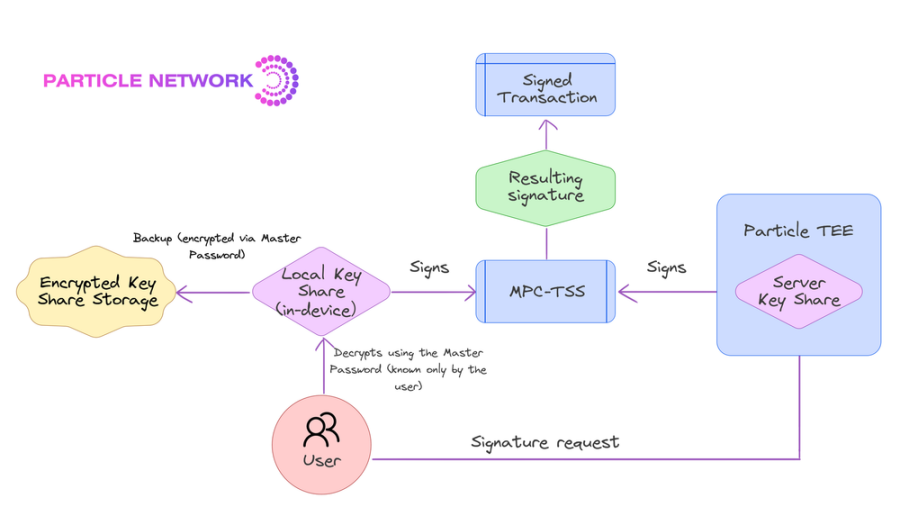
Particle Network's MPC-TSS security setup
Particle Network adopts a 2/2 advanced TSS scheme to ensure that users' private keys are never centralized in one location or entity throughout their entire lifecycle. This scheme splits the keys into two parts, ensuring that each part does not reveal any information about the complete key. Particle Network also allows users to create a master password to encrypt local key fragments, which can then be securely stored. This allows users to restore their wallets across devices in a completely secure manner. To further understand this mechanism and why it is the safest choice for protecting user private keys in a non-custodial manner, refer to the article "How to Choose a WaaS".
What's Next for Particle Network and Wallet-as-a-Service?
The combination of account abstraction and wallet-as-a-service solutions has the potential to transform the experience of Web3 developers and end users, making our ecosystem more attractive.
Particle Network's modular stack for smart wallet-as-a-service is a significant upgrade to existing attractive products, emphasizing practicality and simplifying the process of developing user-friendly applications using AA. In this regard, the integrated ecosystem of Particle Network is one of the main advantages in pursuit of flexibility.
In an upcoming announcement, we will introduce Particle Network's omnichain account abstraction, which will play a crucial role in the token-centric design of Particle Network's upcoming v2 release. Around this innovation, Particle Network will launch a new set of products for developers and end users, creating a more integrated and comprehensive environment.
The advancements in smart WaaS described in this article present an opportunity for innovation and improved application performance. If you've read this far, we invite you to integrate these enhanced features into your projects using Particle Network's resources, including our detailed tutorials and comprehensive documentation. As the adoption of AA increases, developers building super DApps with AA adoption will undoubtedly play a key role in accelerating Web3 adoption.
免责声明:本文章仅代表作者个人观点,不代表本平台的立场和观点。本文章仅供信息分享,不构成对任何人的任何投资建议。用户与作者之间的任何争议,与本平台无关。如网页中刊载的文章或图片涉及侵权,请提供相关的权利证明和身份证明发送邮件到support@aicoin.com,本平台相关工作人员将会进行核查。


