Author: Leo Deng, LK Venture
TL;DR
- The Rise of Anti-Inflation Stablecoins: Digital stablecoins pegged to fiat currencies are affected by purchasing power decline, leading the financial market to show strong interest in a "anti-inflation stablecoin" (Flatcoin) that can truly maintain purchasing power stability in an inflationary environment. This new type of stablecoin resists inflation by pegging to the price of a specific basket of goods and is considered an important direction for the future of finance by industry leaders such as Vitalik Buterin and Coinbase's CEO Brian Armstrong.
- Definition of Anti-Inflation Stablecoins: Unlike other stablecoins pegged to specific assets or fiat currencies, anti-inflation stablecoins are designed to combat inflation and maintain purchasing power. In countries with soaring inflation rates, it provides an effective tool to combat inflation and is used as a hedging strategy in high inflation areas such as Latin America and Africa.
- Design Challenges of Anti-Inflation Stablecoins: Accurately measuring inflation rates is a challenge due to differences in countries, regions, and measurement methods such as CPI and PPI; it requires reliance on reliable, accurate data sources and ensuring data verification and auditing; combating manipulation, attacks, and market volatility requires a high level of system stability and security; legal and regulatory restrictions and risks may arise from differences in countries; designing effective economic models to ensure stablecoins truly reflect inflation; technically, real-time processing of inflation data, designing stable smart contracts, and ensuring system efficiency are necessary; market acceptance and user education are also key to success.
- Significance of Anti-Inflation Stablecoins in the Cryptocurrency Market: Protecting purchasing power for users in high inflation environments, providing stability, and being more reliable than traditional stablecoins; driving technological innovation, increasing the utility of digital currencies, attracting more traditional financial participants, and helping to shape a clear regulatory environment. At the same time, it brings diversity of choices to the market and provides new risk management tools for the global economy.
- Analysis of Typical Projects: Including the Frax Price Index (FPI), Frax Finance's stablecoin pegged to CPI-U, fully collateralized by crypto; the Reserve project, aiming to create a decentralized stablecoin Reserve Token (RSV) with risk reduction through diversification; SPOT, based on Ampleforth and Buttonwood, aiming to bridge the gap between speculative cryptocurrencies and dollar alternatives, providing stability through zero-clearing layers and operating on multiple chains.
Why Do We Need Anti-Inflation Stablecoins (Flatcoin)?
As a reflection of economic and national power, currencies have undergone many changes throughout history. Whenever a dominant power gradually declines and is replaced by emerging powers, its dominant currency status also changes accordingly.
The Dutch guilder once dominated during its economic peak, and the British pound during the British Empire era became a globally trusted currency. However, these currencies failed to permanently maintain their leading positions.
Recently, Ray Dalio, the founder of Bridgewater Associates, suggested that the US dollar's status as the world's reserve currency may be challenged. In an interview in 2023, he emphasized that as the influence of the US dollar diminishes globally, the international economic and monetary landscape is becoming multipolar, and the reserve currency status of the US dollar faces uncertainty in the future.
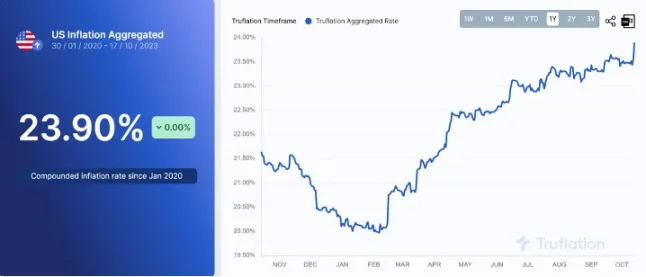
Since January 2020, the average purchasing power of Americans has decreased by 23.90% (data from:https://truflation.com/).
From October 10, 2020, to October 10, 2023, data from Truflation shows that the average purchasing power of Americans has decreased by 20.39%. This effectively means that for individuals holding assets in US dollars, their purchasing power in the market has shrunk by one-fifth over these three years.
However, such inflationary phenomena are not unique to the United States. The International Monetary Fund (IMF) forecasts that the global inflation rate will be 6.6% in 2023, compared to 8.8% in 2022. The World Economic Forum further points out that due to complex factors such as deglobalization, climate change, wage-price spirals, and highly liquid global markets, the global economy is facing a sustained period of high inflation.
Some countries, such as Argentina, Turkey, and Iran, have shown extremely high inflation rates of 76.1%, 51.2%, and 40.0%, respectively in 2023, due to political instability, international sanctions, currency policy errors, and economic management issues.
In the field of digital currencies, although traditional stablecoins aim to maintain their stability by pegging to specific fiat currencies or assets, as fiat currency inflation rises, the corresponding digital stablecoins are also affected. From the first batch of stablecoins born in 2014 to the widespread attention they received with the rise of decentralized finance (DeFi) in 2017, such as Tether (USDT) and USDCoin (USDC) have become the third and fourth largest cryptocurrencies by market value globally. Currently, there are about 200 stablecoins in the market with a total market value of $190 billion.
However, these stablecoins such as USDT and USDC mainly operate in a centralized manner, carrying the risk of control by central entities, and may expose holders to counterparty and audit risks.
More importantly, with the continuous rise in global inflation, stablecoins pegged to currencies such as the US dollar are experiencing erosion of their real value.
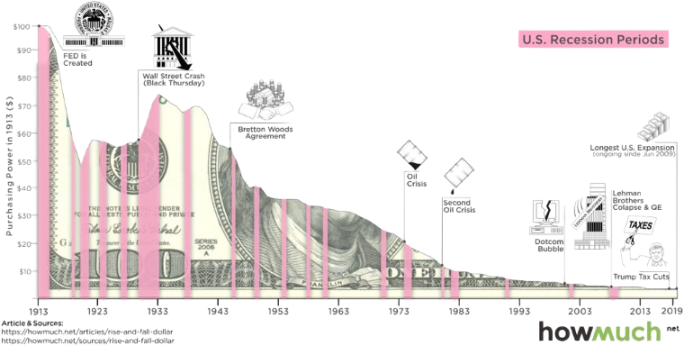 Comparison of the relative purchasing power of the US dollar (compared to the initial issuance) (data from: howmuch.net)
From this perspective, stablecoins are not necessarily truly "stable," which seems unreasonable but is the existing reality. With the rise in inflation rates and the uncertainty of the global economy, the financial market, especially the crypto financial market, is beginning to seek a new type of stablecoin that can maintain purchasing power stability, even in an inflationary environment. Thus, the emergence of anti-inflation stablecoins (also known as Flatcoin) has become a new focus in the market.
Flatcoin, as a decentralized stablecoin, has emerged with the aim of protecting assets from the impact of inflation. Unlike traditional stablecoins, Flatcoin resists inflation by maintaining pegging to the price of a specific basket of goods, thereby protecting purchasing power. Since the concept of Flatcoin was proposed, it has attracted high attention from the crypto industry. The clear goal of Flatcoin is to "maintain stable purchasing power while also having a certain degree of flexibility to resist the economic uncertainty caused by the traditional financial system."
At the end of 2022, Vitalik Buterin, co-founder of Ethereum, shared his outlook for the cryptocurrency industry in 2023 in an interview with Bankless, mentioning three "huge" opportunities that have not yet been realized in the cryptocurrency field: mass wallet adoption, inflation-resistant stablecoins, and Ethereum-powered website logins.
Vitalik believes that creating a stablecoin that can resist various conditions, including hyperinflation of the US dollar, will provide a huge opportunity for the entire cryptocurrency industry. He emphasized that providing a reliable, inflation-resistant stablecoin for billions of users will be an important supplement to the traditional financial system.
Coinbase's CEO Brian Armstrong has also mentioned Flatcoin in public interviews multiple times and discussed this new technology on Twitter, listing it as the first of 10 cryptographic technologies.
Brian believes that Flatcoin is the future direction of stablecoin evolution. Unlike traditional stablecoins pegged to fiat currencies, Flatcoin provides a new and more stable store of value by tracking inflation. He also emphasized that although Coinbase has not yet developed in this area, they have shown strong interest in the potential of this new type of stablecoin.
What is an Anti-Inflation Stablecoin?
Anti-inflation stablecoins, commonly referred to as "Flatcoin" (also known as "value stablecoin" or "purchasing power stablecoin"), are designed to track inflation rates rather than a specific currency.
"Flatcoin" was first proposed by Balaji Srinivasan, former CTO of Coinbase, in 2021. The purpose of Flatcoin is to maintain stable purchasing power, even in an inflationary environment. By pegging to the Consumer Price Index (CPI) or other inflation indicators, these stablecoins can maintain their real value, providing users with a more stable and reliable store of value.
Subsequently, blockchain technology development company Laguna Labs launched a new cryptocurrency called Nuon. They claim it to be the world's first over-collateralized and decentralized "Flatcoin."
Just as decentralized protocols are the answer to the risks of centralized currencies, over-collateralization is the answer to maintaining value in a market collapse, and anti-inflation stablecoins are the solution to maintaining value over time.
With the rise in inflation rates, such as the US inflation rate reaching 8.5% in 2022, far above the Federal Reserve's 2% inflation target, anti-inflation stablecoins have become an attractive option. They are typically not subject to banking deposit restrictions and often offer higher interest rates, making them an appealing choice in the face of inflation.
In Latin America, where the inflation rate reached 14.6% in 2022 and is expected to reach 9.5% in 2023, using anti-inflation stablecoins can be used to hedge against high inflation and promote cross-border remittances across different countries and regions.
Differences Between Anti-Inflation Stablecoins and Other Stablecoins
Different types of stablecoins can be classified based on their backing assets or operating mechanisms. Here are the main types of stablecoins, their characteristics, and examples:
Commodity-backed Stablecoins: Typically backed by hard assets such as gold or real estate to maintain the stablecoin's value. For example, PAX Gold (PAXG) is a stablecoin pegged to gold, with each PAXG representing one ounce of gold.
Crypto-backed Stablecoins: Typically maintain the stablecoin's value through over-collateralization of crypto assets. For example, DAI is a crypto-backed stablecoin issued by MakerDAO, pegged to the US dollar but maintaining its stable value through collateralizing assets such as Ethereum.
Fiat-backed Stablecoins: Usually pegged 1:1 to a specific fiat currency such as the US dollar, euro, or yuan. For example, USDT (Tether) and USDC (USD Coin) are stablecoins pegged 1:1 to the US dollar.
Algorithmic Stablecoins: Typically adjust the supply through algorithms to maintain the stablecoin's value. For example, Ampleforth (AMPL) is an algorithmic stablecoin with its supply dynamically adjusted based on market demand.
The main purpose of anti-inflation stablecoins (such as Flatcoin) is to protect purchasing power by pegging to inflation indices (e.g., CPI) and avoiding the impact of inflation. Other types of stablecoins typically maintain their value by pegging to specific assets or through algorithms.
In terms of design and implementation, anti-inflation stablecoins may require more complex economic models and algorithms to accurately reflect changes in inflation and adjust the stablecoin's value accordingly. Additionally, anti-inflation stablecoins may face more complex regulatory challenges, especially related to the accuracy and fairness of inflation data.
Design Challenges of Anti-Inflation Stablecoins
The design of anti-inflation stablecoins is a highly challenging task both technically and economically, aiming to maintain the stablecoin's purchasing power in an inflationary environment. However, in designing the mechanism of anti-inflation stablecoins, there are several challenges to be addressed:
Accurate Measurement of Inflation Rates: Inflation rate is a key factor influencing the design of anti-inflation stablecoins. The inflation rate may vary in each country and region, requiring designers to find an accurate and reliable method to measure inflation. Inflation can be measured through various methods, such as the Consumer Price Index (CPI), Producer Price Index (PPI), or other inflation indicators. However, these indicators may be influenced by various factors, including political factors, economic policies, and differences in statistical methods, affecting the accuracy and effectiveness of anti-inflation stablecoins.
For example, in an application case of Volt Protocol, its corresponding local stablecoin VOLT maintains stability by anchoring to the Consumer Price Index (CPI). If the annual inflation rate remains at 7%, the token will be anchored at $1.07.
Reliability of Data Sources: The design of anti-inflation stablecoins relies on reliable and accurate data sources. Inaccurate or unreliable data sources may lead to the stablecoin's value being disconnected from the actual inflation rate, resulting in the loss of its anti-inflation characteristics. Designers need to find reliable data providers and ensure the accuracy and timeliness of the data. Additionally, robust data verification and auditing mechanisms need to be established to ensure the authenticity and integrity of the data.
System Stability and Security: Any cryptocurrency project, especially stablecoin projects, needs to consider the stability and security of the system. The design of anti-inflation stablecoins needs to consider how to prevent manipulation, attacks, and other factors that may affect the stability and security of the system. Additionally, consideration needs to be given to designing robust protocols and mechanisms to address market fluctuations and unforeseen events, ensuring the continuous stable operation of the system.
For example, on May 10, 2022, the price of the algorithmic stablecoin Terra USD, running on the Terra blockchain, dropped and lost its peg to one US dollar. This case demonstrates how algorithmic stablecoins can be vulnerable to speculative attacks when the system lacks collateral.
Legal and Regulatory Challenges: Anti-inflation stablecoins may be subject to the legal and regulatory environments of different countries and regions. These laws and regulations may affect the design, issuance, and trading of anti-inflation stablecoins. Some countries may restrict or prohibit the use of anti-inflation stablecoins, or require project teams to comply with specific regulatory requirements. These legal and regulatory challenges may increase the complexity and risks of the project.
At the end of 2019, when stablecoins were just beginning to emerge, the G7 summit strongly declared them as a serious risk for international settlements. This demonstrates the impact of legal and regulatory environments on the design and application of stablecoins. In September 2023, the G20 summit approved the Financial Stability Board's recommendations on the regulation, supervision, and oversight of crypto asset activities and markets, as well as global stablecoin arrangements, with more related regulatory requirements expected to be introduced.
Design of Economic Models: The economic model of anti-inflation stablecoins is the foundation for ensuring their functionality and effectiveness. Designers need to consider how to build an effective economic model to ensure that the stablecoin's value accurately reflects the inflation rate. This may include determining the issuance mechanism, circulation mechanism, and destruction mechanism of the stablecoin, as well as how to adjust the stablecoin's value through market mechanisms.
Complexity of Technical Implementation:
The technical implementation of anti-inflation stablecoins is a complex process that requires consideration of various technologies and algorithms. For example, how to accurately and in real-time obtain and process inflation data, how to design smart contracts for stablecoins to ensure their anti-inflation characteristics, and how to ensure the scalability and efficiency of the system. Additionally, consideration needs to be given to integrating with existing blockchain networks and other cryptocurrency projects to achieve widespread application of anti-inflation stablecoins.
- Market Acceptance and User Education:
Market acceptance and user education are also key factors for the success of anti-inflation stablecoins. Designers and project teams need to consider how to educate users about the advantages and usage of anti-inflation stablecoins, as well as how to promote anti-inflation stablecoins to gain wider market acceptance.
Significance of Anti-Inflation Stablecoins for the Cryptocurrency Market
Exploring anti-inflation stablecoins has various important implications for the cryptocurrency market. They not only provide more choices for market participants but also drive innovation and development in the cryptocurrency industry.
Preservation of Purchasing Power: Anti-inflation stablecoins protect users' purchasing power by pegging to inflation indices, making them highly attractive to investors and users seeking asset preservation in high inflation environments. They provide a unique store of value and trading tool for the cryptocurrency market.
Increased Market Stability and Trust: Traditional stablecoins (such as USDT and USDC) are typically pegged to specific fiat currencies, but in an inflationary environment, their real value decreases along with the purchasing power of the fiat currency. By providing an anti-inflation stablecoin, market stability and trust can be increased, reducing the inflation risk for investors and users.
Driving Cryptocurrency Industry Innovation: The design and implementation of anti-inflation stablecoins address many technical and economic challenges, contributing to innovation and development in the cryptocurrency industry. By addressing the challenges faced by anti-inflation stablecoins, the cryptocurrency market can find new solutions and technologies, driving progress in the entire industry.
Enhancing the Utility and Widespread Acceptance of Cryptocurrencies: Anti-inflation stablecoins can serve as a more reliable store of value and medium of exchange, enhancing the utility and widespread acceptance of cryptocurrencies. They may attract more participants from traditional financial markets to the cryptocurrency market and encourage more merchants and service providers to accept cryptocurrency payments.
Promoting Market Diversification: Anti-inflation stablecoins provide more choices and diversification for the cryptocurrency market, allowing market participants to choose different stablecoins based on their needs and risk preferences. This diversification can increase market complexity and maturity, encouraging more people to participate in the cryptocurrency market.
Providing New Risk Management Tools for the Global Economy: In the context of increasing global economic uncertainty, anti-inflation stablecoins can serve as new risk management tools, helping individuals and businesses more effectively manage their assets and financial risks.
In summary, the exploration and development of anti-inflation stablecoins have significant strategic implications for the cryptocurrency market. They bring more opportunities to the market but also present a series of challenges and issues that require exploration and resolution by market participants, developers, and regulatory authorities.
Analysis of Typical Projects
1. Frax Price Index
The Frax Price Index (FPI) is one of the stablecoins in the Frax Finance ecosystem. It is the first stablecoin pegged to a basket of tangible consumer goods defined by the US Consumer Price Index (CPI-U). Unlike traditional stablecoins priced in national currencies, FPI creates an independent pricing unit fully backed by cryptocurrency collateral, providing consumers with a unit independent of any national currency.
In terms of mechanisms to address inflation, FPI has the following innovations:
— — Pegged to Consumer Goods: FPI is designed to anchor its value to a basket of tangible consumer goods defined by the average of the US CPI-U. This peg is unique as it ties the value of digital assets to tangible consumer goods, aiming to maintain purchasing power and provide unprecedented price stability in the volatile crypto market.
— — Inflation Tracking: The FPI mechanism uses the unadjusted 12-month inflation rate reported by the US federal government's CPI-U. This data is subsequently submitted to the chain immediately after public release by a dedicated Chainlink oracle. The reported inflation rate is applied to the redemption price of the FPI stablecoin in the system contract. This peg calculation rate is updated every 30 days, synchronized with the monthly CPI price data released by the US government.
— — Algorithmic Market Operations (AMOs): FPI adopts algorithmic market operations (AMOs) similar to the main stablecoin FRAX in the Frax Finance ecosystem. However, the FPI model maintains a 100% collateralization ratio (CR) at all times, ensuring that the growth of the protocol's balance sheet is at least consistent with the CPI inflation rate. If AMO earnings are lower than the CPI rate, the protocol triggers specific operations to restore a 100% CR, such as selling FPI S tokens in exchange for FRAX stablecoins.
— — Stablecoin as a Unit of Account: FPI aims to be the first on-chain stablecoin with an account unit derived from a basket of goods. This ambition goes beyond being an inflation-resistant asset; it seeks to create a new stablecoin to represent trade, value, and debt. In doing so, it provides a framework to better measure whether real appreciation is actually combating inflation and links the on-chain economy to a basket of tangible assets.
— — Governance and Revenue Distribution: FPI S tokens are introduced as the governance token for the system. It has the right to receive seigniorage from the protocol, and excess revenue is transferred from the treasury to FPI S holders. When FPI's fiscal revenue is insufficient to maintain the increased support due to inflation, new FPI S tokens may be minted and sold to strengthen the treasury.
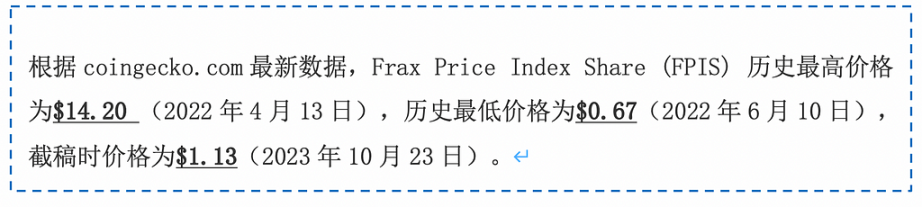
The management of FPI is achieved through Frax Price Index Share (FPI S) tokens, introduced by Frax Finance in April 2022. FPI S tokens are linked to Frax Share (FXS) tokens (linked governance token), providing economic support and governance structure for FPI. FPI S provides unique governance and revenue opportunities for users of the FPI stablecoin through its unique governance mechanism and revenue distribution structure.
FPI adjusts the system monthly based on the on-chain Consumer Price Index to ensure that FPI holders see an increase in their USD-denominated value each month based on the reported CPI. For example, if the inflation rate is 9.1% in June 2022, FPI S will grow at a rate of 9.1% over the next 30 days.
2. Reserve Protocol
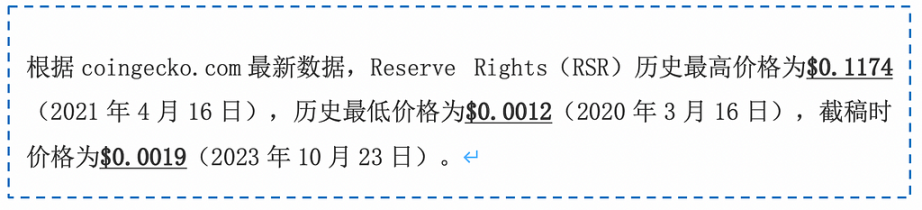
The Reserve project aims to create a decentralized stablecoin called Reserve Token (RSV), allowing holders to conduct various fiat-like transactions. It aims to reduce risk through diversification and decentralization, creating a stablecoin that can maintain its value, unlike traditional fiat currencies (such as the US dollar) that are subject to inflation, but also unlike cryptocurrencies like Bitcoin that are highly volatile.
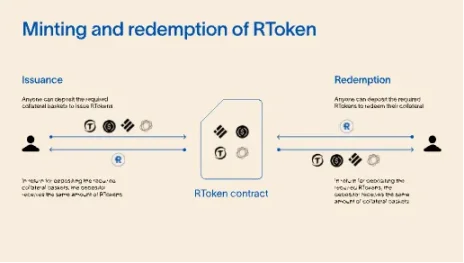
Diagram of RToken issuance and redemption mechanism (Data from:https://reserve.org/protocol/rtokens/).
In addressing inflation, Reserve has the following innovations:
Dual Token Mechanism: Reserve adopts a dual token mechanism consisting of RSV and Reserve Rights Token (RSR). RSV, as a stablecoin, uses other assets and RSR to maintain its stability. This mechanism collectively supports the overall stability of the entire Reserve network.
Governance Collateral Mechanism: RSV is collateralized by a basket of assets. This collateral is crucial in maintaining the peg of RSV and ensuring its stability against inflationary pressures. When the market value of the collateral tokens is insufficient to support the value of RSV, the protocol uses RSR to restore the peg.
Reserve's design innovation revolves around creating a mechanism capable of withstanding the impact of inflationary market conditions and providing stable value storage and exchange functions. Through a dual-token system, collateral support, and decentralized structure, RSV strives to provide a stablecoin solution capable of preserving purchasing power in the long term.
3. SPOT
SPOT is designed as an inflation-resistant stablecoin, aiming to bridge the gap between speculative cryptocurrencies and dollar alternatives. Based on the Ampleforth and Buttonwood protocols, SPOT is governed by the FORTH token.
SPOT is defined as a perpetual note backed by fully collateralized AMPL derivatives. While it shares many attributes of modern stablecoins, it is not pegged to any specific value. It uses zero-liquidation tranching to provide stability, and its price may fluctuate within a range similar to AMPL, making SPOT a derivative that reduces the supply volatility of AMPL.
By introducing SPOT, the Ampleforth team aims to provide the first truly decentralized pricing unit for the crypto-economic system. As a decentralized stablecoin that is not subject to rebase and resistant to inflation, SPOT aims to improve the overall distribution of the emerging digital financial system.
In addressing inflation, SPOT has the following innovations:
ERC-20 Token and Perpetual Wrapper: SPOT is an ERC-20 token and a perpetual wrapper that abstracts the supply volatility of AMPL from holders. Its price will be similar to AMPL (which aims to adjust to the 2019 USD CPI) and can serve as a safe haven for volatility and inflation. SPOT will be fully collateralized by derivatives supported by AMPL.
SPOT Rotator: Through the SPOT Rotator, pledging AMPL can support SPOT Flatcoin while maintaining AMPL rebase (a mechanism to maintain purchasing power through adjusting the quantity of AMPL in users' wallets) and earning AMPL rewards. SPOT is a decentralized Flatcoin using layering instead of liquidation markets to achieve scalable stability.
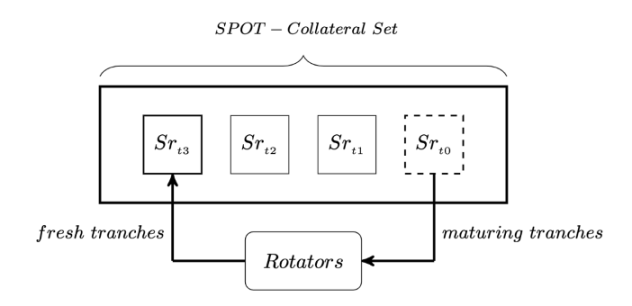 Diagram of SPOT Collateral Rotation Mechanism (Data: docs.spot.cash/spot-documentation)
- Multi-Chain Availability: Due to the full-chain functionality of the SPOT protocol, SPOT is not limited to a single blockchain and can be used and traded on any collaborative chain (such as Ethereum, Polygon (PoS), Arbitrum, Optimism, BNB Chain, and Polygon zkEVM), leveraging unique opportunities on each chain to provide users with more reliable assets.
Conclusion
If there were an anti-inflation stablecoin that could maintain its value without being eroded by inflation over centuries, it would be an ideal asset. Imagine if you could earn some funds today and leave them to your descendants, and when they use those funds a hundred years from now, they could purchase goods equivalent to what you can buy today. However, this is not something that fiat currencies, even strong ones like the US dollar, can achieve.
From a long-term perspective, in the cryptocurrency field, especially in the stablecoin sector, industry innovation should not only expand existing asset categories, portfolios, and mechanisms, but should also create new assets that are stable in the short term, more robust in the long term, and resistant to inflation. In this regard, anti-inflation stablecoins will certainly play a more important role.
免责声明:本文章仅代表作者个人观点,不代表本平台的立场和观点。本文章仅供信息分享,不构成对任何人的任何投资建议。用户与作者之间的任何争议,与本平台无关。如网页中刊载的文章或图片涉及侵权,请提供相关的权利证明和身份证明发送邮件到support@aicoin.com,本平台相关工作人员将会进行核查。


