Bitcoin’s difficulty saw a 6.47% increase this week, surpassing the 61 trillion mark at block height 812,448. This marked the cryptocurrency’s 403rd difficulty epoch, some of which included retargets with no change. In basic terms, Bitcoin’s difficulty measures the challenge of identifying a new block relative to its easiest potential level.
This measure, denoted by a specific number, is adjusted by the Bitcoin protocol every 2,016 blocks — approximately every two weeks — based on the time taken by miners to discover those 2,016 blocks. The difficulty adjustment ensures a consistent discovery of new blocks by miners, regardless of the number of miners in the network.
Notably, during its initial phase at block height 2,016, the difficulty didn’t alter due to a lack of mining activity. The justification for an increase or decrease hinges on the time required to process 2,016 blocks. Ideally, blocks should surface every ten minutes, totaling approximately two weeks for 2,016 blocks.
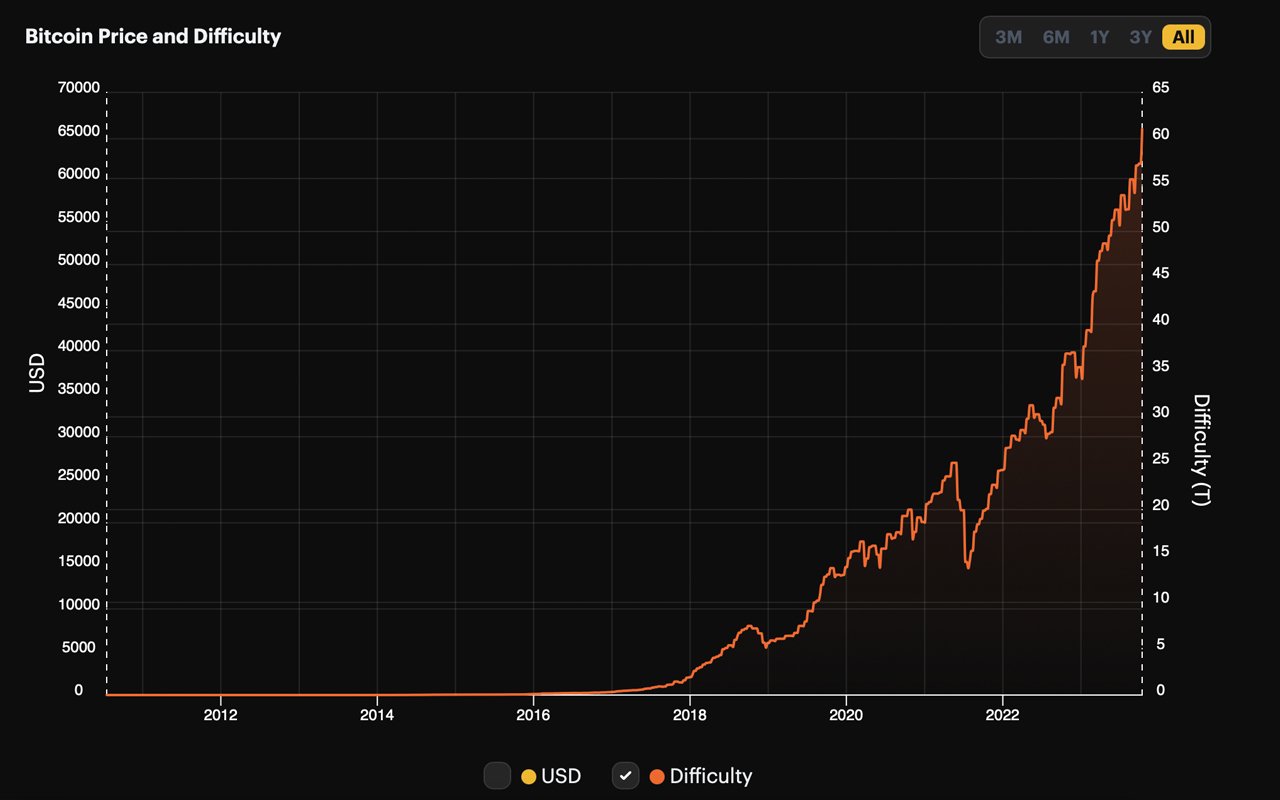
Bitcoin difficulty on October 18, 2023, with USD price omitted from the chart.
If these blocks are discovered quicker than this ten-minute benchmark and the block discovery rate accelerates, the difficulty escalates. Conversely, if it lags, the difficulty diminishes. After 19 different epochs of 2,016 blocks, at block height 40,320, Bitcoin’s difficulty rose for the first time by 100% on February 14, 2010.
The February 2010 adjustment marked Bitcoin’s second most significant change, surpassed only by a staggering 302.22% leap at block height 68,544 on July 16, 2010. Just three days before this monumental shift, the difficulty had surged at block height 66,528, recording the third-largest jump with an ascent of 95.65%.
Fast forward to May 26, 2011, and the fourth most pronounced hike transpired, with a 78.15% uptick at block height 127,008. Not far behind, the fifth most substantial surge in difficulty occurred on June 24, 2011, at block height 133,056, showcasing a 57.27% increment. Some significant upward shifts were witnessed at block 52,416, block 86,688, and block 124,992.
On the flip side, July 3, 2021 bore witness to the steepest negative shift in Bitcoin’s history at block height 689,472, plummeting by 27.94%. Following closely, October 30, 2011, saw the second sharpest dip at block height 151,200, registering an 18.03% decline. The difficulty nosedived by 16.05% at block height 655,200, decreased by 15.97% at block 685,440, and took a 15.95% tumble at block height 622,944. Rounding out the top eight downward adjustments are block 552,384, block 149,184, and block 681,408.
Bitcoin’s difficulty will persistently adapt, responding to the ebb and flow of miners within its network. To date, miners have amped up their hashrate, pushing it by an impressive 0.68 exahash per second (EH/s) daily. Remarkably, despite 15 difficulty increases in 2023, the hashrate still surged, tacking on an extra 194 EH/s in under a year.
免责声明:本文章仅代表作者个人观点,不代表本平台的立场和观点。本文章仅供信息分享,不构成对任何人的任何投资建议。用户与作者之间的任何争议,与本平台无关。如网页中刊载的文章或图片涉及侵权,请提供相关的权利证明和身份证明发送邮件到support@aicoin.com,本平台相关工作人员将会进行核查。


