Intent is still full of risks and challenges in its execution process, as it relies on intermediaries or specific executors, which may lead to the risk of power concentration and monopolization, thereby affecting the trust issue of the entire middleware.
Author: @YBBCapital Researcher @Ac_Core_
Preface
The cumbersome user experience of Web3 has become one of the reasons hindering the large-scale adoption of blockchain. With the recent introduction of the "Intent-Centric" protocol and infrastructure as one of the 10 potential trends that the well-known Web3 venture capital Paradigm focuses on in the encryption field, this concept has instantly attracted industry attention. This is a design concept that centers around user needs and views intent as the core.
For example, "I want to order a $30 hamburger for delivery" is an "intent." To fulfill this intent, users only need to input their name, phone number, delivery address, and place the order on the delivery platform, without needing to be concerned about how the $30 is earned by the merchant or how the platform allocates the delivery person and how the delivery is made. This architectural form greatly simplifies the user's experience threshold, allowing each user to simply express their intent, hand over the intermediate process to various other protocols, and wait for the final result.
Note: This article is not for project promotion, suitable for general readers to read, and the content is for analysis and reference only.
Principles of Intent-Centric Design
Background:
In the Web3 world, transactions are the most core function, and no matter whether it's DeFi, GameFi, NFT, or any other track, they all rely on basic transactions. However, the reality is that the decentralized nature of blockchain means that different chains are independent islands, and we need to find bridges between different islands to complete asset exchanges. Although centralized exchanges provide a convenient user asset trading experience, users still need to authorize wallets one by one to freely use countless Dapp applications. In order to lower the experience threshold of decentralized applications, the concept of Intent-Centric has emerged.
Although the prototype of "intent" did not emerge recently, the wave of this concept was sparked by Paradigm, so we will use their definition for reference: "Intent is a set of signed declarative constraints that allow users to create transactions for third-party outsourcing, but without relinquishing complete control over the transaction party." In practice, the signing is driven by the user's spontaneous intent, but can transferring assets to a third party for processing really achieve the goal of lowering the user's usage threshold? The following discussion will explore what is involved in achieving the vision of Intent-Centric.
What is Intent:
Intent-Centric can be understood as "intent-centered." In a paper titled "Intent-Based Architectures and Their Risks" published by Paradigm on June 1, 23, they explained the concept of intent. In the regular transaction process for users, transaction signatures allow verifiers to verify and execute according to a specific calculation path, and the gas fee in the process is used to incentivize verifiers to complete the calculation. However, intent does not specifically refer to a particular calculation path; any path that achieves the final result under specific constraints is acceptable. In practice, by signing and sharing intent, users are actually allowing the recipient to choose the transaction execution path on their behalf (as shown in the figure below). To distinguish it from transactions, we define intent as a signed message that allows state transitions from a given initial state to retrieve multiple paths to achieve the final state result【1】.
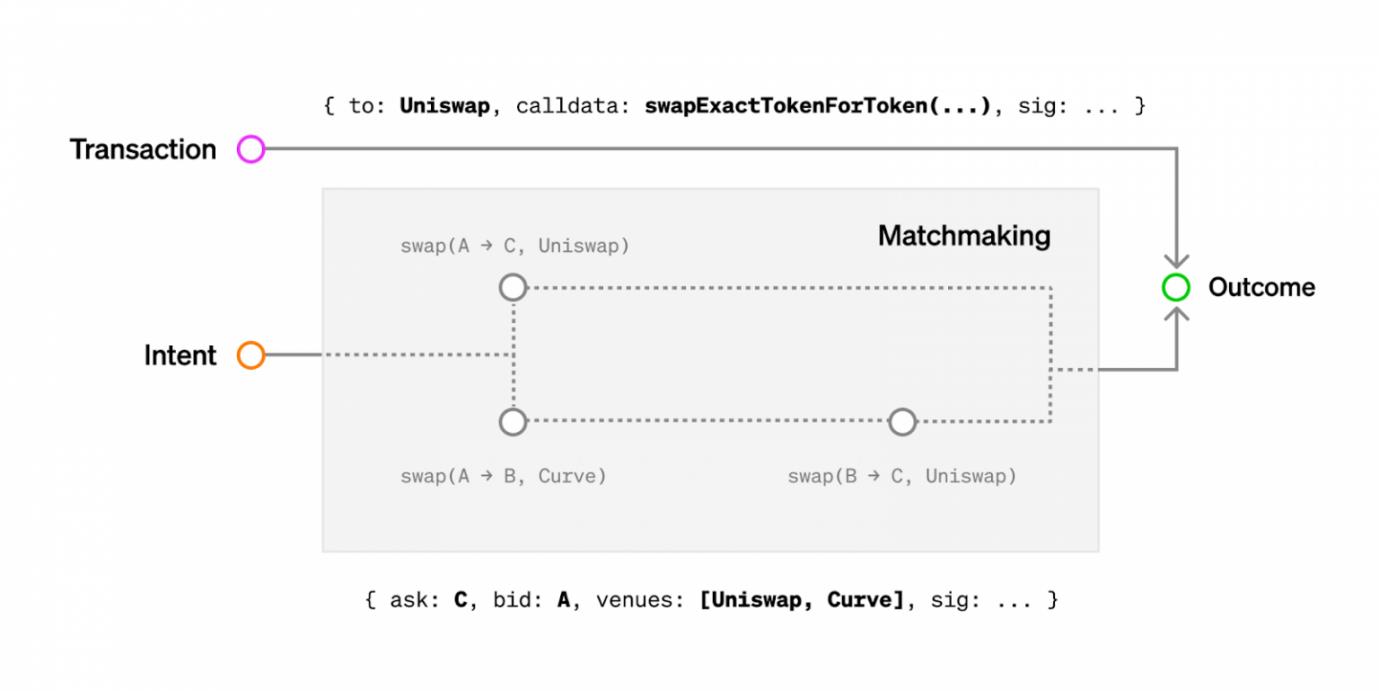
Image Source: Intent-Based Architectures and Their Risks – Paradgim
As shown in the above figure, when submitting a transaction, a specific execution path needs to be specified, such as in exchanging tokens on Uniswap. However, when submitting intent, the execution path is determined by the matching result. For users, they only need to express their intent, and the rest is handled by the relevant Intent-Centric protocols/applications, i.e., matching the execution path. In brief, the execution operation is handled by the Solver, responsible for matching the execution path that meets the intent, and then waiting for the final execution and obtaining the result.
In summary: Transaction = I specify how to do it; Intent = I just want this result and don't care about the process of implementation.
Different preferences of intent can be matched in complex ways, and achieving this process requires "discovering transaction partners" and "solver solving."
Bob, the Intent Solver
Image Source: ETH Global
Bob the Solver is an intent-based transaction infrastructure, the main purpose of which is to simplify the operation process, lower the user's participation threshold, and integrate into wallets and decentralized applications in an integrated manner. Essentially, it creates and executes outsourced transactions for users. Its implementation mainly consists of two related parts:
Transaction creation solver: Comprising AI chatbots + intent classification + transaction optimization, it is responsible for implementing the optimal execution path of user intent and sending it to the AA wallet. The solver is equipped with a machine learning (ML) model for classifying user intent;
"Abstract Account Wallet" for executing transactions: Using the AA wallet system based on the EIP-4337 standard, it consists of a bundler and a paymaster contract, which are integrated with the solver to simplify the transaction process.
Intent Layer and Solver
Is it possible to independently build an intent layer and let solvers compete to solve it? Although it is theoretically achievable, the reality is that it is very difficult to implement. At this point, it is important to mention Anoma and SUAVE (details are mentioned in the following content) to solve the most core MEV problem. In order to achieve the vision of Intent-Centric, what characteristics are needed to safely complete asset transfers by outsourcing transactions to third parties?
- Trustworthiness
To achieve the trust and decentralization features of blockchain, it may not be enough to have a simple "intent network" alone, as this cannot fulfill the guarantees of users and solvers for intent. After users express intent, the Solver will calculate the specific fees required for each execution path, and the Solver will also be constrained by the adjustments set by the user. Users need to know that each execution path is trustworthy;
- Privacy
The complexity of the solver providing users with the best execution path will inevitably be vulnerable to hacking, leading to asset theft or obtaining user information. Additionally, in most cases, users' on-chain activity information will be exposed to observers. To ensure the security of user information, at least some important information needs to be encrypted or hidden, but achieving private computation of information on the blockchain is very difficult;
- Expression of Intent
Intent is an abstract concept, and the way users express intent on the blockchain seems to have similar issues to the way users ask questions to AI, i.e., how should I express it to make it understand what I want to convey? For some implicit and unclear intents, the solver may generate more gas fees when choosing the execution path. An efficient and accurate parser is the key to implementing intent;
- Maintaining Consistency between Intent and MEV
Here's an example of an independent blockchain, SUAVE, that solves real-world problems with the EVM. When it processes Ethereum intents, it requires cross-chain settlement, similar to the MEV decentralized solutions MEV-Geth and MEV-Boost, which have achieved great success in meeting the cross-chain MEV needs with a more fair and transparent transaction processing mechanism.
- Censorship Resistance
According to Paradigm's explanation, we can easily see a core issue: a resolver with AI functionality should not exist as a single entity. If a single resolver is attacked or disabled, it could lead to a catastrophic system crash. Additionally, there may be issues such as resolver refusal to execute or incorrect execution. These issues could possibly be addressed by Anoma, as mentioned in the following section.
- Competitiveness of Solvers
Different users will have different intents, and the solver will also include multiple transaction categories, such as exchange, cross-chain, and staking. There will be no competition between single solvers, as solvers can only collect fees when settling on-chain. It may be possible to allow solvers responsible for different transaction categories to be reasonably redistributed or optimize resolver algorithms to maintain competitiveness between solvers, allowing every valid address to qualify as a solver to successfully participate in the mempool, thereby improving the quality of transaction execution.
- Intent Mempool
Paradigm has proposed three new mempool solutions:
a. Permissionless Intentpools: Open design allowing anyone to submit intents to the mempool and providing unrestricted access for executors.
b. Permissioned Intentpools: Requires permission to submit and execute user intents, allowing users to pass intents to trusted third parties to execute on their behalf.
c. Hybrid Solutions: Combines the characteristics of the above two mempools, aiming to strike a balance between openness and control.
Elements Needed to Implement Intent
Abstract Account (AA)
In a simple review, Ethereum has two types of accounts: EOA (Externally Owned Account) and CA (Contract Account). The difference is that the former can initiate transactions, while the latter cannot initiate transactions but can host Solidity code. Most of the accounts currently in use are EOAs. In addition, there are multi-signature smart contract wallets like Gnosis Safe (SCW). Contract accounts cannot initiate transactions, so EOAs are used to initiate SCWs, allowing EOAs to only sign transactions while smart contracts can execute any logic, enhancing asset security and developing numerous new use cases.
The implementation of the intent layer requires account abstraction (as explained in the SUAVE section below). EIP-4337 consists of six parts: UserOperation, Bundler, EntryPoint, Wallet Factory, Paymaster, and Signature Aggregator. The brief operational process is as follows:
Initiate user operation, i.e., execute transaction content;
Send the operation to the P2P "UserOperation Mempool," and the bundler bundles the signed, gas fee, and other user operation transaction content for submission to the chain (this includes various scenarios not elaborated here);
The bundler sends the bundled content to the entry contract for processing, and optionally uses the signature aggregator to check for legality;
The entry contract pre-sends the transaction to the wallet contract or paymaster contract;
The paymaster contract can unfold into various types based on the project's business logic, but this is not elaborated here for simplicity【2】.
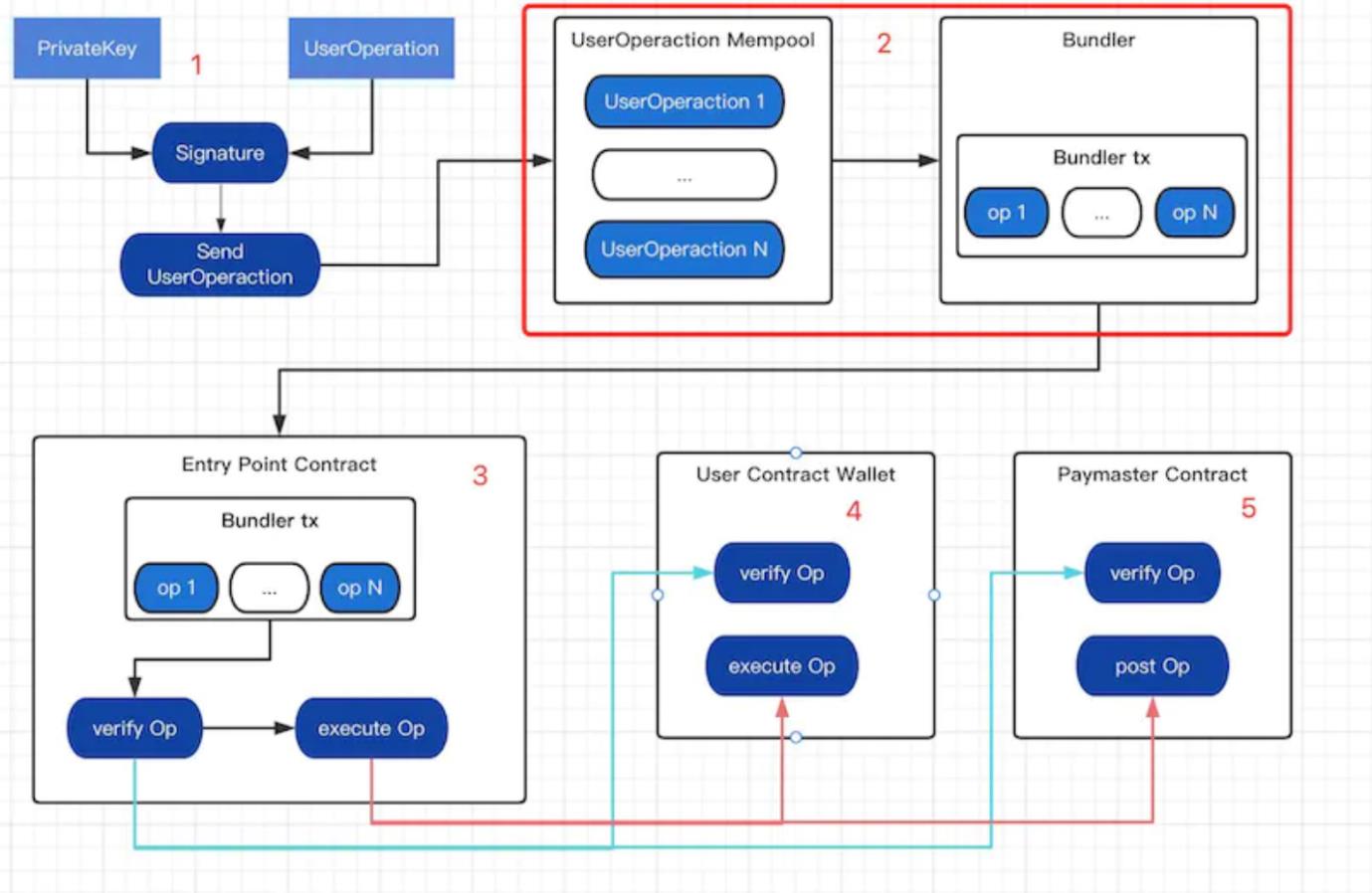
Image Source: ReadON Investment Research Group
Undoubtedly, the smart contract wallet is the most significant participant in account abstraction. The main competing forces currently are the multi-signature wallet Gnosis Safe and the Candide smart contract wallet, which is fully compatible with EIP-4337. From the analysis in the above image, it is easy to see that account abstraction uses the bundler and paymaster to achieve the "narrow" intent for developers, while Paradigm uses the Solver and AI to achieve the "broad" intent for the general public. It is appropriate to place the concepts of "abstraction" and "intent" in the same understanding range, both having a kind of magical concept with a hint of orderliness.
Programmability of Intent
According to Researcher@tmel0211's viewpoint, the programmability of intent can be summarized as follows: if intent is not programmable, programs cannot be executed, automation is not possible, and intelligence cannot be discussed. How to understand this? Intent is a human expression of thoughts that inherently contains emotional factors, while the recipient is a series of cold code and algorithms. For example, if my intent is to make money, how can the code and algorithms help me find the execution path for that intent? Intent-Centric is not a completely new concept, but is built on the current simplified intent design. Therefore, existing Intent-Centric projects and concepts have been organized.
Representative Projects:
UniswapX: Off-chain extension solution for intent;
CowSwap: Off-chain extension solution for intent;
1inch: Fusion order matching off-chain + multi-DEX aggregator;
Solv Protocol: Implements complex financial intent with a new ERC3525 standard;
Unibot: Centralized server backend with preset parameters, rules, and automated intent;
Opensea: Off-chain signatures + on-chain contract combination;
Representative Concepts:
ERC3525 Standard: Proposed by Solv Protocol, aims to provide a semi-standardized asset standard that can more structurally describe digital assets to meet various application scenario requirements;
Abstract Account Account Abstraction: Provides a set of standardized account management interfaces for abstracting the underlying implementation complexity of different account types, such as gas-free, social recovery, etc.;
MPC Wallet: Uses private key sharding technology to split the private key into multiple parts, stored on independent nodes. When performing transactions and other operations, these nodes jointly calculate and generate signatures through secure multi-party computation protocols, without the need to reconstitute the complete private key.
In summary, whether it is representative projects or concepts, they all use a series of more complex instructions to enable users to have a more simplified experience. If the above content is categorized, it can be divided into four categories:
- Centralized Intent:
Based on a centralized resource matching platform, such as Unibot for robot trading on CEX exchanges, Friend.tech, etc.;
- Structured Intent:
Based on smart contract or proxy contract combinations, on-chain + off-chain pre-processing combinations, new ERC standards, etc., to adapt to EVM virtual machine execution;
- Distributed Intent:
Based on a new blockchain architecture with distributed solvers and executors, building a new market for executing complex user intents;
- Intelligent Intent:
Based on AIGC as input+outcome carriers, programming complex user intents through AI trained across DeFi, and executing outputs.
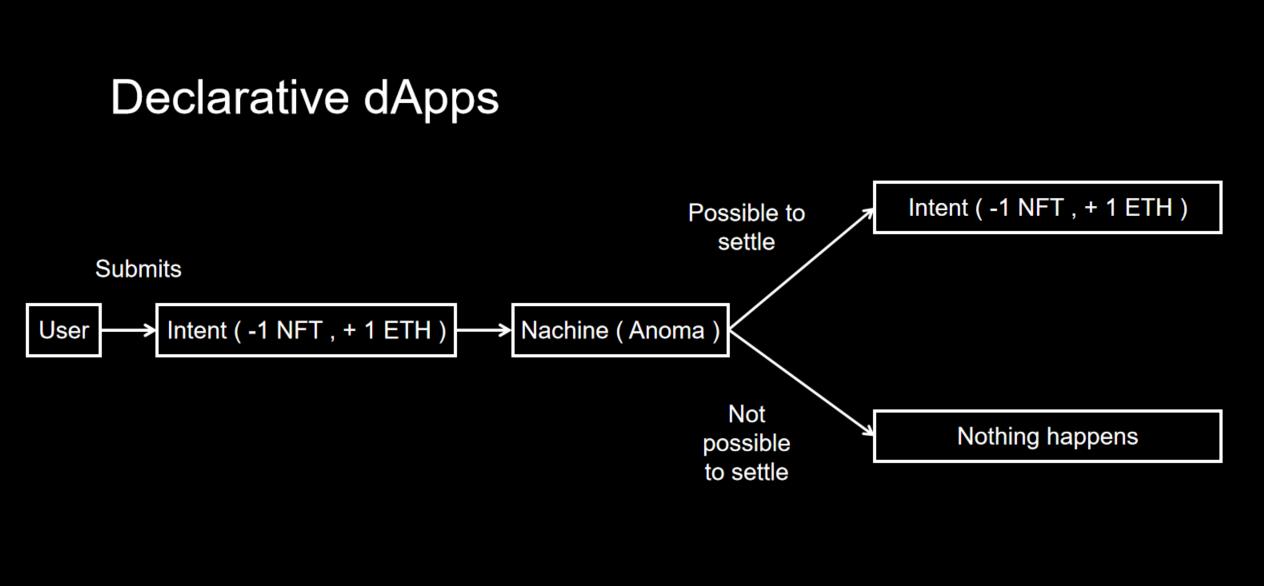
Image Source: Researcher@tmel0211
MEV
Maximal Extractable Value (MEV) refers to the additional revenue rewards that miners can obtain by adding, removing, or reordering transactions. This can be achieved through behaviors such as DEX arbitrage, front-running, back-running, liquidation, sniping bots, time-bandit attacks, sandwich attacks, and more. These actions harm the interests of users who use DeFi in a normal manner. In Ethereum, transactions are sorted by gas, with high gas transactions being prioritized for processing and low gas transactions being processed slowly. Transactions are first submitted to the mempool, where they wait to be included in a block. Validators extract transactions from the mempool and add them to the next block during construction. Since the mempool is public, searchers have the opportunity to pay validators to order transactions in a specific way, extracting value from users through sorting, thus creating value for MEV miners. Implementing user intent requires transferring transactions to third-party outsourcing for processing, making MEV generated by transactions in the Intent-Centric architecture one of the key issues to focus on.
The most direct impact of MEV is that it damages the entire network while also making the market more efficient.
Unequal distribution of capital (larger holders having more ETH chips) may lead to centralization of validators (larger staking pools obtaining higher MEV returns), reducing the overall security of the network. Even though there are currently mitigating measures in place, the centralization risk brought about by the right to construct blocks cannot be completely eliminated.
In order to increase the likelihood of transactions being included in blocks, MEV searchers compete with each other by bidding on gas to gain priority. This can lead to network congestion in the public mempool due to high gas fee transactions from searchers. However, DEX arbitrage and lending liquidation can also help the DeFi market reach equilibrium more quickly to maintain market stability.
MEV is a topic that has been explored for many years and is of great importance. Efforts to mitigate the adverse effects of MEV are continuously being explored. This will be further explained in the next section, "A General Solution for Implementing Intent." According to EigenPhi data as of September 15, 2023, there is still significant profit potential in on-chain MEV. After the Ethereum merge, the profit from using Flashbots' block-producing nodes alone has exceeded 200,000 ETH, making it a very lucrative opportunity.
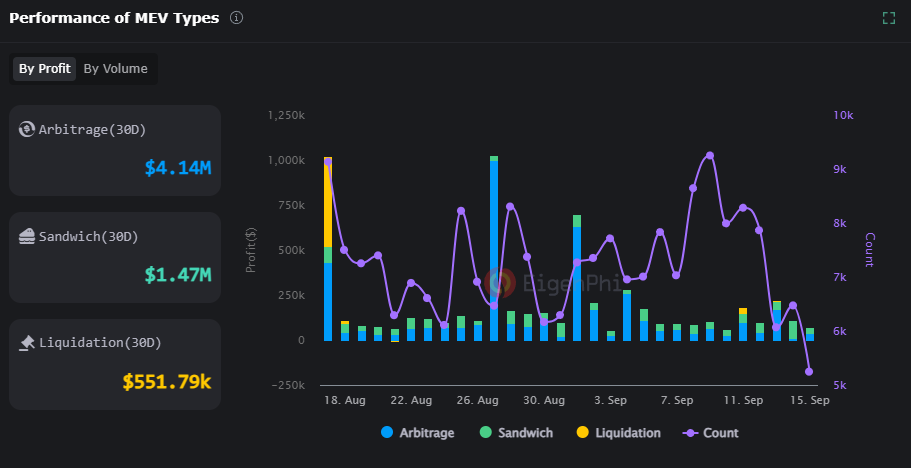
Image Source: EigenPhi | MEV Data
Cross-Chain, Sorters, and Oracles
According to Paradigm's explanation, Intent-Centric is a vast system architecture that involves the entire blockchain field. The transfer of assets between various Layer1 and different Layer2 networks needs to be conveniently handled by intent. The industry's development has brought us into a multi-chain era, where each chain is an isolated island, but there are different bridges between these islands. Therefore, cross-chain and sorters are essential bridges to meet the intent.
With the current prosperity of the Ethereum Layer2 ecosystem, the four major Layer3 solutions—Arbitrum, Optimism, zkSync, and Starkware—are each telling their own stories. OPstack and ZKstack correspond to these narratives. The common problem faced by Layer2 solutions is the issue of centralized sorters. Although viable solutions are actively being sought, the reality is that there is a huge opportunity in this area. Taking OPstack as an example, its profit model can be simplified as "renting shops." The profit of Layer2 = Layer2's gas income + MEV income - Layer1's gas expenditure. To achieve the intent, the toll between Layer2 and Layer1 is essential.
The current prosperity of Layer2 has made us realize the considerable profits of sorters, but the profits from cross-chain solutions should not be underestimated. Cross-chain is an essential bridge to connect different chain islands. As one of the basic infrastructures, in addition to meeting the cross-chain needs of normal trading users in the bear market environment, there is still a practical market demand for cross-chain needs arising from the expectations of airdrops by speculators. The continuously thriving DApps will gradually eat into the profits from convenient centralized exchanges. However, it is worth noting the security of cross-chain bridges. According to official data from hacked.slowmist, in the two years from June 29, 2021, to September 16, 2023, there have been a total of 38 publicly reported security incidents in the cross-chain bridge ecosystem, resulting in a cumulative financial loss of up to $2 billion.
In summary, the inevitable gas fees involved in achieving intent are unavoidable. However, this article does not delve into the security of sorters and cross-chain, although this is an issue that deserves our attention.
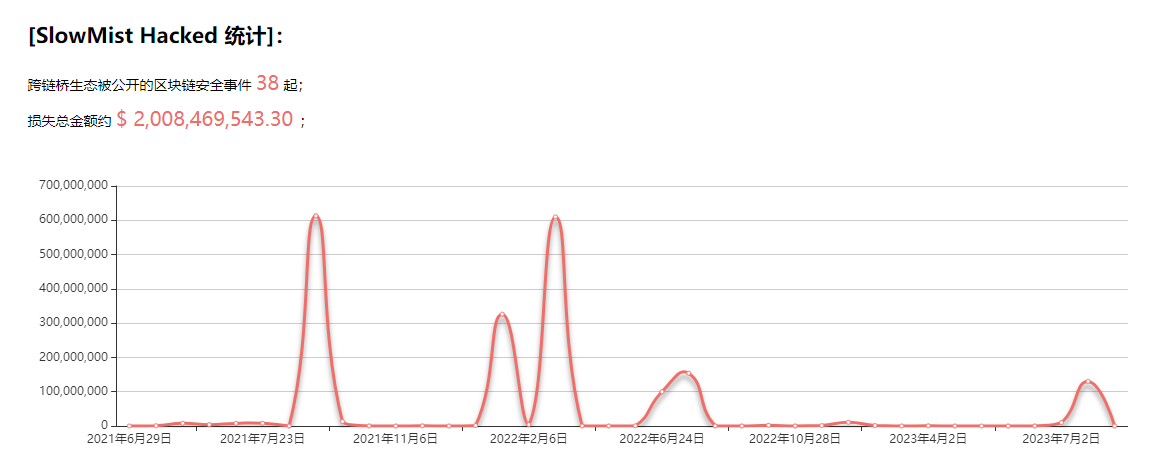
Image Source: hacked.slowmist
The Topic of Oracles
From a macro perspective, the strong financial nature of blockchain makes it a system environment that seeks determinism. Even though narratives about real-world assets (RWA) have been discussed for many years, the reality is that blockchain cannot obtain real-world data outside the chain and can only access on-chain data. This is because the virtual machine (VM) does not allow smart contracts to have network calls. Therefore, the operation of smart contracts must be consistent, and for the outside world, blockchain data is also closed off.
Zooming in to a micro perspective, oracles are an important factor in the DeFi world. While the security of different protocol networks is usually inherited from the underlying smart contract network, their normal operation still depends on oracles. If an oracle for a protocol is attacked or compromised, the entire protocol can be manipulated. Today's DeFi hopes to define itself as "primitives" and hopes to have more teams build products or composite protocols on their foundation. However, in this iterative process, the new DeFi contracts that emerge to support a larger ecosystem will upgrade their operational logic, which brings some external dependencies and generates unpredictable related risks.
After several years of development, the DeFi space has also suffered losses of billions of dollars. For example, in March of this year, the Euler Finance lending protocol was attacked by hackers, resulting in a loss of up to $200 million. The protocol allows users to collateralize and borrow, and the problem occurred in a specific function without proper security checks, allowing users to disrupt the fundamental invariants of the lending market (such as the basic invariant in UniSwap: tokenBalanceX * tokenBalanceY == k). Similarly, derivative protocols that rely on oracles for pricing and lack internal price discovery mechanisms are susceptible to price lag and lack of updates, severely limiting their scale and user experience. This also explains how trader Avraham Eisenberg was able to successfully attack Mango Markets and withdraw $116 million from the cryptocurrency trading platform.
In conclusion, the dark rules of the blockchain forest are generally filled with unknown risks. There is still a long way to go to achieve the vision of the Intent-Centric architecture.
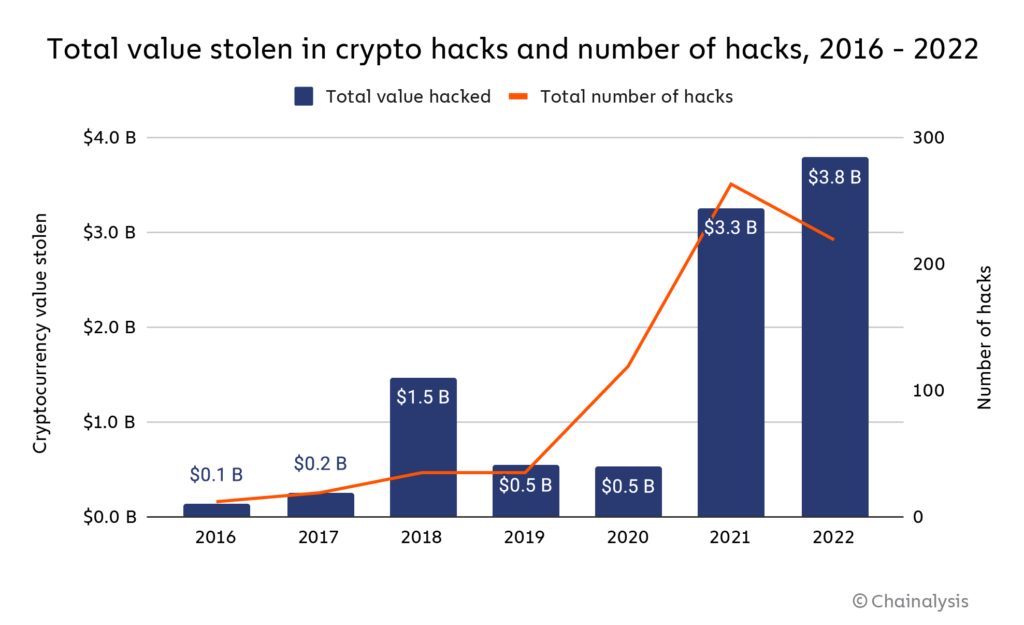
Image Source: Chainalysis
Aggregators and Gas
The direct purpose of aggregators is to save users the trouble of finding the best trading paths and profit strategies, including various types of aggregators such as trade aggregators, information aggregators, yield aggregators, liquidity aggregators, and asset management aggregators. The Intent-Centric architecture requires a certain degree of centralization, and various types of aggregators may provide a "reference answer" to facilitate the execution path in the process of finding intent.
Gas is an indispensable toll for executing various transactions, and optimizing gas fees is a well-discussed topic in the industry. Currently, the overall optimization revolves around product-side, account abstraction wallets, and DeFi protocols. Whether aggregators, account abstraction, and DeFi protocols can be combined to optimize gas from a completely new product perspective remains to be seen.
Wallet Authorization
The first step in Dapps interaction is wallet authorization, bringing our focus back to the transactions themselves. The purpose of the Intent-Centric architecture is to simplify transactions and reduce user barriers. However, each transaction within an intent involves numerous authorization signatures. How to securely and conveniently address the authorization issue is also a consideration. Perhaps account abstraction and the upcoming dappOS V2 mentioned later in this article could provide a good solution.
A General Solution for Implementing Intent
Anoma
Image Source: Anoma Official
Introduction:
According to a report from Coindesk on May 31, 2023, the Anoma Foundation has successfully completed a total investment of $25 million from 14 capital firms, including CMCC Global and Electric Capital. The project's whitepaper, released in August 2022, proposed an architecture for intent: the Intent Gossip Layer for spreading intent, discovering trading partners, and matching execution paths. Its design is the default validation path, and all gossip information is signed by the originating node, forming a signature chain traceable to the initiator. This feature is particularly important for censorship resistance and DoS attacks, making Anoma indispensable when discussing the implementation of Intent-Centric.
Anoma was initially developed based on Tendermint and used a Byzantine Fault Tolerance (BFT) consensus mechanism, then switched to "Typhon," another PoS proof-of-stake consensus mechanism developed by Heliax, to allow consensus partitioning between independent chains. The project team has developed various technologies such as Taiga (an integrated private state transition framework for the Intent Gossip Layer and matching layer), Typhon (cross-chain atomic transaction consensus mechanism), MASP (multi-asset shielded pool), Vamp-IR (arithmetic circuit language), and Juvix (smart contract programming language) to drive experiments in cryptography and distributed systems.
In the context of "programmability of intent" mentioned earlier, to achieve the vision of the Intent-Centric architecture, programmable algorithmic structures and the discovery of trading partners are essential functions. They need to be built on a foundation of multi-interactivity and multi-applications. This leads to the introduction of Anoma, a unified architecture for full-stack decentralized applications, to collectively build a model for decentralized applications.
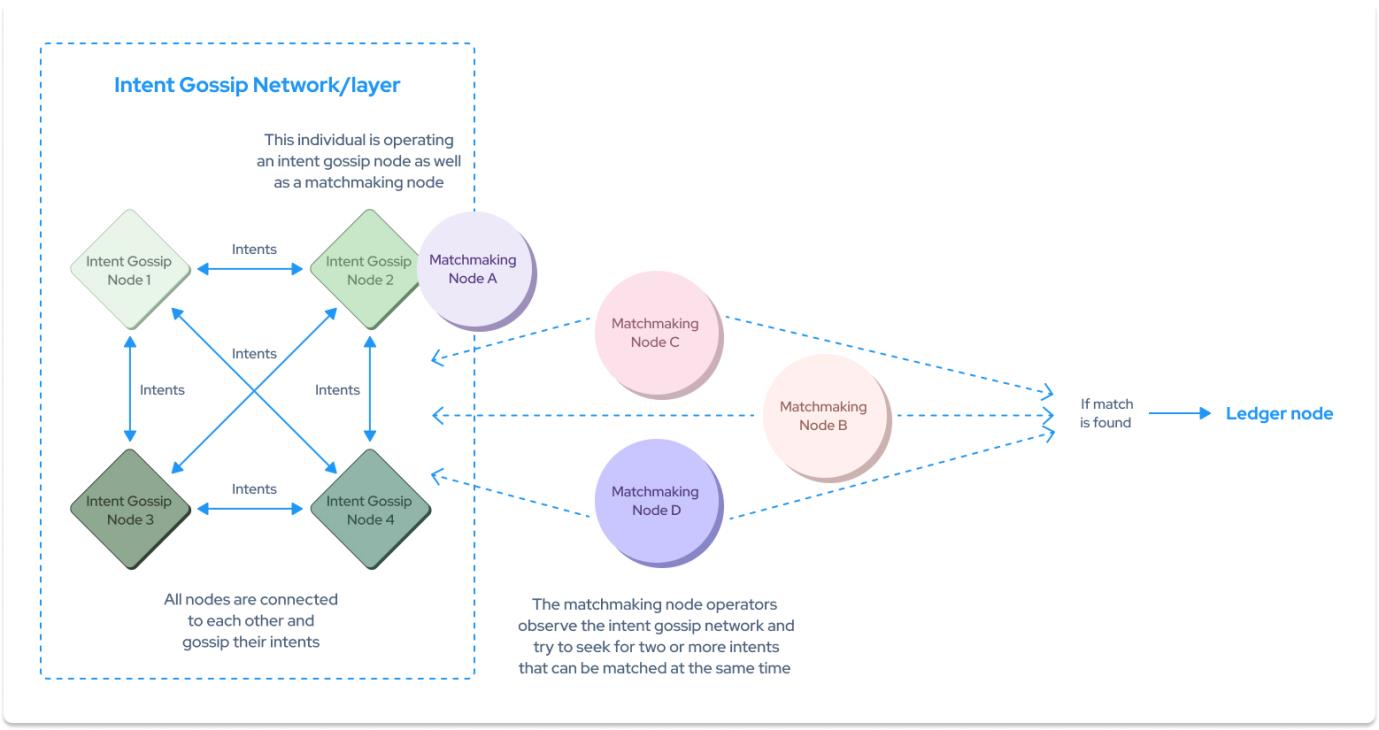
Image Source: Anoma
Design Architecture and Innovations:
- Privacy Payments
To protect user privacy and prevent others from tracing and collecting data, the sender, receiver, amount, and asset denomination are all encrypted. Funds transfer is ensured through zero-knowledge proofs (zk-SNARKs). An innovative aspect is the ability for all assets to share the same shielded pool (MASP) to provide composable asset protection and increase user anonymity, rather than individually shielding each asset. The more participants and assets involved in transfers, the greater the frequency of transfers, significantly increasing the anonymity of asset transfer data.
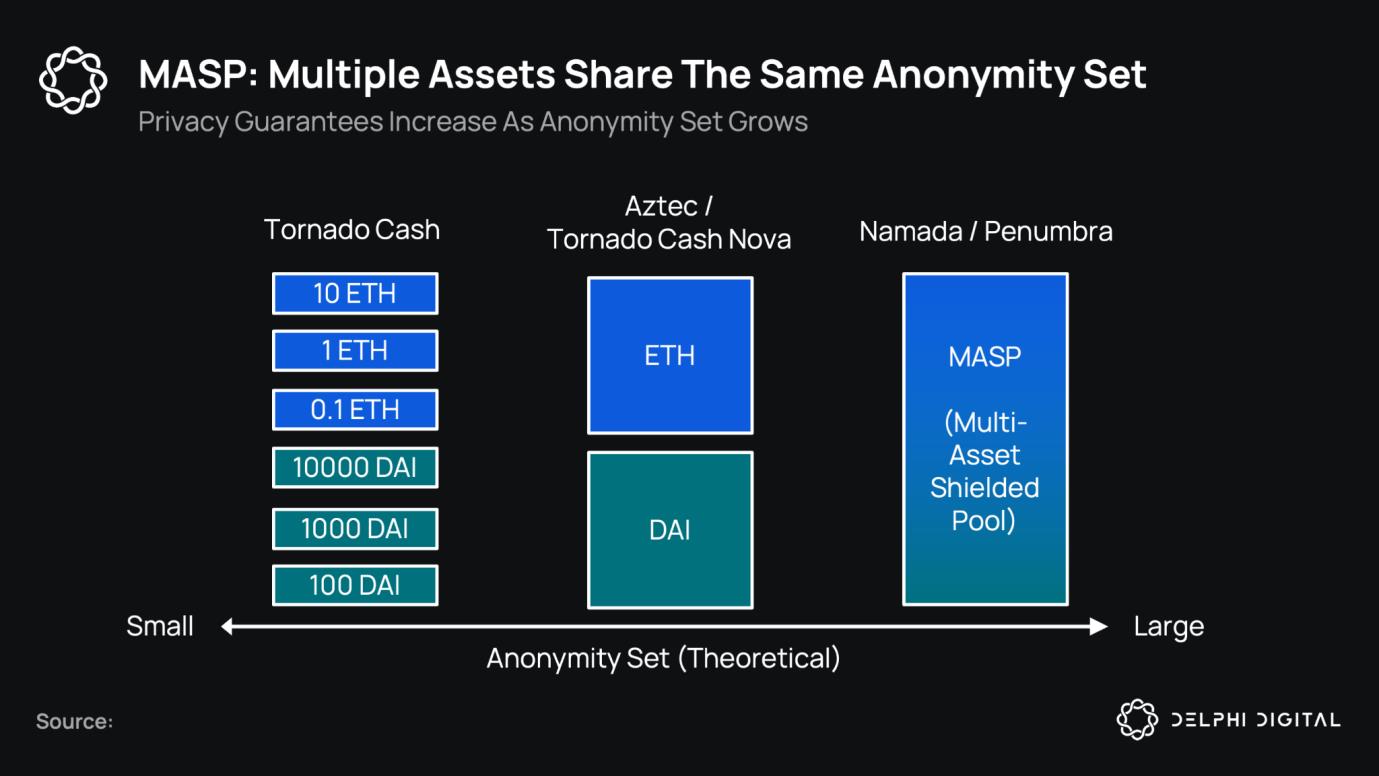
Image Source: Delphi Digital - Delphi Creative
- Barter Trading
The project emphasizes "barter" exchange plans, based on the ancient concept of bartering goods. In simple terms, it involves direct exchange of goods without the need for a medium of exchange and without involving cash payments. Participants must have at least a double coincidence to successfully trade: one, both parties happen to have what the other wants, and two, the transfer of goods is convenient for both parties. This helps users transmit operations to nodes in the Intent Gossip Layer and matching nodes that run checks on whether these intents are compatible, in order to create and match related transactions and send the corresponding execution transaction ledger. Anoma implements a digital barter plan to facilitate the exchange of goods, services, or digital representations of value.
- Intent Matching System
In the Ethereum EVM, transactions do not mandate future states but authorize specific execution paths. Anoma includes a matching system that allows users to broadcast transaction intents through Gossip. In simple terms, Anoma consists of two main parts: a distributed ledger and an intent matching system. They complement each other and can run independently. By using Intent Gossip running nodes, token exchange solvers, and RPC servers requesting new intents, Anoma helps users automatically discover trading partners by submitting matched intents to the distributed ledger.
- Multi-Chain Support
Anoma uses the Inter-Blockchain Communication (IBC) protocol from the Cosmos ecosystem for blockchain communication. IBC uses relayers to achieve data transfer between different blockchains and aims to become a multi-chain privacy layer. While relayers are typically operated by node operators, anyone with the capability can run them and earn fees in the process.
- Fractal Scaling Scalability Solution
Anoma uses a fractal solution to address the scalability issue of blockchain, allowing users to create local instances to meet other transaction needs. Fractal refers to dividing Anoma into different application chains to handle different tasks, allowing each Anoma application chain to be highly customized to achieve scalability and accommodate user growth (similar to supporting the IBC protocol for scalability). Its security will be enhanced in the future by the IV Interchain Security, IV Mesh Security, and IV Interchain Alliance projects.
SUAVE
Introduction:
According to news on July 25, 2023, the Ethereum infrastructure service Flashbots completed a $60 million Series B financing at a valuation of $1 billion for the development of the SUAVE platform. SUAVE (Single Unified Auction for Value Expression) separates the mempool and block generation from existing blockchains to form an independent blockchain network (sorting layer) and provides highly specialized plug-and-play alternatives, aiming to address infrastructure-related challenges related to MEV.
While SUAVE is a new blockchain, it is not a general-purpose smart contract platform that can compete with Ethereum or any other participating chains. If Anoma can be compared to building a blockchain centered around intent, then SUAVE is building infrastructure centered around intent.
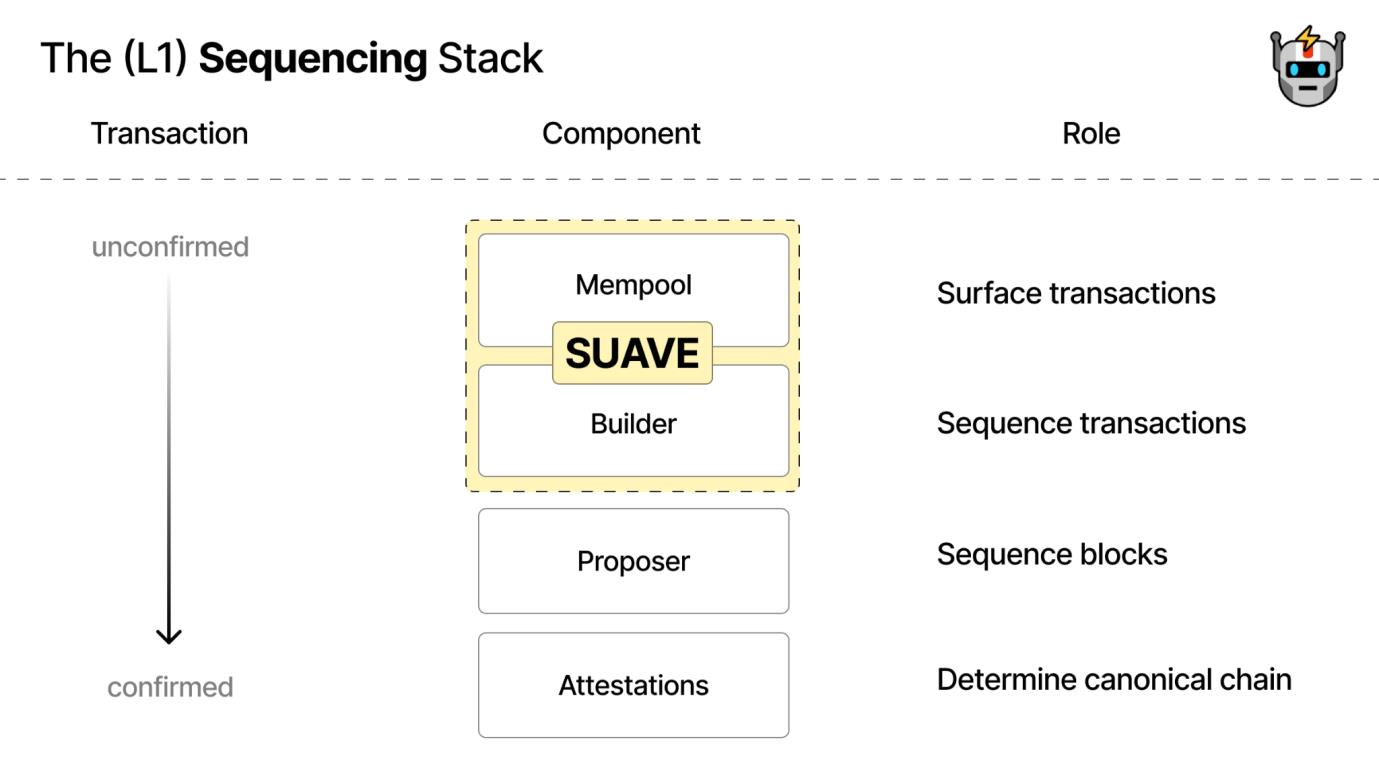
Image Source: SUAVE in the blockchain stack
Three Goals of SUAVE:
Illuminate the Dark Forest: Disclose unfair events in the current opaque MEV ecosystem to every user, quantify their impact, and break down the information barriers between participants.
Democratic Mining: Integrate miners and searchers in an open manner to promote competition among all parties to the maximum extent and make it open to all miners for free to prevent MEV integration and centralization.
Interest Distribution: Give MEV to the people who create it—Ethereum users.
According to the intent solution of SUAVE, when processing transactions from external (e.g., Ethereum), cross-chain settlement is required. It can be used to attempt to address various risks in the EVM, similar to the significant success achieved by MEV decentralized solutions such as MEV-Geth and MEV-Boost. However, it should be noted that users will deposit funds into SUAVE during the intent implementation process, and the smart contracts on SUAVE will need to verify assets, involving oracles in the process of unlocking funds to meet the demand. Therefore, to some extent, SUAVE will also face all the risks of cross-chain bridges today.
From SCW and AA to SUAVE and Intent-centric:
Reviewing the "Account Abstraction AA" section mentioned earlier, let's reconsider the main functions brought by account abstraction: private key recovery, gas-free payments, multi-signature authorization, multiple transfers in a single transaction, fee limits, etc. In general, account abstraction perfectly combines the advantages of regular accounts (EOA) and smart contract accounts (CA).
The vision of SUAVE is to become a common sorting layer between various different chains (including cross-chain transactions and MEV). Therefore, if a user's intent involves cross-chain asset transfers, account abstraction (AA) and multi-signature smart contract accounts like Gonsis Safe (SCW) can combine the advantages of both sides. When combined with SUAVE's EVM solution, it may be the currently theoretically superior solution.
CoWSwap

Image Source: CoW Protocol
Introduction:
If we were to choose the project closest to the Intent-Centric architecture, CoWSwap would definitely be at the top of the list. Unlike other protocols, the CoWSwap protocol only requires users to send a signed order, delegating the execution of the transaction to the resolver network and completing the transaction within that network (without specifying an execution path). Meanwhile, off-chain signed orders are executed after being matched by the resolver (similar but different from the Bob Solver mentioned earlier). Due to the resolver's "batch bundling" authority, the gas fees during the process will be borne by the resolver, and there is no need to pay for failed transactions.
CoWSwap Hooks:
When talking about Hooks, does it remind us of Uniswap V4? However, the actual usage functions of the two are completely different. CoW Hooks link transactions, bridging, staking, and deposits together, and can execute transaction sequencing in a single transaction.
Main Functions:
Pre-hooks can be used to "set" conditions for orders. For example, executing the code required to verify on-chain signatures or setting the required approvals through EIP-2612 permits.
Post-hooks are executed after the exchange occurs and the receiving address receives the funds. Post-hooks provide the opportunity to immediately use the funds, including through staking, providing liquidity, bridging tokens to L2, etc.
DeFi Examples of CoW Hooks:
Debt repayment and staking: Set pre-hook operations to repay debts and liquidate, then use CoWSwap to exchange assets, and finally use post-hook operations to deposit new assets into the collateral pool.
Creating LP positions: Transactions using only pre-hooks or only post-hooks.
JIT (just-in-time) smart orders: Program Safe smart contract wallets through the composable CoW framework (ERC-1271) to execute custom smart contract approvals and exchanges.
NFT: Selling or buying NFTs can be done within the CoW Hooks functionality.
Cross-chain: Assets can be sent to bridging contracts through CoW Hooks to complete cross-chain transactions.
Airdrops: Airdrops can be sold using CoW Hooks without using ETH as gas.
Unlocking and restaking: If staking 32 Ethereum as a validator, it can be unstaked to claim rewards, and assets can be restaked on other chains through CoW Hooks.
Automatic LP position increase: Assuming becoming a liquidity provider in the EUR - USDC pool on the Gnosis chain to receive GNO Token rewards. CoW Hooks can automatically convert your GNO to EUR - USDC in a 50/50 ratio through CoWSwap to automatically increase the LP position.
dappOS V2
After discussing the intent layer and related infrastructure layer, let's explore the dappOS V2 protocol, which is hailed as the "new wave of the intent layer." On July 21, 2023, dappOS V2, valued at up to $50 million, completed a seed round of financing led by IDG Capital and Sequoia Capital (China), and also attracted attention from other major VC firms and Binance.
dappOS V2 is an intent protocol, with dappOS accounts and dappOS networks aiming to simplify user interaction with dApps to achieve a user experience at the level of CeFi. At the same time, it eliminates the fragmentation barriers brought by multiple chains through "Chain Abstraction" technology (similar to but different from account abstraction).
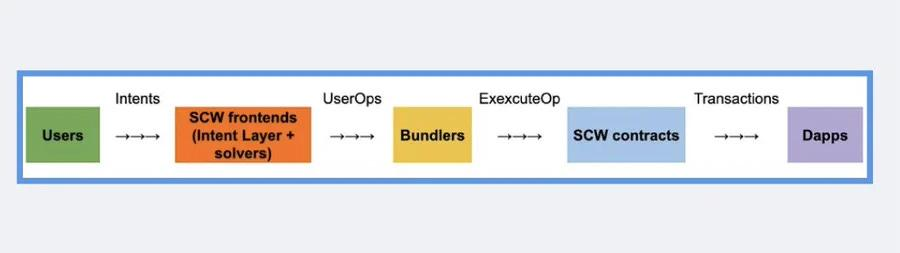
Image Source: Intent-Centric A Narrative worth keeping an eye
Whether it is intent-oriented or transaction-oriented, the user's focus is always on the total amount of funds in the account, rather than the balance of individual assets between different chains. According to dappOS V2's understanding, there should be a unified account wallet to achieve the vision of "one signature completes everything." It introduces the design concept of one-click multiple "TXN (transaction)" to remove barriers for users before completing TXNs, achieving the user's intent-oriented transaction purpose.
For example, using it to interact with GMX between different chains such as Arbitrum and Avalanche without holding assets, to achieve the future DeFi's fundamental transaction rule centered around intent. Therefore, implementing the concept of being intent-centric requires involvement of chain abstraction, account abstraction, and more "protocol abstraction." However, it is worth considering a question: if various abstractions are implemented, will the interaction rules for users and the airdrop rules for various projects change accordingly?
Conclusion:
Intent is still full of risks and challenges in its execution, as it relies on intermediaries or specific executors, leading to the risk of centralization and monopolization of rights, thereby affecting the trust issue of the entire middleware. Secondly, the security and privacy risks brought by handing over transactions to third-party executors are also worth considering. Whether application developers of Intent can achieve a balance in security, privacy, and convenience is also highly anticipated.
The concept of Intent has mature applications in the Web2 domain, such as ride-hailing apps, ticketing apps, and map navigation. However, the success of these applications is based on the soundness of the Web2 infrastructure. Mature application scenarios in the Web3 domain still require the continuous maturity of the industry. Intent-Centric is a grand concept that involves all aspects of blockchain and is also one of the best paths for blockchain combined with AI. However, whether it can be implemented and developed and flourish still requires our continuous attention.
References and cited articles
- https://www.paradigm.xyz/2023/06/intents
- https://mirror.xyz/0x7333aB7AE068Ef92fb77A2bcab32FA273c45185c/ozUKb4RdhqB4ya49uw_OfMHILiZpDBV99eosD9gfumU
- https://www.alchemy.com/overviews/what-is-a-mempool
- https://writings.flashbots.net/the-future-of-mev-is-suave/#iv-suave-in-the-blockchain-stack
免责声明:本文章仅代表作者个人观点,不代表本平台的立场和观点。本文章仅供信息分享,不构成对任何人的任何投资建议。用户与作者之间的任何争议,与本平台无关。如网页中刊载的文章或图片涉及侵权,请提供相关的权利证明和身份证明发送邮件到support@aicoin.com,本平台相关工作人员将会进行核查。


