Xiao Feng stated that the policy goal of the Hong Kong International Virtual Asset Center is not to establish a speculative trading market, but to use tokenization services to support the real economy, promote technological innovation, and upgrade the financial center.
Speech: Xiao Feng, Chairman of Wanxiang Blockchain
On September 20th, the two-day 9th Global Blockchain Summit came to a successful conclusion. Xiao Feng, Chairman of Wanxiang Blockchain, delivered the closing speech titled "Web3.0 and the Virtual Asset Policy Declaration of the Hong Kong Special Administrative Region" at the event. The following is a summary based on on-site notes from the event, with minor deletions that do not affect the original meaning.
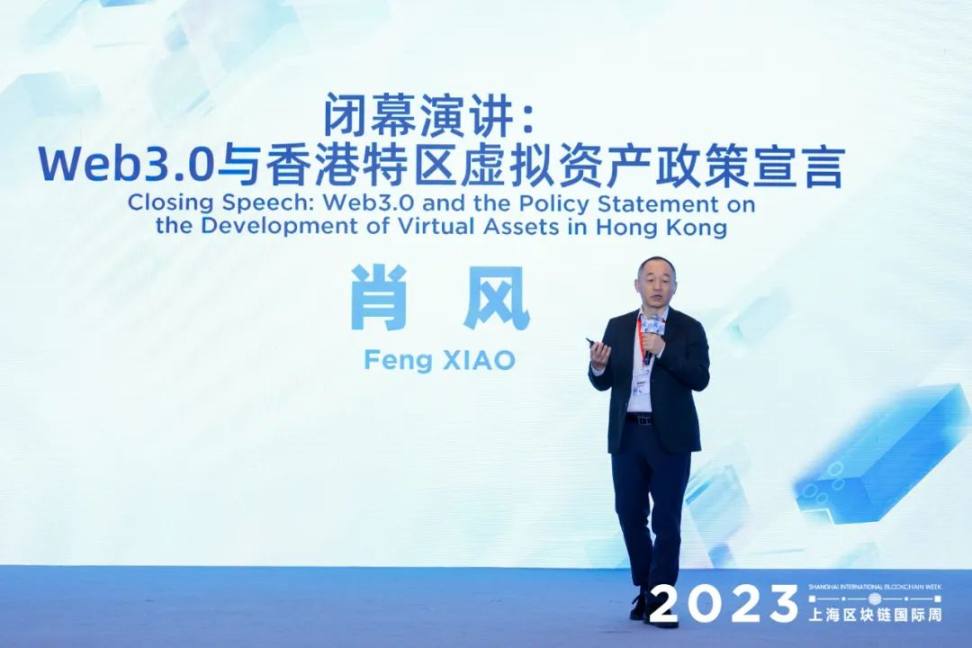
Many people have been interested in the virtual asset declaration of the Hong Kong Special Administrative Region government recently. I will share my views on the virtual asset declaration announced by the Hong Kong SAR government from the perspective of the market and practitioners, and discuss why this declaration was made and what its intended goals are.
Why does the SAR government have a series of virtual asset policy declarations? To explain its origins, we need to start with the digital economy. The basis of this series of declarations is that Hong Kong wants to build a complete set of services to support the deep cultivation, landing, and development of the digital economy in Hong Kong. What are the characteristics of the digital economy?
First, the digital economy is not constrained by geographical space.
Because it is not constrained by geographical space, Hong Kong has the opportunity to leverage its unique advantages of "one country, two systems," common law, and free port in the digital economy. Some say, "Hong Kong missed the Internet, but must not miss blockchain." In fact, Hong Kong did not miss the stage of the Internet, because the Internet is related to geographical space, jurisdiction, and the location of users. However, Web3.0 or blockchain is not closely related to geography, so Hong Kong did not miss the Internet era, but can have the Web3.0 era or blockchain era. Moreover, in this era, Hong Kong has unique advantages, which are the advantages of a free port.
What are the advantages of a free port? It means that capital can flow freely. The inflow and outflow of fiat currency is both a barrier to large-scale application and a necessary prerequisite for large-scale application.
On the other hand, common law in Hong Kong can play a good role in the institutional, mechanistic, and legal aspects of Web3.0, blockchain, and virtual assets, while avoiding geographical constraints.
Second, the digital economy is not constrained by physical rules.
For example, in the metaverse, building a structure or a city is not constrained by the rules of mechanics. Do you need to calculate its structural weight? No need.
Third, the digital economy is not constrained by business organizations.
Digital technology gives individuals tremendous capabilities, allowing individuals to do many things without relying on a specific business organization. For example, you can work for yourself without relying on an organization.
In addition to these characteristics, the value law of the digital economy is completely different. The value law of the digital economy is high fixed costs, low marginal costs, and even zero marginal costs. Developing software requires high fixed costs and huge investments. For example, developing GPT-4 cost OpenAI tens of billions or even hundreds of billions of dollars. In the future, upgrading to GPT-5 or GPT-6 will also require tens of billions or even hundreds of billions of dollars in investment. This is a high fixed cost. However, after GPT-4 is developed, the marginal cost of serving 100 million users and 1 billion users is almost negligible. This is a value law that industrial products and industrial economies do not possess.
Under this value law, the maximization path of the value of a digital product and service is open, free, permissionless, and even free, because only in this way can it be maximally promoted and used by others. In a cost and service with zero marginal cost, serving 100 million people and serving 1 billion people does not increase the cost. In this case, ownership seems less important, and usage rights, which allow more people to use it, seem more important. Therefore, the digital economy can be said to be an economy of usage rights to some extent.
In an economy of usage rights, how can the value of an open, free, permissionless, and even free product and service be captured? The tool for capturing the value of usage rights is a token. In computer language, a token is a usage license. In the blockchain era, it has evolved into a standardized usage right. Taking the fax machine effect as an example, let's assume that a fax machine network consists of 1 million fax machines. Does any user need permission from others to join the fax machine network? Not really, but they need to buy a fax machine first. If you don't buy a fax machine, you cannot join the fax machine network. By purchasing a fax machine, you also purchase the usage license to join the fax machine network. Just like needing to buy a bitcoin before being able to join the bitcoin network, or needing to have an Ethereum to use the Ethereum network. In this case, the fax machine, bitcoin, and Ethereum are all usage licenses. When using this network and enjoying its value, you must have a token and a license. The difference between the fax machine network and bitcoin or Ethereum is simply that one is digital and the other has a physical structure.
The fax machine network does not belong to the people who buy fax machines and join the network, just like Ethereum. Holding ETH does not mean owning the rights to the Ethereum network; you only have the usage rights or usage license. Therefore, the usage rights effect of the fax machine has given birth to a new capital system—the stakeholder capital system. Everyone is a user, and no one owns the network.
At the same time, the fax machine network has a third characteristic: any new user added to the existing users using the fax machine network will bring value and benefits. Because the more people join the fax machine network, other fax machine users have more possibilities to send faxes, and obviously the value is growing. This is the greatest charm of the fax machine effect or usage rights effect—the more people use it, the better for everyone. If it were an ownership structure, owning a share of a company means it is yours, and others cannot claim to own it. Usage rights can be infinitely granted, and the more they are granted, the greater the value, but ownership is not like this.
Based on these three characteristics, we can view the past decade of blockchain practice as a stage of infrastructure construction. At the same time, we can also view it as spending ten years to build a set of financial infrastructure for the digital native and digital twin economy with the above characteristics. According to the three characteristics of the digital economy summarized above, traditional financial infrastructure cannot serve it well. The practice of the past decade was to build a set of financial infrastructure that can serve the new economic model of the digital native and digital twin well.
In the new financial infrastructure, there are several key elements.
First, a new method of accounting.
The most important feature of the new method of accounting is that it is an open, transparent, and global public ledger. Before this, all methods of accounting were private ledgers, where individuals kept accounts for themselves. My account cannot be known to others, and cannot be accessed by others. However, anything on the blockchain is open and transparent to the entire network. Anything built on a public ledger is part of a global ledger system. Once logged into the global ledger system, anyone in the world can view, touch, and trade it. This is a characteristic that traditional financial markets do not possess. The assets of traditional financial markets are registered on private ledgers. If they are not open to you, you cannot view, purchase, invest, or trade them.
Second, a new account system.
Traditional finance is built on the banking account system, and all funds must be stored in the banking account system. With the emergence of internet platforms, a new generation of internet accounts, such as Alipay and WeChat Pay wallets, has appeared, which are not accounts established by banks, nor managed by banks, but managed by internet platforms, and they also hold fiat currency. The revolutionary change comes from blockchain, and digital wallets on the blockchain have various forms of presentation, but for alignment with the above, we call it a blockchain account. The blockchain account system is completely detached from the traditional financial system, and even more detached from the banking account system and the internet account system. The currency running in the blockchain account system is no longer fiat currency, but USDT and USDC, and in the future, it can also be central bank digital currency (CBDC). However, if this currency cannot be digitized and run on smart contracts, it cannot be compatible with the blockchain account.
Third, new settlement methods.
Another change is that the settlement method of this new financial infrastructure has undergone a huge change, where transaction confirmation and clearing settlement are completed synchronously. Transactions are conducted peer-to-peer, and payments are also made peer-to-peer. This new settlement method has already been accepted by traditional banks, at least from the United States, Singapore to Hong Kong. Recently, traditional banks have issued RWAs, which are the tokenization of real assets. Why tokenize real-world assets? It has a very good advantage—greatly improved clearing and settlement efficiency, and significantly reduced transaction costs and transaction links. In addition, the form of currency running in this financial system has also undergone major changes, as it can now be digital currency.
I classify digital currencies into three categories. The first category is central bank digital currency (CBDC), which is issued by the central bank and is the base currency. Base currency needs to go through the currency creation of market institutions to create currency leverage or money multiplier, in order to better serve the real economy. Therefore, stablecoins have emerged, which are digital currencies issued by institutions. In the traditional financial market, banks are the main creators of currency, currency leverage, and money multiplier. Stablecoins issued by institutions are called M2, which is the same as M2 in the real financial market. It is currency created through leverage by market institutions such as banks, and is no longer currency issued by the central bank, but currency created by banks.
In Hong Kong, if you take a banknote, it has a "payable on demand" clause, which is a promissory note and belongs to M2. In the new financial infrastructure, there is also a native digital currency, which is Bitcoin. The form of Bitcoin is still evolving, and it has not yet evolved into a complete form, and its functionality is still being improved.
Another change is the emergence of a new asset category, which is tokens. We divide homogeneous tokens into two major categories: utility tokens and security tokens. There has been a lot of discussion about STO and RWA in the past few days. In my personal opinion, 70% to 80% of the digital assets in the future will be utility tokens, rather than security tokens under the concept of STO. The U.S. Congress has about seven or eight legislations related to blockchain, Web3.0, and digital assets, and everyone's advocacy and viewpoints are different, leading to significant debates. There are laws from the Senate, laws from the House of Representatives, laws mainly from the Democratic Party, and laws mainly from the Republican Party, and their viewpoints are all different. However, they have reached a consensus to transfer the main regulatory authority to the Commodity Futures Trading Commission (CFTC) rather than the Securities and Exchange Commission (SEC). This means that at least 70% to 80% of tokens are virtual commodities, regulated by the Commodity Futures Trading Commission (CFTC). This also indicates that most things in digital assets are still utility tokens, and it is very important to design their compliant boundaries.
In this new financial infrastructure, there is a new token tool called NFT, the so-called non-fungible token. NFT is a digital token used to prove the identity, qualifications, and work of all digital, virtual, invisible, and intangible things. There are several other issues that need to be clarified:
First is STO.
In the view of the regulatory authorities in Hong Kong, STO is divided into two categories. The first category is security tokens or equity tokens, which tokenize the equity of a company, no longer through an IPO, but through STO. The second category is RWA, which may be an issuance of a collective investment scheme, because RWA involves interest payments, and interest payments make it a security. Both of these categories fall under the scope of STO in Hong Kong.
STO must be issued on the blockchain, and it is best to be issued on a global public ledger, because in this way, whether it is a security token or RWA, it becomes an asset issued, registered, and circulated on a global public ledger, thereby gaining support from global liquidity, rather than support from a specific region's liquidity. Looking back at the depth and breadth of the financial market at this time, it is no longer supported by the depth and breadth of the financial market of a specific region.
The second is stablecoins.
I believe that stablecoins are very important for any market. Because stablecoins are not only a trading tool for exchanges, but also a bridge connecting the "real world and the virtual world," "the real economy and the digital economy," and "private ledgers and public ledgers." The so-called private ledger is the ledger of each financial institution, and the so-called public ledger is the blockchain. Therefore, stablecoins also serve as a bridge connecting bank accounts and blockchain accounts, meaning that stablecoins bridge the fiat currency in bank accounts to digital currency. They also serve as a bridge connecting "CeFi and DeFi," "fiat currency and digital currency," and "non-programmable currency and programmable currency." So its importance cannot be overstated. In any region, there is a stablecoin anchored to its own currency, such as a stablecoin based on the Hong Kong dollar. It is unimaginable if there is none.
RWA is a direction that we have observed various regulatory authorities in different countries strongly promoting. By tokenizing real assets, bank assets, and assets with cash flow, they obtain support from the global liquidity market. To obtain global liquidity support, it must be issued based on a global public ledger, and it is unlikely to be done on a private chain or private ledger.
More than 80% of the market share of RWA is not the audience of centralized exchanges, but the market between institutions and banks, and it is a tokenized market traded between institutions. This is similar to almost all stock exchanges in the world, which have tried to establish a centralized and standardized bond market, but no stock exchange has succeeded. Because fixed-income products such as RWA or similar bond markets are not suitable for standard centralized trading, they should be traded peer-to-peer. Even if buying and selling the same bond, the credit of the counterparty, payment conditions, and the size of the purchase quantity will result in different quotes. There is no way to match trades using machines in a system, so it is not suitable for trading on an exchange.
After explaining this, we understand the significance and scientific nature of the virtual asset policy declaration made by the Hong Kong SAR government, and why it is doing this. The policy goal of the Hong Kong International Virtual Asset Center is not just to establish a speculative trading market for virtual assets, but its goal is much greater than that. They hope to find a path to support the real economy, promote technological innovation, and further upgrade the financial center through tokenization, blockchain, Web3.0, and virtual assets. This cannot be limited to the secondary market, meaning it cannot only be a virtual asset exchange.
The Hong Kong International Virtual Asset Center is constructed with a four-tier structure, and only with these four tiers is it a complete financial system.
The first layer needs to have an active secondary market with active trading. Above the active trading, there needs to be a primary market that can issue new digital assets or virtual assets, supporting the real economy and technological innovation, thus building a new and more advanced version of the financial market. Without such a market, the value of Hong Kong's virtual asset declaration will be greatly discounted. With an effective trading market and issuance market, the third layer of the International Virtual Asset Center is centralized industry services. Because serving issuance and trading requires the participation of many institutions and practitioners, a new virtual asset industry will be formed. What does this industry address? First, it solves employment; second, it provides tax revenue. But this industry is far more than that, because with the previous three-layer architecture, the industrial ecology of Web3.0 will also land in such cities. We have observed many Web3.0 entrepreneurial projects seeking to land in Hong Kong Cyberport or Hong Kong Science Park, because there is the core foundation of the ecosystem—a primary market and a secondary market. Blockchain or Web3.0 entrepreneurs may be gaming experts, but not necessarily blockchain experts, so third-party technical support is needed on the chain, a good economic model is needed to support business logic, to support Web3.0 logic, and professional knowledge and talent are needed to support it, thus a modern industry is formed in this way. This is its four-layer structure.
With this foundation, we have already seen the emergence of Hong Kong International Financial Center 2.0. One of the core pillars of Hong Kong International Financial Center 1.0 was the Hong Kong stock market. The Hong Kong International Financial Center relied on two central pillars, one for international trade and international shipping financing, but this pillar has obviously been somewhat impacted in the past few years due to reasons such as the pandemic. After a decline in trade, shipping will also decline. The decline in trade and shipping has gradually weakened Hong Kong as one of the pillars of the international financial center, meaning the number of banks providing trade financing and shipping financing services will decrease, and their importance will also decrease.
The foundation of the Hong Kong stock market is shareholder capitalism, but on the basis of shareholder capitalism, we use the corporate system to fix the rights of all shareholders. Therefore, shareholder capitalism or the stock market is an ownership market, where ownership is tokenized and standardized into stocks and traded on stock exchanges, which is the 1.0 version of the Hong Kong International Financial Center, and it will always exist, and the corporate system will also always exist.
However, the change brought about by the emerging digital economy is a change in the foundation of the system, from Shareholder to Stakeholder, from shareholder capitalism to stakeholder capitalism. On the basis of stakeholder capitalism, the method of using the corporate system to fix and determine the rights of everyone may not necessarily be used. Since it is a stakeholder, the organizational structure of non-profit organizations and open-source organizations can be used. In non-profit organizations and open-source organizations, the system of use is actually used, tokenizing and standardizing the right to use, i.e., utility tokens. Therefore, the 2.0 version of the Hong Kong International Financial Center establishes a tokenized virtual asset market.
Therefore, the policy declaration of virtual assets by the Hong Kong SAR government is related to the status of the Hong Kong International Financial Center, the upgrade of Hong Kong's service to the mainland, and more importantly, the transformation of Hong Kong's economy and the upgrade of the city. It is not just a matter of the financial market, nor is it just about establishing an exchange and obtaining an exchange license; this is just one of its values. Five years from now, we may even find that this is not the most important value.
免责声明:本文章仅代表作者个人观点,不代表本平台的立场和观点。本文章仅供信息分享,不构成对任何人的任何投资建议。用户与作者之间的任何争议,与本平台无关。如网页中刊载的文章或图片涉及侵权,请提供相关的权利证明和身份证明发送邮件到support@aicoin.com,本平台相关工作人员将会进行核查。


