Source: Hard AI
Author: Wang Mei

Image source: Generated by Unbounded AI
After the explosion, can AI create brilliance again?
Recently, Elad Gil, known as the "startup mentor" of Silicon Valley, published a blog post titled "Early AI Era (and AI Hype Cycle)", pointing out that we are still in the early stage of AI development, and the peak of AI usage and AI hype is still far away.
Gil said that AI is a new function and a step function for the introduction of new products, marking the arrival of a new technological era, rather than a continuation of CNN/RNN/GAN.
This is like when the airplane was just invented, some people looked at the airplane and said, "This is just another winged car," completely unable to see the extensive impact of the airplane on travel, logistics, national defense, and various industries—what is coming is the "aviation era," not the "faster car era."
Gil believes that the AI wave will go through at least four stages:
① GenAI native companies → ② Early AI startups, some large companies → ③ Next wave of startups currently being established → ④ Wave of large company applications
Gil is a well-known angel investor and a serial entrepreneur. He joined Google when it had only over a thousand employees, and when he left, Google had over fifteen thousand employees. During his four years at Google, he created the mobile team, was the original product manager for important products, and was involved in all aspects of team startup construction and three important acquisitions.
Gil also helped Twitter grow from a small company with only about 90 people to an industry giant with over 2500 employees. During his tenure as Twitter's VP of Strategy, he participated in the comprehensive work of enterprise scaling, including products, platforms, internationalization, user growth, mergers and acquisitions, recruitment, organizational processes, and more. Even after leaving, he became a CEO and COO advisor, providing business advice to Twitter.
Later, entering the investment field, Gil also had a keen eye. About 25 of the companies he invested in have grown into so-called "unicorns," and beyond that, the companies he participated in investing in, such as Airbnb, Wish, Coinbase, PagerDuty, Square, and Pinterest, have all successfully gone public.
The following is the translated part of the blog, enjoy~ ✌️
I worked on early machine learning (ML) systems and product development at Google and Twitter (after Twitter acquired my co-founded company, location-based technology developer Mixer Labs). For the next decade, I have been a founder and executive of machine learning companies and have been investing.
Before the rise of new artificial intelligence architectures (especially methods based on Transformers and diffusion models), almost all machine learning startups failed.
In the previous AI wave, the value mainly flowed to established companies, not startups—because their capabilities were not advanced enough to create new market opportunities.
This is a PPT I used around 2017-2019 (borrowed from Brandon Ballinger)—this PPT reflects the previous machine learning wave of the CNN (convolutional neural network)/RNN (recurrent neural network)/GAN (generative adversarial network) world.
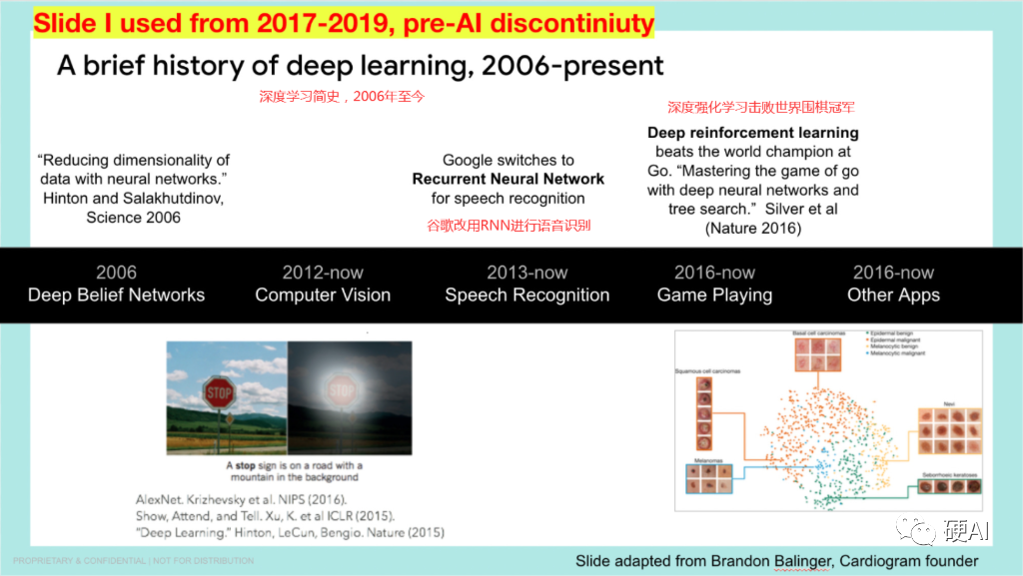
Today, when many business people talk about "artificial intelligence (AI)," they see it as a continuation of CNN/RNN/GAN. In fact, it is a step function for the introduction of new functions and new products, marking the arrival of a new technological era.
This is like when the airplane already existed, and someone invented the airplane and said, "The airplane is just another winged car," without mentioning all the new use cases and the impact on travel, logistics, national defense, and other fields. What is about to unfold is the "aviation era," not the "faster car era."
(Of course, we should fully recognize the importance of the previous machine learning and deep learning waves—however, treating it as a continuous continuation may overlook the qualitative change of this technology).
This is the PPT I use now:
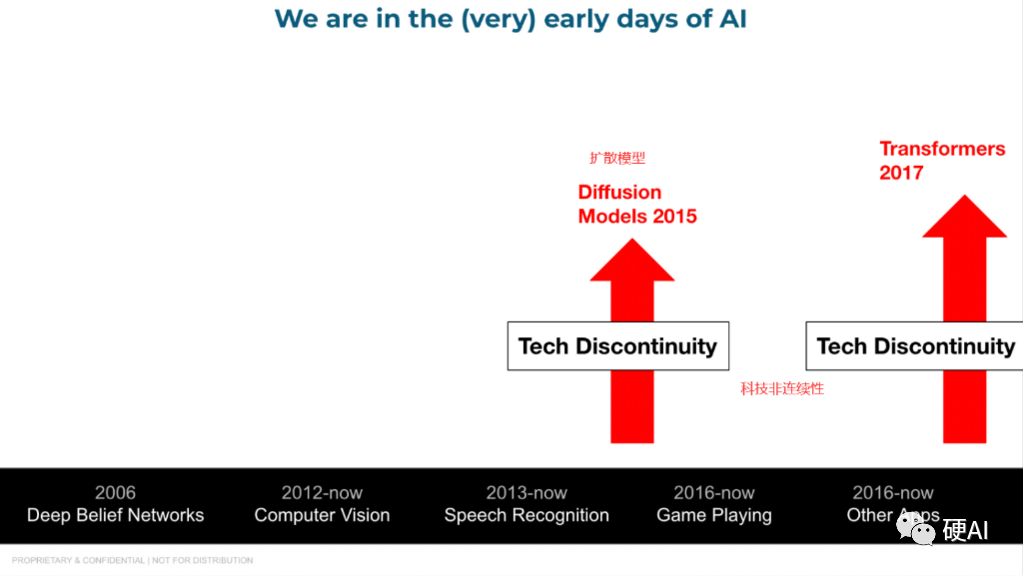
In June 2020, the launch of GPT-3 signaled some interesting things happening. GPT-3 is a huge leap forward from GPT-2 and previous models. It is still not enough to do everything we now consider "AI," but it highly suggests what is about to happen (a few months later, I talked about GPT-3 on the A16Z podcast because it was very eye-catching).
For those in the know, the launch of GPT-3.5 in March 2022 consolidated the view that Transformer-based models are the future trend. Inside companies like Google, OpenAI, Microsoft, and Anthropic, early exposure to models has given some people a preliminary understanding of the future to come. A Google engineer eventually announced that an internal AI chatbot named LaMDA was "perceptive"—this chatbot is the predecessor of products like chatGPT and Character.AI.
The real starting gun for this AI wave was driven by two groups of releases.
First, the launch of image generation products such as Midjourney and Stable Diffusion. Several months later, the launch of ChatGPT shocked the world, sparked public imagination, and became a big explosion moment for AI startups. ChatGPT truly demonstrated the capabilities of these new types of artificial intelligence and the power of RLHF (reinforcement learning based on human feedback).
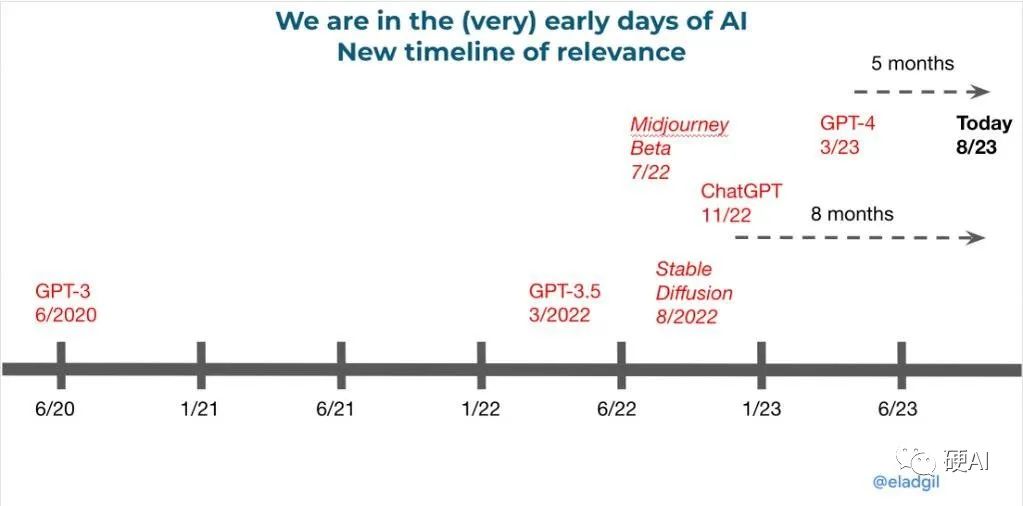
The launch of ChatGPT fired the first shot, making people realize the significant importance of AI in new functionalities and sparked the craze for generative AI. This release was 8-9 months ago, while GPT-4 was not introduced until 5 months ago.
Considering that large companies' planning cycles usually take 3-6 months, and the prototype design and construction of large companies take a year, we are still far from the peak of AI usage or the peak of AI hype. Most large companies are still trying to analyze what "artificial intelligence" means for them, and there is still a long way to go before accepting this new technology.
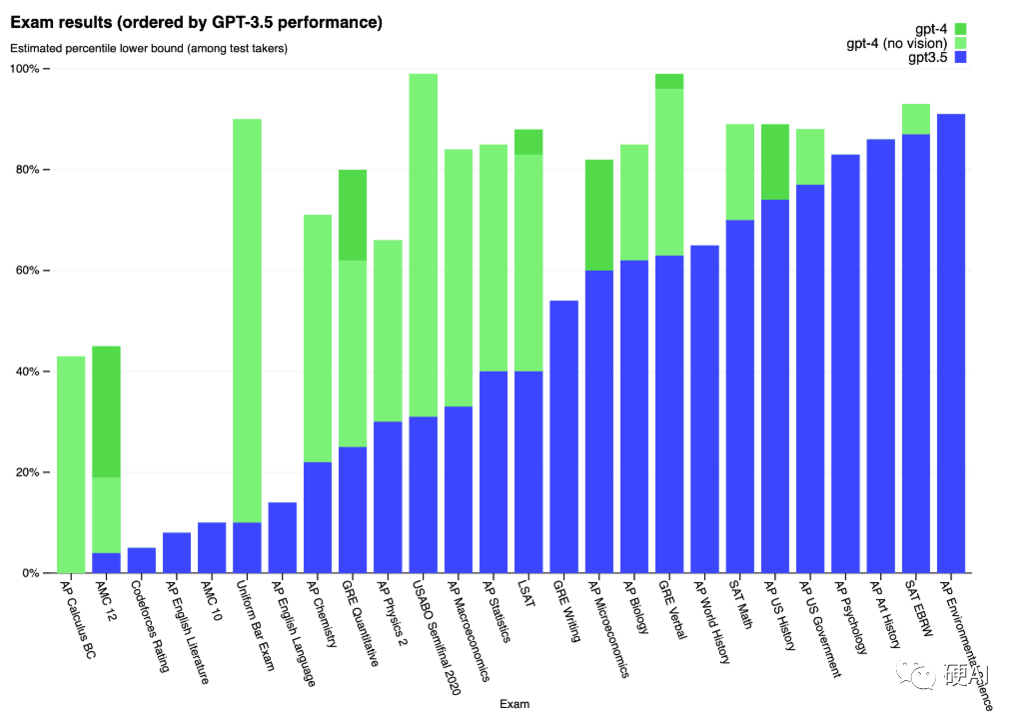
In fact, there may be at least four waves of artificial intelligence:
Wave 1: GenAI native companies.
ChatGPT, Midjourney, Character.AI, Stable Diffusion, Github copilot, and other early products have now gained considerable revenue and user appeal. Clearly, there are some great machine learning companies that are earlier than GenAI continuing to participate in the current era (Hugging Face, Runway, Scale, and WandB are a few I can think of).
Wave 2 (current stage): Early startup adopters and existing companies in the fast mid-market.
This is the first wave of startups launched on top of GPT-3.5/4, such as Perplexity, Langchain, Harvey, etc. At the same time, a few founder-led multi-billion-dollar companies such as Navan, Notion, Quora, Replit, and Zapier quickly launched AI-driven products, becoming early adopters of this wave. Microsoft, Adobe, and Google are notable outliers, as large companies are rapidly turning to AI—Microsoft may be due to its internal connection with OpenAI, and Adobe, as diffusion models are often cheaper and easier to train than large language models.
Wave 3 (coming soon): Next wave of startups being established.
In addition to using natural language in more ways, it may also include new formats such as voice and video, as well as new infrastructure, which will be exciting. Companies like Eleven Labs/LMNT/LFG Labs and Braintrust will provide a progressive experience. A large wave of new startups is coming, with just the current YC investment batch seeming to have 100 or more.
Wave 4 (coming in 2024/2025?): First wave of large company adopters.
Due to the long planning and construction cycles of enterprises, it is expected that the first real products (compared to PPT demonstrations or prototypes) will appear in large companies outside of Microsoft, Adobe, Google, and Meta in one or two years. By then, the revenue of AI infrastructure companies will start to grow significantly, the hype will reach its peak, and we will see further acceleration of investment in artificial intelligence.
The future is bright.
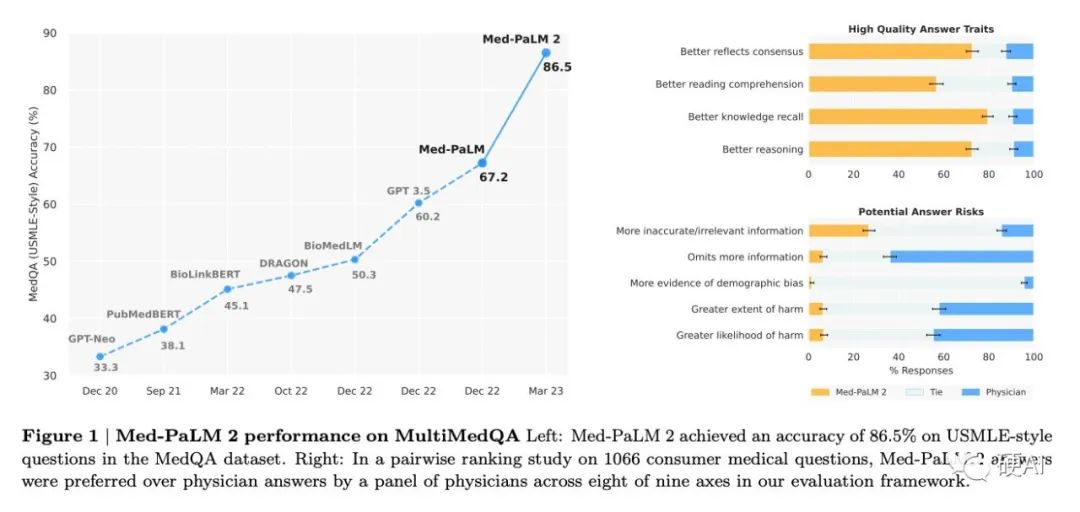
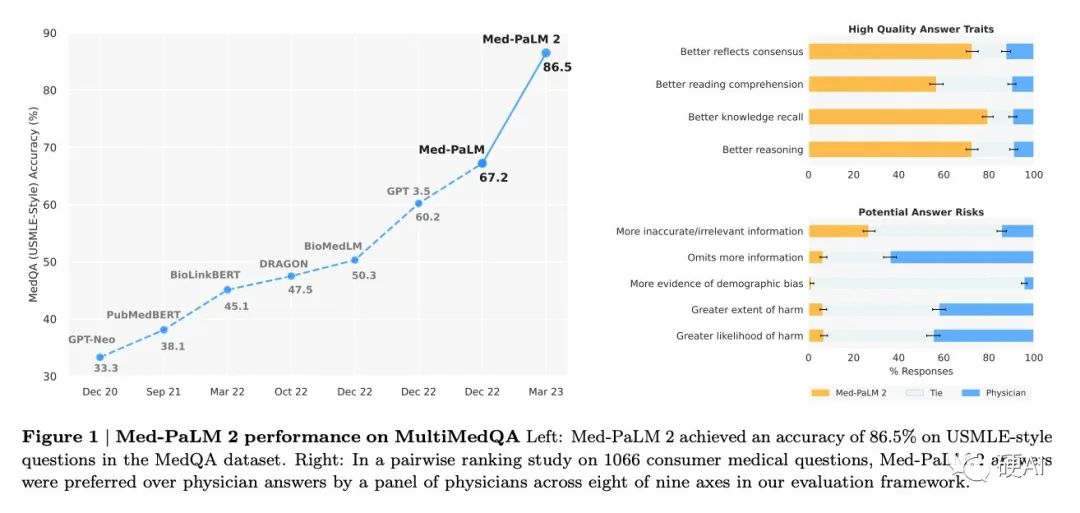
The potential impact of this new technological wave on humanity is enormous. For example, the performance of Google's MedPaLM2 model is largely superior to that of human doctors, to the extent that medical experts making the model undergo RLHF will make it worse.
Given the enormous potential of this technology, it will be exciting to see one day the breakthroughs this technology will bring in education, healthcare, enterprise and consumer software, and other aspects of life.
Now, it's only 8-9 months away from ChatGPT awakening the world to enter the new era of AI, and as we continue along this technology non-linearly, exciting moments are ahead. Now, it is still the early stage of artificial intelligence, and the peak of hype and impact are still in the future, and there is much more to be done.
Original link: https://blog.eladgil.com/p/early-days-of-ai?utm_source=bensbites
免责声明:本文章仅代表作者个人观点,不代表本平台的立场和观点。本文章仅供信息分享,不构成对任何人的任何投资建议。用户与作者之间的任何争议,与本平台无关。如网页中刊载的文章或图片涉及侵权,请提供相关的权利证明和身份证明发送邮件到support@aicoin.com,本平台相关工作人员将会进行核查。


