Source: Bankless
Translator: Mary Liu, BitpushNews
It is said that Ethereum's L2 solution inherits Ethereum's "security", but what does this really mean? The answer varies depending on the different Rollups.
Although every Rollup aspires to achieve complete trust, all of Ethereum's optimistic and zero-knowledge (ZK) scaling solutions currently rely on some form of "training wheels".
Vitalik (V God) has provided an excellent framework to help Rollup users understand the level of trust they have in centralized participants or transparent code. The ultimate goal of Rollup security is to reach the milestone of Stage 2, which requires completely getting rid of the "training wheels" mentioned in Vitalik's literature - the L2Beat chart below summarizes this well.
Few Rollups have achieved the Stage 2 defined by V God, but Arbitrum is moving towards becoming the first notable direction. In early August, Offchain Labs (Arbitrum's development team) announced a new on-chain permissionless verification scheme - BOLD, which solidifies its controversial protocol to resist a denial-of-service attack called "delay attack".
However, each L2 is developing at a different pace. This article will explore the five largest generalized L2s on Ethereum, all of which are committed to eliminating centralization risks in Rollups and moving towards the goal of Stage 2.
Arbitrum One
Risk Stage: 1
Type: Optimistic
Total Value Locked (TVL): $5.41 billion
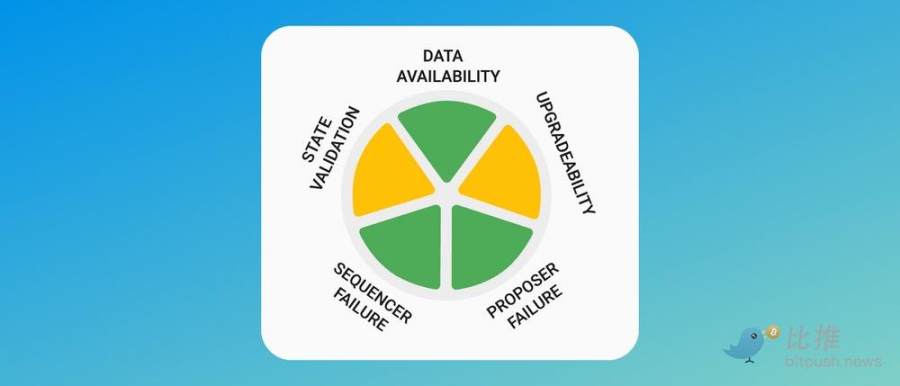
Arbitrum One has successfully reduced more centralization risks than any other chain in this article. If ArbitrumDAO adopts BOLD on One, the chain will turn the state verification part green, but entering the second stage requires the entire risk chart to turn green.
To increase upgradability, two changes will be needed. First, the implementation delay for governance-initiated upgrades must be extended from 12 days to 30 days. Second, no participant should be able to upgrade Arbitrum's code unless verification is error-free.
The final "training wheels," Arbitrum's security council, is directly elected by the DAO and has the ability to bypass governance to implement upgrades immediately. Despite Arbitrum One's best efforts to reduce centralization risks, the security of on-chain assets still depends on the integrity of this all-powerful 9/12 multisig.
Considering the risks of operating Rollup, the security council is considered to have a positive effect on the Arbitrum ecosystem, but to enter the second stage, Arbitrum needs to restrict it to only respond to on-chain provable errors.
This will further protect the security of users on Arbitrum One and ensure that participants cannot publish stateRoots that cover the Rollup proof system (in the absence of errors).
Optimism
Risk Stage: 0
Type: Optimistic
TVL: $2.67 billion
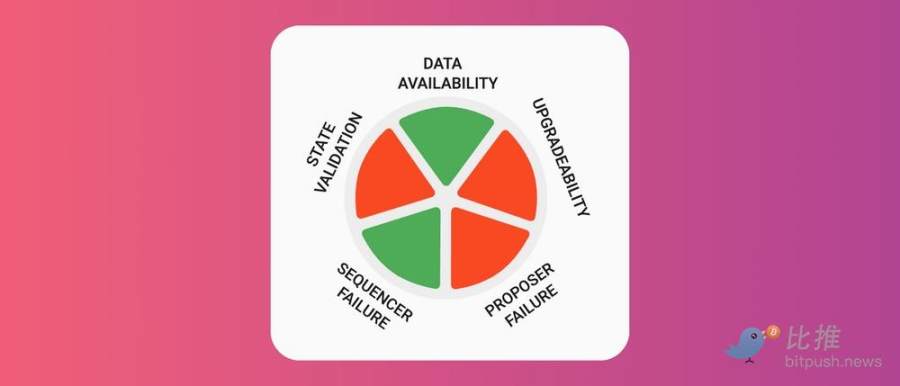
Crypto observers generally tend to think that Arbitrum and Optimism have similar security guarantees because both use optimistic rollups. Security-conscious users know that this is far from the truth!
On the optimistic side, fraud proofs (tools for challenging incorrect information submitted by the chain sequencer to Ethereum) cannot operate. There is no way to challenge incorrect stateRoots, and users must blindly trust that block proposers have submitted the correct stateRoot.
In addition, only whitelisted proposers can publish stateRoots, meaning that if a proposer fails, there is no way to exit from Optimism to Ethereum L1.
Although fraud proofs are actively being developed, there is no clear deployment schedule yet, but they are crucial for any Optimistic Rollup's decentralization and are necessary for Optimism to move past Stage 0 in its current configuration.
Alternatively, Optimism can choose to become a zero-knowledge rollup by implementing validity proofs. Just last month, the Optimism Foundation awarded contracts to two teams to develop zero-knowledge proof modules for OP Stack.
The Optimism Foundation plans to transfer control of the multisig to a council composed of community members by 2024, which will help decentralize control of the chain's keys.
In addition to implementing fraud proofs, Optimism also needs at least a 7-day upgradability lock to become a first-stage rollup.
zkSync Era
Risk Stage: 0
Type: Zero-Knowledge (ZK)
TVL: $399 million
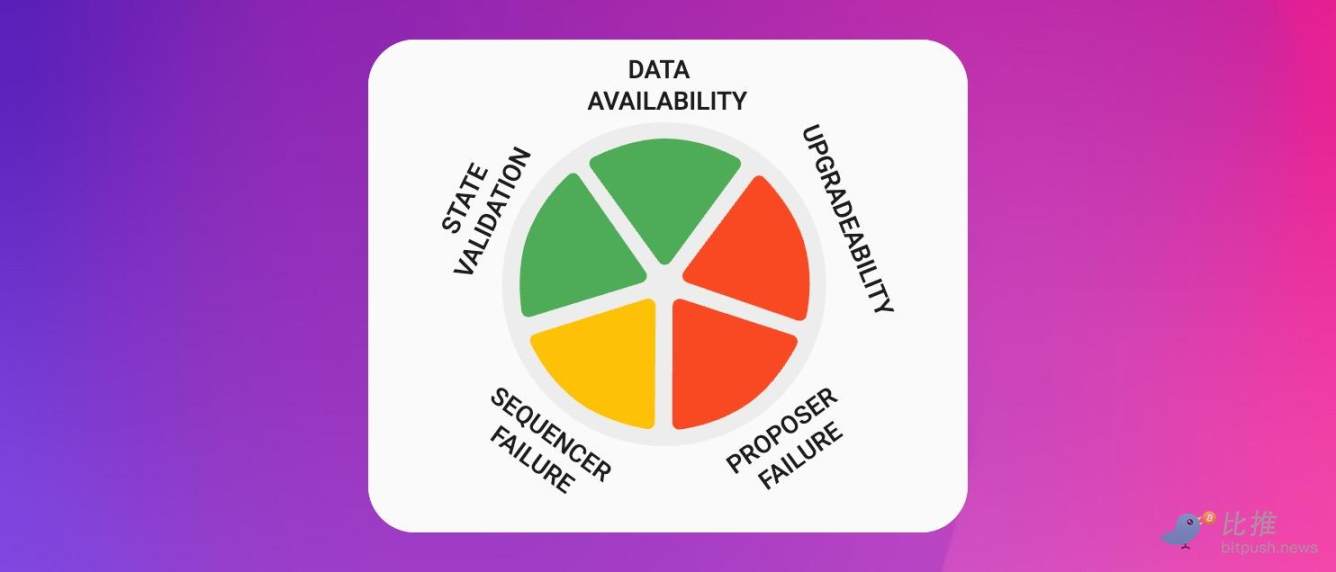
Zero-knowledge proofs ensure that every stateRoot published to Ethereum is correct and allow the state verification section to be green, but zkSync users still face the risk of sequencer or proposer failure.
zkSync establishes a queue for transactions submitted on L1, and the sequencer needs to process this queue to mitigate censorship risks. While this does not guarantee that transactions are included, it means that if the sequencer censors or shuts down an individual, everyone is shut down.
In the future, in addition to working towards decentralized sequencers, zkSync will also update its system to force sequencers to process the L1 transaction queue. These efforts will help mitigate risks associated with malicious or knocked-down sequencers.
Every update to the state of a zero-knowledge rollup is accompanied by a zero-knowledge proof (ZKP) to ensure the correct export of the new state; this is the magic of ZKP, but it means that the only way to include transactions is to include them in the generated proof. The increased decentralization of zkSync will require anyone to be able to create proofs without going through centralized rollup operators.
Similar to Arbitrum and Optimism, zkSync needs to implement upgrade time locks and restrictions on multisig to reduce the risks of upgradability.
Base
Risk Stage: 0
Type: Optimistic
TVL: $246 million
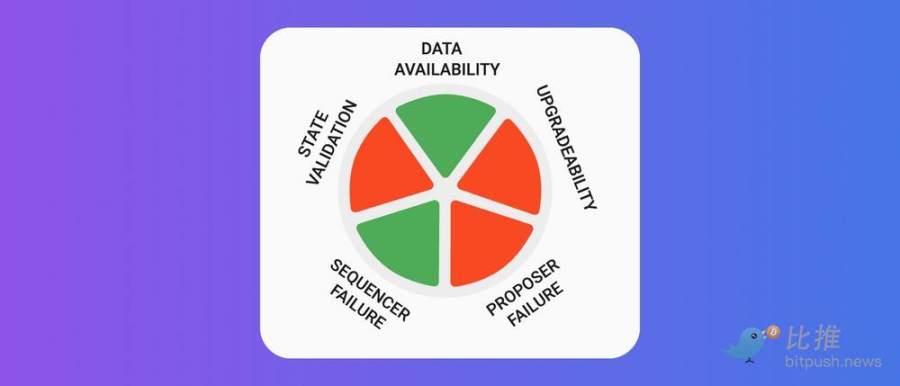
Notice how similar the risk charts for Optimism and Base look?
This is because they are both built on the same blockchain Lego set: OP Stack. Coinbase did not build a custom solution but chose to develop L2 on Optimism's modular rollup framework.
Progress towards decentralization will enable Coinbase to strengthen user security, meaning that Base may follow a similar security path to Optimism, implementing OP Stack innovations such as fraud or zero-knowledge proofs (when available).
Starknet
Risk Stage: 0
Type: Zero-Knowledge
TVL: $110 million
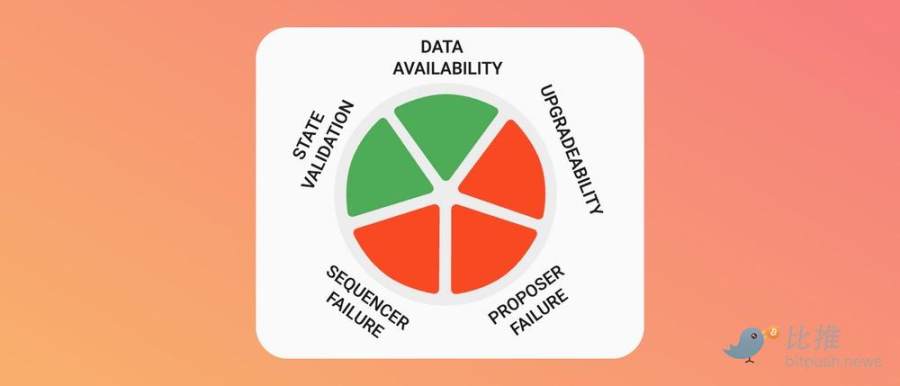
Zero-knowledge rollups face a different set of challenges compared to their optimistic peers. While ZKP ensures that every state root published to Ethereum is correct and allows the state verification section to be green, zero-knowledge rollups face their own challenges in mitigating sequencer or proposer failure risks.
Providing an "escape hatch" for users is crucial to enhancing Starknet's trustless nature and can be achieved by forcing transactions or withdrawals to L1 in the event of sequencer or prover failure. Currently, Starknet has not enabled an escape hatch, but enabling one will largely cut off users' reliance on centralized rollup operators.
If malicious attackers force the network to attempt to accept invalid transactions, forcing the network to accept transactions will open the door to denial-of-service attacks. Implementation first requires the ability to generate proofs without going through StarkWare provers, and all transactions on Starknet can be proven.
Additionally, Starknet can choose a bridging solution called "application escape hatch". This solution can be implemented today but comes at the cost of network simplicity, as it requires the implementation of an Ethereum-to-Starknet account registry and a mechanism to transfer control of assets in L2 to the L1 smart contract of the rollup.
Like all the chains listed above, Starknet needs to implement upgrade time locks and restrictions on multisig to reduce the risks of upgradability.
Starknet will fully open source its prover on August 31, and the team stated that by allowing users to submit their own proofs, this will help mitigate the risks of sequencer or prover failure.
免责声明:本文章仅代表作者个人观点,不代表本平台的立场和观点。本文章仅供信息分享,不构成对任何人的任何投资建议。用户与作者之间的任何争议,与本平台无关。如网页中刊载的文章或图片涉及侵权,请提供相关的权利证明和身份证明发送邮件到support@aicoin.com,本平台相关工作人员将会进行核查。


