Author: Shan Walnut
Editor: Fisherman
Source: Silicon Research Lab
Editor's Note:
One side is passionate, the other is stern. This is the current situation in China's large-scale model industry, and "chaotic era" may be the most appropriate label for this industry. In the past six months, the surge of large-scale models has led to a new stage of reconstruction in the relationship between technology and people, technology and industry, and human civilization and technological civilization. This transformation is driven by both technological advancements and key individuals and enterprises.
As observers at the forefront of the intelligent era, "Silicon Research Lab" pays attention to all stories related to technology. Today, we are launching the "Chaos Era of Large Models" series, starting with deconstructing large models and turning the spotlight on the pioneering companies and individuals at the forefront of these waves, sharing and interpreting their unique insights for our readers.
This article is the third in this series: "The Rise of the 'Tsinghua System' and the Changing Landscape of China's Large Model Industry."
First article: The Chaotic Era of Large Models: Contradictions, Differentiation, and the Future
Second article: The Application Heat of Large Models: The Sweetest Cake and the Toughest Challenge
If we were to find a coordinate system for the entrepreneurial map of China's large-scale models, perhaps the several buildings outside the east gate of Tsinghua University would be the best choice.
A few intersections away, standing in several buildings, are the pioneers of China's large-scale model industry. The most eye-catching is the Sohu Network Building, located in the southeast corner of the park. The second floor is Wang Xiaochuan's Baichuan Intelligence, and the seventh to eleventh floors are occupied by Zhipu AI from the Knowledge Engineering Laboratory (KEG) of Tsinghua University. Not far from here are star startups such as Lingxin Intelligence, DeepSpeech Technology, and Lanzhou Technology.
Although their entrepreneurial times and opportunities are not the same, they all share one identity - the Tsinghua system.
In the development history of Chinese artificial intelligence technology, the "Tsinghua system" is destined to be an unavoidable node. This is one of the origins of Chinese artificial intelligence education. Over sixty years ago, when a truck carrying new students drove straight to the dormitory gate in the dark, Academician Zhang Bo, who had not yet been involved in artificial intelligence, sighed, "Tsinghua Garden is really big." It was also several years before the formal establishment of the "Artificial Intelligence and Intelligent Control" research group in the Tsinghua Computer Science Department.
And now, under the new wave of AI driven by large-scale models, entrepreneurs from the "Tsinghua system" have become an indispensable force. Why Tsinghua? What deeper meaning lies behind the rise of the Tsinghua system?
01 In the Wave of Large Models, the "Tsinghua Stars" Shine
Any entrepreneurial circle is accustomed to labeling entrepreneurs. "Labels" not only allow capital to quickly screen for high-quality targets, but also serve as the best resume for startups. For technology-intensive enterprises, "education" is undoubtedly one of the best yardsticks.
Looking at the list of entrepreneurs in this wave of large-scale models, whether it's the established entrepreneurial leaders or the newbies, the "Tsinghua stars" almost dominate the landscape.
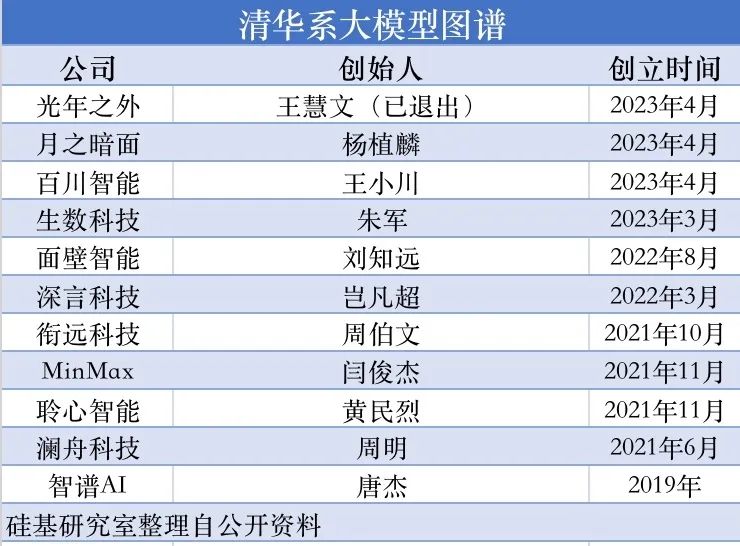
The former "Four Internet Giants," Sogou founder Wang Xiaochuan, was labeled as a "Tsinghua genius youth" before starting his business. This academic prodigy, who was admitted to the Computer Science Department of Tsinghua University, almost participated in the annual student festival of the Tsinghua Computer Science Department. Now, at the age of 45, Wang Xiaochuan has a new identity - the founder of the large-scale model startup "Baichuan Intelligence."
After fading out of the entrepreneurial circle for many years, this former entrepreneurial leader chose to enter the field of large-scale models, believing that working on large-scale models was something particularly suitable for him. "No one has ever said 'Xiaochuan is suitable for search,' but everyone says 'Baichuan is suitable for large-scale models.' For me, this is a very fortunate thing."
Another entrepreneur who chose to enter entrepreneurship earlier than Wang Xiaochuan is Zhou Bowen, the founder of Xianyuan Technology, who is a tenured professor in the Department of Electronic Engineering at Tsinghua University. Another startup, MiniMax, which has been backed by Tencent, miHoYo, and Hillhouse Capital, has its founder, Yan Junjie, a former vice president of SenseTime, who also worked as a postdoctoral researcher in the Computer Science Department of Tsinghua University.
Entrepreneurs like Wang Xiaochuan often participate in or experience the exploration of cutting-edge technologies in large companies. Their entrepreneurship is not only for personal ideals but also comes with inherent commercial advantages, believing in the principle of "great efforts lead to miracles." From the release of open-source and closed-source model products by Baichuan Intelligence, it is evident that "seizing the advantage of being first and occupying a position" is the competition rule they learned from the previous technological wave.
Another group of entrepreneurs from the Tsinghua system, whether in terms of company structure or development history, also have a more "academic orthodox" temperament.
Zhizhi AI, with Chief Scientists Li Juanzi and Tang Jie from the Tsinghua Computer Science Department, incubated at Tsinghua's Knowledge Engineering Laboratory (KEG). The laboratory was established in the 1990s, initially following the path of "scientific research + engineering landing." Tang Jie's favorite student, Yang Zhilin, has founded Moon's Dark Side, which has gained favor from investors due to its strong technical background.
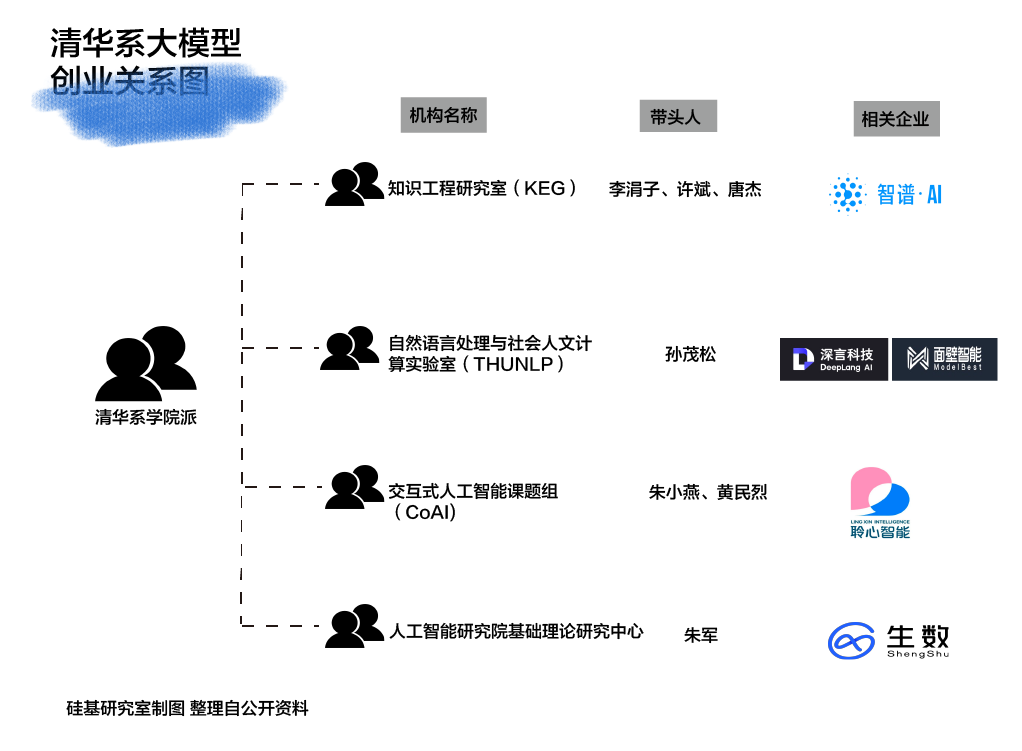
DeepSpeech Technology and Mianbi Intelligence are derived from Tsinghua's Natural Language Processing and Social Computing Laboratory (THUNLP). THUNLP was founded in the 1970s by the country's leading figure in the field of NLP, Professor Huang Changning. The current academic leader is his disciple, Sun Maosong, the Executive Deputy Dean of the Institute of Artificial Intelligence at Tsinghua University. The founders of the aforementioned startups are all students of Sun Maosong.
Under the Interactive Artificial Intelligence Research Group (CoAI) of the Tsinghua Computer Science Department, led by Professors Zhu Xiaoyan and Huang Minlie, Lingxin Intelligence is compared to Character.AI on the other side of the ocean. The new AI company Shengshu Technology, led by Professor Zhu Jun from the Tsinghua Computer Science Department, has completed two rounds of financing. Zhu Jun learned from Professor Zhang Bo, a professor at the Computer Science Department of Tsinghua University and an academician of the Chinese Academy of Sciences.
The characteristic of academic-oriented entrepreneurship is that, on the one hand, it has a strong technical gene. The technical route behind its products is not achieved overnight but is the result of generations of inheritance. On the other hand, compared to the previous AI entrepreneurship boom, the speed at which scholars are entering the field is accelerating, highlighting the trend of integrated production, investment, and research.
For example, behind DeepSpeech Technology, the chief scientist is Sun Maosong, the mentor of the founder Qifan Chao. When Qifan Chao wants to communicate with the professor, he only needs to walk a few hundred meters back to the school. Mianbi Intelligence also has the participation of Zhizhi AI, and another founding member of Moon's Dark Side also comes from the Computer Science Department of Tsinghua University, sharing the same mentor as Yang Zhilin.
On the other hand, among the investment entities behind this wave of large-scale model entrepreneurship, the "Tsinghua system" investors are also noteworthy. This includes Turing Ventures, Zhuoyuan Capital, Tsinghua Holdings, Tsinghua Alumni Seed Fund, and the SEE Fund of Wumuke Tsinghua Alumni, among other Tsinghua-based venture capital institutions. For example, Turing Ventures invested in Lingxin Intelligence and Zhizhi AI, while Zhuoyuan Capital, originating from the FIT Laboratory of Tsinghua University, invested in Shengshu Technology.
Technology, people, and money determine the landscape of this wave of large-scale model entrepreneurship, and Tsinghua seems to have a unique advantage in this competition. But another question arises: why Tsinghua?
02 The Rise of the "Tsinghua System": The Victory of History, Sentiment, and Mechanism
In June of this year, 53-year-old Zhou Hongyi, the founder of 360, was admitted to the Department of Electronic Information at the Department of Computer Science and Technology at Tsinghua University. He posted an admission notice on his Weibo, sparking curiosity about the construction of artificial intelligence disciplines at Tsinghua University.
In fact, in the development history of Chinese artificial intelligence technology, "Tsinghua" is destined to be an unavoidable node. The reason why the Tsinghua system has become the main force in entrepreneurship in this wave of large-scale models is supported by history, sentiment, and mechanism.
First, it is inseparable from the accumulation of the history of discipline construction, which is also the underlying technical strength of the Tsinghua system.
In 1978, in order to meet the needs of national development of computer science and technology, the Department of Automatic Control at Tsinghua University was renamed the "Department of Computer Technology and Applications," and internally established the "Artificial Intelligence and Intelligent Control" research group, officially exploring undergraduate teaching in the field of artificial intelligence. Academician Zhang Bo recalled that at that time, the development of artificial intelligence in China was described as "starting from scratch." "At that time, domestic researchers had very limited understanding of the development of artificial intelligence, and even the relevant materials were very scarce."
After gaining a preliminary understanding of the field of artificial intelligence, scholars identified several specific directions, such as expert systems, natural language, speech recognition, and intelligent control. To make up for the gap in research with foreign countries, they looked abroad for advanced knowledge, translated foreign advanced knowledge into domestic knowledge, and simultaneously conducted cutting-edge research. They also continuously explored and improved internal training programs.
At that time, Academician Zhang Bo went to the University of Illinois at Urbana-Champaign as a visiting scholar, and Professor Huang Changning went to Yale University for a one-year visit. According to Academician Zhang Bo, he sent back all the precious materials he obtained from the University of Illinois at Urbana-Champaign, which became one of the tools to assist the teaching and research work of the Computer Science Department at Tsinghua University.
At the same time, Tsinghua University began offering elective courses such as "Introduction to Artificial Intelligence" for undergraduate students, effectively filling the curriculum gap in the field of artificial intelligence in China at that time. In 1983, the Department of Computer Science at Tsinghua University listed "Artificial Intelligence" as a compulsory course for undergraduates, and related teachers successively wrote textbooks in the field of artificial intelligence, such as "Principles of Artificial Intelligence" (by Shi Chunyi, Lin Yaorui), "Artificial Intelligence and Its Applications" (compiled by Xu Guangyou), and "Handbook of Artificial Intelligence" (compiled by Zhong Yuzhuo).
During this period, Chinese scholars began to emerge in the world of artificial intelligence. Academician Zhang Bo completed the first academic paper by a Chinese scientist in the field of artificial intelligence and successfully published it in a top international journal in the field of artificial intelligence, opening a new chapter in the development of artificial intelligence.
In addition to the establishment of the undergraduate education system, starting in 1978, Tsinghua began to enroll master's students in artificial intelligence, and in 1986, it began to enroll doctoral students in the field of artificial intelligence. At the same time, through the construction of first-class laboratories, strengthening international cooperation and exchanges, and other measures, Tsinghua continuously consolidated its competitiveness in the field of artificial intelligence.
One of the most typical examples is the establishment of the "Yao Class." Tsinghua University actively invited world-renowned professors to participate in the training work at Tsinghua using sponsorship funds from companies. From 2003 to 2006, Turing Award winner Yao Qizhi, as a hired professor, became associated with Tsinghua, and then directly returned to Tsinghua University as a tenured professor, creating the "Yao Class."
"Half of the talents gather at Tsinghua, and Tsinghua talents are in the Yao Class." Today, a large number of graduates from the Yao Class have also contributed to the development of artificial intelligence in China.
In addition to historical accumulation, entrepreneurial sentiment is also one of the characteristics of the Tsinghua system. In the previous wave of internet entrepreneurship, entrepreneurs from the Tsinghua system demonstrated a strong entrepreneurial spirit and an exploratory spirit towards the essence of things, as evidenced by figures such as Wang Xing of Meituan, Su Hua of Kuaishou, A Bei of Douban, and Wang Xiaochuan of Sogou.
In this wave of large-scale model surge, the choice of application scenarios, the construction of business models, and the selection of technological routes all require this spirit of returning to the essence. In other words, entrepreneurs must make more accurate judgments about their own advantages and the future development of technology.
In this regard, compared to early entrants in large-scale models such as Zhipu AI, Wang Xiaochuan's Baichuan Intelligence, as a "latecomer," first used rapid product iteration to leverage the advantage of past experience in search, with Wang Xiaochuan's understanding being "to fill the gap in the domestic business ecosystem." Zhou Bowen's Xianyuan Technology focuses on reshaping the relationship between people and products in large-scale models, focusing on the vertical scene of consumer goods supply chains, based on his experience at his former employer JD.com.
Doubts always linger. For example, the outside world believes that building general large-scale models is the business of big companies. There are also investors who told Zhou Bowen, "You are making things too small."
But most entrepreneurs from the Tsinghua system focus on the essence and don't think too much about "competition." Wang Xing once said, "Too many people focus on the boundaries, not the core." Similarly, among the Tsinghua entrepreneurs in the large-scale model field, there is a similar entrepreneurial temperament, accepting cooperation as a normal state.
Finally, the rise of the Tsinghua system is also a victory for an open mechanism.
One notable example is the establishment of the Beijing Zhiiyuan Artificial Intelligence Research Institute (hereinafter referred to as Zhiiyuan) in 2018.
This independent non-profit research institution, separate from the government, business, and universities, is called the "Whampoa Military Academy" of the large-scale model industry. Microsoft President Brad Smith previously stated in an interview: "Currently, in the field of artificial intelligence, there are three companies in the world that are in the absolute forefront. One is OpenAI, which collaborates with Microsoft, the second is Google, and the third is the Beijing Zhiiyuan Artificial Intelligence Research Institute."
Zhiiyuan is not only a non-profit organization and a technical community but also an idealistic "Utopia." In 2020, Zhiiyuan began to practice large-scale models, launching the "Wudao Large Model" project, without asking about the origin of the hero. According to reports from "Leiphone," scholars and teachers from universities such as Tsinghua, Renmin, Peking, and the Chinese Academy of Sciences, as well as some external members, have also joined the project, forming a group to tackle the challenges of large-scale models in China. This project brings together many well-known entrepreneurs from the Tsinghua system that we know today: Tang Jie, Liu Zhiyuan, Huang Minlie, Yang Zhilin, and others.
It can be said that the rise of Tsinghua at the forefront of large-scale models is not only the result of the accumulation of previous explorations but also the result of contemporary innovation mechanisms of "industry, academia, and research."
03 The Competition of Large Models Ultimately Comes Down to "People"
The rise of the Tsinghua system, dreaming at Wudaokou. All business competition, at its core, is still about the competition of "people."
Across the ocean, beneath the seemingly vigorous surge of large-scale models, the talent war between Google and OpenAI is an undercurrent. According to media reports, over the past five years, more than 30 executives, engineers, or other employees have left OpenAI to start their own businesses. According to "Quantum Bit" statistics, among the 51 researchers at OpenAI, 16 have left, resulting in a turnover rate of one-third. These defectors from OpenAI are known as the "OpenAI Mafia."
The networks they have built, both in terms of relationships and capital, have connected smart people with smart money, bringing about a unique "defector culture" that has created an innovative ecosystem with clear division of labor and has also forged a diverse and rich "unicorn soil."
Of course, the differences in the Sino-US situation mean that the story of OpenAI cannot be replicated. There are three possible reasons for this:
First, there is a difference in time. Unlike the prosperity of the application layer in the United States, the underlying structure of large-scale models in China is still undetermined, so the development of the application layer is still in its early stages.
Second, there is a divergence in the route. Large-scale models in the United States focus on the research and innovation of underlying technologies, such as being in a leading position in the world in hardware and deep learning frameworks. China, on the other hand, focuses more on the application layer, emphasizing integration into industries and commercial realization.
Third, there is a difference in the distribution of top talent. According to incomplete research statistics, among the top scholars in the field of artificial intelligence selected for the AI2000 list worldwide, many in the United States come from technology companies. For example, Google, Microsoft, and Meta together have recruited 30% of the top scholars in the United States. Overwhelmingly, the top artificial intelligence researchers in China come from universities, and Alibaba is the company in China that has recruited the most top scholars.
The rise of the Tsinghua system releases a new signal: from research to innovation, from the ivory tower to enterprises, more top talents are using commercial power to drive technological innovation and achieve specific application scenarios. More young scientists are also bringing new innovations in their own way.
Different from the previous wave of internet entrepreneurship, this wave of large-scale model surge seems to no longer be an era of "heroes based on winning or losing." The entrepreneurial map of large-scale models at Tsinghua has already explained everything. It is inclusive, welcomes innovation, and is also willing to share, even beyond simple competitive thinking.
However, challenges still lie ahead. How to improve innovation efficiency and establish a healthier innovation ecosystem requires entrepreneurs to have a more accurate positioning of themselves, a keen and rational judgment of technology, and also relies on the combined efforts of policies, capital, and academia to explore a more advanced and efficient way of cooperation.
Reference materials:
1. Leiphone: "A Brief History of Wudaokou"
2. Academician Zhang Bo: "Tsinghua's AI, Beyond Insight, More Accumulation"
3. LatePost: "The Surge of Large Models: 180 Days of Frenzy"
4. Science China: "Zhang Bo: From the Past to the Future of Artificial Intelligence"
5. Chuangtou News: "The 'Tsinghua Gang' in the AI World"
6. Investment Times: "Recently, Founders from the Tsinghua System Are on Fire"
7. China Entrepreneur Magazine: "China's OpenAI, Hidden in These Buildings"
8. Tsinghua Xiaowuye Garden: "Ma Shaoping, Zhou Feng, Wang Xiaochuan, Lou Tiancheng, Tang Wenbin: 40 Years of the Tsinghua Computer Science Department and Artificial Intelligence"
9. Leiphone: "Chen Hongyang of Zhejiang Lab: To Realize Large Models, the Computational Gap Must Be Addressed"
10. Economic Observer: "Zhou Bowen: Unknown and Premonition | AI·20 People Series Report"
免责声明:本文章仅代表作者个人观点,不代表本平台的立场和观点。本文章仅供信息分享,不构成对任何人的任何投资建议。用户与作者之间的任何争议,与本平台无关。如网页中刊载的文章或图片涉及侵权,请提供相关的权利证明和身份证明发送邮件到support@aicoin.com,本平台相关工作人员将会进行核查。


