Author: JEREMY KAHN
Source: FORTUNE
Image source: Generated by Wujie AI tool
At the open-air theater on the coastline of Mountain View, California, the audience in front of Sundar Pichai, CEO of Google's parent company Alphabet, filled every seat. He is doing his best to play the role of a new-generation tech company leader, somewhat like a pop idol and a missionary conveying the will of God, but instead of songs or sermons, it's through software and silicon. Unfortunately, Pichai, with his mild manner and introverted personality, is not naturally suited for this role. For some reason, the atmosphere of his speech feels more like a high school musical than the fervor of a Hollywood theater.
As early as 2016, Pichai announced Google's "AI-first" strategy. Now, as the development of artificial intelligence is at a critical moment, Google's competitors have captured all the attention. Last November, the debut of ChatGPT caught Google off guard, and in the past six months, Google has been busy launching products to compete with ChatGPT's developer, OpenAI, and its partner and supporter, Microsoft.
At the company's annual I/O developer conference in May, Pichai hoped to showcase Google's efforts over the past six months. He introduced a new feature in Gmail called "Smart Compose," which automatically drafts entire emails based on text prompts; AI-supported immersive views in Google Maps that can provide lifelike 3D previews of user routes; and a generative AI photo editing tool, among others. He mentioned the powerful PaLM 2 large language model (LLM), which supports various new features, including Bard, which Google uses to benchmark against ChatGPT. He also mentioned the development of a powerful AI model family called Gemini, which could significantly expand the influence of artificial intelligence, but also amplify its risks.
However, the audience both on-site and watching the live broadcast most wanted to hear about a topic that Pichai avoided: What are Google's plans? After all, search is Google's core product, with revenue exceeding $160 billion last year, accounting for about 60% of Alphabet's total revenue. Now that AI chatbots can gather information from the entire web to answer users, providing responses in a conversational format rather than a list of links, how will this affect Google's profit machine?
Pichai was evasive about this. "We are reimagining all of our core products, including search, in a bold and responsible way," Pichai said. Such a low-key introduction to a product that is closely related to the company's fate and his own future seemed somewhat strange. Throughout Pichai's speech, the audience's impatience could be felt from the lukewarm applause in each round.
Yet Pichai did not touch on the key topic again. He chose to have Cathy Edwards, Vice President of Search at Google, introduce the somewhat awkwardly named "Search Generation Experience" (SGE). This feature combines search and generative AI, providing users with a separate "snapshot" answer and website links to confirm the answer when they search. Users can continue to ask questions, just like using a chatbot.
The new product could become a powerful answer generator. But will it generate revenue? This is the core dilemma that Google faces as an innovator.
Alphabet states that SGE is an "experiment." However, Pichai explicitly stated that SGE or similar products will play a crucial role in the future of search. In June, Pichai told Bloomberg, "Similar products will become part of the mainstream search experience." This new technology clearly has not yet met its expected goals. SGE is relatively slow, and like other generative AI, it is prone to what computer scientists call "hallucinations," confidently providing false information. Pichai also admitted that this issue could pose a danger in search engines. He told Bloomberg, "If a parent searches on Google for the dosage of Tylenol for a child, it cannot be wrong."
The launch of SGE reveals Google's response speed in the AI arms race. This technology draws on Google's decades of experience in AI and search, fully demonstrating Alphabet's firepower. However, it also exposes Alphabet's vulnerability at a time of great change. The information gathering of chatbots may erode Google's traditional search business and its lucrative ad-driven business model. Unfortunately, many people prefer ChatGPT's answers over the familiar Google link lists. "The search that people are familiar with is going to disappear," predicted Jay Pattisall, an analyst at research firm Forrester.
Therefore, Pichai and Alphabet cannot afford to make mistakes, not just with Tylenol dosage. Google has powerful AI tools but has not formulated a strategy that matches Alphabet's status as the 17th largest company in the world in terms of advertising revenue. How they respond to this shift will determine whether Google can continue to survive in the next decade, as a verb or as a company.
When ChatGPT was launched, some critics believed it was as significant as the introduction of the iPhone or personal computer; some were more radical, likening chatbots to electric motors or printing presses. But to many executives, fund managers, and technologists, one thing was clear from the start: ChatGPT was a dagger aimed directly at Alphabet's heart. Just hours after ChatGPT's debut, users of the chatbot dubbed it the "Google killer."
Although ChatGPT cannot access the internet, observers accurately guessed that it is relatively easy for AI-driven chatbots to access search engines to provide answers. Handling multiple queries, ChatGPT's unified responses seem more convenient than having to piece together information through multiple links. In addition, chatbots can write code, compose haikus, write high school history papers, develop marketing plans, and provide life guidance, which Google search cannot do.
So far, Microsoft has invested $13 billion in OpenAI and quickly announced the integration of OpenAI's technology into the Bing search engine, whose market share has never exceeded 3%. Commentators believe that this integration may be the best opportunity for Bing to completely defeat Google search. Microsoft CEO Satya Nadella joked that Google is the "invincible giant" in the search field, then added, "I want people to know that we can make the giant dance."
Compared to some commentators who believe that Google is too bureaucratic and sluggish to dance, Nadella is more confident in Google's "dancing skills." For a long time, Google's world-class AI team has been the envy of the tech industry. In 2017, Google researchers invented the basic algorithm that supports the generative AI craze, called the transformer neural network. (The "T" in ChatGPT stands for "transformer.") However, Alphabet seems to be unclear on how to translate research into products that can inspire the public imagination. In 2021, Google also created a powerful chatbot called LaMDA, which has excellent conversational skills. But like other large language models, this bot's responses may be inaccurate, biased, and sometimes just strange and unsettling. As the problem remains unsolved and is difficult for the AI community to address, Google is concerned that rushing to release it irresponsibly could risk its reputation.
Perhaps equally important, chatbots do not quite fit into Google's main business model—advertising. Compared to Google search, the opportunities for advertising placements or sponsored links provided by summary answers or conversational flows seem much fewer.
To many, this conflict exposes deeper cultural barriers. Some former employees have said that Google is too comfortable with its market dominance, too complacent, bureaucratic, and unable to cope with rapid changes, such as when Google acquired entrepreneur Pravin Sesadri's startup AppSheet in 2020. Earlier this year, shortly after leaving, he wrote a blog post listing four core issues with Google: no mission, no sense of urgency, delusions of exceptionalism, and poor management. He said that all the problems stem from "having an 'advertising' cash cow, maintaining year-over-year growth, and covering up other mistakes."
Four other former employees who left Google in the past two years have similar descriptions. "Just trying to improve existing features involves a lot of tedious procedures, not to mention developing new products, which is incredible," one of them said. Another former employee said that Google often uses its large user base and revenue as an excuse to reject new ideas. "They set the bar too high for impact, and there's almost no way around it," another said.
Similar internal dissatisfaction only fuels more widespread claims: Google is in trouble. From the release of ChatGPT to New Year's Day, Alphabet's stock price fell by 12%.
By mid-December last year, signs of panic were evident within Google. The New York Times reported that Alphabet had sounded a "red alert" to catch up with OpenAI and Microsoft. In 2019, Google co-founders Larry Page and Sergey Brin had resigned from their daily duties, controlling the company only through super-voting shares. Now, the two suddenly returned, with reports stating that Brin rolled up his sleeves to help write code.
The sudden return of the co-founders is difficult to interpret as a show of support for Pichai's leadership. However, Google executives believe that the return of Page and Brin, and the recent competition, are driven by passion rather than panic. "It must be remembered that Larry and Sergey are both computer scientists," said Kent Walker, Global Affairs Chief at Alphabet. "Both are excited about the possibilities for the future." Later, in an interview with The New York Times podcast, Pichai admitted that he had never issued a "red alert." However, he acknowledged the need for the team to take urgent action and find ways to turn generative AI into a "profound, meaningful experience."
External stimuli have clearly had an effect. In February of this year, Google announced the launch of Bard, which competes directly with ChatGPT. By March, Google introduced the Workspace writing assistant feature and Vertex AI environment, which can help cloud customers train and run generative AI applications with their own data. At the I/O developer conference in May, almost every product from Google shone with the brilliance of the new generation of AI. Some investors were impressed. After the I/O conference, Morgan Stanley analysts immediately wrote that the company's "innovation speed and market push have increased." After the launch of ChatGPT, Google's stock price fell to $88 per share, but by the time Pichai took the stage in Mountain View, it had risen to over $122 per share.
Doubts still linger. "Google has many inherent advantages," said Richard Kramer, founder of stock research firm Arete Research. After all, Google has unparalleled AI research results and access to some of the most advanced data centers in the world. "Google is just not pushing forward in business," he added, saying that Google's various departments and product teams are too isolated and it is difficult to collaborate at the company level. (So far, the most obvious adjustment to Google's organizational structure under the impact of AI is the merger of two leading AI research projects, Google Brain in Mountain View and DeepMind in London, into an entity called GoogleDeepMind.)
In addition to Arete analysts, others also believe that Google has not realized its potential. Morgan Stanley pointed out that despite Alphabet's recent recovery, there is still a "valuation gap." Previously, its stock price had always been higher than other tech giants such as Apple, Meta, and Microsoft, but as of July, Google's price-to-earnings ratio is about 23% lower than its competitors. To many, this indicates that the market believes Google is unable to overcome the challenges of AI.
Jack Krawczyk, 38, is a "second-time" employee at Google. He joined Google in his early 20s and left in 2011 to join a startup, later working at the streaming radio service Pandora and WeWork. In 2020, he returned to the company to develop Google Assistant to compete with Apple's Siri and Amazon's Alexa.
Google's LaMDA chatbot has piqued Krawczyk's interest, and he wonders if the chatbot can improve the functionality of intelligent assistants. "For most of 2022, and probably also 2021, I've been saying this," Krawczyk said. The obstacle faced is reliability, the persistent "illusion" problem. Can users accept confident but factually incorrect answers?
"We've been waiting for the moment to announce 'ready to embark on extremely convincing interactions,'" Krawczyk said. Last fall, "we started to see some signals," he said, somewhat embarrassed to overlook the popularity of ChatGPT.
Today, Krawczyk is the Senior Product Director of the Bard team. Although the product draws on Google's research over the years, Bard was developed quickly after the launch of ChatGPT. On February 6th, Google released a new chatbot, and a few days later, Microsoft launched Bing Chat. Google did not disclose how many employees were involved in the project. However, some signs indicate that the company is under pressure.
One of the secrets of ChatGPT's smooth response is fine-tuning through a process called Human Feedback Reinforcement Learning (RLHF). The specific idea is to have humans rate the chatbot's responses, and the AI gradually learns to adjust the answers to strive for a high-scoring version. The more conversations a company can train, the better the chatbot may perform.
In just two months, ChatGPT gained 100 million users, far ahead of OpenAI through a large number of conversations. To catch up, Google hired contract evaluators. Some contract workers for the outsourcing company Appen later filed complaints with the National Labor Relations Board, claiming they were fired for openly discussing low pay and unreasonable deadlines. One person told The Washington Post that even for Bard's long-form responses on complex topics such as the origins of the Civil War, evaluators only had five minutes to score. Contract workers are concerned that time pressure may lead to flawed scoring, affecting Bard's safety. Google stated that the issue primarily lies between Appen and the workers, and scoring is only used for training and testing one part of Bard; training is still progressing rapidly. There are also reports that Google is trying to use answers from the competitor ChatGPT to train Bard, as many users have posted conversations on the ShareGPT website. Google denies using related data.
Unlike the new Bing, Bard, although able to provide relevant website links, is not a search tool. Krawczyk said the purpose of Bard is to be a "creative collaborator." According to him, Bard's main role is to retrieve ideas from the user's own mind. "Get key information from the mind, abstract concepts, and then expand," he said. "Ultimately, it's about enhancing imagination." Krawczyk said Google search is like a telescope, while Bard is like a mirror.
It's still difficult to say what people see in Bard's mirror. The initial appearance of the chatbot was unstable: in the blog post announcing Bard, there were screenshots with incorrect statements, such as the first photo of an exoplanet outside the solar system taken by the James Webb Space Telescope launched in 2021. (In fact, it was taken by a telescope on Earth in 2004.) This mistake proved to be worth $100 billion: Alphabet's market value shrank within 48 hours of the reporter reporting the error. Meanwhile, Google warned employees not to rely too much on Bard: in June, Google released a memo reminding employees not to rely on Bard or other chatbots for code advice without careful verification.
Since the initial appearance of Bard, Google has upgraded the AI of the chatbot to PaLM 2 LLM. According to Google's tests, PaLM 2 outperforms OpenAI's top model GPT-4 in benchmarks for reasoning, mathematics, and translation in some areas. (Some independent evaluators did not reach the same results.) Google has also made some adjustments, greatly improving Bard's responses to mathematical and coding queries. Some of these adjustments reduce the likelihood of Bard producing illusions, but the problem is far from solved. "There's no best practice for generating 'x,'" he said. "That's why Bard is still in the trial phase."
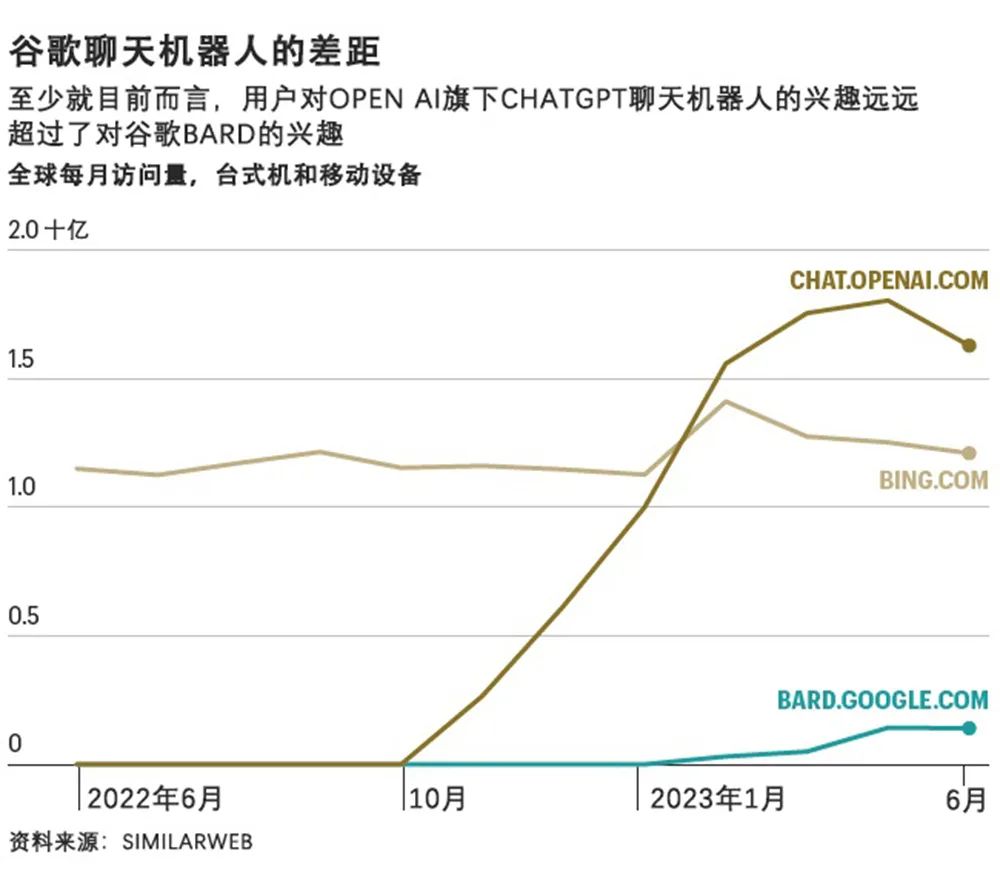
Google refused to disclose the number of Bard users. However, there are signs from third-party data: Similarweb data shows that Bard's website visits increased from about 50 million in April to 142.6 million in June, far behind ChatGPT's 1.8 billion visits in the same month. (In July, Google promoted Bard to the EU and Brazil, increasing the language range of responses by 35, including Chinese, Hindi, and Spanish.) The related numbers pale in comparison to Google's main search engine, which has a monthly visit volume of 88 billion and a daily search volume of 8.5 billion. According to StatCounter data, since the launch of Bing Chat, Google's search market share has slightly increased to 93.1%, while Bing's search market share has remained basically unchanged at 2.8%.
Clearly, Bing is not the biggest threat of AI to search. In May, a survey of 650 Americans by Bloomberg Intelligence showed that 60% of people aged 16 to 34 prefer to ask ChatGPT questions rather than use Google search. "Younger groups may drive a complete transformation of online search methods," said Mandip Singh, Senior Technology Analyst at Bloomberg Intelligence.
This is where SGE comes in. Elizabeth Reed, Vice President of Google's search business, said that Google's new generative AI tools can provide users with more complex multi-step query answers than traditional Google search.
There are still many issues to be resolved, especially in terms of speed. Google search can return results immediately, but users have to wait a few seconds to see the snapshot returned by SGE, which is not a good experience. "One of the joys of technology is dealing with delays," Reed said with a wry smile in a demonstration before the I/O conference. In a subsequent interview, she said that Google has made progress in terms of speed, and pointed out that users may tolerate a brief delay in getting clear answers from SGE, as they no longer have to spend 10 minutes clicking multiple links to find the answers themselves.
Users have also found that SGE engages in plagiarism, extracting answers word for word from websites without providing original source links. This reflects the unique problems of generative AI. "This technology is inherently tricky because the source of its information is often unknown," Reed said. Google stated that it will continue to understand the strengths and weaknesses of SGE and make improvements.
The biggest problem is whether Google knows if the profit from generative AI content advertising can surpass traditional search. "We are continuing to experiment with ads," Reed said. This includes placing ads in different positions on the SGE page, as well as embedding "native" ads in snapshot answers, but Google must explicitly inform users which parts are ads. Reed also said that Google is considering how to add additional "exits" on the SGE page to provide users with more opportunities to link to third-party websites.
For publishers and advertisers who rely on Google search results to increase website traffic, solving the "exit" problem is crucial, and they are already very nervous. With snapshot answers, the likelihood of people clicking on links may be greatly reduced. News publishers are particularly angry: the way LLM currently operates, Google essentially extracts information from news websites for free and then uses the related data to build AI, which could completely undermine the news reporting business. Several major news organizations have entered into negotiations, demanding that Google pay several million dollars annually to access their content. In July, the Associated Press became the first news organization to sign an agreement with OpenAI, with specific financial terms not disclosed. (In July, Jodie Lepars, head of Microsoft Search, told the audience at the Fortune Brainstorm Tech conference that internal data at the company showed that Bing Chat users were more likely to click on links than traditional Bing search users.)
Of course, if people don't click on links, it also poses a survival threat to Alphabet. Whether the advertising model that accounts for 80% of Google's revenue is best suited for chatbots and assistants is currently unclear. For example, OpenAI has chosen a subscription model for the ChatGPT Plus service, charging users $20 per month. Alphabet has many subscription services, from YouTube Premium to various features of Fitbit wearable devices. But the profits are not as high as advertising.
Furthermore, non-advertising business growth is weak. In 2022, Google's non-advertising revenue (excluding its cloud services and "other bets" companies) grew by only 3.5% to $29 billion, while advertising revenue grew at twice the rate to reach $224 billion. It is unclear whether Google can convert a large number of people accustomed to free internet search into paying users. Another not-so-great finding from Bloomberg Intelligence's AI research is that the majority of people in all age groups (93%) say they would not accept a monthly fee of more than $10 for AI chatbots.
If generative AI does indeed become a search killer, where else can Google find growth points? The cloud business may benefit. Google has long integrated AI capabilities into its cloud services, a trend that has sparked customer interest, analysts say. Over the past year, Google was the only major cloud provider to gain market share, which rose to 11%. In the first quarter of 2023, Google Cloud also achieved profitability for the first time.
Arete Research's Kramer pointed out that despite the growth, Google still has a long way to go to catch up with its competitors. The scale of Amazon and Microsoft's cloud products far exceeds that of Google, and their profits are much higher. In addition, the competition related to AI is also fierce: the ChatGPT craze has led many commercial customers to use OpenAI's LLM technology through Microsoft's Azure Cloud.
More broadly, Google's generative AI initiatives so far have mostly been defensive strategies in response to attacks from OpenAI and Microsoft. To win the next round of competition, Google must take the initiative. Several experts unanimously believe that the focus going forward will be on AI systems that can not only generate content but also act on the internet, representing user operations on software. The future of AI will be "digital agents" that can order groceries, book hotel rooms, and manage life beyond the page—such as reminding to take steroids through Alexa or Siri.
"Whoever wins the personal agent war is a big deal, because users will no longer go to search sites, no longer go to productivity sites, and no longer go to Amazon," Bill Gates said in May. He said he would be disappointed if Microsoft did not try to develop an agent. He also invested in Inflection, a startup founded by Mustafa Suleyman, co-founder of DeepMind, which said its goal is to cultivate a personal AI "steward."
Google teased the upcoming establishment of a more powerful family of AI models called Gemini. Pichai said Gemini will be "very efficient in tool and API integration," clearly implying that Gemini can assist digital agents. Another signal is that at the end of 2022, Google's DeepMind published AI research called Gato, which experts believe may be the precursor to Gemini.
Krawczyk of the Bard team acknowledges that digital agents are exciting, but he also points out that the transition from assistant to agent needs to be cautious in order to be "responsible" within the limits of Google. After all, agents that can act in the real world may cause greater harm than simple text generators. And there's a complicating factor: people are often not good at giving commands. "People's commands often lack context," Krawczyk said. "We hope these tools can understand our thoughts. However, in reality, they cannot."
It is precisely because of similar concerns that Google's future will depend on regulatory attitudes. At the end of July, the White House announced that seven top AI companies, including Google, voluntarily committed to several measures regarding the transparency, safety testing, and security of AI models. However, Congress and the Biden administration are likely to set additional barriers. In the EU, an upcoming AI law requires AI training data to be transparent and strictly compliant with data privacy laws, which may pose a challenge to Alphabet. Walker, Google's global affairs chief, faces the daunting task of overcoming numerous obstacles. "Countries should strive to introduce the most appropriate AI regulatory measures, rather than rushing to introduce regulations," he said, hinting at the long road ahead.
A Shakespeare fan, Walker quoted a line from Macbeth when I asked him about the similarities between Shakespeare's works and the present. He cited Banquo's words to the three witches: "If you can look into the seeds of time, / And say which grain will grow and which will not, / Speak then to me, who neither beg nor fear / Your favors nor your hate." "That's what AI does," Walker said. "It observes a million seeds to understand which ones might grow and which might not. Therefore, AI is a tool to assist in predicting what might happen."
However, AI cannot tell Walker or Pichai whether Google has found a solution to the traditional search's impending end. As it stands, neither Shakespeare nor Bard can answer this question. (Fortune Chinese website)
This article was published in the August/September 2023 issue of Fortune magazine, titled "Sundar Pichai and Google face their $160 billion dilemma."
Translator: Liang Yu
Proofreader: Xia Lin
免责声明:本文章仅代表作者个人观点,不代表本平台的立场和观点。本文章仅供信息分享,不构成对任何人的任何投资建议。用户与作者之间的任何争议,与本平台无关。如网页中刊载的文章或图片涉及侵权,请提供相关的权利证明和身份证明发送邮件到support@aicoin.com,本平台相关工作人员将会进行核查。


