Author: Artemis Analytics
Translated by: Deep Tide TechFlow
Deep Tide Introduction: Figure is quietly transforming from a balance sheet-driven lending institution that requires customer acquisition and self-funding to a light-asset marketplace platform that connects loan initiators and institutional buyers. When nearly 80% of the traffic is contributed by partners and the platform fee revenue approaches 30%, the market is still valuing it based on traditional lending models—this discrepancy deserves the attention of anyone focused on fintech and on-chain assets.
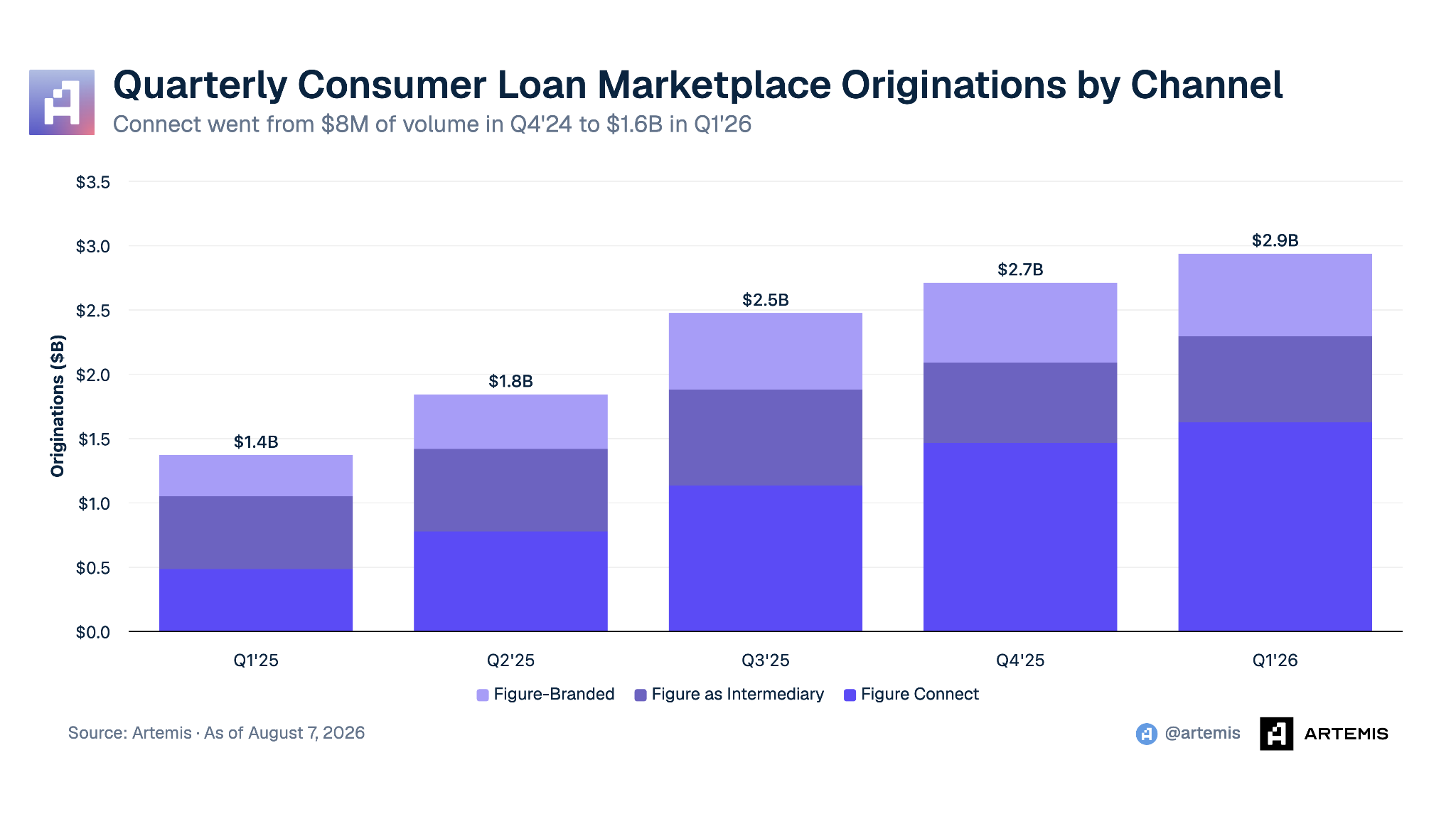
Figure has spent six years building a home equity loan platform aimed at shortening loan times and reducing costs. Today, an increasingly large portion of its business comes from matchmaking activities where the loans are not acquired or funded by Figure. We believe this model could generate substantial incremental profits. In the first quarter of 2026, partners initiated 78% of the platform traffic, while Connect transaction volume surged from 8 million USD in the fourth quarter of 2024 to 1.6 billion USD, with the high-margin fee revenue item growing from 5% of revenue to 28%. We expect Figure to evolve into a channel that charges a light-asset “toll” on loan flow, even as the market continues to value it according to balance sheet logic.
Thus, the key question is: how much loan volume can pass through this platform without self-acquisition or self-funding?
This memorandum is a joint perspective of Artemis and North Island Ventures. Artemis is a digital financial research institution focusing on blockchain and equity assets. NIV is an investment company based in New York, focusing on the intersection of blockchain, fintech, and AI.
Figure Connect, launched in June 2024, is a marketplace connecting loan initiators and institutional buyers. Partners initiate loans, institutional capital provides funding, and Figure earns underwriting and distribution fees. Figure reports all related activities as Consumer Loan Marketplace transaction volume: each loan initiated on its platform plus third-party loans transacted on Connect.
The model has already scaled. Loans initiated by partners now account for 78% of the total, and in the seven quarters since Connect’s launch, it has achieved 56% of CLM transaction volume, while loan inventory days have decreased from 31 days to 16 days, and ecosystem and technology fees have grown from 5% of revenue to 28%.
More loan supply may come from two sources. The pending acquisition of Kiavi will bring an annual loan initiation volume of 7 billion USD, and Figure should be able to channel part of this onto the same infrastructure. Additionally, available industry data indicates that subprime lien loans have begun to recover after more than a decade of contraction, which is expanding Figure's core market.
Meanwhile, Wall Street seems to be pricing the rate compression as Figure enters the first lien business, where the first lien generally has a lower rate than its core second lien business. However, Figure’s disclosed net rates have actually increased, nearly doubling the proportion of first lien. We believe this dislocation is part of a broader misunderstanding of the business and explains why market expectations remain overly low.
Figure was founded by Mike Cagney and June Ou in 2018; both are co-founders and CTOs of SoFi. Figure and its approximately 390 partners issued 8.4 billion USD in loans in 2025, a year-on-year growth of 63%, and the platform currently has an annualized loan issuance volume of about 17 billion USD, growing 130%. This accounts for about 5% of all residential property-secured loans in the United States.
We believe Figure's initial competitive advantage lies in speed and cost. The company has simultaneously built two things: a fully automated home equity loan origination platform and a blockchain Provenance built specifically for this purpose—every Figure loan is initiated, recorded, and ultimately securitized on its chain. Together, they compress the time for home equity loans from about six weeks and costs of 11,000 USD to less than seven days and 1,000 USD. In our view, this advantage has positioned Figure as the largest non-bank originator in second lien HELOC loans.

The second lien comes after the borrower's existing mortgage: homeowners can keep their low-interest first mortgage intact while borrowing against the equity in their homes. The first lien has the first claim on the home, whether for the original mortgage or for new loans provided to homeowners without current debts.
Connect may represent a significant shift in the business economic model.
We see two potential catalysts that may span 2026 and beyond: the continued scaling of Figure Connect and the pending acquisition of Kiavi—once completed, this acquisition will double Figure's first lien business, expected to close in the fourth quarter. The third section below will explain why neither of these has been reflected in the stock price.
1. Connect is transforming Figure from a lender into a marketplace platform
In our view, as of 2024, Figure is an excellent loan originator under a structurally mediocre business model. It acquires borrowers through a sales team, uses warehouse financing to provide loan funds, holds loans on the balance sheet for about a month, and then monetizes them upon sale.
We believe this economic model is typical of professional lenders: capital-intensive, reliant on external financing, facing risks from credit and business volume cycles, hence the market values it typically at 5-7 times EBITDA in the industry range.
Connect has changed part of the funding source for Figure's growth. Partners acquire borrowers and initiate loans against pre-sold commitments to institutional buyers, while Figure provides underwriting and distribution infrastructure, charging approximately 3% market fees. Therefore, the expansion of Connect transaction volume does not require a corresponding increase in customer acquisition expenses, warehouse financing, or credit exposure.
Connect transaction volume has grown from 8 million USD in the fourth quarter of 2024 to 1.6 billion USD in the first quarter of 2026. Transactions initiated by partners now account for about 78% of total volume, meaning most loans reaching Figure do not require it to bear customer acquisition costs.

Figure's reported balance sheet metrics also reflect this shift. Loan inventory days have dropped from about 31 days to 16 days, while transaction volume has nearly doubled. Warehouse financing borrowings are just 15 million USD, compared to 1.9 billion USD of committed financing capacity, with a usage rate of less than 1%. Relative to the 6.8 billion USD of securitized collateral, Figure's disclosed maximum risk exposure is only 378 million USD.
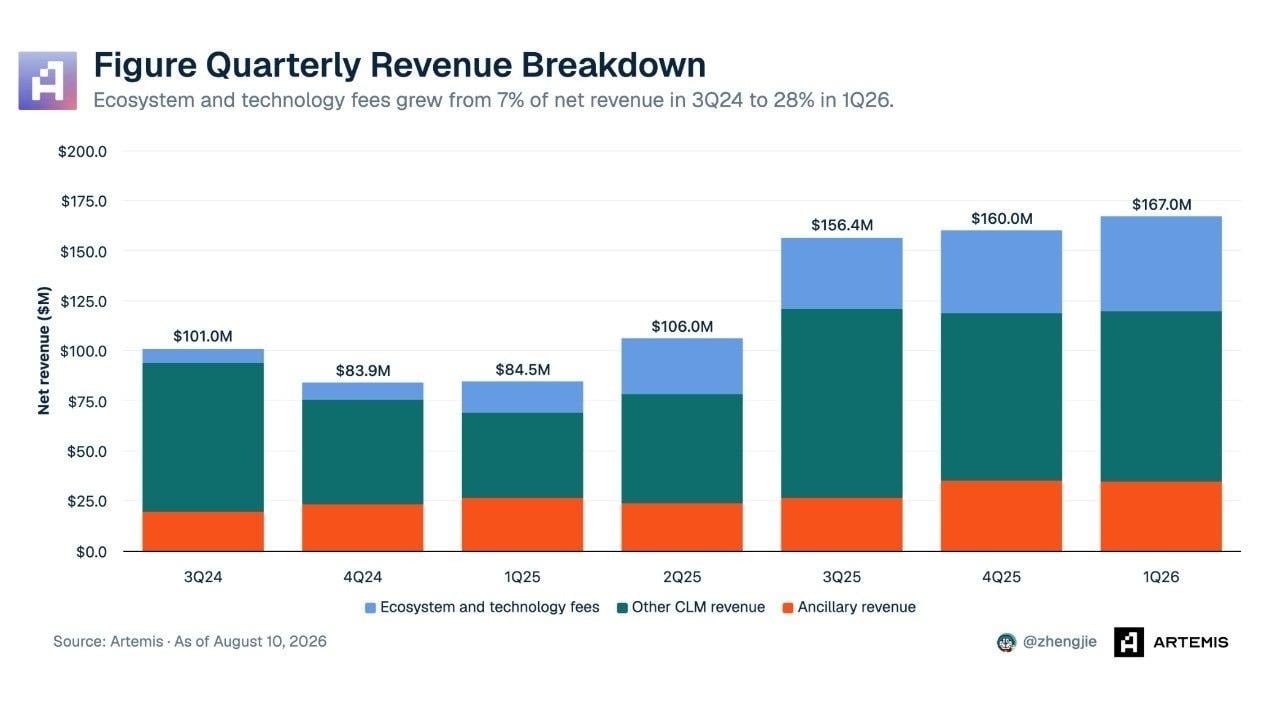
The revenue structure is shifting toward the highest quality lines in the profit and loss statement: ecosystem and technology fees. These are platform and marketplace fees with nearly 100% incremental profit margins, which have grown from 5% of total revenue in fiscal year 2023 to 28% in the first quarter of 2026.
From fiscal year 2023 to fiscal year 2025, revenue grew by 142%, while costs increased only 18%. Incremental EBITDA profit margins for 2024 and 2025 reached 82% and 91%, boosting reported adjusted EBITDA margins from negative 4% to 49%. If business volume continues to grow on the current cost base, it should support margins moving further toward the management's mid-term target of 60% by 2028.
2. More loan supply may be coming
The larger the loan flow in Connect, the higher its value, and Figure has two large new supply streams potentially arriving simultaneously.
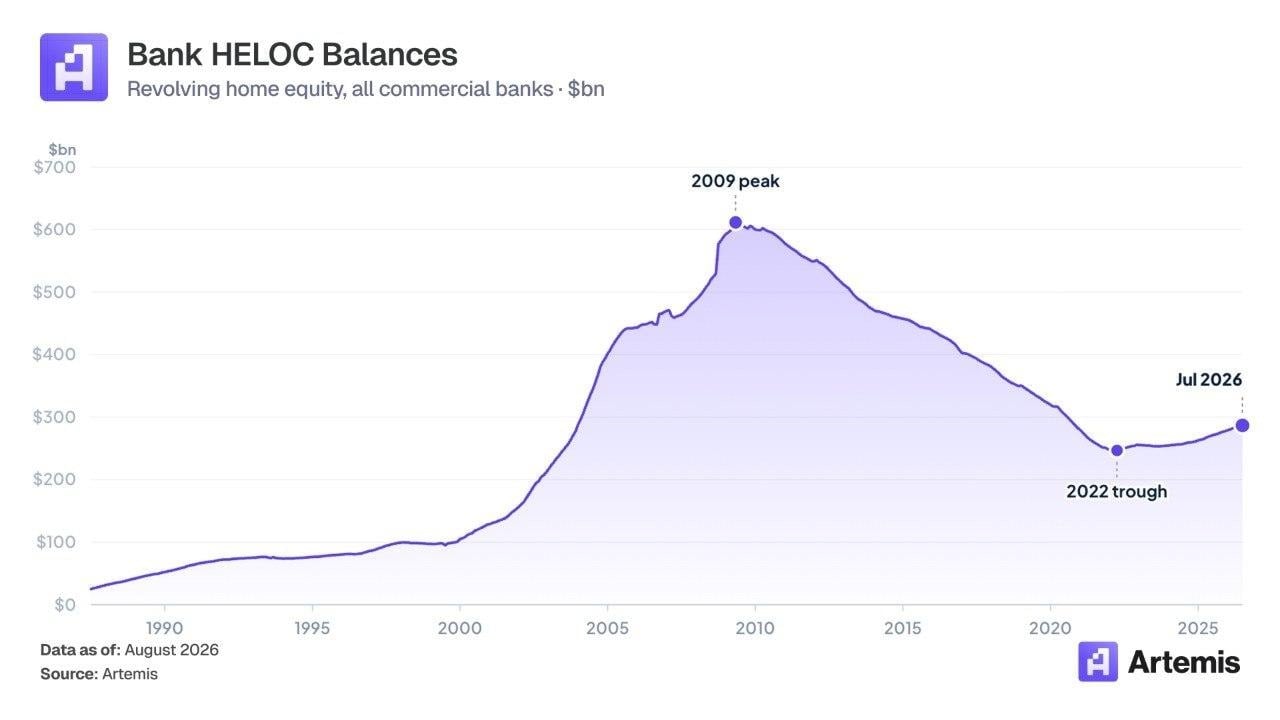
First, regarding the second lien, industry data indicates that after about 13 years of continuous contraction following the subprime crisis, the balances have recently started to rebound. Bank HELOC balances are expected to reach 287 billion USD in 2026 and resume growth, while the peak in 2009 was 600 billion USD. In 2025, the industry opened 1.2 million new HELOC lines, the highest since 2022, but still about half of the mid-2000s peak.
Currently, homeowners hold 71.6% of their property value as net worth, the highest level in about 35 years. Behind much of this net worth are mortgages locked in at interest rates between 3%-4%, making complete refinancing at the current rate of about 7% unfeasible. For homeowners wishing to access this net worth without giving up their low-rate first mortgages, the second lien is a rational choice.
At the time of recovery, Figure is the largest non-bank HELOC originator, and we believe it is facing a relatively thinly contested field: capital requirements, compliance costs, and a lack of support from government-sponsored entities have driven many lending institutions out of this category.
Meanwhile, Kiavi has opened a second front for Figure—the first lien, which will double Figure's existing liability business. The first lien serves borrowers who cannot be covered by the second lien: homeowners without loans—about 40% of US homes—and those with justifiable reasons to refinance existing balances. Individual balances typically range between 200,000 to 300,000 USD, with annual initiation flow of around 2 trillion USD, roughly ten times the market space of second liens.
Kiavi is the largest originator of transitional residential loans, which are loans for purchasing and renovating properties for resale lasting about 12 months. Its 85% of business volume comes from RTL. Kiavi's market share in the RTL market grew from 2.1% in 2020 to 9.7% in 2025, achieving this during three years of frozen housing turnover, while smaller competitors lost credit lines and failed. In 2025, it had a volume exceeding 7 billion USD and revenue exceeding 250 million USD, growing 30%, with an EBITDA profit margin around 40%.
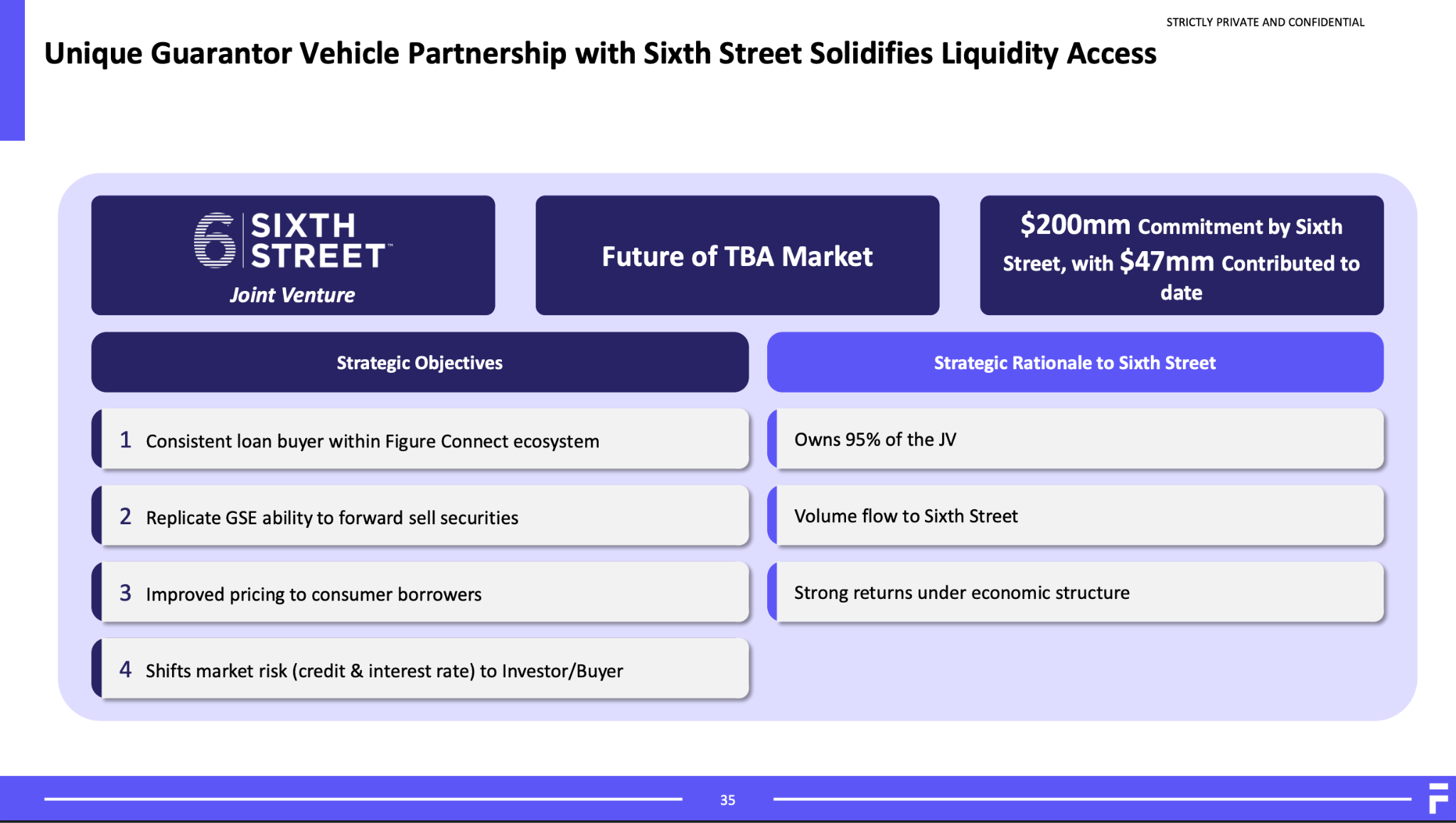
In our view, the structure of this deal is also important. Figure and Sixth Street jointly acquired Kiavi for 717 million USD in cash, with Figure paying 538 million USD and Sixth Street paying 179 million USD. Figure will retain the operating platform, while Sixth Street will place Kiavi's loan assets into a joint venture entity supported by over 3 billion USD in forward purchase commitments, locking in demand for Connect in advance.
3. The market likely misreads this transformation
We believe the mispricing exists for three main reasons.
The market may underestimate the sustainability of Figure's rates. The first lien structurally has lower rates than Figure's traditional second lien business, so as the proportion of first lien increases, the combination effect should mechanically lower the company's overall rates.
However, this has not happened so far. Figure's disclosed net rates have risen from 3.4% in the fourth quarter of 2024 to 3.8% in the first quarter of 2026, while the first lien proportion has nearly doubled, and second lien pricing has remained at around 4.5% to 5.0%. The underlying pricing seems healthy enough to absorb the effects of the combination changes.
This distinction is vital for valuation. Price erosion would reduce the economic benefits of existing business; while combination shifts in first liens would add incremental business at lower rate levels. Furthermore, Connect allows more such business volume to scale with less capital, almost no customer acquisition costs, and higher incremental profit margins. The market seems to anticipate a trade-off with rate compression; however, there are hardly any signs of deterioration in product-level pricing.
Weak research coverage. Currently, only four analysts cover FIGR. Since the first quarter 2026 earnings report, Figure has been publishing CLM transaction volumes on its website weekly, providing investors with an almost real-time revenue proxy metric. Yet, only one sell-side analyst has explicitly modeled CLM transaction volumes, and even this analyst's estimates are below the transaction volumes reported by Figure itself. Figure is offering a real-time data line while the market largely turns a blind eye.
Stock misclassification. Our judgment is that FIGR was initially traded as a proxy for cryptocurrency but now behaves more like a momentum stock, even as its business increasingly resembles financial trading platforms like Tradeweb or ICE.
We believe the valuation has not reflected this transformation. FIGR is currently trading at about 12 times EBITDA, the lowest multiple since its public listing: higher than the 5-7 times typically seen for professional lenders, but far below what a scaled financial platform should have.

Figure does retain some crypto-related business, including the stablecoin YLDS and its tokenized securities market, but collectively they contribute less than 2% of revenues. Management appears to be making efforts to correct market perceptions. Figure’s investor education materials are steering investors away from the crypto narrative and focusing instead on two increasingly pivotal variables determining the company's profitability: CLM transaction volume and rates.
Counterarguments
If Figure's competitive advantage proves to be only temporary, housing transaction volumes decline significantly, or the economics of its core products weaken, this argument would fail.
AI commodifies underwriting. A former Figure product manager believes AI may make five-day transactions a basic requirement, weakening Figure's speed advantage and forcing competition to shift toward price. We believe a more durable moat lies in the platform market, yet general improvements in industry underwriting speed and costs still pose a key risk.
Weak housing transaction volume
Weak housing transaction volume. Connect reduces credit risk, but does not eliminate transaction volume risk. The default rate on home equity lines of credit (HELOCs) is climbing from historical lows, while a downturn in the housing market will suppress HELOC demand and severely impact loans for renovation and resale.
Core pricing deterioration
Core pricing deterioration. This investment logic relies on product-level pricing remaining healthy, while the share of low-margin products continues to rise. A continued decline in second lien take rates, or net take rates dropping below about 3.5%, will indicate that competitive pricing pressure is beginning to outweigh the benefits brought by incremental transactions.
Governance risk materializes
Governance risk materializes. Cagney and Ou control approximately 71% of the voting power through a dual-class share structure, leaving shareholders with limited recourse. The check and balance factor is interest alignment: the substantial FIGR shares held by Cagney and his nearly decade-long experience in building Figure deeply ties his financial and career outcomes to the company's long-term results.
Our assessment is that Wall Street is still focused on two points: the risk of low take-rate products diluting Figure's economic effectiveness and the loans that Figure is still issuing. We believe this neglects the essence of the transformation. Connect is enabling more transaction volume to flow through the platform with less capital, lower customer acquisition costs, and higher incremental profit margins. In our view, as more loan volume circulates along these channels, Figure increasingly resembles a lending institution that the market is still valuing in traditional ways.
Important Disclosure
This article and all information contained herein are provided by Artemis Analytics Inc. and North Island Ventures, LLC (“NIV”) (collectively referred to as “the authors”) for informational purposes only, intended to provide educational content and general market commentary.
Any statements made in this article do not involve and do not constitute an offer of NIV investment advisory services, and none of the content herein, including but not limited to the companies mentioned, constitutes an offer to sell or solicitation to buy any securities, nor an invitation to subscribe for interests or shares in any current or future private investment funds of NIV (each a “Fund”). Such offers can only be made by qualified offerees upon receipt of the relevant confidential private placement memorandum, subscription documents, and governance documents (collectively, “operating documents”).
The information herein is not intended to be relied upon and should not be construed as accounting, legal or tax advice or investment recommendations. NIV does not act, and does not claim to act, as advisor or trustee for any potential investors in any Fund. Recipients of this article should consult their tax, legal, accounting or other advisors regarding the matters discussed herein.
While the information contained herein is believed to be accurate, neither the authors nor their respective affiliates and representatives (i) make any express or implied warranty as to the completeness or accuracy of the information, (ii) accept any responsibility for errors appearing herein, or (iii) have any obligation to update the information. Some information contained herein constitutes “forward-looking statements,” which can be identified by the use of words such as “may,” “will,” “should,” “expect,” “anticipate,” “project,” “estimate,” “intend,” “continue,” “aim,” or “believe” (or their negative forms) or other similar expressions. Actual events or results or actual performance of investments may differ substantially from those reflected or implied in forward-looking statements due to various risks and uncertainties. No representation or warranty is made regarding any forward-looking statements.
Any analyses and opinions in this article (including market commentary, statements or projections) may contain subjective factors (including certain assumptions) or be based on incomplete or incorrect information. The authors have no obligation to update the information contained herein.
This article depicts certain trademarks and logos owned by the companies discussed. All such trademarks remain the property of their respective owners and are used solely for direct identification or description of the companies discussed. Their use is not intended to, nor does it imply any sponsorship, endorsement or affiliation between the authors or their affiliates and the trademark owners.
NIV's advisory accounts currently invest in Figure and may independently decide to increase or decrease positions or exit such investments at any time for various reasons, without notice. No representations are made on any performance (historical or otherwise) or past records in this document. Company metrics, including but not limited to revenue, profitability, EBITDA, net income, and similar metrics, are not proxy indicators of potential investment performance and should not be construed as such. There can be no assurance that achieving any financial metrics (including stock price movements) will result in positive investment performance. Unforeseen or unconsidered events may have significant impacts on Figure’s performance and/or valuation—in which case projections may change significantly. Investment performance is based on and must consider numerous factors not reflected in material such as trading behavior, investment terms (e.g., share class), use of leverage, transaction costs, and other factors. Readers of this document should not interpret any price display as a proxy for the performance or investment returns of funds managed by NIV. NIV does not guarantee or warrant that any Fund will make similar investments. All investments carry a risk of total loss.
Discussion of Figure references public information, and certain estimates or projections are provided by Figure or primarily sourced from Figure. The authors make no representations regarding (i) the accuracy or reliability of any estimates or projections, (ii) the reasonableness of the applicable assumptions, and the completeness of inputs available, or (iii) the validity and reliability of the calculations. The authors make no guarantees regarding the prices of any securities traded. Numerous factors influence the performance of any investment.
免责声明:本文章仅代表作者个人观点,不代表本平台的立场和观点。本文章仅供信息分享,不构成对任何人的任何投资建议。用户与作者之间的任何争议,与本平台无关。如网页中刊载的文章或图片涉及侵权,请提供相关的权利证明和身份证明发送邮件到support@aicoin.com,本平台相关工作人员将会进行核查。


