Written by: 100y_eth
Translated by: AididiaoJP
Key Points
Unlike the recently stagnant tokenized U.S. Treasury market, the tokenized stock market is experiencing both quantitative and qualitative growth, expanding rapidly.
From traditional stock infrastructure providers, fintech companies, crypto exchanges to Web3 native platforms, all parties see tokenized stocks as the next significant opportunity in the RWA industry. In fact, there are various pathways for stock tokenization, making it crucial to understand the pros and cons of each and their positioning.
This article will analyze the strategies of various players from different backgrounds, including Securitize, Ondo, xStocks, Robinhood, DTCC, the New York Stock Exchange, Nasdaq, and Coinbase.
Everyone is Eyeing Tokenized Stocks
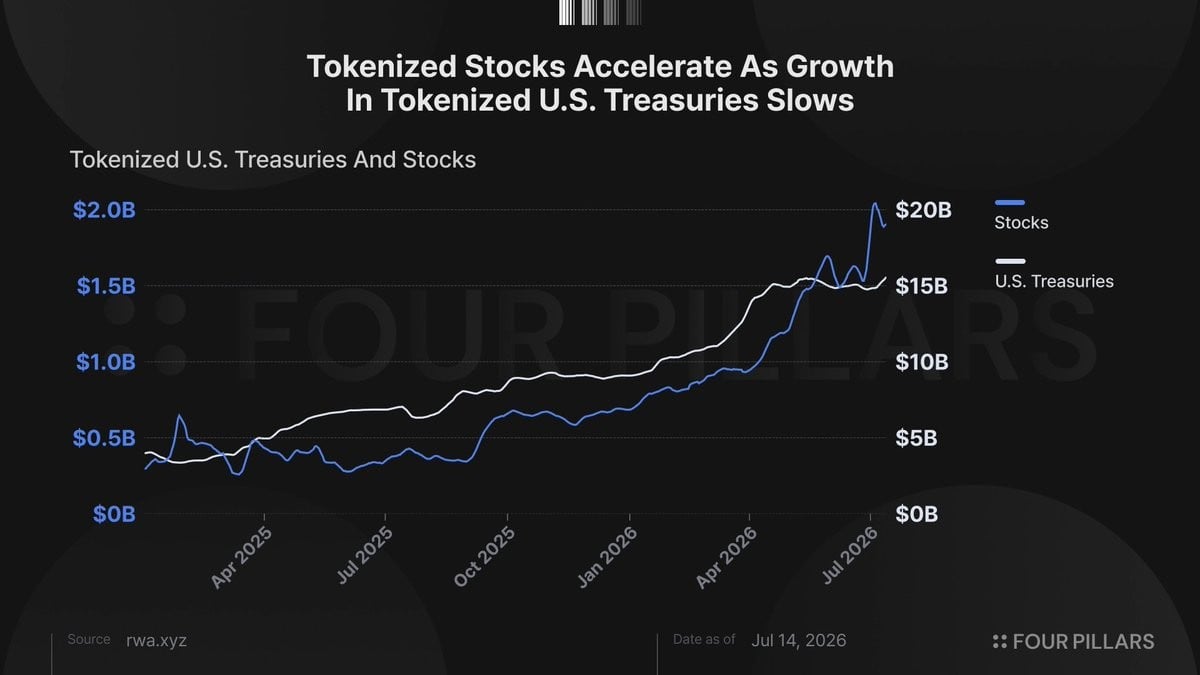
Today, regulators, banks, institutions, fintech companies, and nearly every major market participant are showing a strong interest in tokenization. However, the term "tokenization" has only recently become a focal point. The primary asset driving the growth of the tokenization market in its early stages was undoubtedly U.S. Treasuries. Its rapid increase is attributed to three factors: the safety of U.S. government debt, the relatively simple tokenization structure, and the higher yields at the time.
The tokenized U.S. Treasury market grew from $701 million on January 1, 2024, to over $15 billion for the first time on April 17, 2026, with an impressive compound annual growth rate of about 3.81 times. However, after surpassing $15 billion, the market has been hovering around this level, with growth visibly slowing. Considering that a significant portion of demand for tokenized Treasuries comes from DeFi protocols or exchange margin scenarios, it is not surprising that demand has stagnated in the current market environment.
As the momentum for tokenized Treasuries weakened, another track for tokenization is rapidly emerging in both quantity and quality—tokenized stocks. The market size grew from $291 million on January 1, 2025, to approximately $1.9 billion in just a year and a half, marking a 6.5-fold increase. From an industry perspective, whether it’s Web3 native players like Securitize and Ondo Global Markets, or financial companies like Robinhood and Coinbase, or financial infrastructure providers like DTCC, the New York Stock Exchange, and Nasdaq, they have either already launched tokenized stocks or are actively preparing to do so.
What advantages do tokenized stocks hold over traditional stock markets to lead almost all major players in the U.S. to treat it as the next significant opportunity? At first glance, tokenized stocks seem straightforward, but in practice, various tokenization structures emerge depending on the regulatory framework adopted, each with its respective advantages. To understand these differences, one must first clarify the SEC's classification framework for tokenized securities.
SEC's Classifications of Tokenized Securities
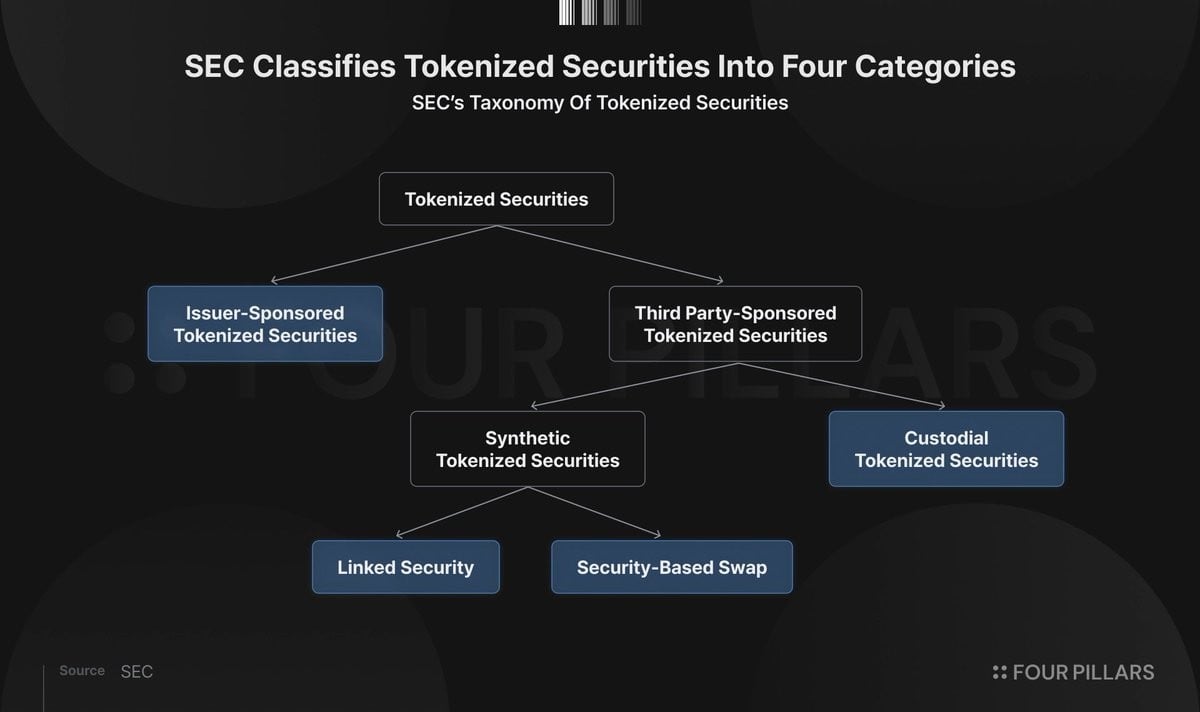
In January of this year, the SEC released a statement proposing a classification framework for tokenized securities.
Firstly, based on whether the tokenization subject is the securities issuer itself or a third party, tokenized securities are divided into "Issuer-Sponsored Tokenized Securities" and "Third Party-Sponsored Tokenized Securities."
Third Party-Sponsored Tokenized Securities are further subdivided: if the rights associated with the underlying securities are tokenized, it is termed "Custodial Tokenized Securities"; if only an independent tokenized product is issued that is only linked to the price, yield, events, or other features of the underlying securities, it is termed "Synthetic Tokenized Securities."
Synthetic Tokenized Securities can be classified further: if a third party issues an independent security (such as debt securities), it is referred to as "Linked Security"; if a derivative contract is signed, it is called a "Security-Based Swap."
Ultimately, under this framework, tokenized securities can be classified into the following four categories, and tokenized stocks are equally applicable:
- Issuer-Sponsored Tokenized Securities: Directly tokenized and operated by the stock issuer or its designated agent (such as a transfer agent). The issuer (or its agent) integrates blockchain or DLT systems with the official shareholder registry to maintain shareholder records. This method does not fundamentally alter the existing legal framework and directly complies with current securities laws. The biggest advantage is that all shareholder rights, including ownership, are inherited by the tokens. However, strict compliance requirements somewhat limit availability. Major representatives: Securitize, Superstate, Figure.
- Custodial Tokenized Securities: Third parties tokenize the rights to securities held by custodians (such as DTCC) or brokerages (indirect rights). All associated rights can also be inherited, but they heavily depend on existing stock market infrastructure, with ownership still being indirect and limited improvements to the traditional system. Major representatives: DTCC; Ondo has recently used this method to tokenize IVV and MU.
- Linked Securities: Third parties issue and tokenize an independent security (such as debt securities) to provide synthetic exposure to the underlying stocks. Token holders only gain exposure to price performance and do not inherit other shareholder rights. The biggest advantage is high flexibility for on-chain usage. Major representatives: Ondo, xStocks, Robinhood Stock Tokens.
- Security-Based Swaps: Third parties issue derivative contracts, providing synthetic exposure to the underlying stocks and subsequently tokenizing the contracts. Like Linked Securities, they only provide price-related exposure and do not inherit other rights. Currently, almost only Robinhood Classic Stock Tokens are a significant case.
Analysis of Major Tokenized Stock Platforms
Securitize: Taking the Most Direct Route
Securitize is currently the largest tokenization platform by market share, with a total of $5.1 billion in tokenized RWA, and its flagship product is BlackRock's money market fund BUIDL. Securitize holds SEC-registered broker-dealer, transfer agent, and ATS licenses, and exploits these regulatory advantages to adopt a "Direct Tokenization of Securities" model. According to the SEC classification, this falls under "Issuer-Sponsored Tokenized Securities."
Recently, Securitize has also expanded this model to tokenized stocks. When it listed its own stock SECZ via SPAC, it used its own services to tokenize and issue $180 million of SECZ on-chain.
The advantages of this model are clear: existing stocks can be tokenized as they are while fully complying with current securities laws. Investors first register ownership directly through DRS of stocks previously held through DTCC or brokers, and then Securitize tokenizes these stocks in its capacity as a transfer agent. The result is that stock tokens share the same CUSIP as existing stocks, inheriting not only economic rights but also voting rights, claims for remaining assets in bankruptcy, and all related rights.
However, since the tokenized stocks are essentially another form of the same stocks, they come with certain downsides. The most important issue is the strict compliance requirements, limiting on-chain usage. Unlike the tokenized stocks from Ondo or xStocks, Securitize's stock tokens can only be transferred between whitelist wallets that have undergone KYC/AML, and on-chain interactions can only occur with limited smart contracts approved in advance by the team.
How does Securitize enforce KYC/AML and other compliance requirements on-chain? The answer is the DS Protocol. This is a set of smart contracts developed by Securitize, enforcing compliance through code throughout the lifecycle of tokenized securities (issuance, transfer, usage, voting, dividends). Four Pillars has previously conducted an in-depth research report on the DS Protocol, which is also available on the Securitize website. Readers interested in understanding how tokenized securities operate at the smart contract level can refer to that report.
Other platforms that tokenize stocks using a similar approach include Superstate and Figure. They both perform tokenization as transfer agents, with the main difference being the type of stocks being tokenized: Securitize and Superstate tokenize shares that are identical to existing stocks through the DRS system, whereas Figure issues blockchain-native classes of shares separately and then tokenizes those shares.
Ondo and xStocks: Expanding Ecosystems with Broad Accessibility
Ondo and xStocks use a structure where, when users order stock tokens, an offshore SPV acquires the underlying stocks and then issues tokenized debt securities backed by these stocks.
For instance, with xStocks, it has a Jersey Island-regulated SPV—Backed Assets (JE) Limited. When users request the issuance of stock tokens through the platform, this SPV purchases the underlying stocks through U.S. Alpaca Securities and stores them in a segregated account with a regulated custodian. The SPV then issues independent debt securities backed by these stocks, tokenizing them and delivering them to users.
This structure falls under the SEC's classification of "Linked Securities."
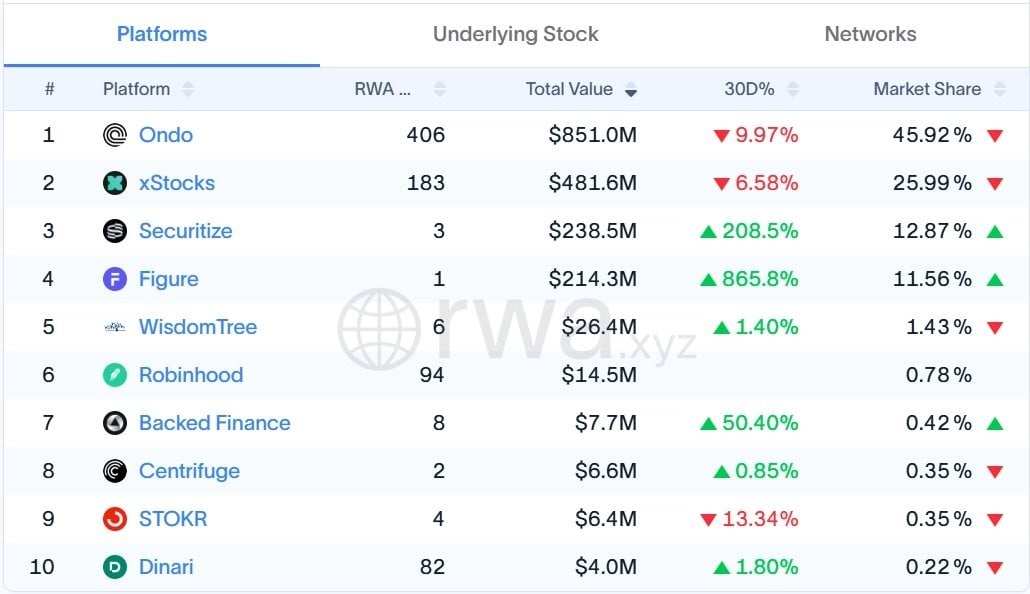
Currently, Ondo has tokenized 406 different stocks, with a total value of about $851 million; xStocks has tokenized 183 stocks, approximately $482 million. Both hold the top two market shares in the tokenized stock space, at 45.9% and 26.0%, respectively.
The key to their rapid growth lies in the broad accessibility brought by their tokenization structure. Strictly speaking, they are not tokenizing the stocks themselves, but rather tokenizing debt securities issued by third parties that are backed by stocks. Therefore, compared to the issuer-led model of directly tokenizing existing stocks, this type of structure has looser compliance requirements for distribution and secondary trading, allowing users to trade and use the tokenized stocks issued by Ondo and xStocks more freely on CEX and on-chain DeFi protocols. For example, with xStocks, anyone can trade using a Web3 wallet through the Jupiter DEX, and can also deposit them in lending protocols like Kamino as collateral to borrow stablecoins.
However, this indirect tokenization can also lead to issues: even if the underlying assets are the same, the tokens issued by different platforms do not interoperate, resulting in fragmented liquidity. For example, while both are backed by Nvidia stocks, Ondo issues NVDAon, while xStocks issues NVDAx, and the two cannot interchange. Additionally, due to reliance on Regulation S, U.S. investors and U.S. persons cannot participate.
To address these limitations, Ondo recently acquired Oasis Pro, obtaining broker-dealer, ATS, and transfer agent licenses, and began moving towards a more compliance-friendly tokenization model. In fact, Ondo has already used these licenses to tokenize holdings of IVV ETF shares and MU stocks in brokerage accounts through the "Custodial Tokenized Securities" model, demonstrating the possibility of parallel multi-structure frameworks.
Robinhood: Can a Latecomer Make an Impact?
A significant new player has emerged in the tokenized stock ecosystem—Robinhood. It had been offering tokenized stock services to European investors through Classic Stock Tokens, but according to SEC classifications, that structure falls under "Security-Based Swaps": Robinhood signs derivative contracts with users that are based on stocks and then tokenizes those contracts into receipt tokens. The whole structure is highly closed and can only be used within the Robinhood App.
On July 1, 2026, Robinhood launched a new Stock Tokens service. Its tokenization structure adopts the "Linked Securities" model, nearly identical to Ondo and xStocks, with similar advantages and disadvantages.
Despite the structural similarities, Robinhood's imaginative potential is clear: its product gene and large existing user base. When launching Stock Tokens, Robinhood also introduced the Robinhood Chain mainnet, centered around Stock Tokens. U.S. users can deposit stablecoins in Morpho on the Robinhood Chain through the Robinhood App to earn 7% interest. Although Robinhood is entering the market later than Ondo and xStocks, its product iteration capabilities and ecosystem expansion potential give it an opportunity for rapid growth.
DTCC, NYSE, Nasdaq: Signals of Financial Infrastructure Reshaping
It’s not just platforms and companies considering stock tokenization. Traditional key players in the stock market settlement and trading infrastructure—DTCC, the New York Stock Exchange, and Nasdaq—are also moving towards tokenization.
DTCC's DTC has received a no-action letter from the SEC allowing the tokenization of certain securities held by DTC on a pre-approved blockchain. DTC hopes to enhance collateral liquidity, extend trading hours, improve operational and settlement efficiency, and achieve programmability and real-time audits. On July 15, DTCC conducted limited tokenization of securities like QQQ and SPY within a true securities infrastructure environment, successfully completing transactions and collateral transfers.
In April 2026, the NYSE submitted a rule change proposal to the SEC to support DTC's tokenization pilot, allowing stocks to be settled in tokenized form. Additionally, the NYSE is developing a new regulated exchange—Digital Trading Platform—aiming to achieve 24/7 trading of U.S. stocks and ETFs using blockchain infrastructure and support stablecoin deposits. In March 2026, the NYSE signed a memorandum of understanding with Securitize, designating Securitize as the first potential digital transfer agent for the new platform.
Nasdaq received SEC rule change approval in March 2026, allowing trading and settlement of stocks in the DTC tokenization pilot in tokenized form. Nasdaq has also collaborated with Kraken's parent company, Payward, to design a gateway service that enables issuers and investors to transfer stocks between the regulated Nasdaq market and unlicensed blockchain environments.
Coinbase: Which Path Will It Take?
The last player worth noting is Coinbase. It has yet to launch a tokenized stock service, but has expressed intentions to do so multiple times since last year. In February of this year, Coinbase launched traditional stock trading for 5×24 in the U.S.; at a June event, it announced that tokenized stocks would be offered soon.
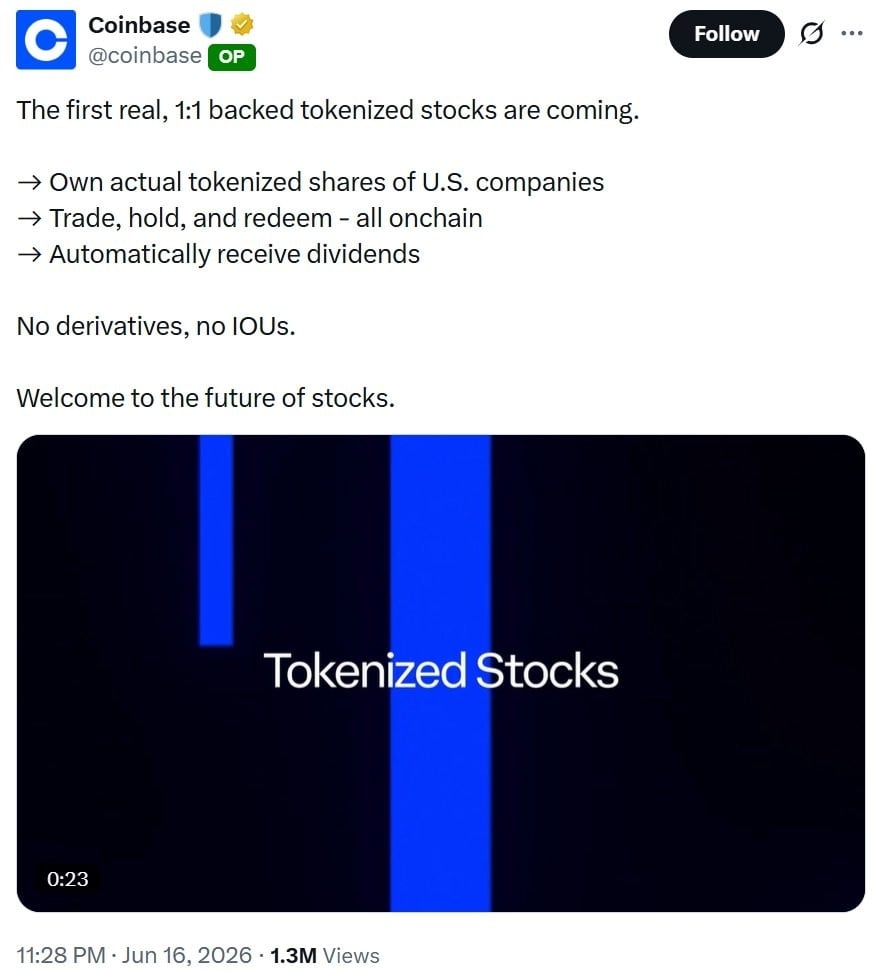
The industry is highly attentive to what structure Coinbase will use to tokenize stocks. Coinbase stated that its service will not only provide a 1:1 backing of tokens to real stocks, but will also offer shareholder rights, though specific structures have yet to be detailed. More critically, it explicitly stated that these stock tokens could be used on-chain while not being available to U.S. customers.
If it adopts an issuer-led structure, the tokens would generally inherit all shareholder rights and be open to U.S. customers, but the on-chain availability would be relatively limited. The combination of "broad on-chain availability + exclusion of U.S. customers" is more akin to a third-party structure (such as Linked Securities). It will be interesting to observe which structure Coinbase ultimately chooses for tokenizing stocks and how it leverages its exchange infrastructure to expand the tokenized stock ecosystem.
Competing on the Same Battlefield
The goal of financial services is clear: to allow anyone, anywhere, at any time, to trade any type of asset through a single backend and frontend. Today's financial services seem to be approaching this goal, but in reality, integration mostly occurs at the frontend, with the backend remaining fragmented.
Stocks, as one of many asset classes, are no exception. Robinhood, which started with stock trading, Coinbase, which began with crypto trading, traditional stock infrastructure providers DTCC/NYSE/Nasdaq, and Web3 native players like Securitize, Ondo, and xStocks all have different tokenization structures and strategic directions but are all moving towards the same guiding star—tokenized stocks.
Moving forward, it will be important to observe how the U.S. and other jurisdictions view tokenized stocks, how the regulatory frameworks will be implemented, and how these changes will reshape the competitive landscape; also, whether tokenized stocks will become the next significant catalyst for the expansion of the entire RWA track following tokenized U.S. Treasuries.
The South Korean market is also noteworthy: despite high retail trading activity, the RWA industry is developing relatively slowly. It will be interesting to track how discussions surrounding tokenized stocks unfold in South Korea.
免责声明:本文章仅代表作者个人观点,不代表本平台的立场和观点。本文章仅供信息分享,不构成对任何人的任何投资建议。用户与作者之间的任何争议,与本平台无关。如网页中刊载的文章或图片涉及侵权,请提供相关的权利证明和身份证明发送邮件到support@aicoin.com,本平台相关工作人员将会进行核查。


