
Original Report: Morgan Stanley Research "Weighing In: Open-Weights Models & 3 States of the World," August 3, 2026
Compiled and Organized by: DaiDai, Frank, MSX Mingtong Research Institute
Core Overview
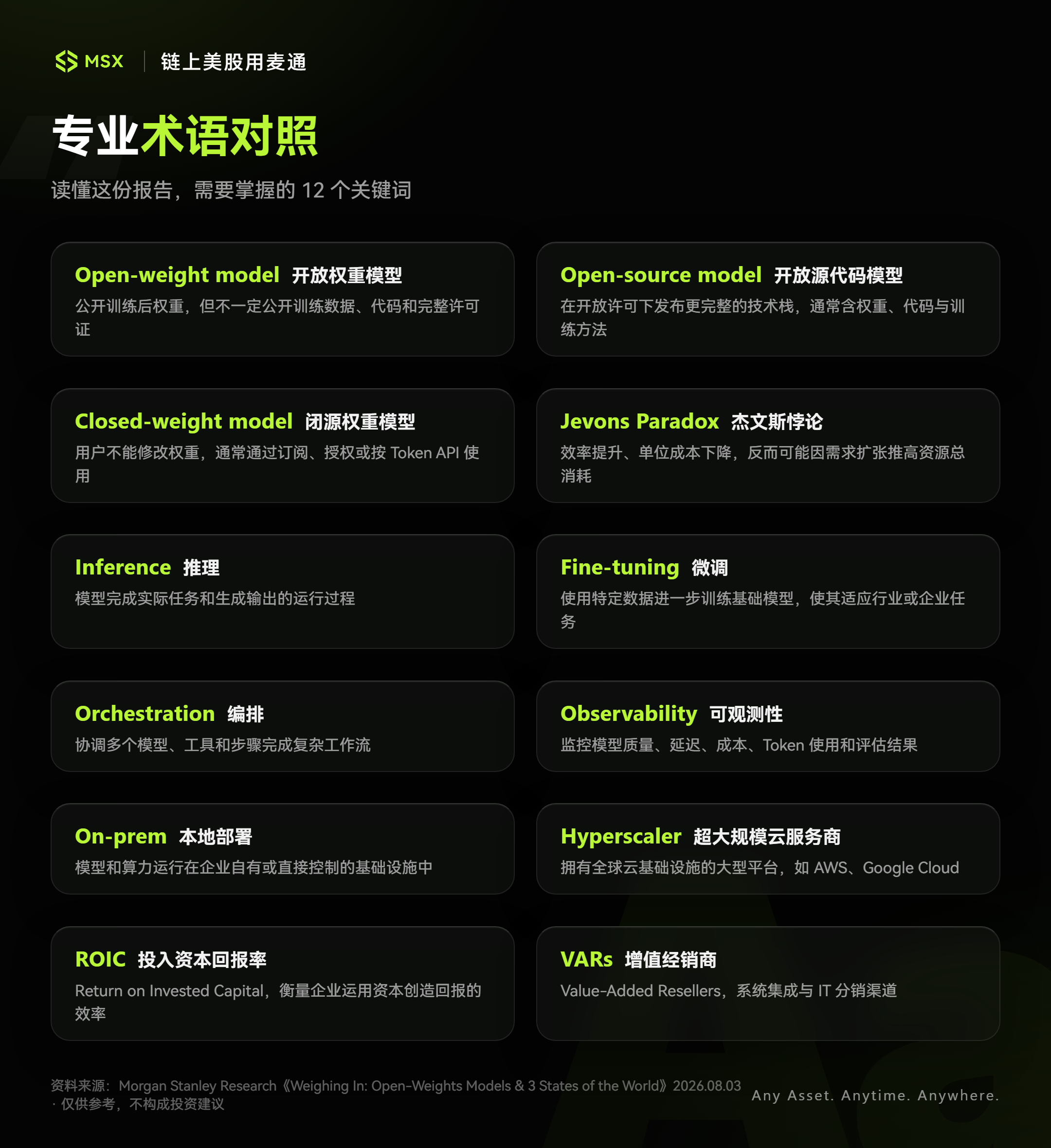
- Open weight models reduce the cost of single calls and deployment thresholds, but do not necessarily reduce total computing power demand. As AI enters more enterprises, workflows, and devices, the growth in call volume may exceed efficiency gains, triggering a typical "Jevons Paradox";
- Enterprises have already entered a multi-model era, where open weight models primarily handle programming, document processing, high-frequency calls, and specific domain tasks, while complex reasoning and Agent workloads still rely more on cutting-edge closed-source models;
- Open weights do not equal free; enterprises may save on model licensing fees or some API costs, but still need to bear costs for GPUs, cloud services, local data centers, fine-tuning, talent, security, and operational management;
- Regardless of whether closed-source, mixed, or open weight models ultimately dominate, NVIDIA, onsite power, and security software are clear beneficiaries across scenarios;
- The more open weight models become popular, the more likely the AI value chain will spread from foundational model layers to inference, routing, orchestration, observability, local infrastructure, edge devices, and vertical applications;
Every so often, the AI market seems to experience an "efficiency panic."
When model parameters shrink, inference costs drop, or a model company achieves near-leading performance with fewer chips, the market quickly develops an intuition that as computing resources needed to complete the same tasks decline, will demand for GPUs, data centers, and power peak as well?
The emergence of next-generation open weight models, such as Kimi K3 and DeepSeek V4 Flash, brings this question to the market again. They not only attempt to narrow the capability gap with leading closed-source models but also allow enterprises to download, modify, and deploy models independently, spreading capabilities that were once highly concentrated in a few American model labs to a broader developer and enterprise tech stack.
However, Morgan Stanley's latest report provides an answer opposite to this intuition:
Improved model efficiency is unlikely to kill computing power demand; it is more likely to make AI cheap enough to enter previously uneconomical scenarios, ultimately driving up overall call volume.
On this basis, the real discussion needs to shift to where computing power will occur, who will provide it, and which companies can earn revenue from this diffusion.
1. Why might cheaper models consume more computing power?
A common misunderstanding about open weight models is equating "lower model costs" directly with "lower infrastructure demand."
But for most enterprises, whether to adopt AI depends not only on how much computing power is required to complete a task but on whether the gains it creates can cover the costs of models, engineering, and infrastructure.
Calculations cited by Morgan Stanley show that an enterprise AI task can average about $55 in returns, while direct costs are approximately $2–$5. Even considering data, engineering, security, and management costs, this return-to-cost ratio still implies that many enterprise workflows have yet to be fully realized with AI.
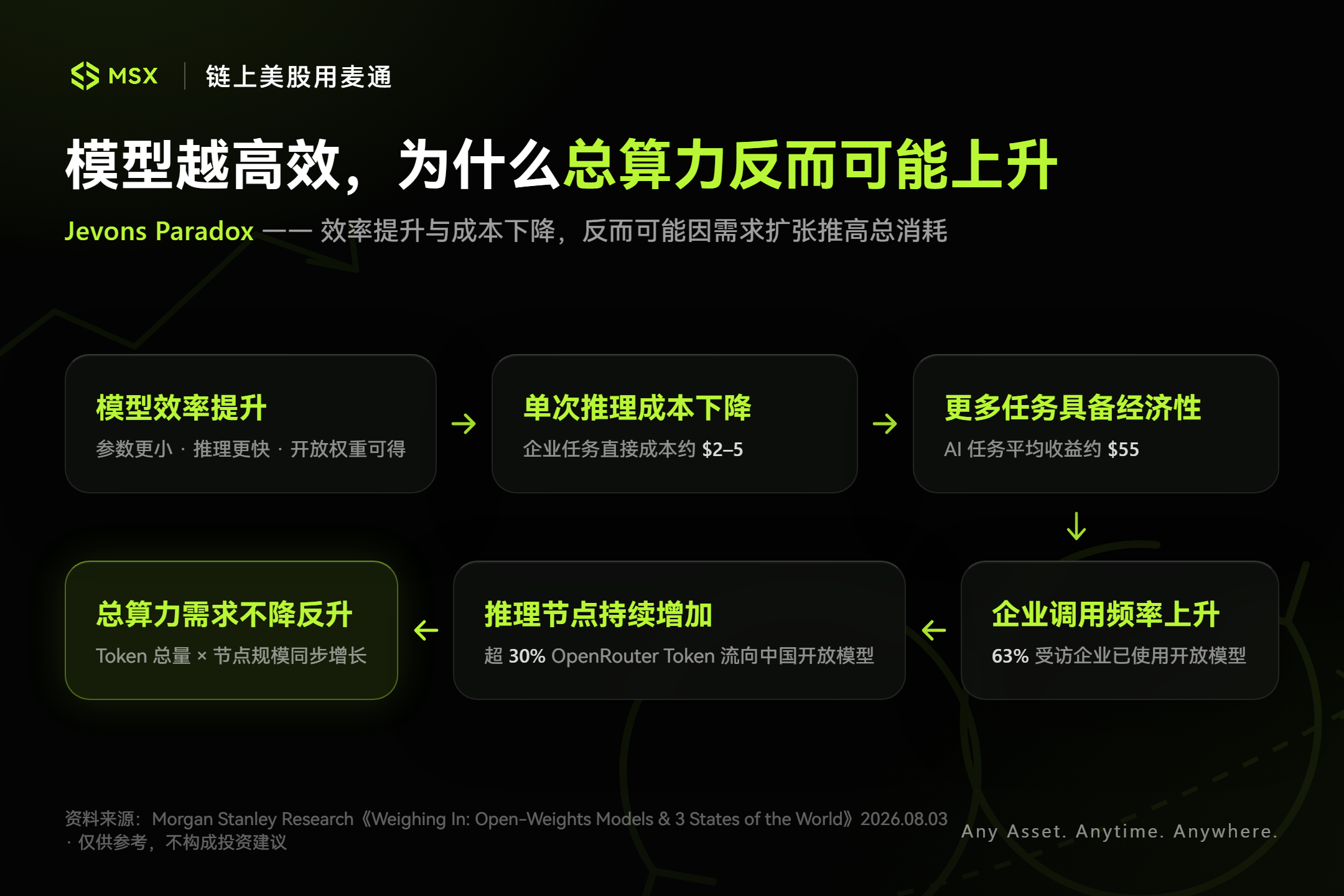
In such a scenario, the result of model price reductions may not be enterprises cutting AI spending but rather more tasks crossing the threshold of economic feasibility.
In the past, enterprises might have entrusted only the most important, high-value tasks to AI; as inference prices continue to decrease, customer service record categorization, contract review, code testing, product descriptions, enterprise searches, marketing materials, data cleansing, and even internal approvals could all be incorporated into modeled workflows.
The amount of computing resources required for each task may decrease, but the number of tasks, frequency of execution, and user scale will expand simultaneously.
This is precisely the "Jevons Paradox" mentioned repeatedly in the report: when the efficiency of using a resource improves and unit costs decrease, its total consumption might actually increase due to the rapid expansion of its application range.
For instance, more fuel-efficient cars did not automatically eliminate global oil demand; cheaper internet bandwidth did not lead to reduced data traffic. Similarly, more efficient models may not reduce GPU usage but rather transform AI from a few high-value tasks into a pervasive foundational capability within enterprises.
Currently, this diffusion is already beginning to occur.
The report cites a McKinsey survey indicating that 63% of surveyed enterprises are already using open models in their tech stacks, but most have not completely abandoned closed-source models. Instead, they are using a combination of both, with open weight models primarily utilized for programming, document parsing, high-frequency calls, and specific domain tasks, while cutting-edge closed-source models continue to handle complex reasoning, higher reliability requirements, and tasks that are harder to standardize.
From February to July 2026, the percentage of tokens routed through OpenRouter to Chinese open models by American companies exceeded 30% on a weekly basis, a figure that may lean more toward developers and startups and cannot directly represent spending by large enterprises but at least indicates that open weight models have moved from lab concepts into real calling and deployment environments.
Of course, open weight models do not equate to "free models."
When enterprises self-host, they may no longer pay token-based API fees to model providers but still need to purchase or lease GPUs and bear the costs of data centers, cloud services, fine-tuning, engineering teams, security, and daily operational costs. This means that enterprises using open weight models through managed APIs provided by model vendors or cloud platforms may still pay based on tokens or computational volume.
Thus, what changes with open weights is not whether computing costs exist, but how enterprises pay those costs and whether the value comes from model vendors, cloud platforms, or the enterprises' own infrastructure.
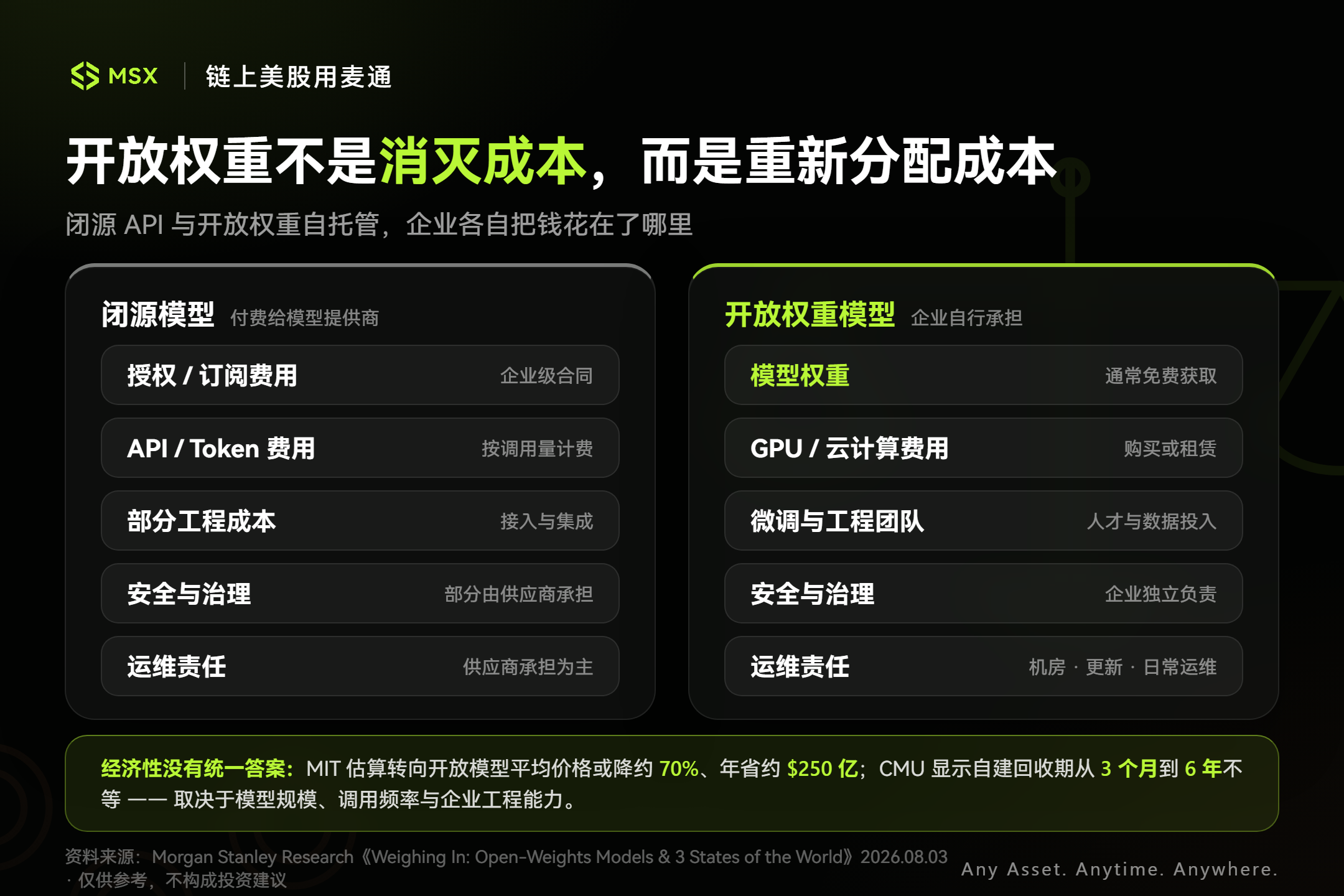
A study cited by Morgan Stanley from MIT estimates that shifting from closed-source models to open models could reduce average prices by about 70%, saving consumers approximately $25 billion annually. However, the report also notably cautions that this study was completed early, and the capabilities of different models are not entirely comparable and may not fully account for implicit costs such as engineering, fine-tuning, and operational management.
Another study by Carnegie Mellon shows that the payback period for self-deployment of open models can extend from about 3 months to 6 years, with models that have smaller parameters, fixed tasks, and high call frequencies able to amortize hardware costs more quickly; large models and complex enterprise applications might be unable to prove cheaper than APIs for a long time due to low utilization, frequent updates, and high fine-tuning costs.
Therefore, there is no unified answer to the economics of open weight models.
It depends on model scale, usage frequency, infrastructure utilization, enterprise engineering capabilities, and whether data must remain local. The more open the model, the more choices enterprises have, but the more technical responsibilities they must assume.
2. In the next phase, where will computing power occur?
If the future of AI is dominated only by a few closed-source models, training and inference will continue to concentrate in large cloud platforms and massive data centers.
However, if open weight models achieve broader adoption, AI computing power will not disappear but will further diffuse from a few central nodes to private clouds, enterprise data centers, sovereign data centers, edge servers, and personal devices.
This means that the variables the market needs to focus on will shift from "how many GPUs are needed" to "where are GPUs deployed, who manages them, and how are they called."
During the closed-source model era, enterprises could outsource most of the complexities to model companies: connect to an API, pay by token, with providers responsible for model updates, infrastructure, security alignment, and some legal liabilities.
As we enter the multi-model era, this simple structure begins to break down.
Enterprises may assign the most complex tasks to cutting-edge closed-source models while allocating high-frequency, cost-sensitive tasks to open weight models; sensitive data remains local while general workloads run on public clouds; some requests are processed in data centers while others are completed directly on computers, mobile phones, or other edge devices.
The greater the number of models and the more dispersed the deployment locations, the more complex the enterprise AI tech stack will become:
- First, there is the gateway layer: enterprises need a unified entry point to manage identity authentication, calling permissions, rate limits, logging, and vendor failover for different models;
- Second, there is the routing layer: the system needs to allocate each request to the most suitable model based on accuracy, latency, cost, data sensitivity, and task difficulty;
- Next is the orchestration layer: complex Agent workflows often require multiple models, databases, and external tools to coordinate, with a single user request potentially broken down into dozens of steps and calls;
- Finally, there is the observability and evaluation layer: enterprises must continuously track the quality of model outputs, response delays, token usage, operational costs, failure causes, and security risks.
This is also why the diffusion of open weight models not only benefits model vendors.

As foundational models become more accessible, enterprises are more willing to pay for "how to stably deploy models in production." Model gateways, task routing, Agent orchestration, data governance, observability, and security software could become the tougher segments of the value chain to compress.
The importance of security is especially pronounced. When closed-source models run in concentrated settings, some security responsibilities are borne by model labs and cloud platforms; however, as open models enter enterprises' local, private clouds, and edge devices, identity, data, endpoints, model weights, and runtime environments all require independent protection.
Enterprises not only need to prevent employees from sending sensitive data to the wrong models, but they also need to manage which databases different models can access, which tools can be called, and whether they might be vulnerable to prompt injection, model distillation, weight manipulation, or permission misuse.
The more dispersed the model deployments, the larger the attack surface; the more models there are, the higher the governance costs.
Thus, what open weight models truly bring is not the disappearance of AI infrastructure value but a diffusion of value from a single foundational model and API layer to the entire system stack.
Future AI spending may no longer only reflect a few tech giants building super training clusters, but will also manifest as enterprises purchasing servers, upgrading networks and storage, deploying security systems, building private AI platforms, and configuring stronger edge computing power on phones and PCs.
Demand for computing power shifting from centralized to distributed does not mean a decrease in total demand; it simply means that beneficiaries are no longer concentrated solely in model labs and large cloud vendors.
3. Three worlds of AI: Regardless of who wins, no one can avoid computing power, energy, and security
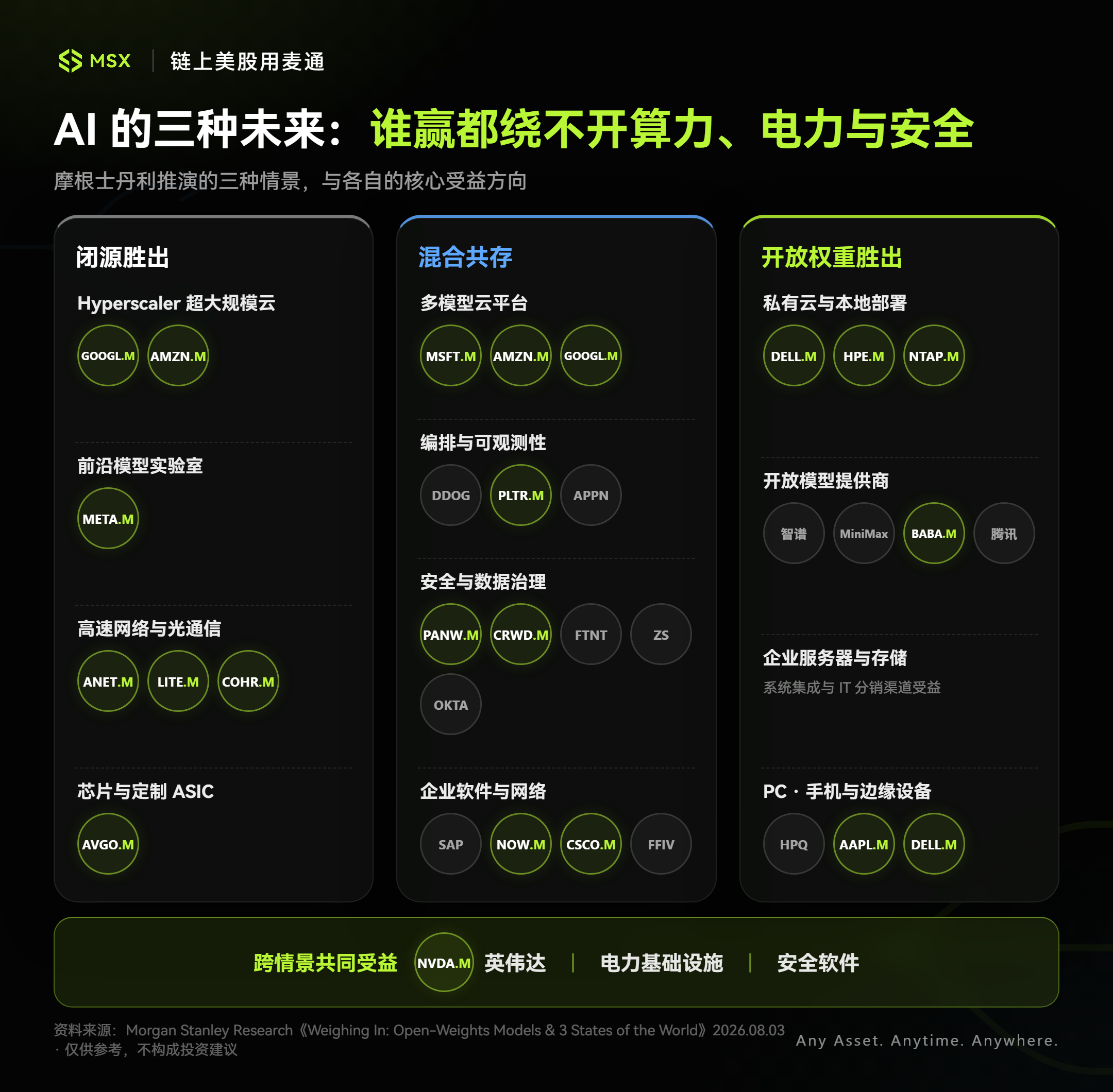
Morgan Stanley did not assign clear probabilities to the three future scenarios but explored the possible value distribution in the AI industry chain for each scenario—closed-source models winning, mixed architectures coexisting, and open weight models prevailing.
First World: Closed-source models continue to dominate frontier capabilities
In this scenario, the performance, reliability, and security capabilities of leading models remain difficult to replicate, and a few financially strong model labs continue to maintain leadership.
Enterprises prioritize accuracy, deployment convenience, intellectual property compensation, and brand credibility over complete control of model weights, and are thus willing to continue paying for closed-source APIs and enterprise subscriptions.
Training and inference workloads will further consolidate on platforms like AWS, Google Cloud, and other hyperscalers, with super training clusters continuing to drive demand for GPUs, high-speed networks, optical communications, and custom ASICs.
Platforms like Google and Amazon, which possess cloud infrastructure and model capabilities, will be in a more advantageous position, while chip and network vendors like Broadcom, Arista Networks, Lumentum, and Coherent may also benefit.
Report calculations indicate that if Google can run the Gemini API on its own infrastructure with its leading model, its implied capital return could reach about 45%; even if the model is not in an absolute leading position but solely as an infrastructure provider, the relevant return might still approach 30%.
This suggests that the most critical asset in a closed-source world is not just the model itself but also the ownership of the computing power it relies on; whoever owns the chips, data centers, and customer entry points has a greater capacity to retain profits generated from model calls.
Second World: Open and closed models coexist in the long term
This is the scenario that most closely matches the actual usage state of enterprises today.
Closed-source leading models handle complex reasoning, long-process Agents, and highly reliable tasks, while open weight models and smaller models manage high-frequency, cost-sensitive, low-latency, or highly specialized work.
Enterprises will not just choose one model but will constantly switch and route based on tasks, which also means AI deployment coexists across public clouds, private clouds, local infrastructures, and edge devices.
In this scenario, a single model vendor will find it difficult to gain completely monopolistic pricing power, but the overall AI software and infrastructure market will experience the broadest demand.
- Microsoft, Amazon, and Google will continue to benefit from cloud workloads;
- Infrastructure and workflow software vendors such as Datadog, Palantir, and Appian may benefit from demand for model orchestration, data connectivity, and observability;
- Security vendors like Palo Alto Networks, CrowdStrike, Fortinet, Zscaler, Netskope, and Okta will benefit from the continuous expansion of enterprise attack surfaces and identity boundaries;
Meanwhile, network equipment manufacturers like Cisco and F5, as well as enterprise infrastructure companies like Dell, HPE, and NetApp, may also gain new demand from local and hybrid deployments.
The main investment implication of mixed architectures is that AI spending will not only concentrate on training clusters but will layer down the enterprise tech stack, and the more intense the competition at the model layer, the more enterprises will need neutral software and infrastructure to help them switch between different models and deployment environments.
Third World: Open weight models become mainstream
In this scenario, open weight models gradually approach cutting-edge closed-source models, foundational model intelligence becomes widely accessible, and API prices significantly decrease.
Enterprises will no longer be willing to pay excessive premiums for generic model capabilities but will use private data to fine-tune, allocating primary budgets to inference optimization, Agents, industry tools, and application deployment.
The focus of innovation will shift from pre-training to post-training and application layers, and AI infrastructure will also become more decentralized. Governments and large enterprises may increasingly deploy more models in sovereign clouds, private data centers, and local environments for reasons relating to data sovereignty, privacy, latency, and avoiding vendor lock-in.
- Microsoft may leverage Azure, GitHub, enterprise software, and the open model ecosystem to secure a stronger position;
- Strategic value for open model providers like MiniMax, Zhipu/Z.ai, as well as Alibaba and Tencent will rise;
- Local infrastructure vendors like Dell, HPE, NetApp, and edge device companies like HP and Apple, along with system integrators and IT distribution channels, will also see significantly greater demand;
However, an open world does not mean that cloud platforms lose value.
Most enterprises will still not fully build their infrastructure; open models may still run on Azure, AWS, or Google Cloud, and the role of hyperscalers will shift from being the sole model entry point to providers of open model hosting, computing resources, data services, and enterprise AI platforms.
Therefore, cloud vendors face not simple win-lose scenarios but rather changes in profit structures, for example, foundational model rents may decline, yet revenues from computing, storage, databases, security, and enterprise services may still grow.
Common winners across the three outcomes
In the asset matrix presented by Morgan Stanley, the most noteworthy point is not the companies unique to each scenario but rather those names that recur across all three columns.
First is NVIDIA.
If closed-source models win, it means more computing power will be centralized in super-large training and inference clusters; if open weight models triumph, it signifies inference nodes will diffuse to enterprises, local, and edge environments.
The corresponding forms of chips, customer structures, and individual cluster sizes may differ between the two paths, but both require sustained increases in computational capacity. Ultimately, open models lower the threshold for model usage, not eliminate the computational processes.
Second is energy.
The closed-source world needs stable gigawatt-level power to support super data centers, while the open world will increase power demand for enterprise data centers, sovereign clouds, and onsite inference facilities. Improved model efficiency may reduce the electricity consumption of single tasks but could also lead to more tasks and devices running AI continuously.
Thus, onsite power, natural gas, and energy infrastructure companies like Bloom Energy, Williams, and Liberty Energy are repeatedly included in the list of beneficiaries by the report.
Third is security software.
Regardless of whether enterprises use closed-source or open models, they need to protect identity, data, and applications; as deployment diffuses from a few cloud platforms to local and edge environments, security needs will only become more complex.
From this perspective, security software might be the underestimated secondary beneficiary in the diffusion of open weight models.
In Conclusion
Overall, what open weight models may truly kill is perhaps not the demand for computing power, but rather the imagination that the foundational model layer can maintain high rental rates in the long run.
As model capabilities gradually become widespread, enterprises will no longer pay solely for "gaining intelligence" but will invest more budgets into how to deploy intelligence, connect data, manage workflows, protect systems, and ensure that models continuously generate returns in real business.
Computing power will not simply shift from growth to decline—it may spread from a few super training clusters to more inference nodes, enterprise data centers, sovereign clouds, and edge devices; morphing from one-time model training competitions into long-term infrastructure investments covering every workflow in enterprises.
Thus, the greatest change brought about by open weight models is not that the AI CapEx cycle is about to end, but that this cycle is entering a new phase with more participants, more decentralized deployments, and a longer value chain.
免责声明:本文章仅代表作者个人观点,不代表本平台的立场和观点。本文章仅供信息分享,不构成对任何人的任何投资建议。用户与作者之间的任何争议,与本平台无关。如网页中刊载的文章或图片涉及侵权,请提供相关的权利证明和身份证明发送邮件到support@aicoin.com,本平台相关工作人员将会进行核查。


