Author: Jae, PANews
On August 7, Musk's two publicly listed companies, SpaceX and Tesla, joined forces to announce an investment of $16.8 billion to build the Terafab chip factory. Just a day earlier, SpaceX set a record on Wall Street for the largest "chip deluge" in history, with over 900 million early employee equity incentives being concentratedly unlocked.
What surprised the market was that after a large number of shares entered circulation, SpaceX's stock price rose a cumulative 24.5% over two consecutive days, showing no signs of reversal and instead achieving better-than-expected results in its first secondary market test. However, the ongoing wave of unlocks lasting until December still casts a shadow over SpaceX's forthcoming stock price increases.
On one hand, there is the expanding map of AI infrastructure, and on the other, there is the pouring out of unlocked shares. This capital game drama regarding AI computing power, space, and pricing power is fiercely unfolding in the secondary market.
Musk Takes Computing Power to the Skies: $16.8 Billion for Self-Built Chip Factory, Partnering with NVIDIA to Send Data Centers into Space
In the physical world, Musk is executing the largest vertical integration in U.S. industrial history, extending the frontline of computing power from the Earth's surface to near-earth orbit.
Terafab Foundry: A Major Bet on AI Chip Manufacturing
On August 7, SpaceX and Tesla jointly announced that they would invest $16.8 billion in Texas to establish a super-large AI chip manufacturing complex named "Terafab," covering an area of 100 million square feet, attempting to break free from the bottlenecks of the global semiconductor supply chain and achieve full-process integration in the manufacturing, packaging, and testing of high-end logic chips and memory chips.
Terafab will mainly be used to meet the computing power needs of Musk's ecosystem exceeding 1 terawatt (TW). The produced chips will be divided into two paths: one for SpaceX, manufacturing high-power, radiation-resistant high-performance processors for space orbital data centers; the other for Tesla, used in the Optimus humanoid robot and Cybercab self-driving edge inference chips. Notably, the Texas government has also allocated a special subsidy of $30 million for this.
Starmind: Moving Data Centers into Space
In terms of computing power, the "Starmind" plan, promoted by SpaceX in collaboration with NVIDIA, aims to send data centers into space, potentially redefining the physical shape of AI infrastructure.
This plan will deploy NVIDIA's next-generation Rubin GPUs and Vera CPU architectures on a new generation of Starlink satellites and dedicated computing power platforms, taking advantage of the low-gravity environment and unshaded solar resources in near-earth orbit to complete edge training and inference of remote sensing data in space, and achieve global low-latency distribution through inter-satellite laser links, thereby bypassing the environmental constraints such as power supply and heat dissipation faced by ground data centers, expanding the boundaries of computing power infrastructure into near-earth orbit.
However, space AI data centers still face numerous challenges, including hardware reliability, space radiation, communication latency, equipment maintenance, and launch costs. Currently, no enterprise has proven that large-scale orbital data centers can surpass ground data centers in terms of economic viability and operational efficiency.
SPCX Rises Over 20% Against the Trend: Massive Unlocking Surge Does Not Break Stock Price, Growth Engine Shifts to AI
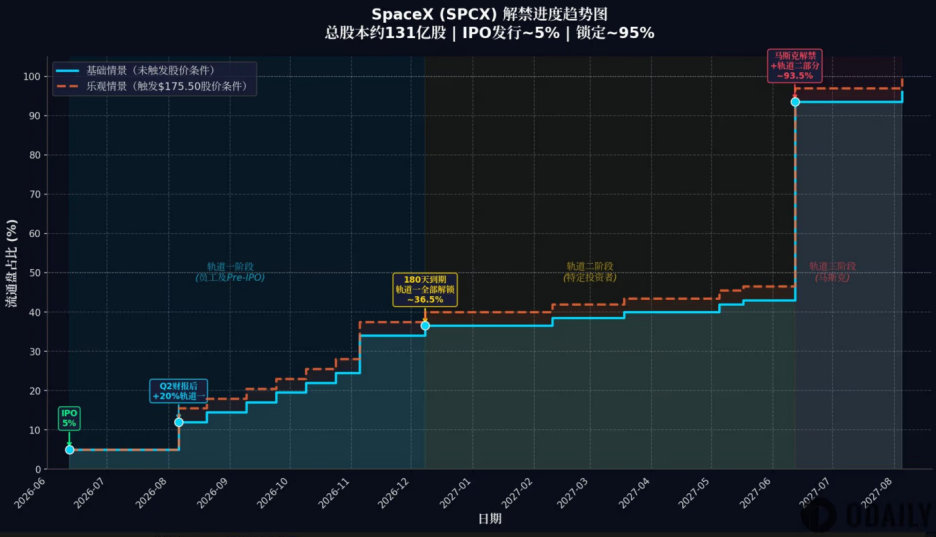
Returning to the capital market, the most direct factor affecting SpaceX's stock price in the next phase is the release of a massive amount of shares due to the expiry of the lock-up period post-IPO. Employee equity incentives accumulated over twenty years are now concentrated in the secondary market, with the unlocking scale being rare in the history of U.S. stocks.
The curtain on the unlocking was officially lifted on August 6. The first batch of approximately 912 million shares was unlocked, equivalent to 140% of the initial circulating supply, with the circulating share ratio rising from less than 5% to about 12%. Generally speaking, a substantial expansion on the supply side will create significant pressure on the market's capacity to absorb it, thus suppressing the short-term stock price. However, as of now, the price of SPCX has risen over 20%. Bloomberg noted that the market had already anticipated the hundred billion level sell-off pressure on SPCX and had digested it in advance.
It is essential to be alert that SpaceX will enter a peak period of unlocks. Bernstein data shows that the initial unlock permits about 20% of restricted internal shares to be sold. Subsequently, about 7% of total shares will be unlocked in stages before October, with a new round of unlocks expected after the third-quarter earnings report. Bernstein estimates that by December, once the 180-day lock-up period ends, the proportion of publicly traded shares of SpaceX could rise to about 40% of the total equity. Early employees and management have low holding costs, and the demand for cashing out is stronger. The tiered release of supply effectively constructs an invisible ceiling above the stock price.
At the same time, a day before the stock unlock (August 5), SpaceX released its financial report for the second quarter (Q2) of this year.
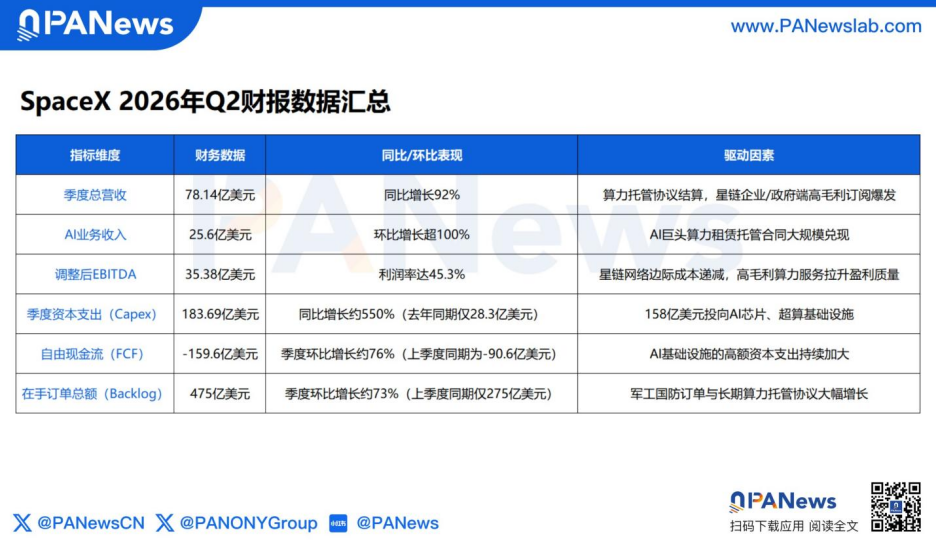
The financial report showed that SpaceX achieved total revenue of $7.814 billion in Q2, a significant year-on-year increase of 92%; adjusted EBITDA reached $3.538 billion, with a profit margin of 45.3%; and the order backlog soared to $47.5 billion, increasing by $20 billion quarter-on-quarter, of which about 56% of orders are expected to convert into actual revenue within the next year, with all three key indicators significantly exceeding Wall Street's consensus expectations.
A more symbolic change is the shift in revenue growth engines. The space launch services that have supported SpaceX in the past are gradually giving way to AI infrastructure and Starlink enterprise/government subscriptions. Among them, AI business revenues reached $2.56 billion in a single quarter, doubling quarter-on-quarter, mainly coming from supercomputing hosting and cloud service revenues provided to AI giants like Anthropic. This indicates that SpaceX's valuation logic is changing. The market is no longer solely measuring it by the standards of an aerospace company but is beginning to view it as a potential player in the competition for AI infrastructure.
Intense Tug-of-War for SPCX: Short Sellers Bet on "Unlimited Cash Burn," Bulls Wager on "Valuation Mismatch"
The massive unlock has provided a natural soil for short sellers to bet against the stock, and the release of the financial report further exacerbated the degree of divergence between bulls and bears, making SpaceX one of the hottest battlegrounds between the two camps on Wall Street.
Short Sellers’ Camp: Betting on Supply Shock and Uncontrolled Capital Expenditure
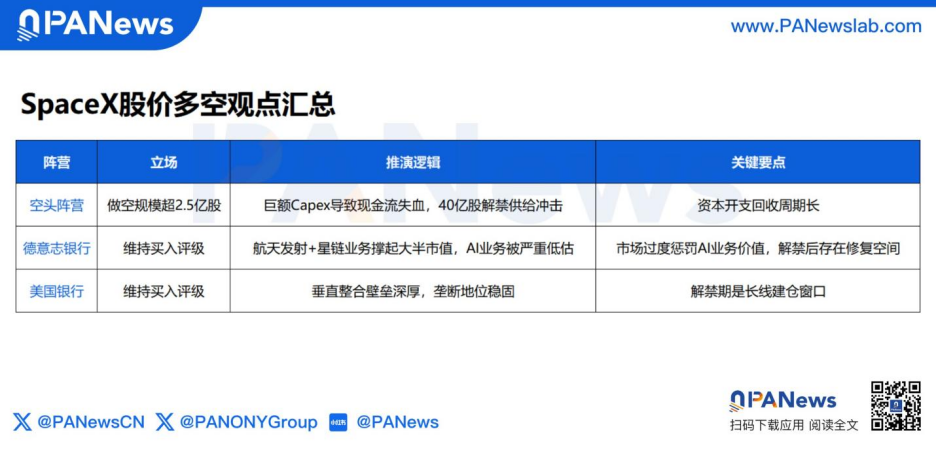
S3 Partners data shows that over 250 million shares of SpaceX have been shorted, officially surpassing Tesla and becoming one of the largest shorted stocks across the entire U.S. market.
The underlying logic behind the assembly of short sellers, aside from the "flood of shares," focuses on "cash burn."
SpaceX's Q2 financial report indicated that its capital expenditures in a single quarter reached $18.37 billion, over $15.8 billion of which was invested in AI computing power infrastructure and chip research and development. Such an aggressive investment pace has resulted in a significant net cash outflow of $15.96 billion in a single quarter.
In the eyes of the short sellers, this level of cash burn speed presents a considerable uncertainty in recovery cycles. What they read is a perilous story of "a flood of shares, unlimited cash burn," suggesting that there remains downward pressure on the stock price under dual pressures.
Bulls’ Camp: AI Business Subject to Market "Punitive Pricing"
However, top investment banks such as Deutsche Bank and Bank of America are standing on the opposite side.
According to Deutsche Bank’s valuation framework, the combined median value of SpaceX's two major business blocks—rocket launches and satellite broadband—amounts to about $1.35 trillion, while its market value is currently only $1.75 trillion. This means that the market is pricing SpaceX's AI business at only $400 billion, which is clearly inconsistent with its growth potential. Deutsche Bank believes this valuation deviation represents an excessive market punishment, a typical case of pricing mismatch, and after the unlocking period ends, if significant government or sovereign-level AI collaborations materialize, this will further catalyze the stock price positively.
Bank of America similarly reiterated their bullish stance, pointing out that SpaceX's vertical integration barriers in space logistics, satellite communication, and computing hardware are extremely deep, and the unlocking period may instead create a rare strategic positioning window for long-term institutions.
Musk also revealed during the earnings call that SpaceX's conservative target is to add 6-8 gigawatts (GW) of incremental computing power by 2027, with the upward potential possibly exceeding 10 GW. SemiAnalysis projects that if SpaceX exceeds 10 GW of computing power by 2027, its annual revenue could reach $300 billion. However, based on approximately $50 billion in capital expenditures per GW, capital expenditure in 2027 may reach as high as $300 billion to $500 billion. Additionally, the 10 GW target will also face multiple practical challenges, including land approvals, gas supply, and equipment delivery.
Clearly, SpaceX stands at a crossroads for a valuation reassessment: in the short term, it must endure the flooding of shares due to unlocks, the concentrated betting of short funds, and cash flow pressure from massive capital expenditures; in the long term, it is extending its monopolistic advantage in space launches into broader fields such as satellite-based AI computing and semiconductor manufacturing, with the expansion of its commercial boundaries far from reaching its end.
For SpaceX, its real test may not be whether it can tell a bigger AI story, but whether it can turn investments in computing power, chips, and space infrastructure into sustainable revenue and profit growth. The answer to that remains to be seen.
免责声明:本文章仅代表作者个人观点,不代表本平台的立场和观点。本文章仅供信息分享,不构成对任何人的任何投资建议。用户与作者之间的任何争议,与本平台无关。如网页中刊载的文章或图片涉及侵权,请提供相关的权利证明和身份证明发送邮件到support@aicoin.com,本平台相关工作人员将会进行核查。


