Author: Jaleel Jia Liu
Binance is really angry this time.
Looking through public records, Binance rarely sues partners for breach of commercial cooperation. Its most famous lawsuit occurred seven or eight years ago, concerning a financing dispute with Sequoia Capital.
This time, it has targeted a U-card payment company, RedotPay, with which it had collaborated in two rounds and was preparing to list in the US, directly suing the three co-founders personally. The claim amount is $472.8 million, which is roughly two and a half years of revenue for this payment company.
The timing of Binance's move is also quite subtle. At this moment, RedotPay is considering going public with a valuation of around $4 billion while also negotiating a new round of financing.

At 11:30 AM today, the Supreme Court of Singapore held a procedural meeting that could be concluded in fifteen minutes. And forty-eight hours before this hearing, Bloomberg obtained a document from a Hong Kong court: three entities associated with Binance have brought RedotPay's three co-founders to the defendant's seat: Gao Zhangpeng, the current CEO; Chan Wa Choi; and Yao Chao.
In the complaint, Binance used a very heavy word: fraud scheme.
The allegations state that more than 470,000 users originally belonging to Binance cards were directed to RedotPay; the funds from Binance Pay were not isolated as promised but instead allowed, even encouraged, to be used for recharging RedotPay cards. Binance calculated the claim amount based on a lifecycle value of $925 per user, totaling approximately $472.8 million.
The Most Difficult Year for Binance
The story of RedotPay and Binance began three years ago.
2023 is the most challenging year for Binance. In June, the SEC sued Binance and Zhao Changpeng. In July, Visa stopped issuing new Binance co-branded cards in Europe. In August, Mastercard announced it would terminate its partnership with the Binance Card, notifying some South American users that their cards could no longer be used. In October, Binance announced that Visa debit card services in Europe would be terminated.
But Binance offered an alternative in the announcement: switching to Binance Pay.
This is a forced strategic shift for Binance. The Binance Card is gone, but users' demand for consuming with crypto assets hasn't disappeared. Binance still has a payment channel, Binance Pay, but this channel still needs refinement, especially in operations.
At this point, a company called RedotPay was also established around the same time in Shenzhen and Hong Kong.
The legal entity of RedotPay is Red Dot Technology Limited, registered in Hong Kong in 2023, with a main product being a Visa card and a stablecoin wallet: users can deposit USDT and BTC into the app to use for card transactions, cash withdrawals, and Apple Pay binding, with the system automatically completing the settlement from crypto assets to fiat currency in the background. Its app was launched in August 2023, and physical cards were issued in October.
In the Chinese-speaking community, it is often referred to as the "Little Red Card."

The person behind it is Yuan Dawei. This early co-founder of Huobi left in 2015 and founded KuShen Cold Wallet in Beijing in 2016, being one of the earliest in China to develop digital asset hardware storage. According to industry reports, RedotPay was originally incubated and founded by his investment. He began researching Bitcoin in 2010, and the trust accumulated in the early Bitcoin holder and miner circles became resources that this new company could initially mobilize.
Thus, the industry's explanation for "RedotPay's cooperation with Binance" was quite simple: Yuan Dawei had a good relationship with the Binance system, so he got the initial contact and cooperation.
After all, initially, RedotPay was much smaller than outsiders imagined.
"Because RedotPay initially was a project with very few people, and the relationships within it were quite complicated." Insiders told Rhythm BlockBeats, "Mr. Yuan should just be a shareholder; he was not very involved in actual operations, and the full-time staff in the early days of RedotPay was very few. The technology and product side were not full-time RedotPay personnel, but part-timers."
On the issuing side, RedotPay's initial cards were co-branded with the Hong Kong card issuance service provider Reap, "Overall, it was packaged as a card issuing service for enterprises," said the insider. Reap is a Hong Kong fintech company holding major Visa membership status, specializing in providing white-label card issuing and cross-border payment services for other enterprises.
According to his inference, the group of people who founded RedotPay should also be operating another entity, using this operating company to manage and promote payment services for Binance Pay, similar to a contractor. That company might have no equity relationship with RedotPay, "only that some actual controllers behind are overlapping."
In other words, in the summer of 2023, RedotPay had a working card, an almost nonexistent team, and an unnever-ending volume.
"There wasn't much volume at first." He said, "I know quite clearly that their first wave of larger volume came from Binance."
Binance and RedotPay's First Falling Out
In November 2023, Binance's related party signed the first cooperation agreement with RedotPay. This is the time point mentioned in the Hong Kong lawsuit.
A notice released by RedotPay later removed, but preserved by web archives, described this relationship clearly: Users open the Binance App, enter the mini-program, select RedotPay, enter the amount, click "Pay with Binance Pay," and receive a recharge exchange code. The announcement stated that this path compressed the recharge time from minutes to seconds. The fees were clearly listed, with Binance Pay taking 1% and RedotPay’s mini-program receiving 1%. The announcement also specifically introduced a function called Lightning Deposit, allowing Binance users to directly deposit USD stablecoins into RedotPay.
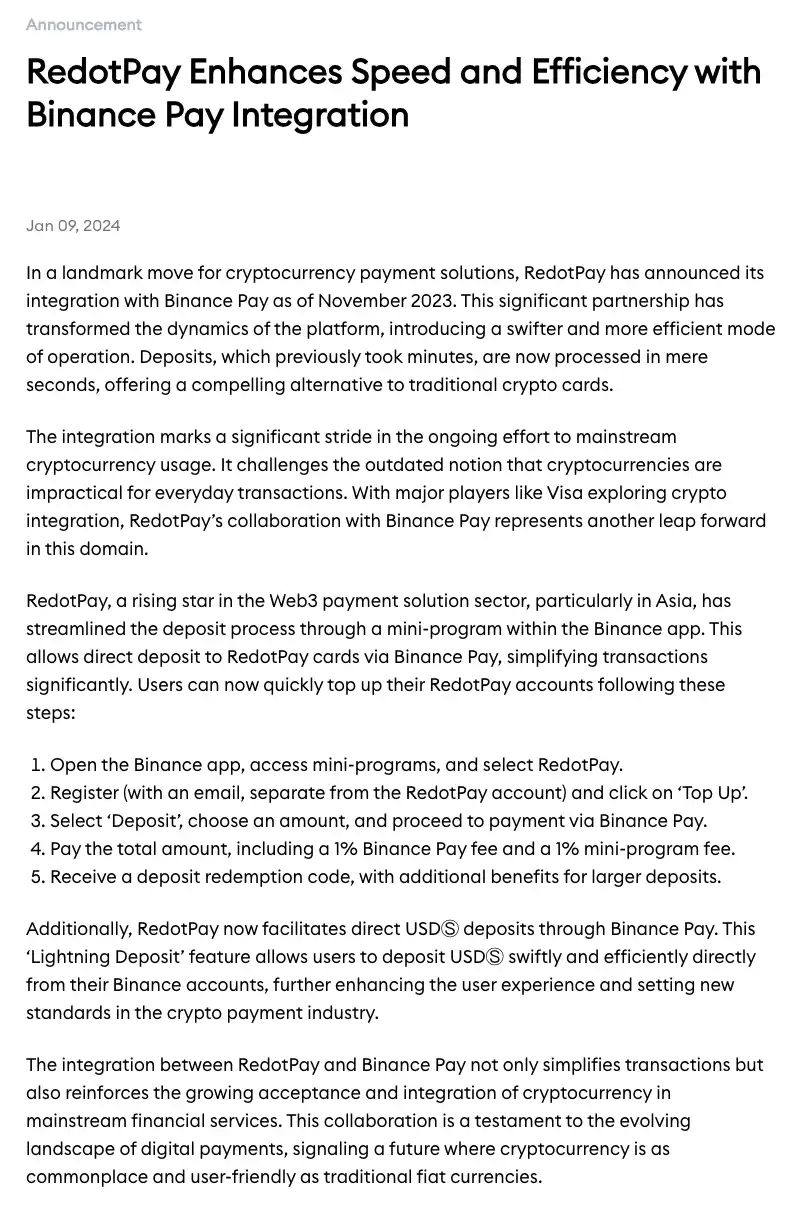
Announcement on Collaboration from RedotPay in 2024
For RedotPay, this channel saves the most expensive segment in customer acquisition: persuading a stranger to download an app, register, complete KYC, and make a deposit. It no longer needs to find users one by one; users are right at the door.
However, this first agreement did not last more than half a year.
Public reports cited the complaint stating that it fell apart in less than six months after being signed, with the controversial point being that funds from Binance Pay were used to recharge prepaid RedotPay cards.
Here arises the most glaring contradiction of the entire case: the public announcement from RedotPay at that time stated that it could directly recharge cards. The same pathway presents one side as the product selling point on the official website while the other side is seen by Binance as crossing the line. Whether it was that the advertisement outpaced the contract, specific routes violated regulations, or the two sides had different understandings of "recharge accounts" and "rechargeable consumable cards," we had no further information to judge before the original contract was made public.
Nevertheless, this falling out did not stop RedotPay.
In 2024, in the documents for A-round financing, RedotPay still listed its partnership with Binance as a factor for "accelerating user adoption," explicitly stating that users could deposit funds directly from Binance Pay into RedotPay cards. These aspects were all taken as RedotPay's growth story to present to investors.
Two Years, $1 Billion Valuation
Perhaps the relationship was strong enough, or perhaps "the arrangements were in place."
In March 2025, Binance and RedotPay sat down at the negotiation table again, initiating the second cooperation agreement.
According to public reports on the complaint, the core of the second agreement is: funds from Binance can be used for currency exchange, internal transfers within the RedotPay app, and purchasing RedotPay's own products, but cannot directly convert into redeemable balances on RedotPay cards, and must be clearly isolated and labeled on the accounts.
In simple terms: Binance's money can enter RedotPay's door, but cannot exit RedotPay's door.
Why is Binance so adamant about this step? Because account balances and card balances are two different worlds. Account balances are the endpoint of a transfer; card balances are the starting point of a consumption relationship. Once users put money into the card wallet, they will link to Apple Pay, buy coffee, pay subscriptions, and settle bills, and their daily cash flow will henceforth grow on this platform. The real profit for U cards comes from exchange rate spreads, transaction fees, and balance deposits, not from the card issuance fee.
The so-called fund isolation is not about putting money in different drawers but marking it with a source label in the system: this money comes from Binance Pay and can only follow the paths permitted by the contract, must not be mixed with ordinary balances, and definitely cannot automatically convert into usable card balances.
After the start of the second cooperation, the financing pace for RedotPay began to accelerate.
Also in March 2025, RedotPay announced the completion of a $40 million A-round financing led by Lightspeed, with participation from HSG and Galaxy Ventures. In September, Coinbase Ventures entered, adding $47 million in strategic financing, and the company's valuation reached $1 billion for the first time, officially becoming a unicorn. In December, Goodwater Capital led a $107 million B round, with Pantera Capital, Blockchain Capital, and Circle Ventures following suit, with HSG continuing to invest. Within a year, RedotPay raised $194 million.
The operational data in the same financing materials is equally steep: by November 2025, registered users exceeded 6 million, covering over 100 markets; annualized payment volume exceeded $10 billion, and annual revenue exceeded $150 million. Annual payment volume tripled, adding 3 million new users.
A company that only had a few full-time employees two years ago and had to rely on others for card issuance thus achieved a valuation of $1 billion.
Mass Emails to "Siphon Off" Binance Customers
Binance's accusation is: more than 470,000 users originally belonging to Binance cards were directed to RedotPay. How did RedotPay "siphon off" these users? We have not seen a reasonable explanation from various channels.
However, insiders pointed out to us that the most crucial and original move for RedotPay in the business war was to send emails.
According to the lawsuit, Binance discovered the issue in March 2026: RedotPay was still allowing and encouraging unused Binance Pay funds for prohibited purposes, including recharging RedotPay cards. Then, on April 3, Binance ceased related support, explaining to the public that it was reviewing merchant partners. Four months later, Binance submitted a complaint to the Hong Kong court.
But according to insiders' memories, Binance may have discovered issues with RedotPay in 2023, during the time when Binance cards were malfunctioning and many users could not use their cards.
"The few people operating Binance Pay should be the founding team of RedotPay, and those people had access to Binance's customer email addresses, so they basically directly emailed customers and redirected them to RedotPay," said this insider.
"This is definitely not normal." When asked if this could be considered a common practice in the industry, he quickly replied, "If it wasn't explicitly agreed upon by Binance, then it definitely doesn't qualify as normal business behavior."
But immediately after that, this insider also stated: "To say that Binance was completely unaware of this situation at that time seems unlikely."
He believes: if an exchange is willing to outsource this operation and the authority to access user data to an external team, it indicates a deep personal relationship. The more likely scenario is that the core executives at Binance did not concern themselves with this not-so-important business line, while those specifically responsible for the project "turned a blind eye or even tacitly accepted it verbally."
Revenge on the Way to RedotPay's Listing
In February 2026, Bloomberg reported that RedotPay was working with JPMorgan, Goldman Sachs, and Jefferies to prepare for a listing in New York, potentially raising over $1 billion and achieving a valuation exceeding $4 billion, possibly happening as soon as this year. This would be one of the largest IPOs in the Asian stablecoin sector this year.
However, this path has never been very stable. In March, Bloomberg further reported that RedotPay had lost at least five executives in the past 12 months and still did not have a CFO while also seeking up to $150 million in new financing.
A company lacking a CFO, experiencing executive turnover, and currently fundraising received a bill amounting to roughly two and a half years of its revenue. Is this a coincidence?
"In fact, RedotPay likely had the capability to make the payment a year ago." He speculated that both parties had probably been negotiating this issue for a while but had never come to an agreement, and now was just the right time for "revenge."
Because from RedotPay's perspective, a payment company preparing for a U.S. listing should not have an ongoing cross-border lawsuit in its prospectus. Underwriters will ask, investors will inquire, and regulators will question. In contrast, making a one-time payment in exchange for a settlement agreement, transforming the risk from "pending litigation" to "resolved matter," would be the quickest route to ringing the bell.
It seems that a settlement should be a high-probability event.
"I feel the fine amount that Binance is seeking is a somewhat moderate figure." This insider said that if the claim were in the tens of billions of dollars, the other party would likely walk away from negotiations completely; but $472.8 million is a number that "would cause RedotPay significant losses, but is also something they can manage to pay."
This is an offer designed for settlement.
免责声明:本文章仅代表作者个人观点,不代表本平台的立场和观点。本文章仅供信息分享,不构成对任何人的任何投资建议。用户与作者之间的任何争议,与本平台无关。如网页中刊载的文章或图片涉及侵权,请提供相关的权利证明和身份证明发送邮件到support@aicoin.com,本平台相关工作人员将会进行核查。


