Written by: Eric, Foresight News
In the overall turmoil of the cryptocurrency market during June and July, the price trends of most mainstream tokens were lackluster, but UNI performed unexpectedly strong.
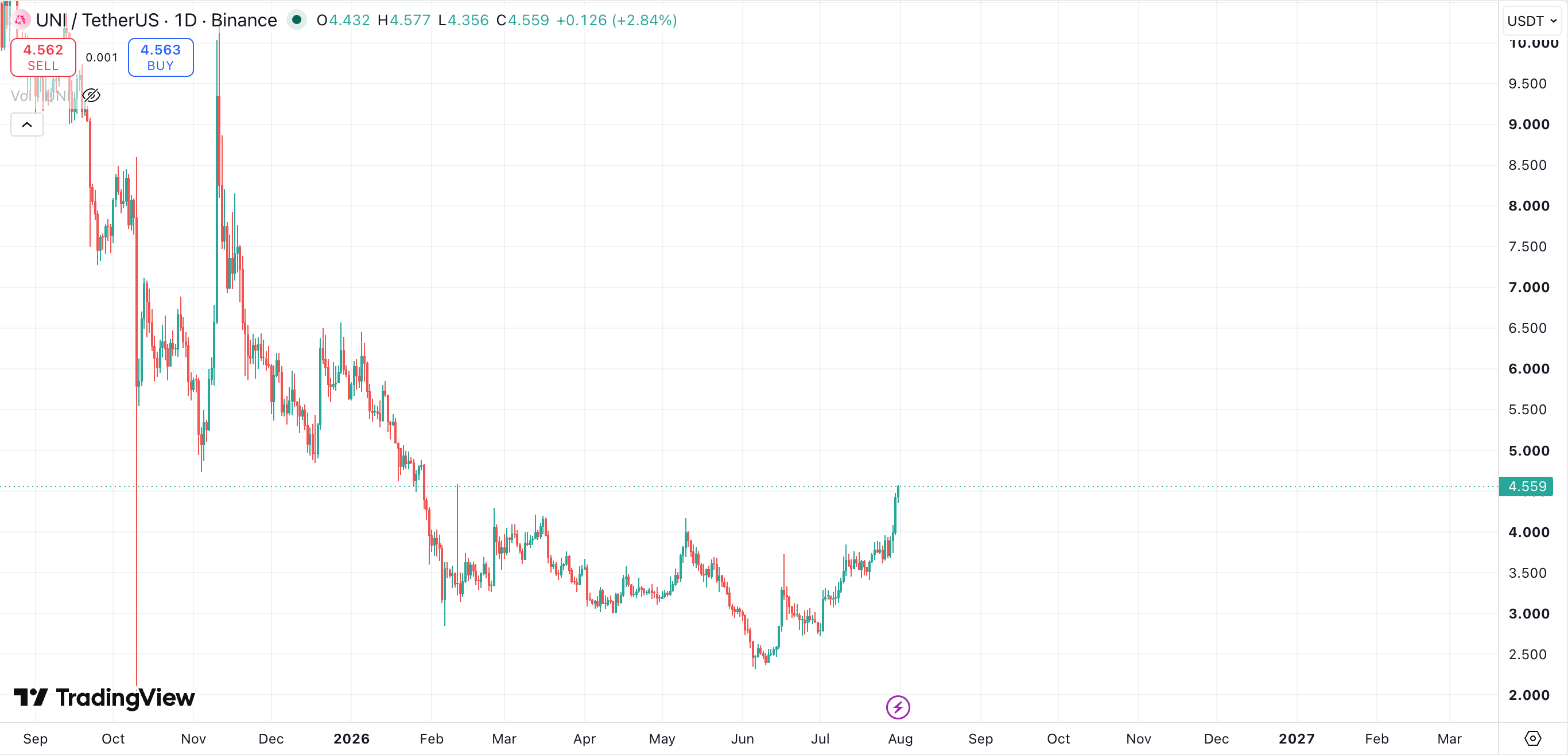
At the beginning of June, UNI's price was hovering around 2.3 dollars, and by the end of July, it had approached 4.6 dollars, almost doubling in two months. Rewind to December last year when Uniswap had just passed the long-debated fee switch proposal, but UNI only rose for a day before falling back with the larger market; interest in the leading exchange of the DeFi world was scant.
However, the turning point had already been laid back then, though not many people realized it at that time.
On December 28, 2025, the Uniswap governance proposal UNIfication was officially executed on-chain. The protocol fee switch was turned on, allocating a portion of the trading fees from the v2 pools and some v3 pools on the Ethereum mainnet to the protocol itself; Unichain's sequencer revenues, after deducting OP shares and L1 data costs, were also incorporated into the same fund pool; a one-time destruction of 100 million UNI from the treasury was carried out as retrospective compensation for the past years of "free era"; Uniswap Labs reduced fees for its front end, wallet, and API to zero while receiving an annual growth budget of 20 million UNI. All of this protocol revenue ultimately flowed into a treasury contract named TokenJar, which had only one outlet: to buy UNI through the Firepit contract and permanently destroy it.
This is what the long-debated "fee switch" looks like in practice after more than five years. Since the DeFi Summer, the community had been discussing whether to allow the protocol to take a portion of transaction fees, but each voting round got stuck on concerns over profit distribution, legal risks, and LP loss. When it finally passed, the market's reaction was rather tepid. Upon the proposal announcement, UNI surged nearly 50% within hours, but as the market weakened, UNI fell back again, and by March 2026, it had dropped below 3.8 dollars, oscillating around 3 dollars throughout April and May, and in early June it even fell to 2.3 dollars. The fee switch was activated, but it was quiet.
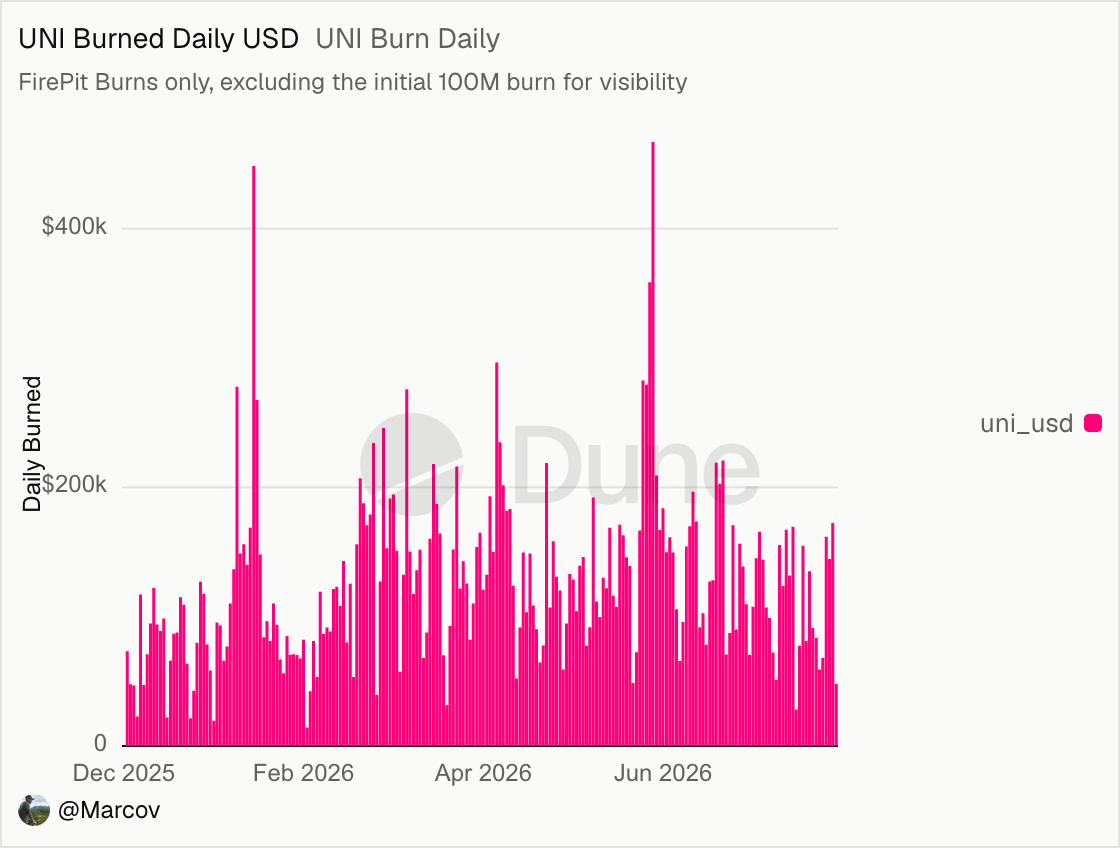
The reason for the quietness is that the data was still insufficient. According to Dune's statistics, in the first 12 days after the fee switch was activated, the accumulated value of burned UNI was only about 800,000 dollars, annualized to about 26 to 27 million dollars, corresponding to a destruction volume of about 4 to 5 million UNI per year. Considering that the protocol still had a growth budget expenditure of 20 million UNI each year, this number was hard to claim as attractive. By May 2026, the cumulative protocol revenue was approximately 12.3 million dollars, with a daily protocol revenue around 73,000 dollars. The destruction mechanism was in operation, but it resembled a revved-up engine, unable to make a sound.
Change occurred in July. On July 1, the Robinhood Chain was officially launched, and Uniswap's v2, v3, v4, and UniswapX were deployed on the first day. This chain, designed for tokenized stocks, pushed Uniswap's daily trading volume to 500 million dollars within eight days, with cumulative trading volume surpassing 1 billion dollars by July 10. In its first week, the Robinhood Chain contributed nearly half of all weekly fees for Uniswap, around 11 million dollars, with daily protocol fees reaching as much as 5.2 million dollars, second only to the two major stablecoin issuers in the entire network. Uniswap founder Hayden Adams called it the most active chain outside of the Ethereum mainnet.
Next came the voting. From July 7 to 12, a Snapshot vote determined the extension of the fee mechanism to v4 pools, followed by an on-chain vote the next week; from July 10 to 15, a temperature check for activating protocol fees for the Robinhood Chain deployment was also underway. On July 27, the fee switch for v4 was officially activated. The effect was immediate: according to DefiLlama's data, the protocol revenue surged nearly threefold after activation, with daily funds flowing to UNI for destruction rising from around 114,000 dollars in early July to 325,000 dollars, of which the Robinhood Chain alone contributed 170,000 dollars, accounting for over half of the total, while the Ethereum mainnet contributed approximately 82,000 dollars. On the day the news hit, UNI rose by 12%, reaching a price of 4.4 dollars.
Looking back at this curve, the logic is actually quite clear. When the fee switch was opened at the end of last year, the market responded to expectations, which could not deliver and thus declined; when the destruction data climbed from tens of thousands of dollars monthly to hundreds of thousands daily, and the largest new source of income integrated into this destruction machine, the market priced not expectations but cash flow. For a protocol with annual trading volumes in the trillions of dollars, token holders had previously received nothing; now every transaction creates a permanent automatic buyer for the token. This transformation from a governance token to a cash flow asset is the core narrative of this price surge.
It is worth mentioning that buyback and destruction are no longer novel in today's crypto industry. Hyperliquid has a monthly buyback approaching 95 million dollars, pump.fun also has 35 million dollars, Jupiter uses half of its operating income for buybacks, and dYdX, Aave, Lido are all pushing similar mechanisms. However, whether buyback and destruction can be effective never depends on the mechanism itself, but rather on the chip structure.
UNI is an "old token" that completed its distribution in 2020, and over six years has allowed sufficient chip dispersion; there are no large unlocks pending in circulation, and only about 830 million dollars of UNI are available for sale on exchanges, making the buy orders formed by buybacks materially applicable to the secondary market. Many new projects, although also advertising buyback and destruction, have teams and investors unlocking far more tokens each month than the buyback amount, causing the chips destroyed to be a drop in the bucket against the continuous new supply, naturally struggling to maintain price.
This is a rare advantage for older DeFi projects. Surviving long enough, launching early enough, and cleaning up chips thoroughly allow the buyback and destruction machine to truly get up and running. For UNI, the next question to verify is quite specific: the Gas subsidies for Robinhood Chain are set to expire approximately 90 days after launch, and how much trading volume can remain by then determines whether this doubling is the beginning of value return or yet another illusion sustained by subsidies.
免责声明:本文章仅代表作者个人观点,不代表本平台的立场和观点。本文章仅供信息分享,不构成对任何人的任何投资建议。用户与作者之间的任何争议,与本平台无关。如网页中刊载的文章或图片涉及侵权,请提供相关的权利证明和身份证明发送邮件到support@aicoin.com,本平台相关工作人员将会进行核查。


