Behind Anthropic's 1.5 billion dollar settlement: Where does the data for AI companies come from, and what are the boundaries of authorization?

CN
PANews
Follow
9 hours ago

Author of this article: Zhao Xuan

The copyright risks of AI companies often occur even before the model is launched.

When communicating with AI entrepreneurs, we found that many teams are not unaware of copyright risks; their real confusion lies in: Where exactly does the risk occur? Some believe that since the company only calls upon third-party foundational models, the responsibility should be borne by the upstream vendors; others think that the data comes from clients, the open internet, or paid databases, and there is nothing wrong with the sources themselves; still others explain that RAG is merely retrieval, and the model does not output large segments of original text, thus should not constitute infringement.

These statements are not completely incorrect, but they typically only explain one link in the data usage chain. When the company enters financing due diligence, undergoes review by major clients, or receives complaints from rights holders, the real questions often asked by the opposing side are: Where did the information come from? Who has the right to provide it to the company? Does the company obtain reading rights or rights to copy, slice, train, and store long-term? Which knowledge base or model version did this batch of data enter? If the rights holders request to stop using it, can the company accurately locate and remove it?

On July 20, 2026, the U.S. Federal Court ultimately approved the $1.5 billion class action settlement reached by Anthropic and some authors, publishers, and other rights holders. It should be noted that this $1.5 billion is not a court judgment for Anthropic to pay for copyright infringement, nor is it a unified licensing price for AI companies using books to train models. What truly deserves attention in this case is the court's breakdown examination of data acquisition, database construction, model training, and subsequent use: the ability to claim fair use for one link does not mean that the entire data usage chain will automatically be legal.

The court supported training; why does Anthropic still have to pay $1.5 billion?

In the Anthropic case, the court concluded that using books for model training, under the specific facts of this case, was to analyze language structure and statistical relationships rather than to provide users with a substitute for the original books; therefore, the related training is transformative and may constitute fair use. The court also supported a narrower method of digitization: after purchasing a physical book, scanning it into a digital format and destroying the original, without increasing the number of copies or disseminating it, such format conversion may also be supported.

However, downloading a large number of e-books from pirate websites and placing them in a permanent, general-purpose database leads to a different conclusion. The court rejected the notion that just because this data might "possibly be used for training" in the future, it could categorize the front-end piracy download and long-term storage as fair use. In other words, the transformative purpose of training does not automatically resolve the issue of how the data was obtained.

However, this does not mean that the court has conclusively determined that Anthropic bears the responsibility for piracy. The relevant liabilities and compensations still needed to be reviewed, and the case later concluded through a settlement. Anthropic's willingness to pay $1.5 billion is more accurately described as a concentrated pricing for the uncertainties of class action lawsuits, statutory compensations, court trials, and appeals, rather than a payment made to the court as an "AI training fee."

This matter can be understood as follows: a chef studying the structure and writing of a recipe book is not the same as downloading the entire recipe set from a piracy website and permanently storing it in his own database. The former discusses how to learn and use a work, while the latter must first answer where the material comes from, why it can be copied, and why it can be stored long-term.

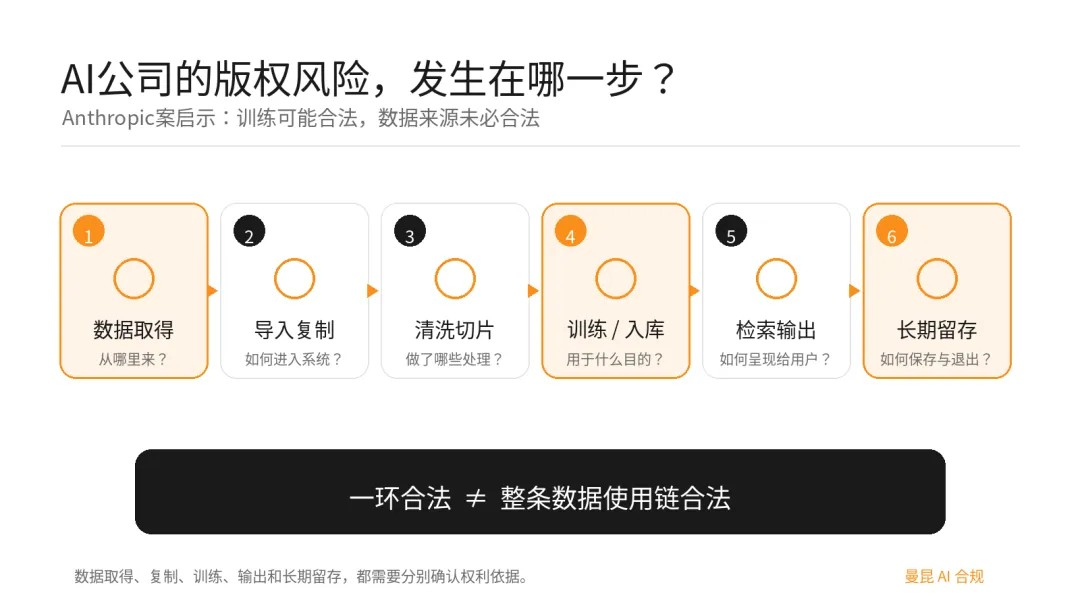
Data acquisition, importing copies, cleaning, slicing, model training, or knowledge base storage, retrieval output, and long-term retention are different links in a chain. Just because one step has a legal basis does not mean that the entire chain is free from issues.

Figure 1 | Copyright risk nodes in the AI data usage chain

Using third-party models does not mean that the data responsibility lies entirely with the upstream

Many AI startup companies do not train foundational models but instead call third-party models through APIs and build their own industry knowledge bases, RAG systems, agents, or vertical applications. This model certainly reduces some risks associated with directly training foundational models, but it does not transfer the companies’ responsibilities for processing data to the upstream model vendors.

Companies must first distinguish between "data" and "works." Pure facts, values, formulas, and common information may not constitute works under copyright law, but the same batch of data may contain articles, images, reports, personal information, trade secrets, platform data rights, and contract restrictions simultaneously. Therefore, determining whether a batch of data can enter an AI system cannot simply ask "Is there copyright?" but must also consider what specific data is included, how the company obtained it, and whether the current usage is within the authorized scope.

RAG is also not a copyright vacuum. An industry report entering the RAG system usually requires downloading, format conversion, cleaning, slicing, vectorization, and knowledge base storage. Even if the model ultimately outputs only a few sentences of summary, copying may still occur in the preceding technical processing, and it may exceed the database agreement or client authorization. Conversely, just because the knowledge base contains protected works does not mean every instance of retrieval output must infringe; one must still consider the specific form of copying, output content, and authorized scope for each individual assessment.

Therefore, "We are just doing RAG" cannot replace data review; invoking third-party models also does not absolve companies of responsibilities incurred while building their own knowledge bases, processing client data, and continuously optimizing products.

The three most easily misunderstood things by Chinese AI companies

Data not constituting a work does not mean it can be used freely

Even if certain content is not protected by copyright, it may still involve personal information, trade secrets, platform rules, database rights, and contractual obligations. Companies cannot direct conclude that there are no other restrictions simply because they believe a batch of data "has no copyright."

Having public access or purchasing does not mean it can be used for training

Publicly accessible only indicates that a user can access the content under specific conditions; it does not automatically mean that it can be downloaded, copied, sliced, fine-tuned, or stored long-term into a commercial knowledge base in bulk. Purchasing a database account is more like buying a ticket to a reading room; it usually allows for querying and reading but does not necessarily permit the entire collection to be moved into the company's knowledge base.

Article 29 of the Copyright Law states that rights not explicitly licensed in the licensing contract cannot be exercised by the other party without the consent of the copyright holder. Thus, "legal source" and "authorization for current use" are two different things. The rights to read, download, use internally, build knowledge bases, and use for model training are not inherently the same set of rights.

Not applicable to the "Interim Measures for the Administration of Generative Artificial Intelligence Services" does not mean there are no other compliance obligations

Some internal knowledge bases, enterprise-internal tools, or specific B-end services may not directly apply to these measures, but the relevant businesses are still subject to copyright, personal information, data security, anti-unfair competition, as well as customer contracts and platform terms.

Fair use is not a universal access card just because it seems "innovative"

The Anthropic case is governed by U.S. copyright law and cannot be directly applied to China. Article 24 of the Copyright Law enumerates the specific scenarios for fair use, and at present, there is no general exception in China applicable to commercial AI training for text and data mining.

This does not mean that all AI training is necessarily infringing; rather, it means that companies cannot simply conclude fair use based on the reasoning that "training is innovative," "the model does not output the original text," or "the use will not replace the original work." It still requires a specific judgment of whether copying has occurred in technical processing, at which link copying occurred, whether the model, knowledge base, or final output retained and presented recognizable work expression, and whether the related behavior falls into specific circumstances defined by current laws.

The Supreme People's Court has already stated that it is necessary to prudently handle new types of cases regarding the use of corpus for large model training and infringement of content generated by artificial intelligence. This indicates that domestic adjudicative standards are still being formed, and companies should not establish their core products and data assets entirely on the uncertain defense of fair use.

How to handle historical data: Control the increment first, then clean the stock

For startups that have been operating for some time, the most realistic problem is often not "what to do in the future," but rather what to do with the data that has already entered the system. Many companies cannot simply stop their products, empty their knowledge bases, and retrain. Therefore, the governance plan must consider legal risks, technical costs, and business continuity simultaneously.

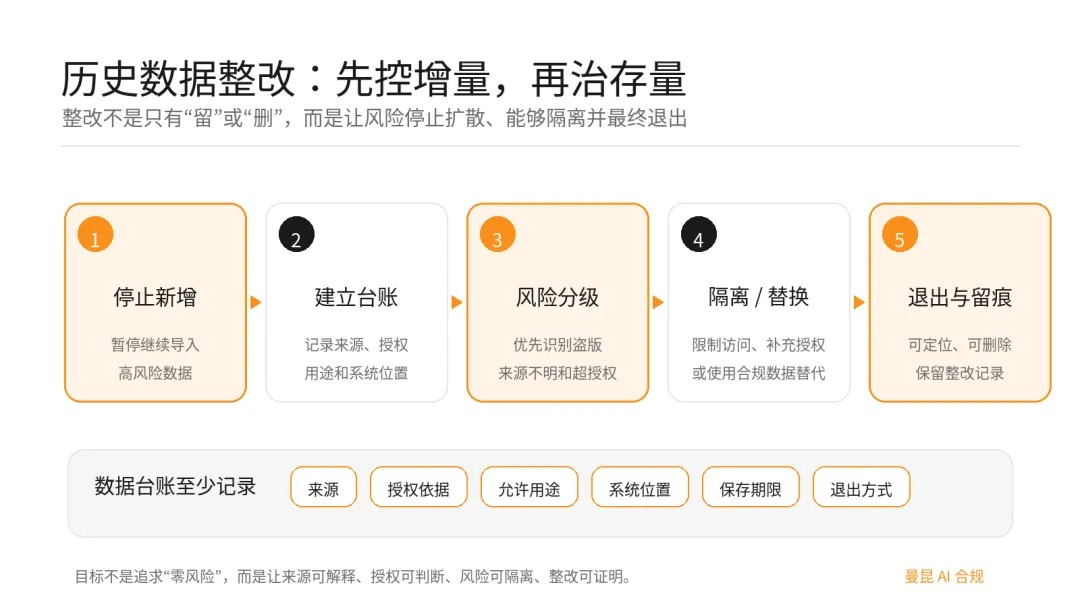
A more realistic order is: first stop adding high-risk data, then inventory historical stock; first save sources, contracts, and usage records, and then decide whether to isolate, replace, or delete. Companies can first establish a data list documenting the source of the materials, acquisition time, providing entity, contracts and platform terms, usage purpose, storage location, and which knowledge base, fine-tuning tasks, or model versions the data entered.

High-risk data should be prioritized for processing, including files from piracy websites or those without a clear source, data for which vendors cannot provide proof of rights chain, materials used plainly outside the authorization scope, and content acquired by circumventing paywalls, anti-scraping measures, or access controls. Such behavior may not only involve copyright and contract risk but can also potentially lead to liability for unfair competition when meeting certain conditions.

Remediation does not only involve the two options of "continuing to use" and "immediately deleting." Companies can first stop new additions, limit access, isolate suspicious data from the production environment, and then, based on actual circumstances, supplement authorizations, replace with compliant data, or rebuild knowledge bases and fine-tune again. If deletion is indeed necessary, it should also ensure that related files, sliced data, vector records, and backup copies can be located, while retaining complete internal approval and remediation records.

These measures cannot automatically legalize past actions, but they can prevent risks from expanding further and can demonstrate the company's ability to identify issues, limit impacts, and complete remediations in future financings, client reviews, or disputes.

Figure 2 | Five-step path for rectifying historical data

Controlling new risks can start with a data ledger

For startups with limited resources, data governance does not need to begin with constructing a massive compliance system. The most practical starting point is to create a data ledger maintained by business, technology, and legal departments.

Each batch of data should at least record: who provided it, where it was obtained from, based on what contract or platform terms, permissible use scenarios, prohibited use scenarios, which product, knowledge base, or model version it entered, how long it is saved, and how to exit after complaints, authorization expiry, or termination of cooperation.

Contracts must also accurately reflect the true technical scenarios. Rather than vaguely agreeing that "data sources are legal" or "the supplier guarantees non-infringement," it is better to clearly specify whether the data can be downloaded, copied, cleaned, converted, sliced, used for knowledge base construction, retrieval, fine-tuning, testing, or model optimizations, and to clearly outline applicable products, the user entity, duration, and handling of third-party claims.

Companies should also know which knowledge base or model version has received a batch of materials, whether they can be isolated, replaced, and deleted. Data that cannot be located becomes hard to mitigate the damage in the event of complaints; data that cannot be split and exited increases uncertainty in financing, mergers, and major client reviews significantly.

Conclusion: AI copyright risks often occur before the model launches

The most noteworthy aspect of the Anthropic case for Chinese AI companies is not the isolated conclusion that "training constitutes fair use," nor the figure of $1.5 billion, but rather the court's disaggregation of different data usage links: where does the information come from, why can it be copied, for what purpose did it enter the database, and why does it need to be stored long-term.

Fair use is not a label of exemption for illegal data sources; a legal source is also not a synonym for arbitrary training, retrieval, and long-term preservation. While invoking third-party models can reduce some of the foundational training risks, it does not relieve companies of their responsibilities when building knowledge bases, processing client data, and optimizing products.

For startups, it is not too late to start governance now. First control the new data added today, and then gradually address past issues; the sooner source records, authorization boundaries, and exit mechanisms are established, the lower the subsequent remediation costs, and the easier it is to turn data from potential risks into company assets that withstand financing and client scrutiny.

免责声明:本文章仅代表作者个人观点,不代表本平台的立场和观点。本文章仅供信息分享,不构成对任何人的任何投资建议。用户与作者之间的任何争议,与本平台无关。如网页中刊载的文章或图片涉及侵权,请提供相关的权利证明和身份证明发送邮件到support@aicoin.com,本平台相关工作人员将会进行核查。

Share To
APP

X

Telegram

Facebook

Reddit

CopyLink