trade.xyz's cumulative trading volume exceeds 400 billion USD, with daily independent traders peaking at over 60,000.
Written by: Maher, Foresight News
In the past week, discussions within the crypto community regarding the relationship between trade.xyz and Hyperliquid have noticeably intensified. The reason is not complicated: the trading volume of RWA perpetual contracts on Hyperliquid has for the first time surpassed crypto-native contracts, while trade.xyz has almost monopolized the HIP-3 segment. Some have begun to ask a sharp question — what would happen if trade.xyz chose to become independent?
On July 24, Lorenzo Valente, the head of crypto research at ARK Invest, posted that Hyperliquid had its first week where RWA trading volume exceeded that of crypto assets, reaching 54%. During that week, Hyperliquid's total trading was approximately 50 billion USD, with RWA transactions from HIP-3 contributing 26 billion USD, surpassing the total of all other DEX crypto perpetual contracts during the same period.
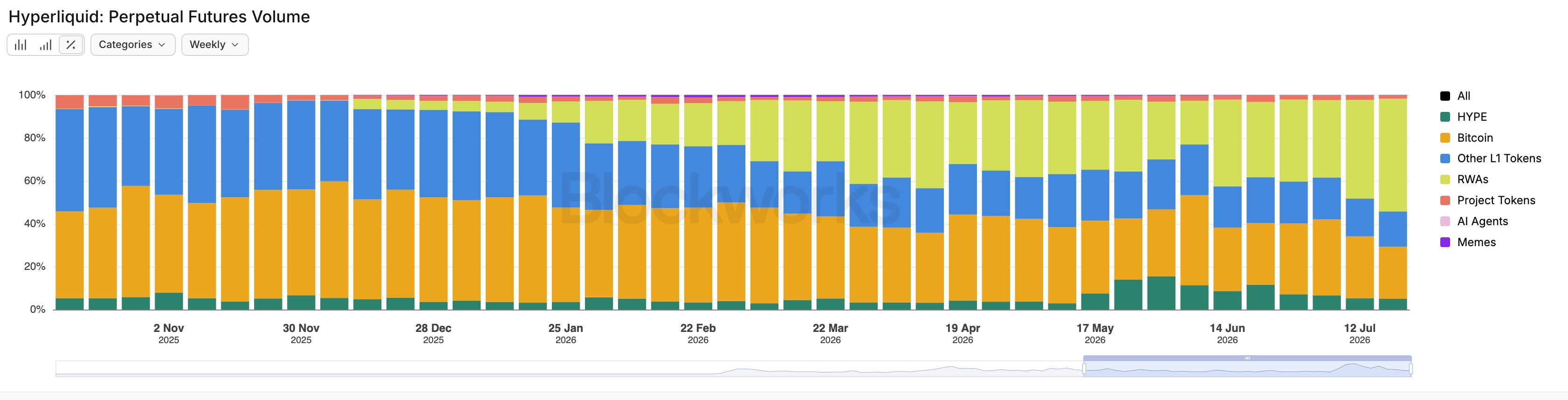
More noteworthy is that since June, individual stock perpetuals have begun to surpass indices and commodities, currently accounting for 61% of the RWA trading volume. Lorenzo candidly stated that he is no longer sure that RWA trading will naturally aggregate into the same venue as crypto assets, suggesting that there might emerge independent leaders in the category.
Two days later, investor @0xCryptoSam directly posed the question to the market: If trade.xyz were to leave Hyperliquid tomorrow and launch its own exchange, where would traders go to do RWA perpetuals? If trade.xyz were to issue stocks or tokens, how would the valuation logic of HYPE change? He claimed to have confidence in the answers to these two questions, but like most large allocators, he admitted uncertainty regarding the "probability of occurrence." He emphasized that this was not a slight against either party but a statement of fact — trade.xyz has already gained significant leverage over Hyperliquid.
Cobie responded more directly in the related discussion: Why must they leave? Theoretically, they can deploy market generation simultaneously in multiple venues.
Behind these discussions is the leap that trade.xyz has completed in less than a year.
Cumulative trading volume reaches 408.4 billion, daily independent traders peak over 60,000
trade.xyz is not an independent chain, nor is it its own matching engine. It is the first and currently the absolute dominant deployer of the HIP-3 framework on Hyperliquid.
HIP-3 is an upgrade that will be launched on Hyperliquid around October 2025, allowing independent teams to deploy perpetual contract markets on Hyperliquid's infrastructure. trade.xyz is responsible for deciding which assets to list, which oracle to use, setting leverage limits and risk parameters, and continuously conducting market operations; true order matching, clearing, margin calculations, and on-chain settlement are all completed by Hyperliquid's HyperCore.
It allows users to use USDC as collateral to trade perpetual contracts on stocks, indices, commodities, forex, and Pre-IPO assets 24/7. The official documentation states clearly: all markets accessed through trade.xyz operate on Hyperliquid. trade.xyz is just one interface, not an exclusive entry.
From being the first deployer when HIP-3 launched in October 2025, trade.xyz has expanded its market count to nearly 100. The coverage is quite comprehensive: individual stock perpetuals (Tesla, NVIDIA, Google, Micron, SK Hynix, etc.), indices (XYZ100, S&P 500, and even the Sci-tech 50 ETF), commodities (crude oil, gold, silver), forex, and a batch of Pre-IPO contracts (SpaceX, CXMT, etc.).
This past Monday, the Pre-IPO market price for CXMT almost perfectly matched the spot opening price, and the accuracy of the price discovery results even exceeded the team's own expectations.
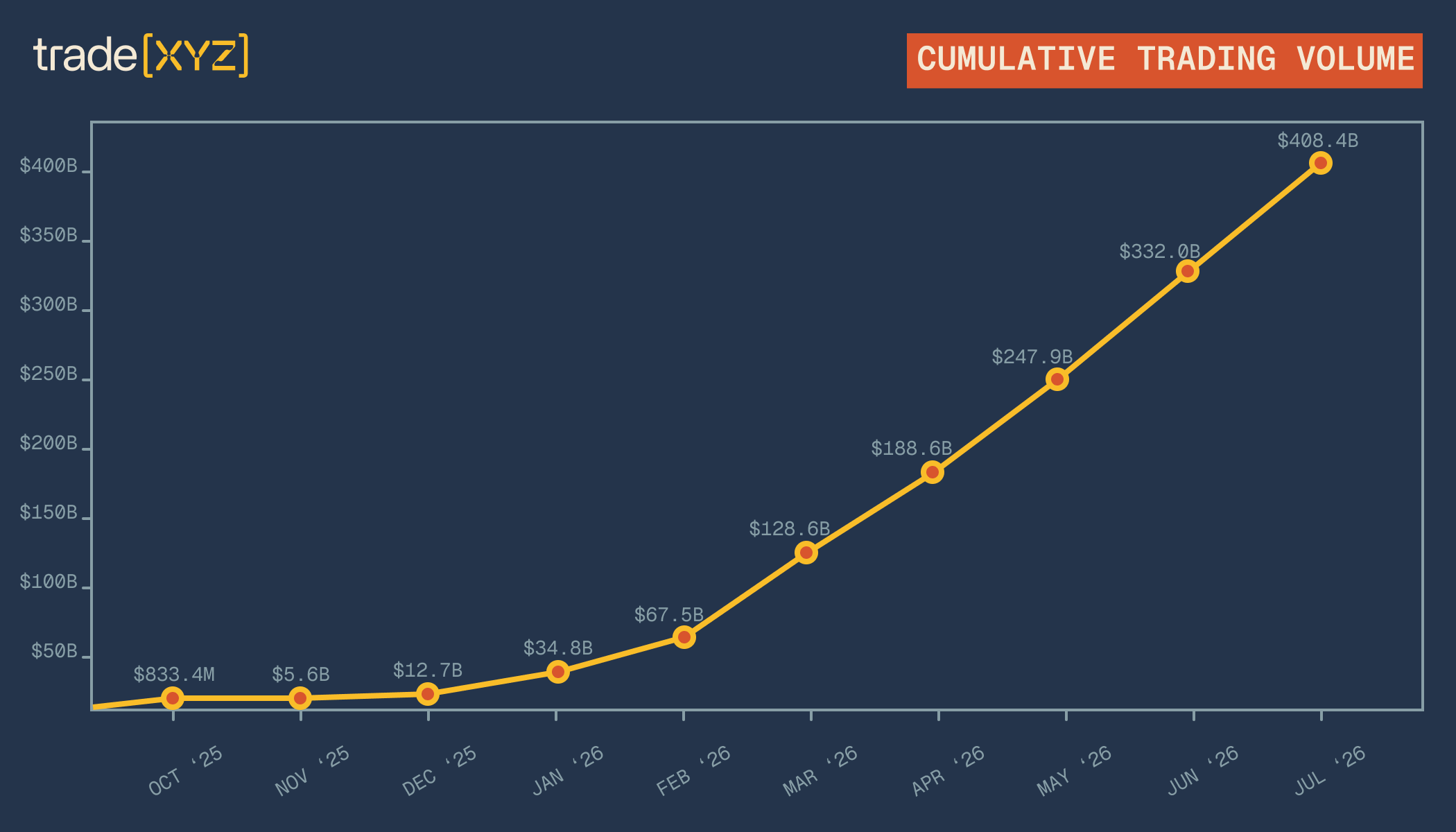
On July 27, the latest data officially released by trade.xyz has all refreshed historical highs. Cumulative trading volume reached 408.4 billion USD, with the weekend cumulative trading also exceeding 26 billion USD. The single-day peak trading reached 5.6 billion USD, with open interest standing at 3.9 billion USD, and daily independent trader peaks exceeding 60,000.
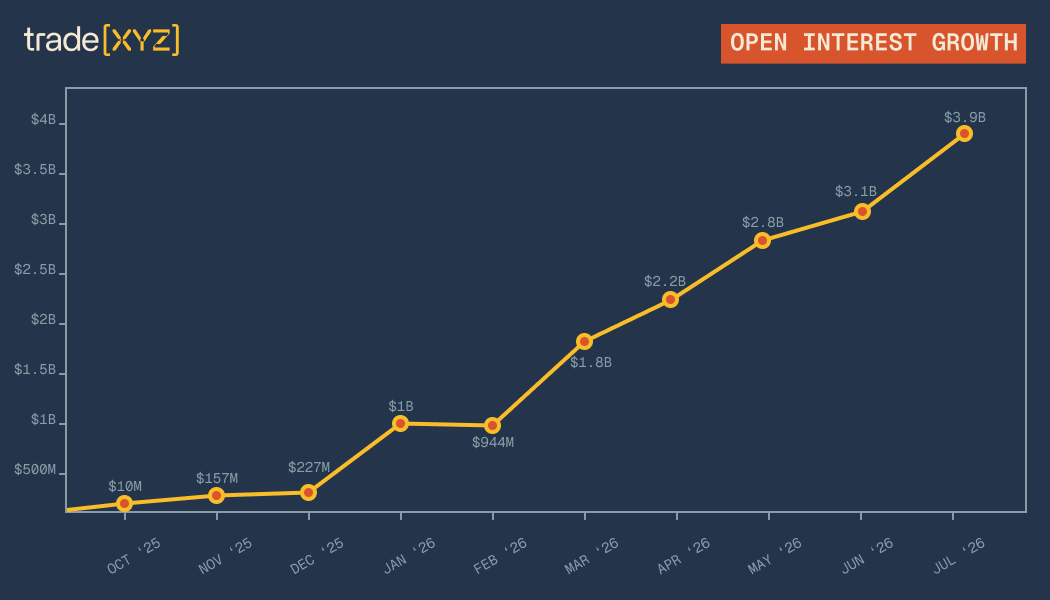
Early HIP-3 competitors such as Felix Exchange and Ventuals have shut down one after another in 2026 due to liquidity being completely drained by trade.xyz. trade.xyz has long occupied more than 95% of the trading volume and open interest in the entire HIP-3 segment.
The vast majority of trades actually occur at the front end of Hyperliquid, rather than on trade.xyz's own interface. Both parties share the protocol fees 50/50, with Hyperliquid's portion used for HYPE buybacks. It has also brought in a large number of new users to the entire ecosystem — cumulatively attracting over 300,000 different wallets, with monthly growth stable in the tens of thousands, peaking close to 80,000. Many traders initially came for stocks or commodities perpetuities but ultimately stayed within the Hyperliquid ecosystem.
The market depth has also reached a level where institutions can seriously participate. Top index and commodity markets have order depths in the millions of dollars near the mid-prices, and individual stocks such as NVIDIA and Tesla also have sufficient liquidity to support larger positions. Operationally, the team is also not neglecting things after "going live" — a significant number of on-chain operations show that adjustments to risk parameters like position limits, Growth Mode switches, funding rate multipliers, and temporary suspensions are very frequent.
Power structure begins to tilt
The core of the dispute is not whether "will they leave now," but whether "the power structure has already tilted."
Proponents of the "potential move" side see the concentration. When a deployer almost monopolizes the fast-growing field of RWA perpetuals, and that field's trading volume has surpassed that of crypto-native parts, it naturally holds negotiating leverage. If in the future it issues its own token and directs fees toward its own assets, or seeks a higher profit-sharing ratio, or even deploys simultaneously on other high-performance perpetual chains, it would change the existing distribution of interests.
Opponents start from structures and incentives. trade.xyz's currently core moat — user entry points, liquidity networks, market maker relationships, cross-margin composability — are all deeply embedded in the Hyperliquid ecosystem. Leaving means having to rebuild a matching engine, re-accumulate depth, and re-persuade users to migrate positions, which is extremely costly and poses significant risks. A partner at Multicoin pointed out in a recent discussion that as long as Hyperliquid retains distribution capabilities, trade.xyz lacks the motivation to leave.
A more direct signal comes from the official side. At the 2026 Hyperliquid Summit, trade.xyz's COO legal advisor Collins Belton explicitly stated that there is no reason to leave.
From a business logic standpoint, both parties are highly aligned at this stage. trade.xyz has gained high-performance infrastructure and a ready user base through HIP-3; Hyperliquid has quickly filled in the RWA perpetuals vertical that was originally inconvenient for it to enter directly due to regulatory risks, while also obtaining revenue sharing and user growth. This is a typical "open infrastructure + vertical experts" cooperation model.
The real aspects that need continuous observation are not "will they move tomorrow," but several more realistic variables: whether profit-sharing ratios will be renegotiated, whether there will be trade.xyz's own tokens or equity instruments, whether markets will be deployed simultaneously in other venues, and whether changes in the regulatory environment will force structural adjustments.
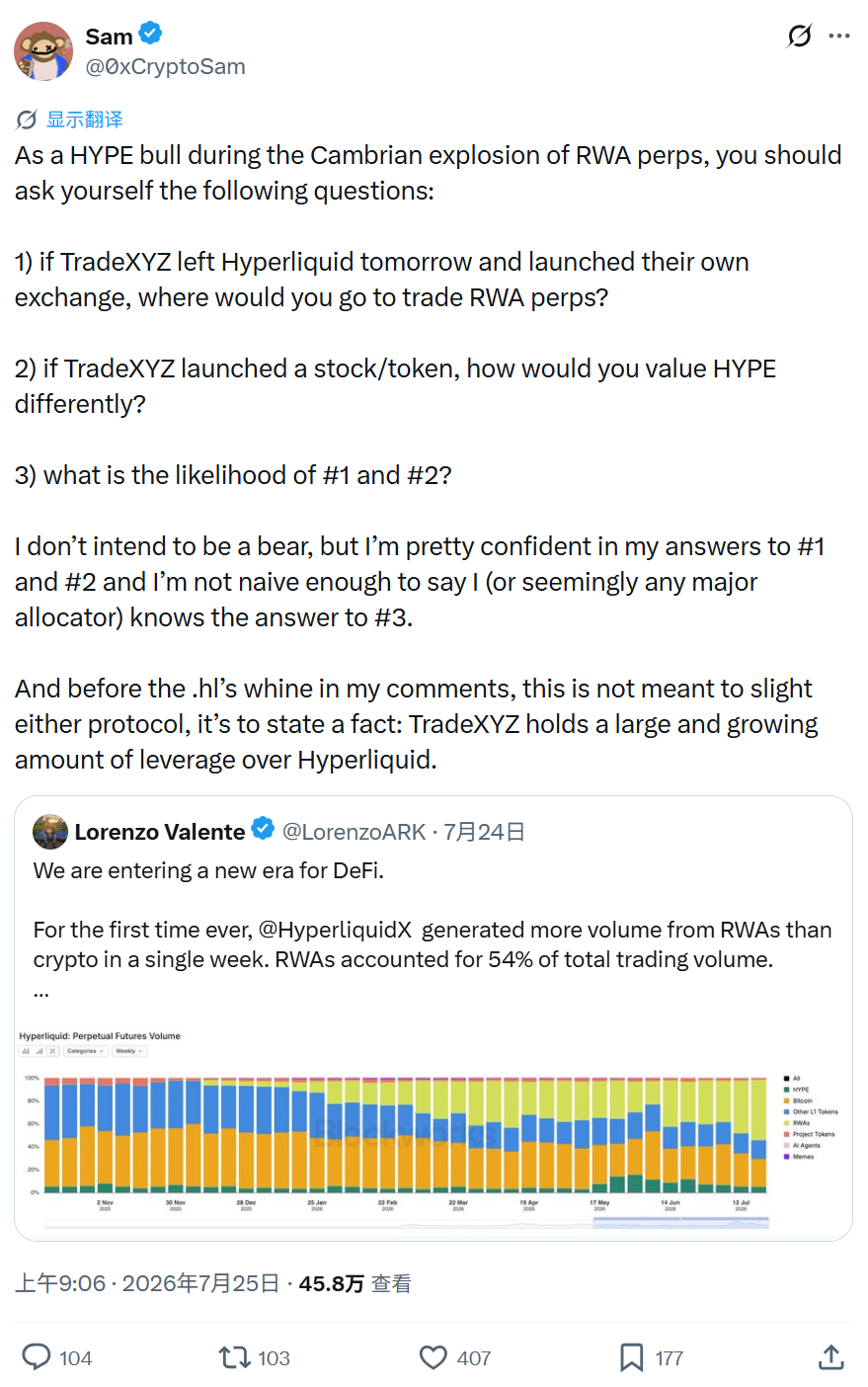
Currently, the probability of completely becoming independent is low, while the likelihood of benefits gradually differentiating is somewhat higher. But as @0xCryptoSam reminded, trade.xyz has already formed real leverage over Hyperliquid. This leverage itself is the latest example of the "successful application layer and underlying protocol relationship" in the crypto industry.
trade.xyz does not need to completely leave Hyperliquid; it only needs to deploy its front-end and risk control engine simultaneously on Monad or Solana's derivatives protocols. As long as 20% of the flow is diverted, Hyperliquid's exclusive premium will be broken. This is its biggest covert threat to Hyperliquid.
免责声明:本文章仅代表作者个人观点,不代表本平台的立场和观点。本文章仅供信息分享,不构成对任何人的任何投资建议。用户与作者之间的任何争议,与本平台无关。如网页中刊载的文章或图片涉及侵权,请提供相关的权利证明和身份证明发送邮件到support@aicoin.com,本平台相关工作人员将会进行核查。


