Author: Zhou, ChainCatcher
Recently, BIP-110 has brought the Bitcoin community back into a familiar yet unfamiliar debate.
Familiar in that the controversy still revolves around arbitrary data on-chain, inscriptions, Runes, OP_RETURN, and the nodes themselves. Unfamiliar in that the participants this time are no longer just developers and node operators.
Michael Saylor, founder of Strategy, Adam Back, co-founder of Blockstream, the mining pool Foundry and Ocean, the Bitcoin Knots node faction, as well as participants in the Ordinals ecosystem have all entered this debate from different angles.
On July 18, Michael Saylor listed 110 reasons opposing BIP-110 in his lengthy article “110 Reasons BIP-110 Is a Bad Idea.” He believes this proposal would escalate the garbage data dispute into a consensus rule change, and render some currently valid transactions, which are willing to pay fees, invalid.
This makes BIP-110 more than just a technical proposal. It begins to question a deeper issue within the Bitcoin community: who has the authority to decide what Bitcoin should be.
What is BIP-110: Moving Anti-Garbage from Forwarding Strategy to Consensus Layer
BIP-110 stands for Reduced Data Temporary Softfork, which can be translated into Chinese as “减少数据临时软分叉”, its predecessor is BIP-444, and the original author of the current BIP-0110 is Dathon Ohm.
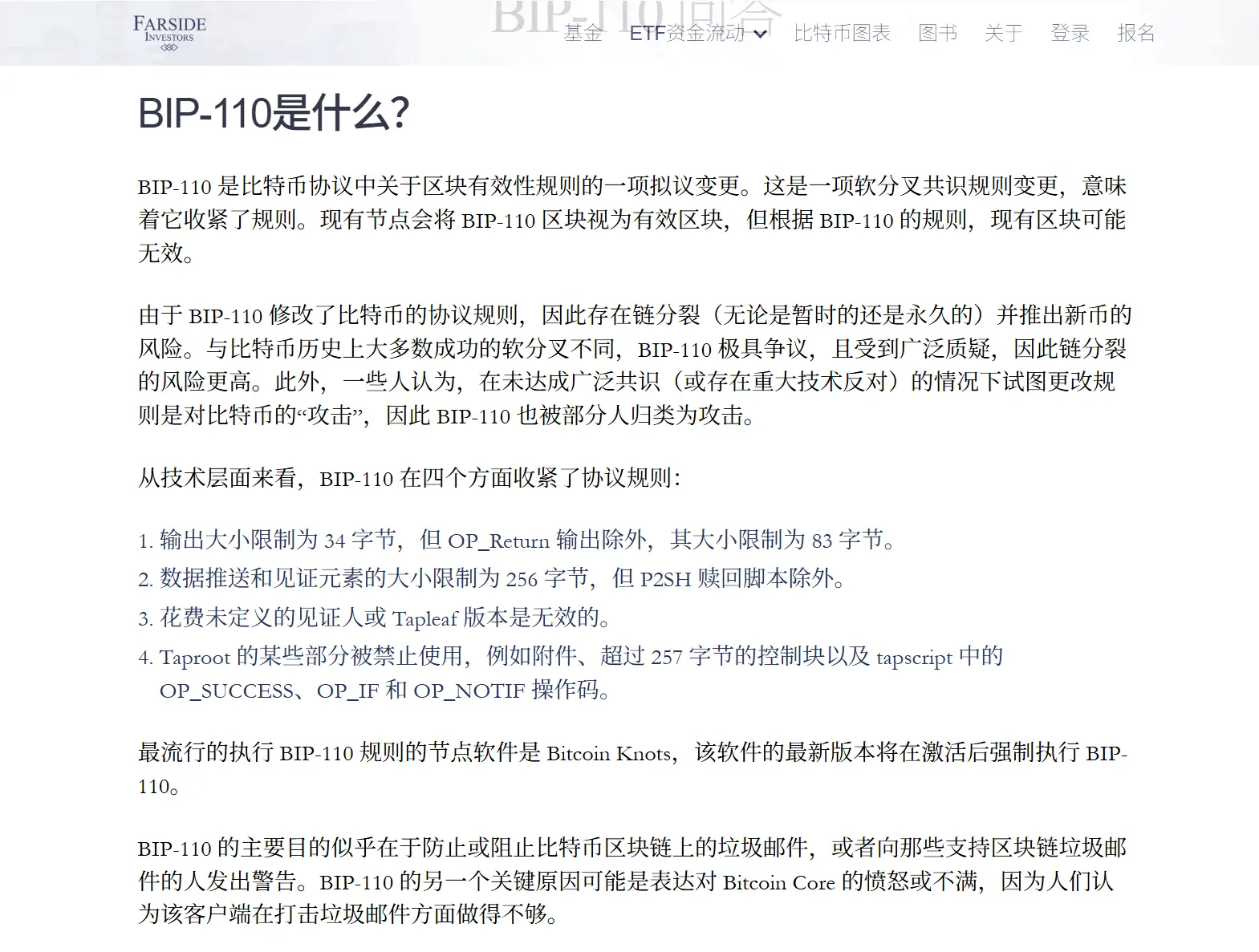
Image source: FARSIDE
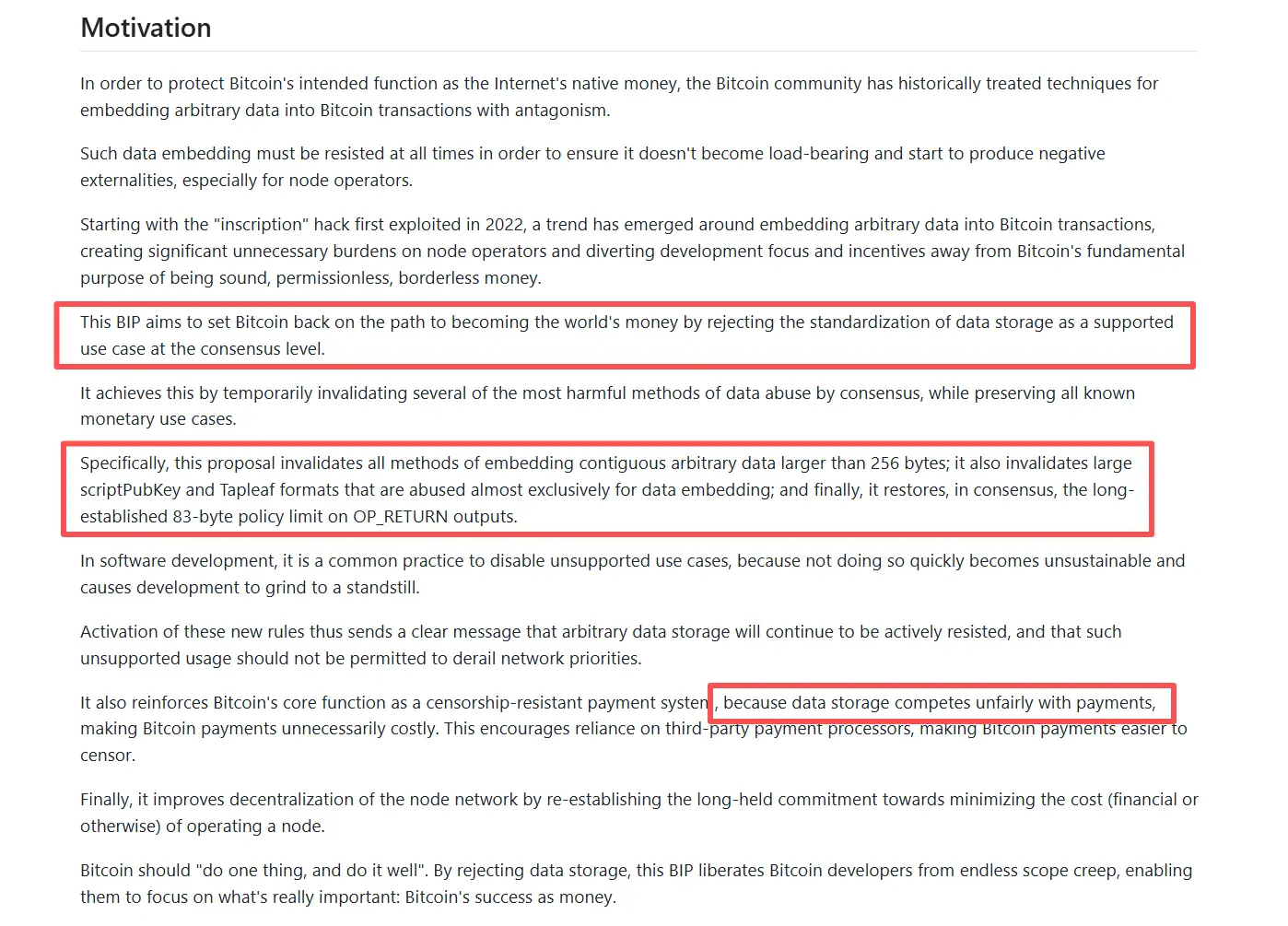
It plans to add seven restrictions through consensus rules within about a year, including limiting most new output scripts to within 34 bytes, restoring the OP_RETURN limit to 83 bytes, restricting the push of data exceeding 256 bytes and certain witness items, and temporarily banning some undefined witness versions and Taproot expansion paths.
The proposal sets an automatic expiration after one year, while existing coins before activation are protected by grandfather clauses.
Data source: GitHub
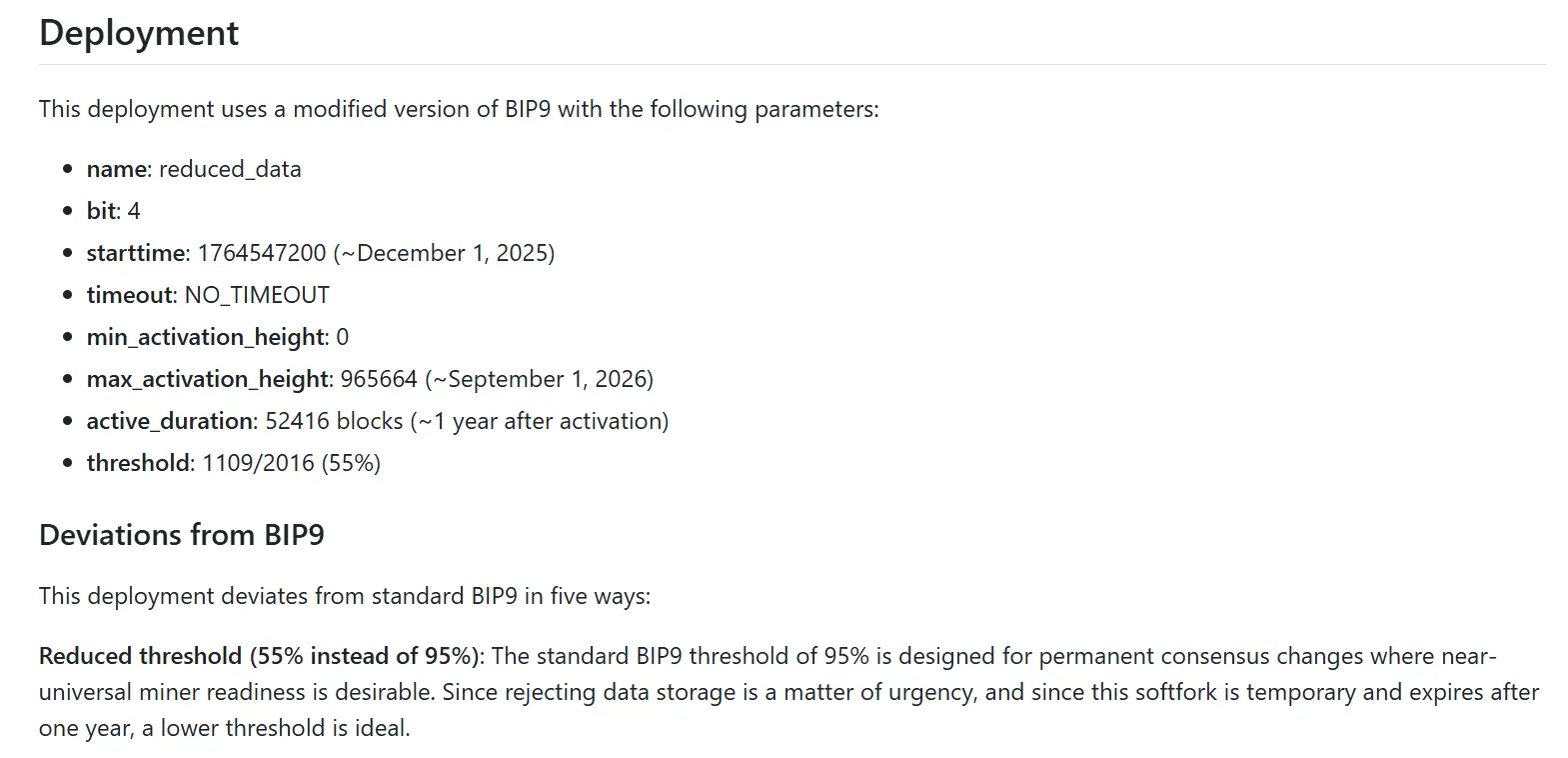
Regarding the deployment mechanism, according to the original text of bip-0110, the proposal uses bit 4 miner signaling, with a threshold of 1109/2016, or 55%. The compulsory signaling period is set from block 961,632 to 963,647, locked at the latest in 963,648, and activated in 965,664.
Proponents argue that non-monetary data like inscriptions and Runes occupy block space, increasing the long-term burden on full nodes, and diverting developers' attention from Bitcoin's core mission as a currency network.
What truly sparks controversy is BIP-110 pushing this matter to the consensus layer. In the past, nodes could choose not to forward certain transactions, and miners could choose not to package certain transactions. BIP-110 seeks to directly invalidate some currently valid transactions at the protocol level.
This changes the nature of the issue.
v30 and Node Forwarding Strategy: Why Supporters Say Default Governance Has Failed
One background to BIP-110 is the adjustment of the OP_RETURN default strategy in Bitcoin Core v30.
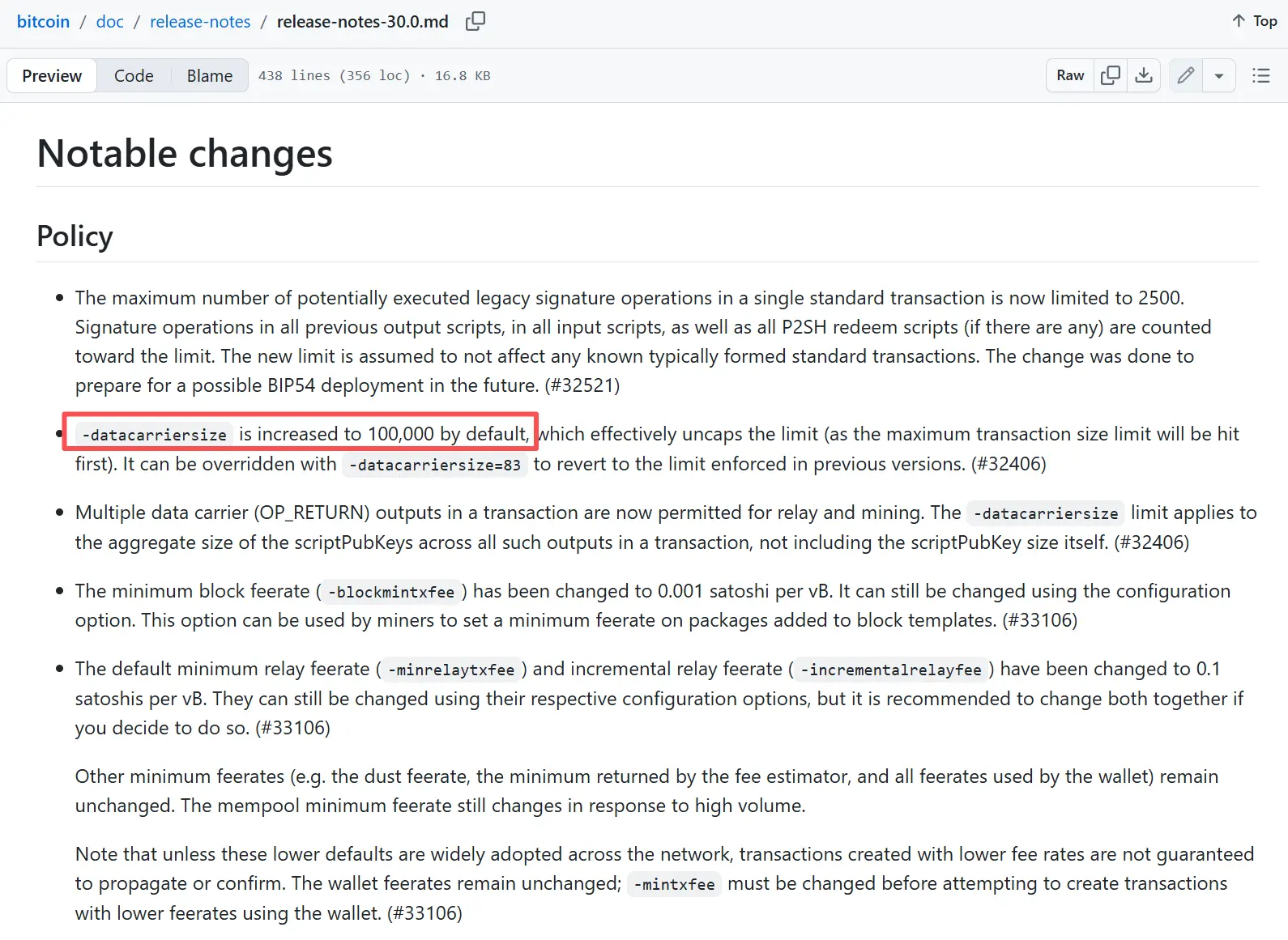
According to the release notes of Bitcoin Core 30.0, the default value for datacarriersize has been raised to 100,000, effectively lifting the default limit on OP_RETURN data carriers, while users can still manually reset datacarriersize to 83 to restore the old limit. Multiple OP_RETURN outputs in the same transaction are also allowed for forwarding and mining, with limitations changed to aggregate size calculations of all relevant scriptPubKeys.
Three layers need to be distinguished here. Forwarding strategy determines what nodes default to forwarding, mining strategy determines what miners default to packaging, and consensus rules determine whether blocks are valid. v30 modifies the first two layers, while the controversy around BIP-110 is that it attempts to advance the policy debate of the first two layers to the third layer.
The reason from the Core side is that this modification belongs to forwarding and mining strategy and does not touch the consensus rules. Since users can continue to maintain a default limit that is easy to circumvent through other script paths, private forwarding channels, or direct submissions to miners for writing data, it only creates a false sense of security. The default node software should be closer to transactions that miners and the market are reasonably likely to accept, which comply with consensus rules.
Supporters of BIP-110 do not accept this explanation.
According to early Bitcoin participant secsovereign, in response to Saylor's lengthy article Response to Michael Saylor's 110 Reasons, the situation today is pushed to this point through the development of infrastructure such as direct submission APIs, alternative forwarding networks, and private connections to mining pools. They allow transactions to bypass the default filtering of public nodes and reach miners’ block templates directly. Inscriptions themselves did not break the balance; they merely exposed that it has long been lost.
According to this narrative, node forwarding strategy has long ceased to be enforceable. It is disclosed that Core v30's relaxation of OP_RETURN's default limits is viewed by supporters as formalizing this loss of control. Since the policy layer cannot hold the line, the boundary must be moved to the consensus layer.
This section touches not on OP_RETURN itself but on the power of default software. Bitcoin Core does not change consensus rules but can affect the actual behavior of many nodes and miners through default strategies.
Supporters argue that the action of changing the v30 default strategy lacked a signaling window and thresholds, completed by a minority who hold code merging authority. BIP-110, adopting a 55% miner signal, has a higher threshold than that which it seeks to correct.
Opponents contend that the failure of the policy layer does not automatically prove that restrictions at the consensus layer are appropriate, valid, and low-risk solutions.
Adam Back's Rebuttal: Technical Consensus Itself is Bitcoin's Immune System
The most complete first-principles theoretical argument against BIP-110 comes from Adam Back, co-founder of Blockstream and designer of hashcash.
According to Adam Back's statement, he personally abhors garbage data, and the design of hashcash was indeed related to anti-garbage. However, he believes that the essence of Bitcoin as an unpermissioned currency is that no one can impose their value judgments on others.
In his expression, users can modify their software but cannot modify others' software. The side effect of decentralization is that there are no police in the network, and no authority can determine legitimate use for everyone.
Back also referred to the technical consensus process of Bitcoin as a kind of protective resistance. Any protocol change must be subjected to a review by a large number of developers and protocol observers; this technical consensus similar to the IETF, while slow, can prevent unproven changes from eroding the fundamental attributes of the system.
Thus, his opposition to BIP-110 falls at the governance level. He has disclosed that if supporters cannot accept the status quo, they can unite to fork, but Bitcoin will not join.
Ironic Blowback: Even if Activated, BIP-110 May Not Stop Arbitrary Data
BIP-110 faces a more practical problem. Even if it activates, it may not truly block arbitrary data.
According to RustBitcoin maintainer Martin Habovštiak, he revealed in March that he was able to write a 66KB TIFF image into a single transaction without using OP_RETURN, Taproot, or OP_IF, and it could be publicly verified and decoded as a complete file on-chain.
This shows that as long as Bitcoin still allows sufficiently complex state transitions, data can be split, encoded, or disguised before entering the chain.

Workarounds are also taking shape.Leonidas, co-founder of Runestone, pointed out that he is launching an open-source client named DOG Mode, specifically to relax BIP-110's restrictions on non-financial data. It does not change consensus rules, does not require voting, but only changes the forwarding rules of individual nodes; as long as enough nodes and miners accept it, related transactions can be propagated and confirmed.
@secsovereign pointed out that BIP-110 primarily blocks large continuous data channels but cannot completely seal off distributed stuffing data; therefore, a separate minimum output value proposal is also needed to address issues arising from scattered outputs.
This puts BIP-110 in an awkward position. It bears the risk of consensus change but may not be able to completely achieve its cleanup goals. It can increase the cost of data embedding but finds it difficult to end the data war.
Miners and Nodes: PoW Constitution, Knots Sovereignty, Foundry Hashrate Voting
The activation mechanism of BIP-110 has resurfaced the old contradictions between miners and nodes.
F2Pool co-founder Wang Chun stated that PoW is the constitution of Bitcoin, and nodes should respect miners. This represents a core view from the miner camp, that a soft fork without miner support, especially a UASF with a compulsory signaling period, is hard to gain legitimacy on the execution level. He had previously expressed opposition to BIP-110, arguing that protocol upgrades should not mimic American politicians' bundling bills.
The answer from the Knots node faction is entirely different. @MarcanoFilms believes that the over 15,000 nodes currently running RDTS rules are legitimate sovereign operators, not the product of any witch attack. Each node equally implements consensus rules, and the protocol layer will not give more validation rights simply because a node belongs to a large exchange.

The mining pools themselves are also expressing their positions with actions, albeit in opposite directions.In March, the first block supporting the BIP-110 proposal was mined by OceanOcean recently indicated that they would upgrade their backend to independently follow multiple chains when BIP-110 triggers a chain fork, effectively operating as two mining pools from the fork point onward.
Leading mining pool Foundry has handed the decision-making power to clients, allowing mining pool accounts to vote weighted by average hash rate; it will switch to support BIP-110 signaling only when the approval votes exceed 51% of the voting hash rate.
Miners, nodes, and mining pools are all responding to the same question in their own ways. The legitimacy of Bitcoin upgrades comes from PoW, from node execution, or from the checks and balances of both. The one holding real signal power is not unified internally.
BlockSlop: When Forks Shift from Verbal Warfare to Upgrade Paths, Engineering Risks Begin to Emerge
It is against this backdrop that a technical tail risk has been publicly disclosed.
According to a lengthy article published by researcher Dathon Pwn titled “BlockSlop: BIP 110 Consensus Bug Public Disclosure,” it points out that there is a consensus bug in the activation client of BIP-110 regarding a late upgrade path. (Note: The discloser Dathon Pwn and proposal author Dathon Ohm are two different people; Pwn in hacker terminology means to breach)
It is disclosed that the problem does not lie in the inability of the new BIP-110 rules to check new blocks, but rather in that nodes may first accept a block under the old rules and then, upon enabling BIP-110, continue to trust the existing database without re-validating that history according to the new rules.
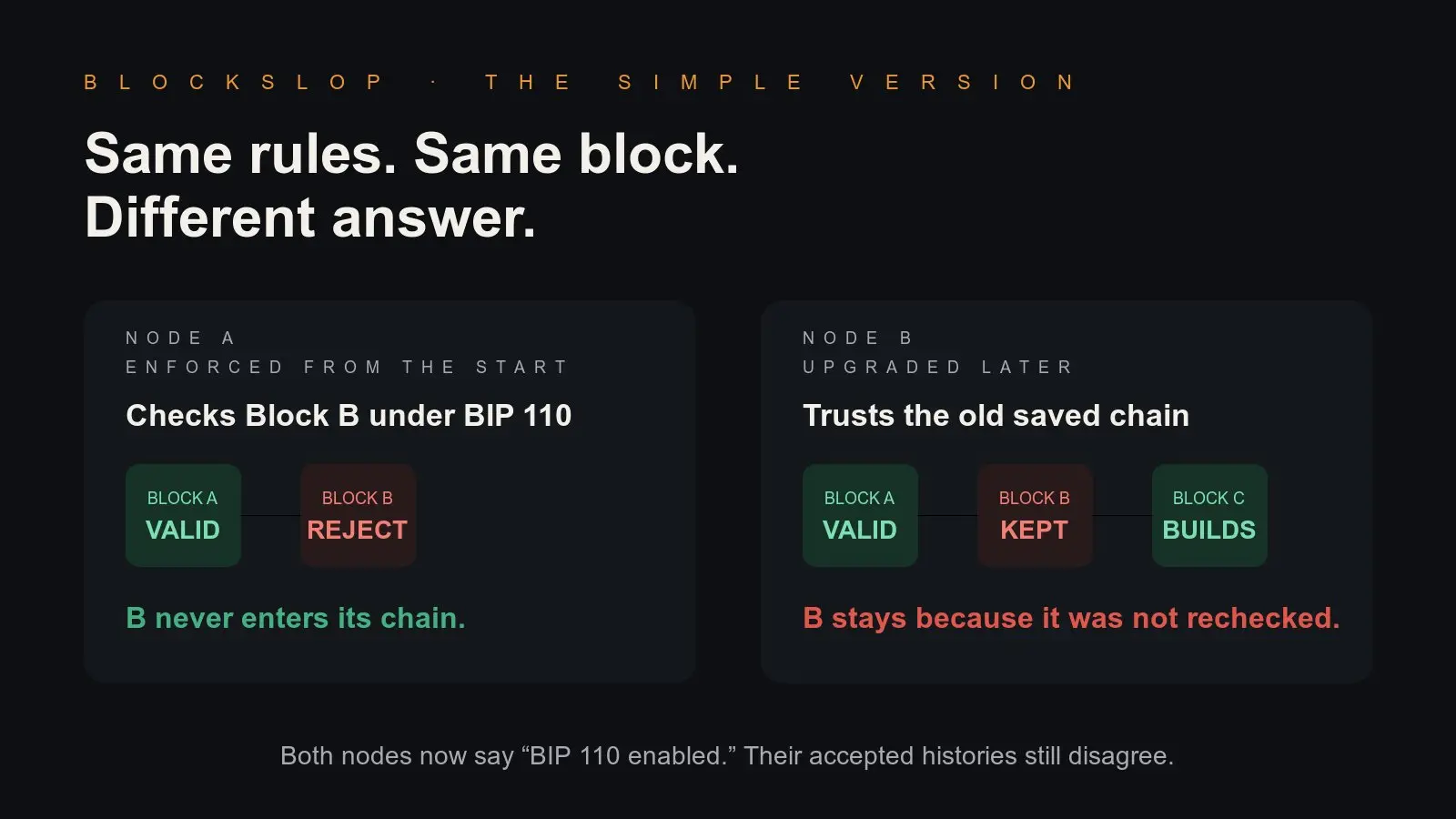
In other words, a late-upgrading node retains a historical block that is valid under the old rules but should be rejected under BIP-110. A completely new BIP-110 node refuses the same block when re-validating from scratch. Both claim to have enabled BIP-110 but provide different answers for the same segment of history.
Dathon Pwn also emphasizes that this does not mean the mainnet is already split, nor does it mean that installing the software will trigger the problem. The prerequisite for triggering this issue is that there indeed exist blocks that are valid under the old rules and invalid under the new rules on the chain, and the node has already accepted and retained them before enabling BIP-110.
The weight of this discovery lies in its timing. It appears at the juncture when Foundry consults miners’ opinions on whether to signal, presenting a preconditioned but fixable upgrade path flaw in front of all participants who may mine, settle, or build on this chain. For miners, exchanges, wallets, and custodians, hidden divergences are often harder to deal with than open forks.
Corporate Treasury's Involvement: A New Variable in Protocol Politics
Returning to Saylor, his involvement adds a new weight to this debate.
In his article “110 Reasons BIP 110 Is a Bad Idea,” he opposes BIP-110 adopting a 55% miner signal threshold, believing it is clearly lower than the 95% standard of BIP-9 and removes the usual timeout and failure modes, potentially increasing coordination errors, chain splits, and market uncertainties.
He also believes that block space fees, node forwarding strategies, miner strategies, pruning, and Layer 2 tools can address related issues without changing consensus.
It is disclosed that even if the rules are only temporarily effective, the governance precedent it establishes may still exist long-term, making this proposed governance approach more dangerous than the problems it aims to solve.
Saylor’s uniqueness lies in the fact that he represents BTC holders at a publicly traded company level. According to the latest disclosures, Strategy holds 843,775 BTC.
It is neither a mining pool, nor the Core maintenance team, nor an ordinary node community, but its balance sheet can influence the market's judgment on which chain is BTC.
What he possesses is narrative power and clout in the capital market. He can influence how the market and media interpret this dispute, provide legitimacy for a certain party, and amplify his preferences in the capital market.
In the last round of the Bitcoin governance debate, the participants were usually developers, miners, node operators, and even exchanges. This time, the balance sheet of a publicly traded company has also stepped onto the stage of protocol politics. This might be the biggest change left by BIP-110.
Conclusion
When all these five forces are put together, what BIP-110 truly exposes becomes clear. Bitcoin does not have a universally recognized arbitrator.
Miners hold the hash power but are internally divided. Node operators advocate for equal validation, refusing to weight by economic size. A minority of developers hold code merging authority, can actually alter the default across the entire network, but lack accountability mechanisms for the node operators bearing permanent costs.
Treasury holders wield narrative and capital yet have no votes on-chain. Adam Back's technical consensus process treats the resistance to change itself as a source of legitimacy.
Each faction invokes different sources of authority and competes for the interpretation rights of neutrality and conservatism.
BIP-110 may ultimately fail to activate, but it has already performed a governance stress test.
When the claims to defend currency borders and maintain protocol neutrality collide head-on, each side will claim to be defending Bitcoin. The real core of this dispute is who has the authority to determine what Bitcoin is.
免责声明:本文章仅代表作者个人观点,不代表本平台的立场和观点。本文章仅供信息分享,不构成对任何人的任何投资建议。用户与作者之间的任何争议,与本平台无关。如网页中刊载的文章或图片涉及侵权,请提供相关的权利证明和身份证明发送邮件到support@aicoin.com,本平台相关工作人员将会进行核查。


