Author: Nancy, PANews
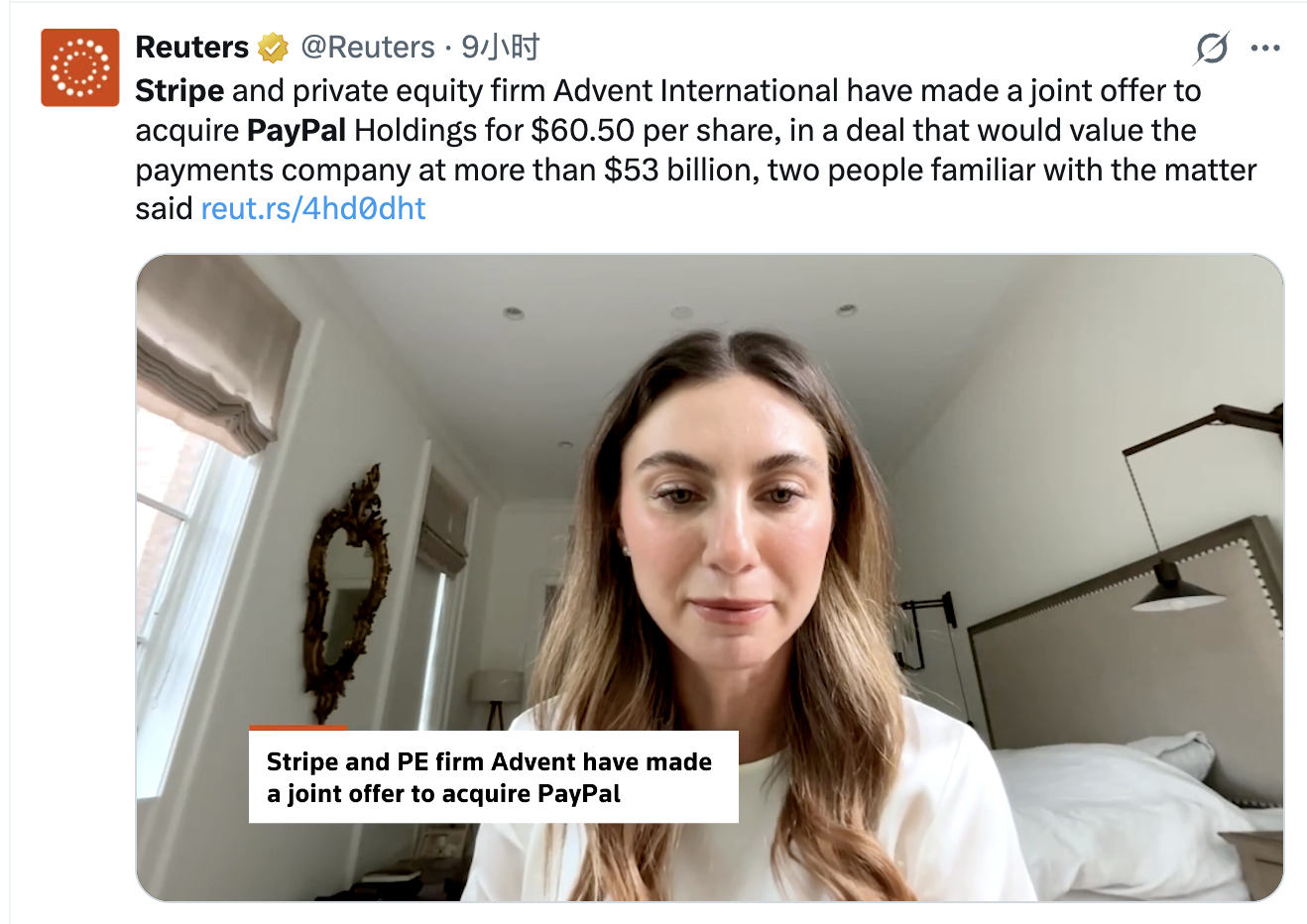
Recently, the payment unicorn Stripe has been reported to team up with private equity giant Advent International to propose a $53 billion acquisition of former payment giant PayPal. Following the announcement, PayPal's stock price rose nearly 17.2%.
This merger rumor, which could rewrite the global payment landscape, surfaced several months ago, but as of now, PayPal has still not officially responded, and both parties have not entered substantive negotiations yet.
Stripe plans to spend $53 billion to acquire PayPal, but has yet to open the negotiation door
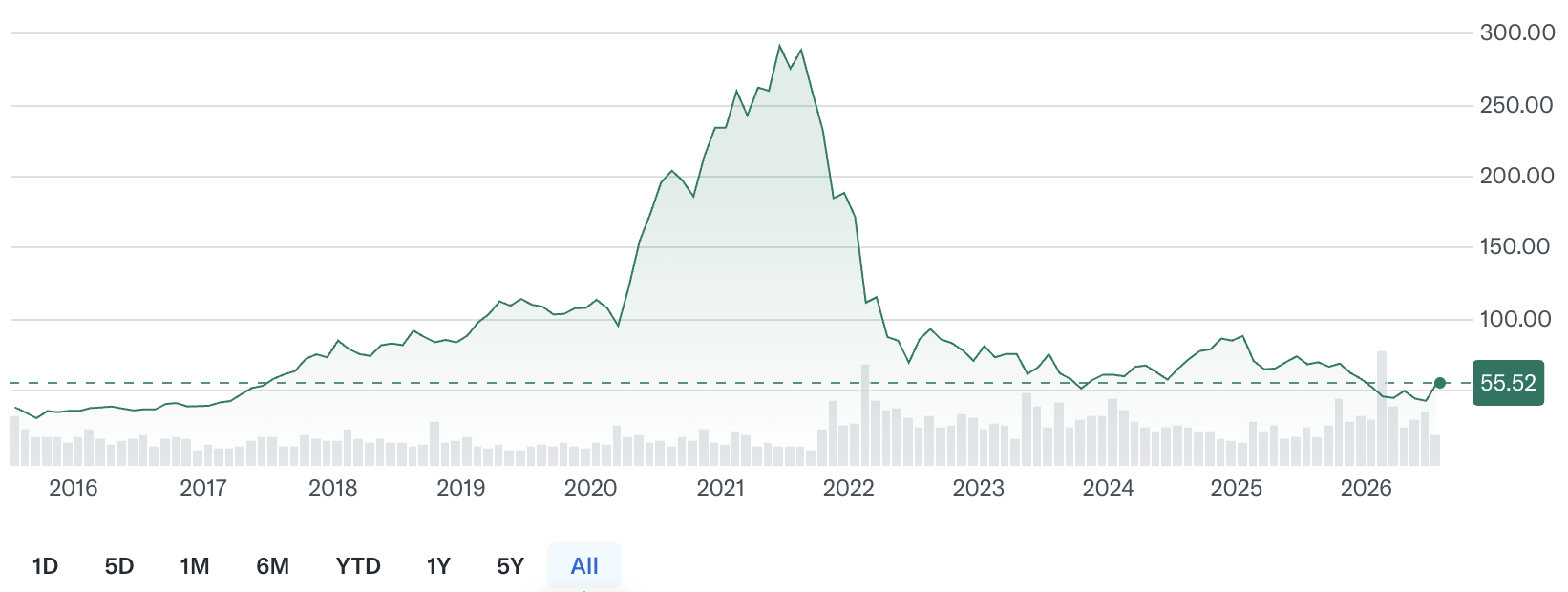
On July 15, according to Reuters citing informed sources, Stripe and Advent International have jointly made a buyout offer to PayPal at $60.5 per share, corresponding to a total valuation of over $53 billion, reflecting a premium compared to PayPal's current stock price of about $55.5.
Although the not-yet-public Stripe's latest valuation has risen to $159 billion, more than three times PayPal's current market value, relying solely on its own funds would still make it difficult to complete a transaction of over $53 billion.
According to informed sources, Stripe and Advent have secured about $50 billion in bank financing commitments to provide primary funding support for this acquisition. After the transaction is completed, both sides plan to co-own PayPal, each holding 50% of the equity, rather than splitting or divesting PayPal as traditional private equity funds typically do.
This transaction structure is not common in the fintech industry. Typically, tech companies prefer to complete acquisitions independently for quick business integration; private equity funds lean towards gaining control through leveraged buyouts and then maximizing exit and returns through asset restructuring and divestiture. By choosing equal shareholding, Stripe and Advent share the funding pressure of this super-sized acquisition and realize complementary advantages of industry resources and capital capabilities.
Among them, Stripe is responsible for industrial synergy and business integration, further consolidating its leading position in the online payment sector. For Stripe, PayPal's greatest competitive advantage is not a single business but a complete ecosystem built by consumers, merchants, and the payment network. Disposing of parts would not only weaken the network effects between consumers and merchants but also impact brand value and limit future development space. Therefore, for Stripe, retaining the complete value of the PayPal platform is of far greater long-term strategic value than acquiring several independent assets.
In contrast, Advent plays more of a "capital bridge" role in this transaction. As a globally renowned private equity fund, it has long been entrenched in the fintech sector, possessing abundant experience in large leveraged buyouts and excelling at enhancing corporate value through operational optimization and capital management. Public records show that since 2008, Advent has invested over $7.8 billion in 18 payment and fintech companies. One of its most representative cases is the privatization acquisition of the Canadian fintech company Nuvei for about $6.3 billion completed in 2024.
Hence, this potential deal is not a traditional financial investment but rather a long-term strategic integration based on the global payment ecosystem.
In fact, as early as February of this year, there were reports that Stripe had made a preliminary acquisition offer to PayPal. According to the latest informed sources, Stripe and Advent hope to push for the start of negotiations in the coming weeks, but there remains considerable uncertainty regarding whether the deal will ultimately materialize.
As of now, PayPal has yet to respond publicly. However, according to reports from the foreign media Semafor in February, PayPal was not negotiating with Stripe or any other companies regarding a sale at that time and had been collaborating with investment banks over the past few months to prepare for possible actions from aggressive investors or hostile acquisition offers.
According to insiders, this series of preparations arises from a significant drop in PayPal's stock price, with company management concerned that a reduced market value might make it a target for external capital attacks or acquisitions.
The market also speculates that Stripe's current offer may not be sufficient to persuade PayPal's board and shareholders to accept the deal; it seems more like a probing offer. Considering that large mergers typically undergo multiple rounds of negotiation and bargaining, if Stripe aims to complete this acquisition, the likelihood of further increasing its offer in the future is not low.
After an 80% drop in PayPal's stock price, Stripe aims for more than just payment business
If this transaction is completed, it will become one of the most influential mergers in the global payment industry in recent years. It is not only a capital transaction of over $50 billion but also a sign of changing competitive logic in the global payment industry.
As fintech continues to evolve and AI technologies increasingly permeate payment scenarios, traditional payment giants face new competitive pressures, with even the industry pioneer PayPal being "abandoned" by the times.
As of July 16, PayPal's stock price had dropped about 82% from the historical high of $307.5 set in September 2021. Although its long-accumulated consumer base, merchant network, and brand influence still constitute an important moat, slowed growth, intensified competition, and insufficient innovation have made it challenging for PayPal to replicate its past rapid growth.
However, PayPal's vast user base, mature payment network, and global brand influence still provide it with significant strategic appeal. Bloomberg previously reported that several banks, financial institutions, and industry competitors have expressed interest in acquiring all or part of PayPal's business. Rumors of acquisition have also temporarily boosted PayPal's stock price, but the capital market remains cautious about its independent growth capability.
In the face of growth pressure, PayPal is accelerating its reform pace. After Enrique Lores officially took over as PayPal CEO in March, he rapidly launched a series of adjustments, including restructuring business departments, renewing the executive team, focusing on core businesses such as Checkout, Venmo, and cryptocurrency payments, while promoting cost optimization and layoffs, and investing more resources into new growth directions like AI.
However, for the capital market, internal reforms often mean longer fulfillment cycles and higher execution uncertainties. Therefore, rather than waiting for PayPal to complete the transformation independently, the market is more focused on achieving value reassessment through strategic mergers and acquisitions.
For the emerging payment giant Stripe, PayPal's real value lies not only in the payment business itself but also in its long-accumulated consumer access. Stripe has long held advantages in enterprise payment and merchant services but still has shortcomings in consumer payment. PayPal possesses over 430 million consumer accounts, the Venmo social payments network, and a mature digital wallet ecosystem. If the two parties complete integration, Stripe will be able to enhance its consumer payment capability, forming a complete payment loop covering both merchants and users.
More importantly, this merger could reshape both parties' competitive positions in the next-generation payment infrastructure.
In recent years, both Stripe and PayPal have continued to lay out stablecoin payments and cryptocurrency payment infrastructure. Stripe previously entered the stablecoin payment field through the acquisition of Bridge and recently announced a collaboration with several companies to promote the new stablecoin OUSD. Notably, after the release of the OUSD alliance list, some companies like Samsung and Dunamu had stated they had not formally participated in the collaboration, sparking market controversy.
In contrast, apart from providing cryptocurrency asset trading services, PayPal's issued stablecoin PYUSD has become the eighth largest stablecoin globally, with a market value exceeding $2.8 billion.
If Stripe ultimately acquires PayPal, it will simultaneously gain issuance capabilities, payment infrastructure, digital wallet ecology, and merchant network resources in the stablecoin domain, thereby enhancing its competitive ability against traditional payment networks like Visa and Mastercard, as well as other digital payment platforms.
However, this transaction is still in the early stages, and many uncertainties remain before it can materialize.
On one hand, whether PayPal's board is willing to accept the acquisition remains unknown, and disagreements between the two sides over valuation could lead to a breakdown in negotiations; on the other hand, such a large-scale merger must face real challenges like antitrust scrutiny, stability of bank financing, and the difficulty of integrating both parties' businesses.
But regardless of whether the transaction ultimately materializes, this potential acquisition has already become a microcosm of the changing landscape in the payment industry, with global payment competition entering a new phase.
免责声明:本文章仅代表作者个人观点,不代表本平台的立场和观点。本文章仅供信息分享,不构成对任何人的任何投资建议。用户与作者之间的任何争议,与本平台无关。如网页中刊载的文章或图片涉及侵权,请提供相关的权利证明和身份证明发送邮件到support@aicoin.com,本平台相关工作人员将会进行核查。


