Author: Castle Labs
Compiled by: Shenchao TechFlow
Shenchao Introduction: The on-chain RWA scale has reached $32 billion, but 90% of gold tokens are lying dormant in wallets. Enhanced turns PAXG into an income-generating asset using covered call options, allowing users to earn premiums without needing to understand options. This is the first step for RWA from "moving on-chain" to "doing real work," with gold being just the beginning.
The on-chain RWA scale has already exceeded $32 billion.
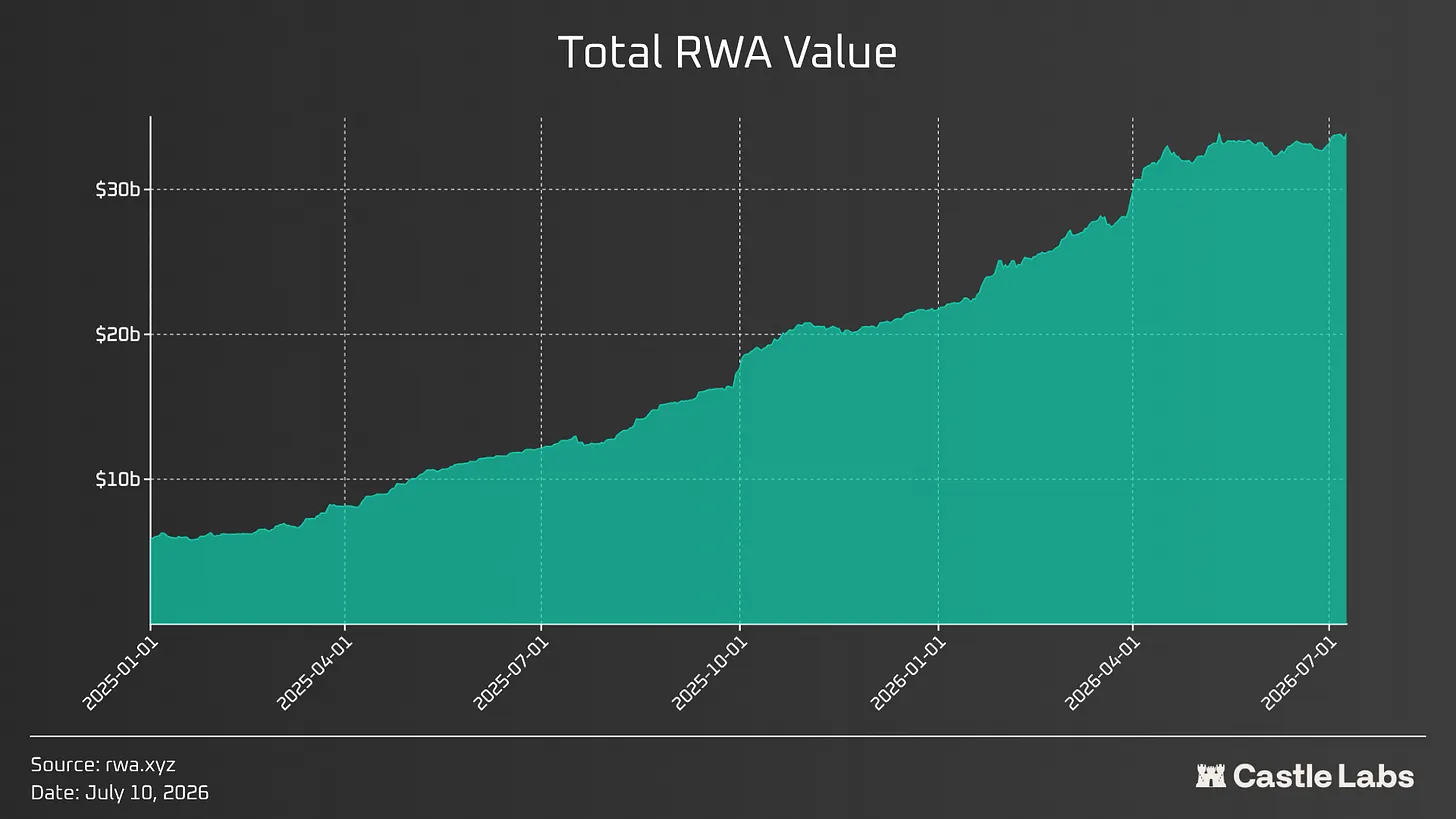
Most of it consists of low-risk assets, such as U.S. Treasuries, while other asset classes like stocks are also increasing.
Gold is the largest commodity on-chain. Tokenized value exceeds $4.9 billion, paving the way for tokenization as a store of value.
However, most on-chain products have limited functions: users can only buy physical gold, and there is no management of how these gold assets can generate returns on-chain.
This results in on-chain products being discounted in terms of value and practicality compared to traditional financial (TradFi) products.
This article focuses on what we believe to be the next wave of RWA: enabling these assets to generate yields.
We take Enhanced as a case study, analyzing its upcoming gold volatility yield vault, which uses PAXG. This is Enhanced's first "thematic vault," where users can express specific expectations and returns through options (with more binary tools to come in the future). This vault is designed using covered call options, a strategy that has been undervalued but has unique advantages: it can generate returns and hedge, marking the first step for traditionally non-yielding RWAs like gold to start making profits.
The on-chain RWA ecosystem is just beginning.
Will the options vault be key to making RWA truly work?
Let’s start talking about how to make gold generate returns.
Making Gold Work
Gold is a $30 trillion asset class and the first commodity to pave the way for on-chain tokenization. However, although there is more than $4.9 billion in on-chain gold, the vast majority of funds remain idle and generate no returns.
Traditional financial products, such as covered call ETFs, allow many to use options to earn premium income or hedge gold positions.
Yet these products suffer from the usual downsides of traditional financial products: limited accessibility, high fees, high management costs, brokerage fees, KYC, and custody requirements. For instance, GLDI, the oldest covered call ETF for gold (similar to the strategy Enhanced uses) charges a 0.65% fee, which is deducted before investors earn any returns.
This is why Enhanced decided to focus on gold. On-chain gold solutions exist, but are currently very limited: mostly spot, with no income generation.
Moreover, gold is the largest asset by market value on-chain and is in a historic moment:
In April 2026, gold prices hit an all-time high.
More investors want to allocate gold due to its value storage function.
Geopolitical and macroeconomic volatility has been at historic highs in recent years.
This makes gold the perfect candidate for covered calls: it can provide significant premiums while its price trends are relatively stable and range-bound.
Turning on-chain gold into an income-generating asset is a natural evolution of on-chain RWA: the first wave of growth focused on democratizing and expanding the accessibility of these assets. The next wave, perhaps more importantly, is to differentiate these assets from their off-chain counterparts and ensure they are efficient and capable of generating returns.
The vault is the perfect way to bundle all of this.
Enhancing Yield
Enhanced's goal is to bridge the gap between RWA assets and their on-chain productivity.
The approach is to identify the unique characteristics of each asset, as well as those of retail and institutional investors, packaging these nuances into structured strategies that can provide yields on RWA.
For gold, they focus on thematic vaults using covered call options.
Utilizing Options
Compared to perpetual contracts and other on-chain derivatives, options have always struggled to achieve broader adoption. This is often attributed to the complexity of options trading, requiring learning and skill. Since not everyone is familiar with options, we ensure that we clearly explain covered calls and how Enhanced uses them.
A covered call allows one to choose to sell only at the strike price upon the stock's expiration. In return, the seller can collect a premium while still holding the stock (or in the case of Enhanced's first vault, commodities).
Users using covered calls have a neutral/slightly bullish outlook on the underlying asset: they expect slight fluctuations while generating yields during the holding period. However, in certain circumstances, covered calls can also serve as a hedge after steady appreciation in the asset's value. Both scenarios perfectly align with the characteristics of gold.
Covered call users are essentially spot bulls because they hold the asset while having a short position in options that generate premiums.
Covered calls provide reliable premiums to buffer losses but also limit potential upside. Therefore, they are better suited for directionally neutral (e.g., mildly bullish), more passive investors.
RFQ System
The underlying mechanism of the PAXG vault utilizes a Request for Quote (RFQ) system.
On the back-end, deposited assets are auctioned in batches to the best bids in the RFQ system (from top market makers), and options are signed on-chain. Users then receive premiums in advance.
There is also a manual RFQ feature open for access, expected to gradually attract more market makers, institutions, and retail investors to ensure fair option premiums.
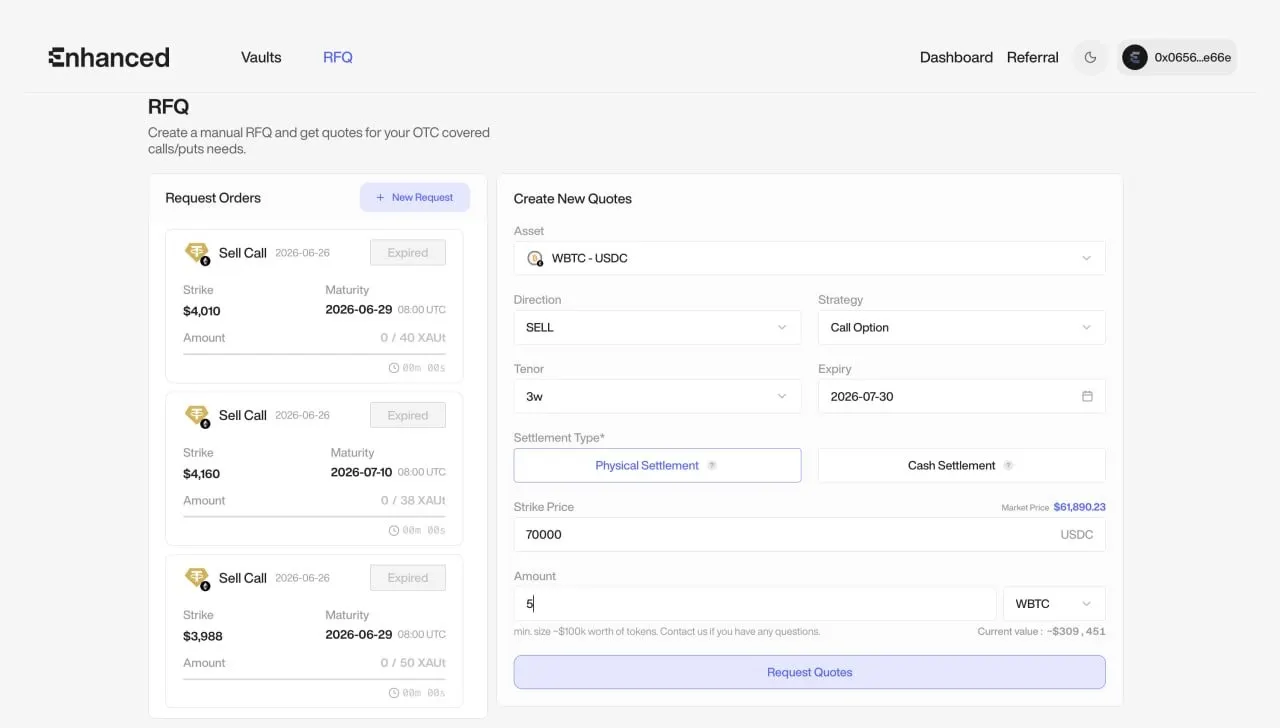
Any participant can directly sell covered calls against their holdings and define custom execution parameters (such as strike price, term, and direction). In the future, the range of available tools can be expanded to options on any assets beyond just gold, including any ERC-20 tokens.
Trades are signed by both parties, executed atomically, and cannot be altered by the operator, ensuring fair quotes.
The RFQ system is very attractive for any large vault that needs regular rebalancing or has specific sale terms for its assets, aiding in asset monetization.
Enhanced targets a broader structured products market, as the RFQ system can be utilized for asset classes beyond gold, ensuring future expansion.
PAXG Volatility Yield Vault
The first thematic vault launched by Enhanced is the PAXG Volatility Yield Vault.
It will focus on utilizing the volatility of PAXG to generate premiums for users.
The vault will utilize covered calls to allow users to earn option premiums on gold.
The vault operates as follows:
Subscribe to European-style options. They can only be exercised on the expiration date, meaning funds are locked during the cycle.
Users can deposit PAXG and USDC (which will be converted to PAXG).
The strike prices are expected to be 103-107% out-of-the-money (OTM), which means the strike prices will typically be 3-7% higher than the spot price of gold, dynamically adjusted to reflect market conditions.
The option cycle lasts two weeks (14 days, 26 cycles a year).
A fund protocol fee of 0.019% will be charged at the end of each cycle (annualized 0.5%).
To make this more practical, let’s look at what it means for a user to deposit gold in the vault and what happens at expiration in different scenarios.
Specifically, suppose a user deposits gold in the vault (which the vault sells covered calls against). When the options expire:
If the gold price is above the strike price, the option is settled, and the user receives the value of the options they subscribed to, plus the USDC premium. The cost of in-the-money (ITM) options is the potential upside that was forfeited during the period. In this case, the user foregoes potential appreciation beyond the strike price.
Let’s use a practical example with an initial gold price of $100 and a strike price of $105.
If at expiration the price is $107, the option is exercised: the user receives the appreciation to the strike price and the premium (from $100 to $105) but gives up an additional $2 of appreciation from $105 to $107.
If the gold price is below the strike price, the call option expires worthless and is not exercised; the user retains their gold holdings and the premiums generated. Based on the current strategy configuration, this is the target scenario and is expected to be the most common. Covered calls do not hedge against downside risks and only provide a buffer through income. If the gold price drops, the vault holds the same amount of gold but at a reduced dollar value.
The feature of Enhanced's vault configuration allows users to choose different settlement modes to determine how premiums are allocated.
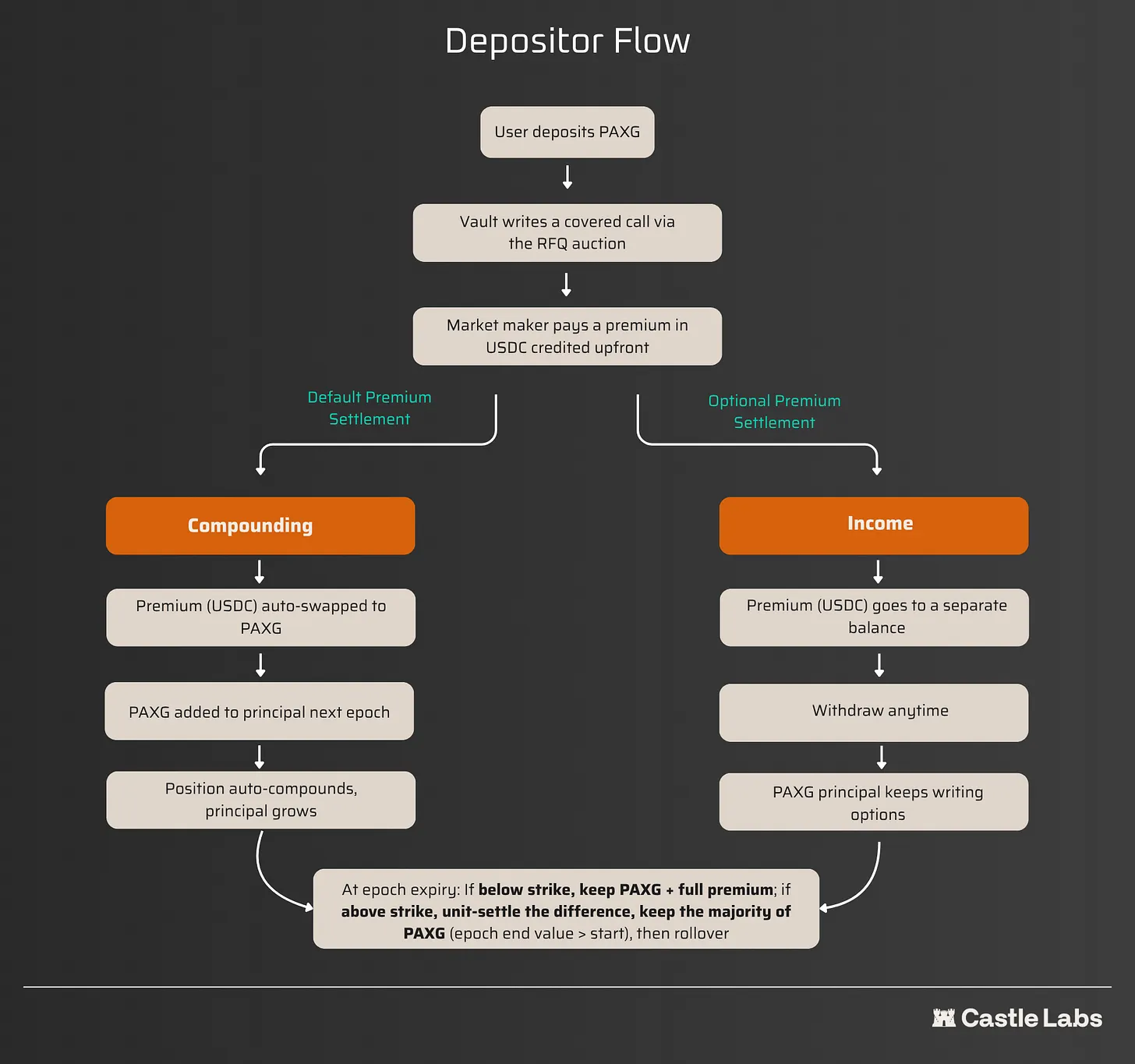
The default settlement option is a compound mode, where every earned USDC premium is automatically compounded, converted to PAXG, and added to the deposit for the next cycle. This is a classic auto-compounding position, more suitable for long-term gold investors.
The optional mode is an income mode, where each USDC premium is deposited into a separate balance that can be withdrawn at any time. This strategy is more suitable for users wishing to accumulate and generate USDC income from their gold assets (similar to dividends), which is very attractive for those with a significant amount of idle asset vaults.
Users can easily switch modes before the start of any cycle.
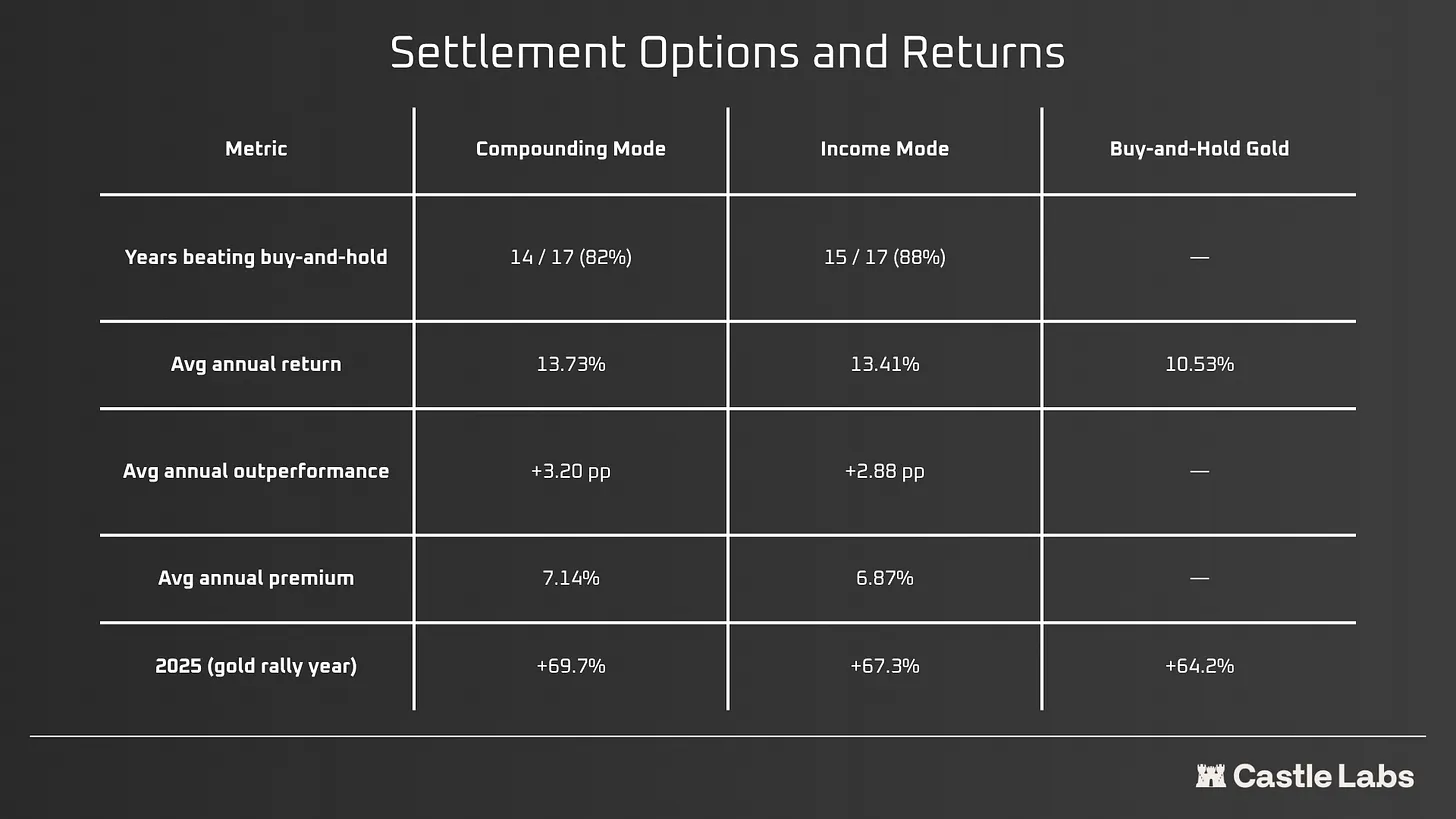
Here’s an example of the performance difference between the two settlement modes, using a strategy backtest of gold spot from January 2010 to April 2026:
The end-to-end operation of the vault is illustrated by this chart:
The focus of the PAXG vault is not to maximize premiums but to adopt a more conservative strategy: to retain gold in the money while still generating premium income for users.
Points to Consider
The vault is evolving from a singular strategy to a multistrategy range, covering the nuances of RWA asset classes and investor characteristics.
Enabling currently idle assets to generate yields on-chain is a top priority for yield providers and users holding those assets.
The Enhanced gold vault is a suitable example demonstrating how options and covered calls can provide additional income streams in the form of premiums for PAXG holders.
Since one of the main issues with options is complexity, in this scenario, the functioning of options is abstracted in the background, providing a seamless experience for users.
Through these products, investors can now earn yields on gold, a significant step towards making on-chain RWA profitable like off-chain alternatives, with advantages in accessibility, automation, and configuration. A clear example is the ease of switching between two different types of settlements using a toggle.
Other advantages include transparent pricing and fees, as well as flexibility in deposits and withdrawals each cycle, with no strict lock-up periods.
We expect this is just the starting point, as vaults have proven to be the most suitable primitives for generating yields on-chain RWA. Enhanced itself can utilize RFQ for a broader range of assets, including equities, and so on—gold is just the first proof of concept.
Broader strategy and asset coverage will be crucial for ensuring large capital allocation. Once the CLARITY Act is fully enacted, friendly regulation will make initiating liquidity and managing asset scale more accessible.
We will closely monitor these developments.
免责声明:本文章仅代表作者个人观点,不代表本平台的立场和观点。本文章仅供信息分享,不构成对任何人的任何投资建议。用户与作者之间的任何争议,与本平台无关。如网页中刊载的文章或图片涉及侵权,请提供相关的权利证明和身份证明发送邮件到support@aicoin.com,本平台相关工作人员将会进行核查。


