
Author: Zhou, ChainCatcher
Since Binance announced the launch of stock trading on June 1, more than a month has passed.
According to official data, among more than 7,000 tradable US stocks and ETFs, over 700 have been traded. As of the week ending July 1, Binance stock users had a net increase of $193.3 million in exposure, exceeding $190 million for the second consecutive week.
Regarding tokenized stocks, bStocks also went live on June 11.
One month later, is there actual buying in spot stocks, what are users mainly buying, and has bStocks carved out its own use case?
Let's take a closer look below.
1. In the first month, transactions break the ice, with buying concentrated in emerging markets
First, let's look at the spot stock segment.
Binance stock spot covers over 7,000 US-listed stocks and ETFs, supporting fractional share purchases, stablecoin settlements, and extended trading hours. On July 6, Binance continued to add stocks like ANTA, CBRS, DISK, FOTO, KMEM, QNT, STRC, among others. In terms of trading structure, Nest Trading is responsible for order referral, while Alpaca Securities handles execution, clearing, settlement, and custody.
In terms of usage rates, according to Binance Research, over 700 of the 7,000 targets have been traded. This figure indicates that this business is not just spinning its wheels, with about 10% of the targets reached by users within a month. On the other hand, it also suggests that early demand has not been evenly distributed; users are not using Binance as a complete US stock supermarket.
Regarding fund flow, the report shows that as of the week ending July 1, Binance stock users had a net increase of $193.3 million in stock exposure, down from $227.3 million in the previous week. Although this represents a 15% decrease month-over-month, it has remained above $190 million for two consecutive weeks.
In terms of the source of buying, emerging market users contributed 81% of the net inflow, unchanged for two weeks. In terms of user demographics, another previous data point from Binance Research indicated that nearly 93% of Binance stock trading users are from emerging markets.
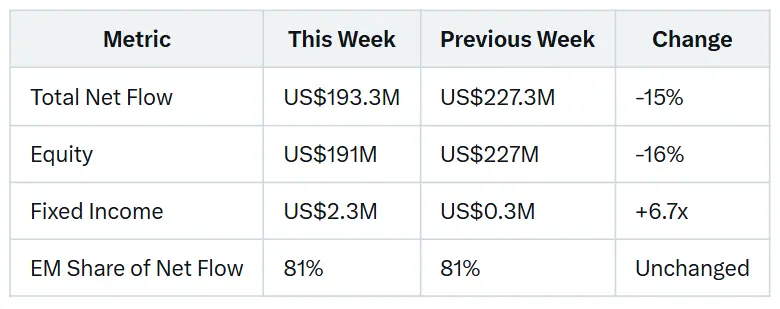
Image Source: Binance Equity Weekly Fund Flow
This indicates that Binance has not been competing for users in the most mature markets of traditional brokerages, but has found a group of users willing to buy US stocks directly using stablecoin accounts in markets with weak cross-border access, dollar asset allocation, and local brokerage experiences.
Thus, the early buying in Binance stock spot has emerged. However, this group of buyers is not evenly distributed across the more than 7,000 targets, but rather concentrated in a few high-interest assets and among users from emerging markets.
2. The technology sector absorbs 83% of net inflows, revealing thematic trading characteristics
If we only look at net inflows, Binance's stock business does indeed show some demand. The more crucial question is what kind of demand this is.
From the weekly data released by Binance, as of the week ending July 1, the technology sector absorbed $159 million in net inflows, accounting for 83% of total net inflows, with trading themes highly concentrated.
Micron's earnings report was the most significant catalyst of the week. After Micron released strong results after hours on June 24, the AI storage theme shifted from a net outflow of $1 million the previous week to a net inflow of $47 million. Fund inflow in the semiconductor industry rose from $22 million to $108 million, nearly a fivefold increase.
At the individual stock level, MU, MUU, SNDK, AMAT, INTC, and others in the AI storage and semiconductor chain absorbed significant capital. MU along with the 2x leveraged product MUU received a combined net inflow of $58 million, accounting for about 30% of the net inflow in stocks that week.
This type of capital is not blindly chasing after highs. The weekly report indicated that users net sold $11 million of MUU the week before the earnings report and then net bought $24 million after the report confirmation.
This shows that Binance stock users have a high risk appetite, but it is not a simple impulse for high leverage. They reduce risk around events and then increase their positions once the results are confirmed.
The report further stated that about 71% of Binance stock product holders have their stock allocation in the technology sector, with about 48% of funds flowing into semiconductors, a category that sees trading volume approximately 23 times that of other categories.
In terms of thematic fund flow, 25% flows into AI infrastructure and computing, 22% into quantum computing, with relatively higher allocations also in cutting-edge themes such as space and satellites, robotics, and humanoid robots. At the same time, broader ETF funds have mainly concentrated on semiconductors and AI storage.
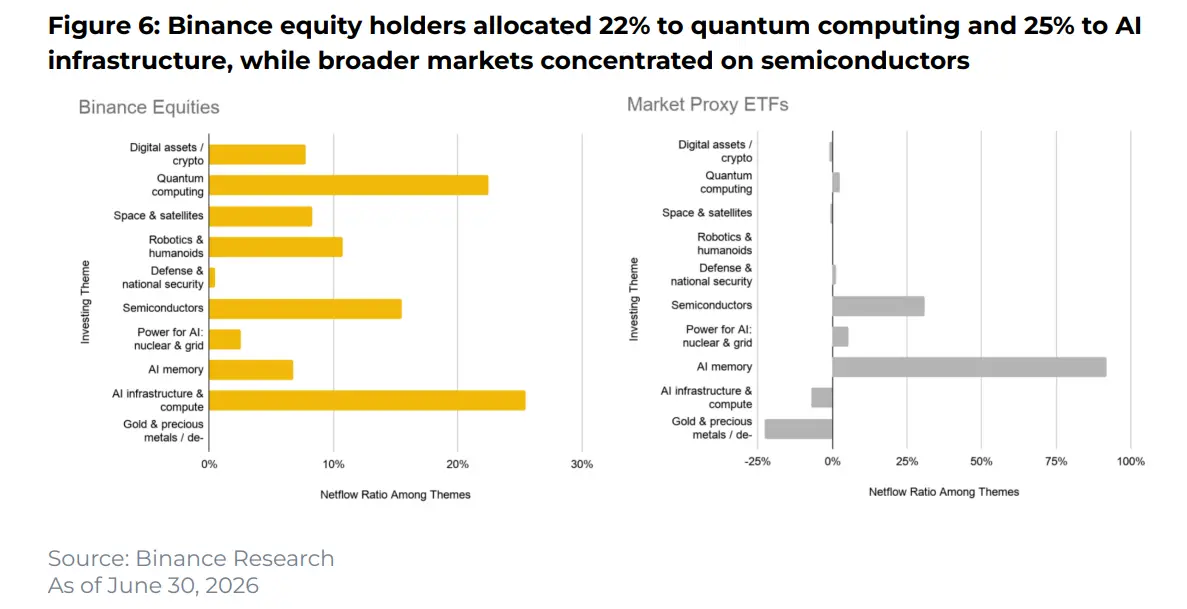
On the other side, thematic switching is extremely rapid. The most popular theme the previous week, defense and national security, saw net inflow drop from $150 million to $3 million this week, a decline of 98%. Funding related to SpaceX also retreated from previous highs, but SPCX still had a net inflow of $29 million, continuing to rank high in single stock inflows.
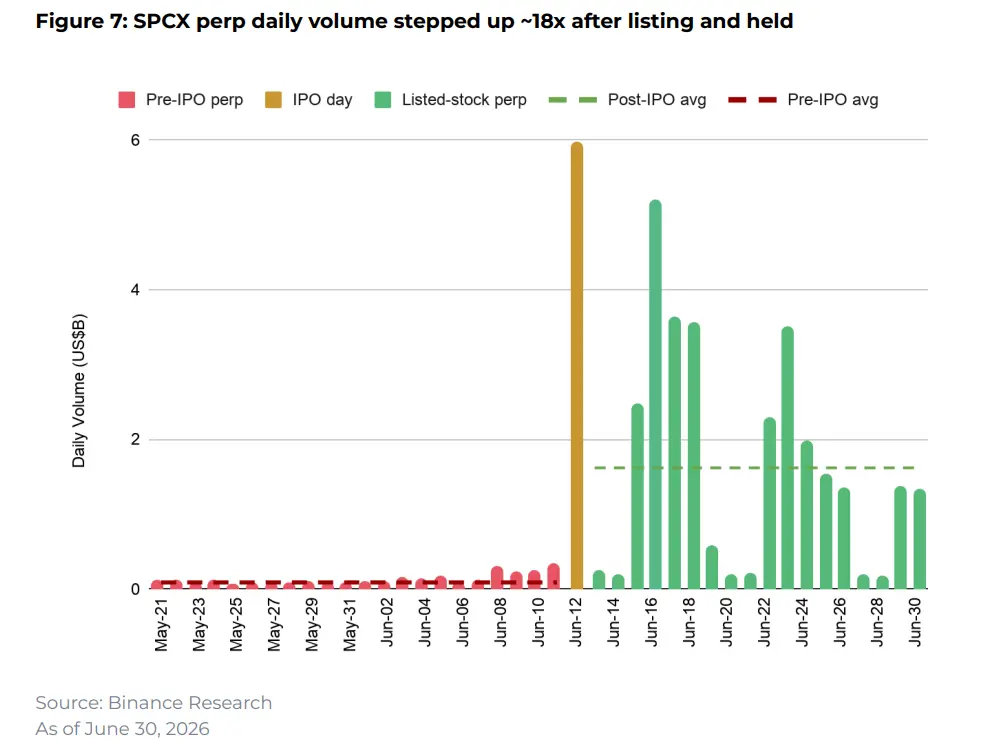
This series of changes is quite representative. Binance stock users are not buying traditional long-term US stock portfolios, but rather high-narrative assets like AI, semiconductors, quantum computing, SpaceX, Tesla, and Circle. They pay attention to earnings reports, policies, mergers and market sentiment, with trading logic that is closer to the triggers and volatility familiar to crypto users.
This also explains why users from emerging markets have become the main force. For many users in emerging markets, purchasing US theme stocks, leveraged ETFs, or popular private equity-to-public investments through local brokerages is costly, lengthy, and offers poor experience. Binance combines stablecoins, stock spot, and thematic assets within the same account, reducing not the overall investment threshold, but the threshold for expressing trading-type demands.
3. Tokenized stocks enter pressure testing, on-chain shares still hold some uncertainty
Next, let's examine the tokenized stock business.
Binance officially states that bStocks are considered tokenized securities, which are certificates representing specific financial instruments and do not equate to direct ownership of shares in the underlying listed company.
Spot stocks answer whether users can buy US stocks on Binance. bStocks answer whether users still want to trade US stock exposure when US markets are closed.
The bStocks report released by Binance Research on July 2 indicates that about 44% of transactions occur outside the regular trading hours for US stocks, compared to about 32% for spot stocks. Even when US markets are completely closed on weekends, bStocks still average about $346,000 in transaction volume per hour.
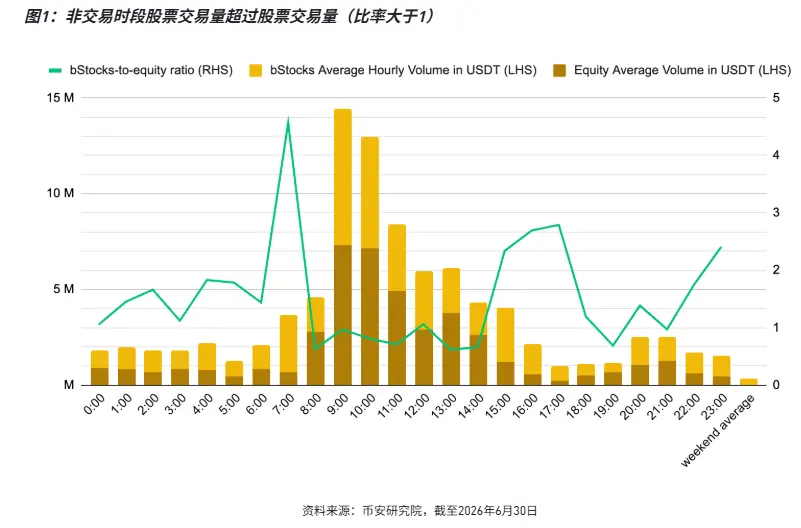
During the pressure tests over three holiday weekends, bStocks anticipated 87% of Monday open fluctuations, getting the direction correct 21 out of 22 times, achieving an accuracy of 96%. During the Juneteenth long weekend, bStocks had an average price difference of about 0.12% with the regulated market, the smallest among the three tests.
Specifically, the news of SpaceX confirming a $60 billion acquisition of Cursor occurred before the US market opened, and the tokenized SPCX had already completed both upward and downward movements before the market opened. Micron's earnings report was released two minutes after the US market closed, and MUB rose by 7% within five minutes and 13% within an hour, effectively completing the repricing before the next day's opening.
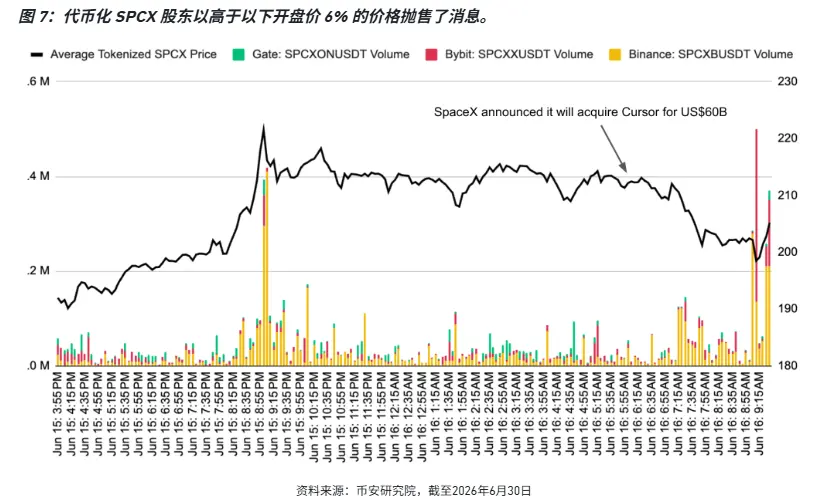
This data illustrates that the real use case for bStocks is quite specific. It is not due to a universal desire to put stocks on-chain, but rather because there are still people wanting to trade US stock exposure when US markets are closed.
However, the existence of demand for tokenized stocks does not mean that bStocks has captured the largest share.
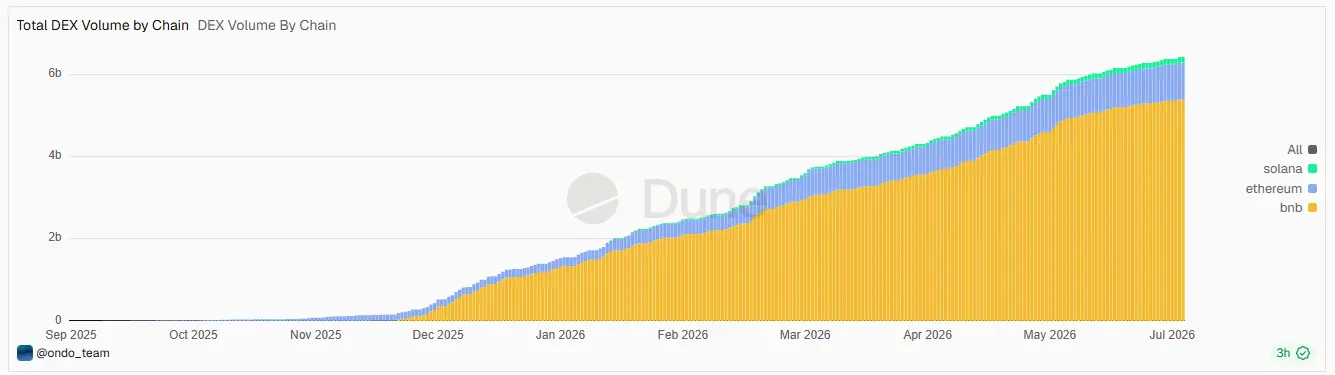
The BNB Chain officials reported on June 26 that there are already more than 709 tokenized stocks and ETFs on the BNB Chain, with a total trading volume exceeding $5 billion and a market cap over $1 billion. Meanwhile, the tokenized version of the same company on BNB Chain may exist in multiple forms, such as SpaceX having bStocks' SPCXB, Ondo's SPCXon, and xStocks' SPCXx at the same time.
Moreover, it is worth noting that Ondo is the primary venue for tokenized stock trading on the BNB Chain; according to Dune data, BSC contributed about $5.12 billion of the $6 billion total DEX trading volume for Ondo.This means that while the demand for on-chain tokenized stocks may already be verified, this incremental portion may not primarily belong to bStocks.
Conclusion
One month has passed, and approximately 10% of the targets in spot stocks have been reached by users, but overall, the scale remains limited and is concentrated among emerging market users and a few top assets.
This demand has emerged against a backdrop of regulatory turbulence. On June 24, Binance withdrew its MiCA license application submitted in Greece, and after the transition period ended on July 1, notified users in multiple EU countries to suspend certain services and halt new user registrations.
On the bStocks side, the use case for trading US stock exposure during market closure has been validated, and the speed of price discovery has withstood several holiday pressure tests. However, within the entire tokenized stock ecosystem, a significant chunk of trading volume has flowed to third parties like Ondo, and bStocks' own share lacks independent data support.
免责声明:本文章仅代表作者个人观点,不代表本平台的立场和观点。本文章仅供信息分享,不构成对任何人的任何投资建议。用户与作者之间的任何争议,与本平台无关。如网页中刊载的文章或图片涉及侵权,请提供相关的权利证明和身份证明发送邮件到support@aicoin.com,本平台相关工作人员将会进行核查。


