The hash price will determine which miners can continue to survive.
Written by: Liam Akiba Wright
Translated by: Chopper, Foresight News
A set of comprehensive pressure indicators for Bitcoin miners has recently circulated on platform X, with values falling into an historically rare extreme pressure zone, once again confirming a classic logic of the bull-bear cycle: market bottoms are often accompanied by collective pressure on miners.
The real impact of this market cycle is more immediate; if the hash price continues to weaken, the industry will face a major survival test. Only quality mining enterprises can maintain the continuous operation of their computing equipment, avoiding passive selling of Bitcoin while waiting for mining revenues to recover.
Analyst Gaah has issued a new signal indicating that the comprehensive pressure indicator for Bitcoin miners has fallen to a new low of 2026, entering a historically undervalued range. BitcoinNewsCom supplemented this view, referring to it as a combined indicator of the Puell multiple and inverse miner surrender index.
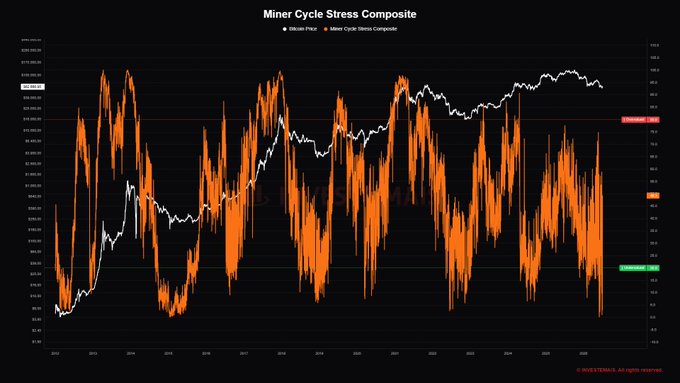
The comparison of the comprehensive pressure indicators for Bitcoin miners and Bitcoin prices shows that the stress of mining profitability corresponds in time with major turning points in the market cycle. Source: Investemais
This comprehensive indicator is an observational tool set up by analysts to gauge miner pressure, with core underlying indicators still being hash price, network difficulty, total network hash rate, and the balance sheets of mining enterprises. It can only reflect the degree of industry pressure and cannot independently determine market bottoms; what truly determines the direction of the industry is the profit pressure that forces miners to take actions such as shutting down or selling coins.
Hash Price: The Core Metric of Mining Profitability
The Puell multiple is used to calculate the ratio of miners’ block reward income to the annual average price of newly issued Bitcoin, intuitively reflecting the current quality of mining cash flow.
This perspective is very applicable for miners, as they operate cash-based businesses. Electricity, server hosting, debt repayment, equipment maintenance, repairs, and personnel costs all compete against block reward income for market share. When the dollar value of the rewards decreases, the weaker miners are often the first to be eliminated.
However, the hash price is a more straightforward profitability measure. According to the Luxor Hash Rate Index definition, the hash price refers to the dollar earnings generated per day from a hash rate of 1PH/s, encompassing four major variables: block subsidies, transaction fees, network difficulty, and the current BTC price. Even if Bitcoin prices do not fall below previous lows, as long as network difficulty increases, transaction fees remain low, and mining machine energy consumption is high, the unit earnings per hash rate will continue to shrink.
Recently, mining profitability has continuously tightened. The hash rate index weekly report on June 1 showed a 9% weekly drop in hash price, down to $32.56 / PH/s / day, with a forward average price of only $31.71 over the next six months; two weeks later, on June 15, data slightly rebounded to $33.74, but the forward average remained at $32.13.
This slight rebound did not erase the industry divide. The hash rate index estimates that new-generation low-power mining machines with a unit energy consumption of less than 19 J/TH have earnings of about $81 per megawatt; older high-power machines with 25–38 J/TH only earn $43 per megawatt. Under the same Bitcoin price environment, low-cost new mining sites can operate stably, while older high-energy-consuming sites are nearing shutdown thresholds.
This significant profitability gap transforms the apparent bottom indicators into real survival tests for enterprises. Mining companies equipped with new mining machines, low electricity prices, flexible production-limit agreements, and ample cash flow can withstand the cycle while waiting for a reduction in difficulty; companies that rely on old equipment, have high hosting costs, and operate with heavy debt have almost no buffer space and can only reduce production passively if the hash price remains low.
Who Will Be Eliminated?
Miner pressure has a self-adjusting mechanism, but the process involves industry growing pains. As numerous miners shut down, the total network hash rate declines, and if the shrinkage persists until the difficulty adjustment window, the Bitcoin mining difficulty across the network will automatically decrease, increasing the unit block rewards for the remaining miners.
This is also the underlying logic behind the frequent surge of miner surrenders at bear market bottoms: inefficient players exit first, and after the difficulty is lowered, surviving mining enterprises receive more block rewards. As long as Bitcoin price and transaction fees do not continue to decline, the industry profit margins can gradually stabilize.
The data from the second quarter of 2026 has already verified the effectiveness of this adjustment mechanism. The heat map of the hash rate index for the second quarter shows that the core source of the current hash rate decline stems from economic profit pressure. The 30-day moving average hash rate across the network fell from 1,066EH/s in the first quarter to 1,004EH/s in the second quarter, a quarterly decrease of 5.8%; the report estimates that a large number of old mining machines with a consumption of more than 25J/TH have seen their gross profits turn negative, with about 252EH/s of marginal inefficient capacity being in a shutdown state.
The price of Bitcoin itself remains the cornerstone of the economic system. Market data from CryptoSlate shows that as of July 6, 2026, the trading price of Bitcoin was $63,007, with a market capitalization of $1.26 trillion and a market share of 58.0%. However, the profitability of miners depends on a specific combination of factors such as price, transaction fees, mining difficulty, electricity costs, and machine efficiency.
If the hash price remains at around $30, the primary pressure source is the mining restrictions imposed by miners. Miners with high electricity costs or old machines may shut down their hash power during unprofitable periods, especially when electricity can be resold or redistributed. Next, there is the cash flow of miners. Miners holding Bitcoin can sell Bitcoin or use it as collateral for loans, which will further exacerbate pressure during already tight liquidity periods.
The third point is consolidation. Low-cost miners, capital-rich listed companies, and operators with newer machines can persist longer than weaker competitors and may acquire mining sites, power contracts, or market shares after difficulty decreases and revenue distribution becomes fairer.
The fourth trend is the transformation of artificial intelligence and high-performance computing. Many mining companies are no longer solely relying on Bitcoin mining for profit, having opened a second growth curve by hosting AI servers during the bear market. However, only those mining enterprises with land, electricity, cooling facilities, stable customers, and ample funds can realize practical value in transformation; a continued low hash price will significantly raise the strategic value of this transformation route. Wall Street funds have already pre-emptively invested in mining companies with AI computing capabilities, even if the related data centers have not yet been established.
Signals to Watch
The comprehensive mining pressure indicator is more suitable as an early warning signal and cannot precisely predict the timing of market bottoms. It indicates that mining income pressure has reached levels seen in previous pressure cycles. However, it does not clarify whether the market has finished repricing under such pressure.
The upcoming signals will be more specific: whether the hash price can recover to just above $30, whether mining difficulty will continue to decrease, whether hash rates will stabilize, whether miners will sell more Bitcoin, and whether the AI computing layout of mining enterprises is part of a growth narrative or merely a financing means.
If the above indicators improve in unison, looking back, the current pressure on miners may only represent the bottoming phase; if the data continues to worsen, the industry will face a deeper reshuffling, with inefficient hash power shares continuously shrinking, and a reduction in overall network difficulty benefiting the surviving players.
Therefore, this bottom signal can also serve as a solvency test. Although the charts may catch attention due to their similarity to previous cycle lows, if the recovery time exceeds expectations, the hash price will determine which miners can continue to survive.
免责声明:本文章仅代表作者个人观点,不代表本平台的立场和观点。本文章仅供信息分享,不构成对任何人的任何投资建议。用户与作者之间的任何争议,与本平台无关。如网页中刊载的文章或图片涉及侵权,请提供相关的权利证明和身份证明发送邮件到support@aicoin.com,本平台相关工作人员将会进行核查。


