
White-haired stock god Serenity @aleabitoreddit said: Robotics is next.🤖🤖🤖
In the past two years, the market has mainly traded in the brain of AI: GPU, CPU, storage, data center, large models, inference computing power.
However, once the brain is built, AI cannot forever stay on the screen writing code, drawing, and chatting.
Large models are the brain of AI, while robots are the body of AI. The brain is responsible for thinking, and the body is responsible for action.
Only when AI has a body can it truly step into factories, warehouses, hospitals, and homes to transport, sort, assemble, care, and clean, ultimately creating value in the real world.
Biteye organized key players in the US stock market for robotics and supply chain based on the components of humanoid robots👇
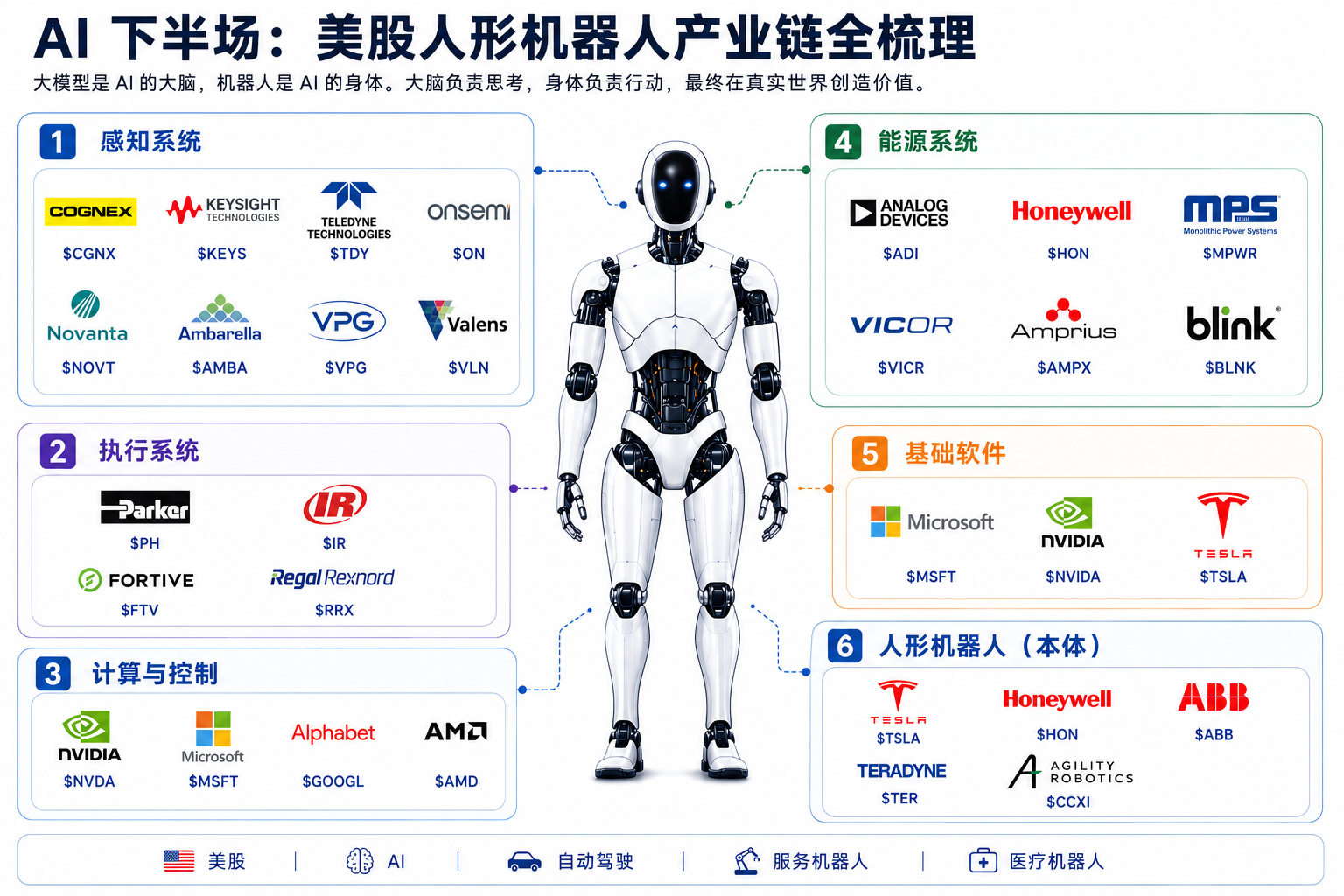
🔹 Perception System
This part is responsible for allowing robots to see the world. It uses sensors like vision, depth, and touch to convert the real world into digital information, enabling robots to recognize objects, understand the environment, and perform spatial positioning, which is the first step for robots to understand the external world.
$CGNX Cognex | ~$8B+ | Leading industrial machine vision company, factory automated inspection and recognition systems
$KEYS Keysight | ~$30B+ | Testing and measurement systems, robotics electronic system validation infrastructure
$TDY Teledyne Technologies | ~$25B+ | High-end industrial cameras + LiDAR + sensor systems
$ON onsemi | ~$25B+ | Core supplier of automated driving + robotic image sensors
$NOVT Novanta | $5.61B | Producing robotic force/torque sensors, important in humanoid and industrial robots.
$AMBA Ambarella | ~$4B+ | AI vision chips for robotic/drone/security recognition
$VPG Vishay Precision Group | ~$1.7B | Precision mechanical sensor company, strain gauges and force sensors can be used for humanoid robotic dexterous hands, joint force control, and high precision grasping, making it one of the resilient targets in the Optimus supply chain.
$VLN Valens Semiconductor | ~$200M+ | High-speed signal transmission chip company, providing low-latency visual data transmission solutions, applicable to robotic multi-camera, autonomous driving, and edge computing systems.
🔹 Execution System
The execution system is equivalent to the muscles and joints of the robot, responsible for translating commands from the computing system into real actions. Whether walking, turning, grasping, transporting, or maintaining balance, it relies on motors, reducers, hydraulic/pneumatic systems, and precision transmission parts to achieve.
$PH Parker Hannifin | ~$120B+ | Motion control + hydraulic systems, core drives and actuators for robots
$IR Ingersoll Rand | ~$32B+ | Industrial compressors + automation pneumatic systems
$FTV Fortive | ~$18B+ | Industrial precision tools + automation equipment systems
$RRX Regal Rexnord | ~$14B+ | Motors + transmission systems, core power for industrial robots
🔹 Computing and Control
Computing and control are equivalent to the robot's "brain + cerebellum," responsible for processing perception data, understanding the environment, planning paths, and converting AI decisions into stable actions. It determines how fast the robot reacts, how accurately it moves, and whether it can operate autonomously in complex environments.
$NVDA Nvidia | ~$3.0T+ | AI GPU + Jetson edge computing platform, absolutely core for robot computing power
$MSFT Microsoft | ~$3.2T+ | Azure + Copilot + AI infrastructure, providing the cloud brain and development platform for robots
$GOOGL Alphabet | ~$2.0T+ | DeepMind + Waymo, layout for autonomous driving and robotic AI systems
$AMD AMD | ~$880B+ | GPU/CPU alternatives, providing robotic edge and training computing power
🔹 Energy System
The energy system determines how long a robot can operate and how powerful it can be, including battery technology, power management, and charging systems, which are key limiting conditions for whether robotics can be scaled for implementation.
$ADI Analog Devices | $203.57B | Analog chips, power management, sensing, and industrial control giants, core of robotic underlying hardware.
$HON Honeywell | $144.11B | Power management + industrial energy systems
$MPWR Monolithic Power Systems | $76.83B | Leading power management chip company, widely used in robotics, AI servers, and automotive electronics.
$VICR Vicor | $14.40B | Producing high-efficiency power modules, converting battery voltages for various components, suitable for robotic energy systems.
$AMPX Amprius Technologies | $2.43B | Silicon anode high energy density lithium batteries, already entering the drone and robotic market
$BLNK Blink Charging | $85.63M | EV charging infrastructure company, exploring charging scenarios for robots and logistics equipment
🔹 Basic Software
Basic software is the true "intelligent base" of humanoid robots, determining that robots do not simply repeat actions, but can understand tasks, learn environments, and continuously optimize behavior.
In humanoid robot training, the importance of software is even greater than that of individual hardware. Robots need to learn to walk, grasp, avoid obstacles, and execute tasks in a simulated environment first and then continuously correct the model using real-world data.
$MSFT Microsoft | ~$3.2T+ | Azure AI + Copilot ecosystem, the cloud brain and enterprise AI development platform for robots.
$NVDA Nvidia | ~$3.0T+ | Isaac Sim + Jetson + GPU computing power platform, foundational infrastructure for robotic simulation training and AI inference.
$TSLA Tesla | ~$1.3T+ | FSD + Optimus data closed loop, representative of the end-to-end robotic strategy model.
🔹 Humanoid Robots
In the direction of humanoid robots, the goal of the original company is to allow robots to complete general tasks in complex environments like humans; for industrial and collaborative robots, there is a greater emphasis on stability, efficiency, and scalable deployment. Therefore, this level is usually the part of the robotics industry chain that is closest to end-user demands, the most likely to form brand and valuation narratives.
$TSLA Tesla | ~$1.3T+ | Optimus humanoid robot + FSD autonomous driving unified system, representing the integrated route of "AI brain + robot body + data closed loop."
$HON Honeywell | ~$140B+ | Provider of solutions for industrial automation, aerospace automation, and logistics automation, focusing more on robotic system integration and scenario implementation.
$ABB ABB | ~$100B+ | Global leader in industrial robots and automation, with products covering robotics arms, control systems, and production line automation, representing mature industrial robots.
$TER Teradyne | ~$24B+ | Through Universal Robots and MiR, layout collaborative robots and autonomous mobile robots, a platform-type company in industrial collaborative robots.
$CCXI Churchill Capital Corp XI / Agility Robotics | Proposed merger valuation of about $2.5B | Agility is a US humanoid robot company, focusing on logistics, warehousing, and manufacturing scenarios with its core product Digit.
Currently, Agility Robotics is going public through a merger with SPAC company Churchill Capital Corp XI, expected to be renamed Agility and use the new ticker $AGLT after the transaction is completed.
🌟Final Words
The investment logic of the robotics supply chain is actually very similar to the semiconductor cycle.
In the early stages, it is difficult to determine who will become the final winner, but every layer of the supply chain will first emerge with phased opportunities: perception, execution, energy, control, and body will all be repriced as industry attention increases.
Today, the hype around Amphibious Robots is a clear signal: robotics is starting to step out of the laboratory and conference and into the public eye. According to public reports, on June 30, Amphibious announced that the "You World U1" series multi-channel orders have surpassed 10,000 units and plans for delivery this year.
Of course, this does not mean that robots will soon be fully commercialized. In the short term, it looks more like a turning point from "concept display" to "real orders." What is truly worth paying attention to is whether orders can be sustained, costs can be reduced, and the supply chain can keep up.
For ordinary investors, rather than betting on who is the “Nvidia of humanoid robots” right now, it is better to study robots as a complete industrial chain: perception, execution, energy, body, selecting core companies in each layer, using a combination approach to disperse the uncertainties of a single target.
"Robotics is next" is likely correct. However, the rhythm will not happen overnight; the real opportunities may be hidden in the core supply chain that every robot cannot bypass.
免责声明:本文章仅代表作者个人观点,不代表本平台的立场和观点。本文章仅供信息分享,不构成对任何人的任何投资建议。用户与作者之间的任何争议,与本平台无关。如网页中刊载的文章或图片涉及侵权,请提供相关的权利证明和身份证明发送邮件到support@aicoin.com,本平台相关工作人员将会进行核查。


