The betting data from Kalshi has attracted attention because it provides a market signal independent of traditional sell-side research. The price mechanism of prediction markets directly reflects the true positions and probability judgments of trading participants, rather than the subjective forecasts of analysts.
Written by: Xu Chao
Source: Wall Street Journal
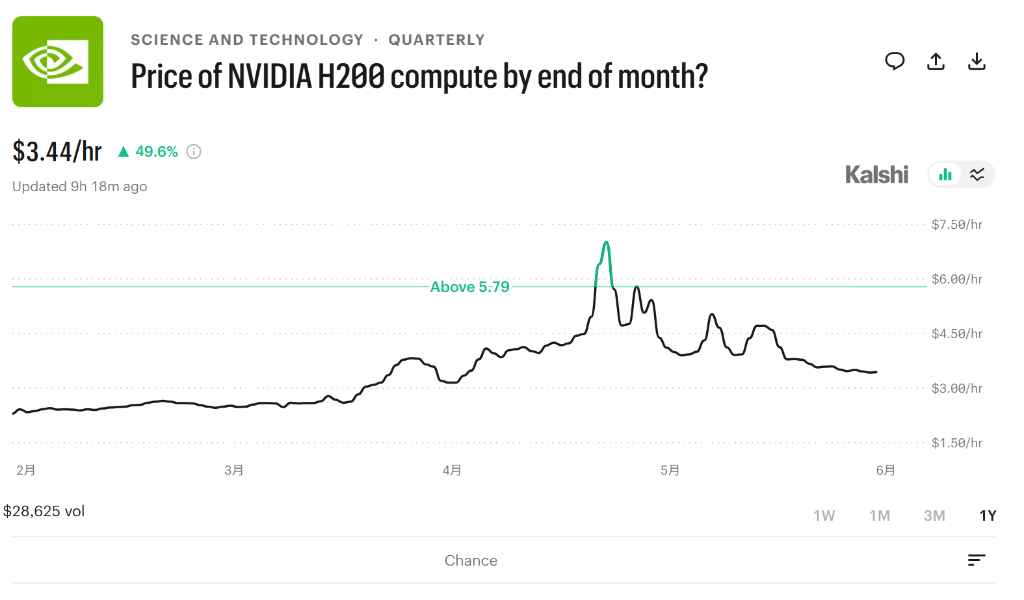
Nvidia's pricing power is currently being directly questioned by the market. Trading data from the prediction market Kalshi shows that traders generally bet that the leasing price of Nvidia's flagship GPU chip B200 will not return to its recent highs before the end of the second quarter. This "alternative data" signal resonates with Nvidia's relatively sluggish stock price in recent times, making the market more cautious about the short-term prospects of this AI chip giant.
According to data from the real-time GPU computing price tracking platform Ornn, the hourly computing price of the Nvidia B200 chip climbed to a nearly three-month high of $6.11 on May 30, and has since continued to decline, dropping to $4.22 as of June 21, a cumulative drop of over 30%. Meanwhile, Nvidia's stock price has fallen about 3% over the past month, while the Philadelphia Semiconductor ETF (SMH) has risen 15% during the same period, and memory chip stocks like Micron Technology and Sandisk have each surged nearly 60% in the past month.
Related contracts on the Kalshi platform will expire on June 30, based on the B200 computing price shown on the Ornn platform. The current distribution of trader positions indicates that the majority believe the B200 price will struggle to surpass the peak level seen at the end of May before then. This pessimistic bet directly points to the core issue of whether Nvidia can maintain strong pricing power during the AI infrastructure construction cycle.
Stock price underperforms its peers; Nvidia falls into relative stagnation
Despite a roughly 12% increase in Nvidia's stock price since the beginning of the year, its recent performance has clearly lagged behind the overall semiconductor sector. SMH has seen a cumulative increase of as much as 84% this year, also recording a 15% increase in the month, contrasting sharply with Nvidia.
The market's attention is shifting. Wall Street is currently focused on the next phase of memory chips and AI infrastructure development, with Micron Technology and Sandisk becoming the main targets for capital, both seeing nearly 60% gains in the past month. Nvidia has become significantly marginalized in this round of market performance, and investors are becoming increasingly sensitive to its lack of short-term catalysts.
B200 computing price decline; uncertainties on both supply and demand sides
The decline in the B200 computing price reflects deep uncertainties on both the supply and demand sides of the AI infrastructure market.
Seoyoung Kim, a finance professor at Santa Clara University, previously told CNBC: "Many companies are unsure how much computing power they will need in the next year, computing power suppliers do not know how many GPUs to order or what production capacity to procure, and manufacturers like Nvidia are also unclear on how much to produce." This information asymmetry among the three parties makes fluctuations in GPU rental prices the norm, and makes it difficult for the market to form stable expectations for Nvidia's revenue.
Most companies rent GPU computing power through cloud service providers or emerging "neocloud" platforms, with rental prices fluctuating according to changes in AI infrastructure demand. The more than 30% drop in B200 prices from their peak suggests a relatively loose supply of computing power in the short term, or a slowdown in demand growth.
Google - SpaceX large order boosts, RBC optimistic about the second half outlook
Despite the recent weak data, Nvidia still has support from the fundamentals. Earlier this month, Google and SpaceX signed an agreement to pay $920 million monthly to lease AI computing power from October 2026 to June 2029, which will utilize about 110,000 Nvidia GPUs and related supporting hardware.
Following the announcement of this deal, RBC Capital Markets expressed an optimistic outlook for Nvidia's performance in the second half of 2026 and 2027, stating that Nvidia is "in the most favorable position among its peers." Analysts wrote in the report: "Regardless of the specific reasons, these GPU rental agreements should alleviate the market's ongoing concerns about Nvidia's share being encroached upon by customized chips (ASICs), at least in the short term."
Signal value of alternative data
The attention given to Kalshi's betting data stems from its provision of a market signal independent of traditional sell-side research. The price mechanism of prediction markets directly reflects the true positions and probability judgments of trading participants, rather than the subjective forecasts of analysts.
Currently, the focus of Kalshi traders leans towards the idea that the B200 computing price will not break through the May peak before the end of the second quarter, which corresponds with the recent trend of Nvidia's stock price. For investors, this indicates that the market is still seeking a new balance between the long-term optimism brought by large procurement agreements like Google's and the short-term pressure on computing pricing. Whether Nvidia's pricing power can be validated in the next quarter will be a key indicator for observing its fundamental trends.
免责声明:本文章仅代表作者个人观点,不代表本平台的立场和观点。本文章仅供信息分享,不构成对任何人的任何投资建议。用户与作者之间的任何争议,与本平台无关。如网页中刊载的文章或图片涉及侵权,请提供相关的权利证明和身份证明发送邮件到support@aicoin.com,本平台相关工作人员将会进行核查。


