Written by: Trend Research
When an AI entity is awakened, it is not waiting for an answer; it needs to retrieve information, plan steps, invoke tools, reason intermediate results, call models again, and finally execute actions. The CPU computing power required for this entire process far exceeds that of ChatGPT generating a segment of dialogue.
Bernstein analyst David Dai's team released a report titled "Global Semiconductors: CPU Renaissance?" on June 17, with a core judgment: AI is transitioning from the chatbot era to the agentic AI era. The role of the CPU in data centers is shifting from that of a supporting actor to the lead role alongside the GPU, forecasting that the addressable market (TAM) for server CPUs will reach $223 billion by 2030, which is six times the $37 billion of 2025.
Reasoning is no longer a "One Question, One Answer"; CPUs are making a comeback
Since the rise of large language models, GPU/AI accelerators have been at the core of AI computation. In custom inference clusters like Google TPU v6e and Meta Grand Teton, the ratio of GPUs to CPUs once reached 8:1.
However, Bernstein believes that as agentic AI becomes mainstream, this ratio is reversing.
The core feature of agentic AI is "circular reasoning": a single request may trigger retrieval, planning, tool invocation, intermediate reasoning, another model call, and action execution. GPUs handle intensive mathematical calculations, but CPUs determine whether the entire system can efficiently orchestrate workflows, schedule tasks, manage memory, and avoid idle accelerators. If the CPU is too weak, expensive GPUs may be forced to stand idle, significantly decreasing the overall efficiency of the system.
Bernstein predicts that by 2029, the GPU:CPU ratio in CSP inference clusters will drop from 8:1 in 2025 to 1:1. In agentic AI workloads, the CPU's share of computation will leap from 14% of traditional LLMs to 50%, equally sharing the workload with GPUs.
The report specifically points out that hardware roadmaps are already supporting this direction. AMD's new generation Venice compute trays have four MI455X GPUs for each CPU, Nvidia's Vera superchip includes two Rubin GPUs for each Vera CPU, and Google TPU v7x expansion units have four TPUs for each CPU. The physical ratio of CPUs is already on the rise; this is not a prediction, but a fact happening now.
How is a $223 billion market calculated?
Bernstein has significantly raised its 2030 server CPU TAM forecast from $137 billion to $223 billion based on the following core assumptions:
- AI capital expenditures reach $3.5 trillion by 2030, corresponding to 70GW of AI data center deployments
- The market size of AI accelerators is $1.6 trillion, accounting for 45% of AI DC capital expenditures
- Inference share rises from 35% to 70%, with a CPU:GPU ratio of 1:1 in inference scenarios and 0.5:1 in training scenarios
- The unit price of CPUs is equivalent to 13% of GPUs
Within this framework, the $223 billion TAM includes $174 billion from agentic AI workloads and $49 billion from non-AI traditional server CPUs. In comparison to current levels, the entire server CPU market is expected to be only $37 billion in 2025, with only $6 billion related to AI. This means that, according to Bernstein's predictions, the CPU market will experience a sixfold expansion over the next five years, with a compound annual growth rate of 43%, which is unprecedented in the history of the semiconductor industry. Bernstein also provides ranges for bullish ($330 billion, assuming $4 trillion in AI capital expenditure + 1.5:1 inference ratio) and bearish ($137 billion, assuming $3 trillion in capital expenditure + 0.5:1 inference ratio) scenarios.
An interesting cross-validation comes from the number of server CPU cores: Arm data shows that agentic AI requires 120 million CPU cores per GW, four times that of traditional data centers. Based on this calculation, 70GW of AI deployment by 2030 would require 8.4 billion CPU cores, corresponding to a $168 billion AI CPU TAM, which aligns closely with the aforementioned model.
Why is Arm the biggest winner? It's not just about IP; it's making chips
Arm is identified by Bernstein as a structural beneficiary of the CPU renaissance. The Arm architecture is becoming increasingly attractive in AI data centers due to its performance per watt efficiency. AWS Graviton offers 40% higher cost-performance than x86 instances and consumes 60% less power.
More critically, in March 2026, Arm announced a strategic transformation: shifting from solely providing IP licensing to independently manufacturing CPUs, aiming for $15 billion in chip revenue by 2030. Arm's AGI CPU has already locked in Meta as its first customer and co-developer, with partners including OpenAI, Cerebras, and Cloudflare. Based on this, Bernstein raised Arm's fiscal 2030 EPS estimate to $11.79 (previously $9.83) and believes its chip revenue could reach $22 billion, exceeding Arm's own target. A target price of $500 is given based on a 42x PE (previously $300).
This has also led SoftBank (which holds about 90% of Arm's shares) to raise its target price from 8,200 yen to 11,200 yen, implying a 58% upside. Bernstein's valuation of SoftBank is based on a 30% discount to its net asset value for the assets it holds, reflecting the rising equity value of Arm and improvements in SoftBank's own business.
AMD, Intel, Hygon: Who benefits?
AMD (overweight, target price $600): Its products remain leading in the x86 camp and are expected to continue gaining market share. Its existing model already implies strong CPU assumptions, and the target price is raised to $600 after rolling valuation to the average CY27/28.
Intel (market perform, target price $100): Benefits from stronger, more sustained server CPU demand, with earnings forecasts significantly raised. Bernstein adjusted Intel's model from conservative assumptions to align with the industry, raising the target price from $65 to $100.
Hygon (overweight, target price 450 RMB): Bernstein believes that China's x86 CPU demand will exceed global growth rates, with Hygon’s share in the Chinese server CPU market continuing to expand, projected to exceed 35% by 2030, having clients from government and state-owned enterprises, and penetrating into CSPs. The target price is significantly raised from 280 RMB to 450 RMB.
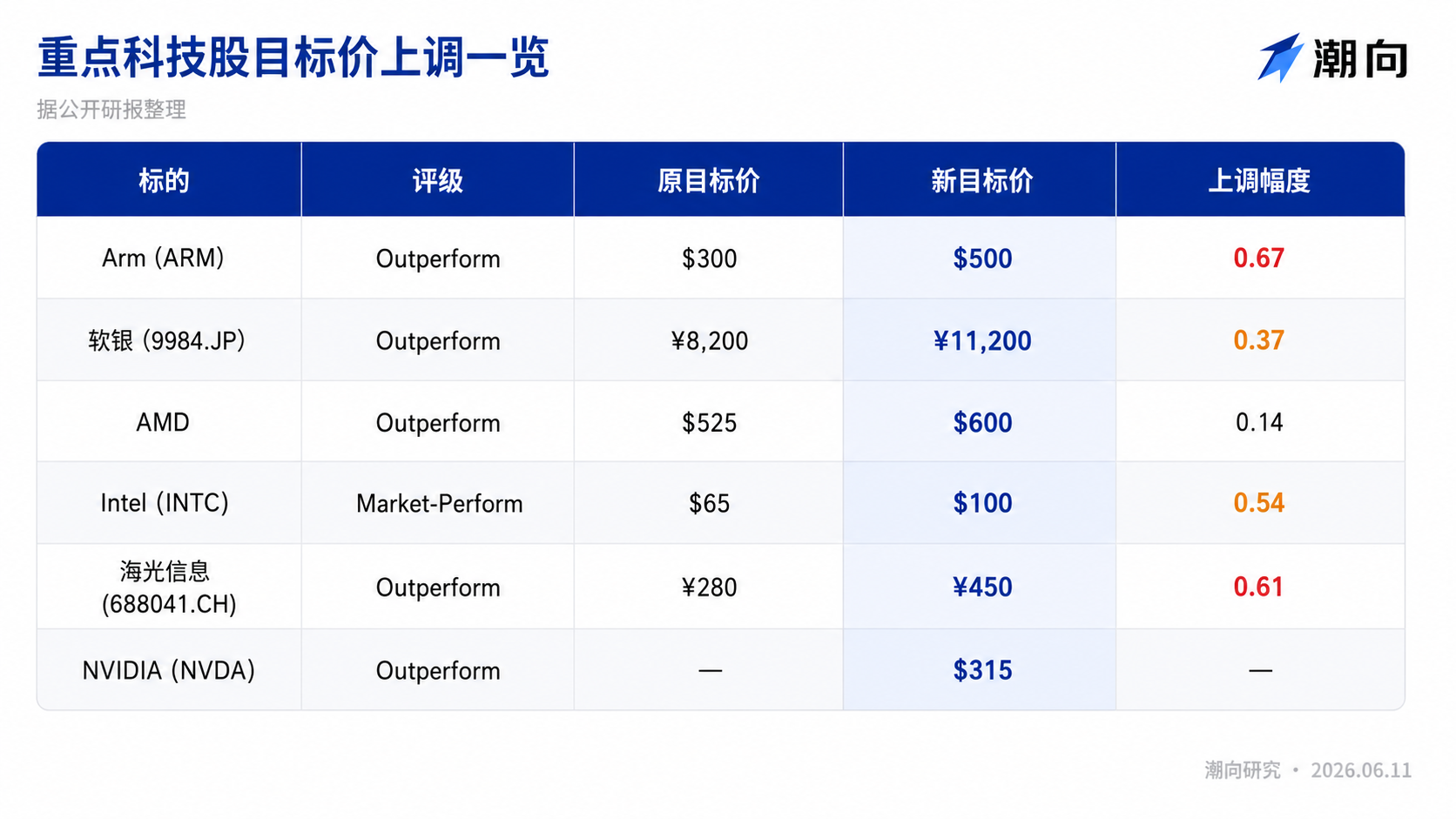
Data Source: Bernstein
Trend Interpretation
In Bernstein's analysis, the weakest link may not be on the demand side, but on the supply side.
The report explicitly acknowledges as a footnote that "it is still evaluating whether foundry and memory capacity is sufficient to support CPU growth," which is the greatest uncertainty throughout the entire report. Pulling the CPU TAM from $3.7 billion to $22.3 billion implies that there will be a need for an additional approximately $30 billion of CPU capacity each year by 2030.
Tsmc's 3nm/5nm capacity is currently being squeezed by AI accelerators and mobile chips, and whether there is enough flexibility in the foundry capacity allocated to server CPUs is not clearly mapped in the report. Additionally, the report's core assumptions are based on Nvidia's guidance that "AI infrastructure spending will exceed $1 trillion in 2027," which is itself the most optimistic forecast from sellers, presenting a risk of expectation stacking as another research report's demand starting point.
Another noteworthy signal is that Nvidia's Vera CPU uses an in-house Arm architecture, which means Nvidia may play both a partner and competitor role in the CPU space, subtly impacting Arm's ability to reach a 54% share in the long term.
For investors focused on this area, the most valuable point of this report is not just a specific target price; it provides a clear judgment framework: If you believe agentic AI is truly the next stage, CPU configurations must be repriced from "good enough" to a more balanced narrative of CPU+GPU, shifting the entire semiconductor investment landscape.
Risk Disclaimer
This article is a整理与解读 of Trend Research on third-party brokerage research reports. The ratings, target prices, earnings forecasts, and related judgments quoted in the text are the opinions of the analysts from that brokerage and reflect the positions of their respective institutions, not the views of Trend Research, and do not constitute any investment advice.
免责声明:本文章仅代表作者个人观点,不代表本平台的立场和观点。本文章仅供信息分享,不构成对任何人的任何投资建议。用户与作者之间的任何争议,与本平台无关。如网页中刊载的文章或图片涉及侵权,请提供相关的权利证明和身份证明发送邮件到support@aicoin.com,本平台相关工作人员将会进行核查。


