Author: Claude, Deep Tide TechFlow
Deep Tide Overview: SpaceX is pricing tonight and will launch on Nasdaq tomorrow, raising $75 billion with a valuation of $1.75 trillion, marking the largest IPO in history. At the same time, the cryptocurrency IPO pipeline is completely frozen: BitGo, the only company to go public this year, has seen its stock price drop by about 70% from the offering price, Kraken's valuation has shrunk by 33% in five months, Consensys has postponed to autumn, and Bitpanda's timeline is ominously slipping. With only five months left until the midterm elections in November, the window for cryptocurrency companies to go public is narrowing.
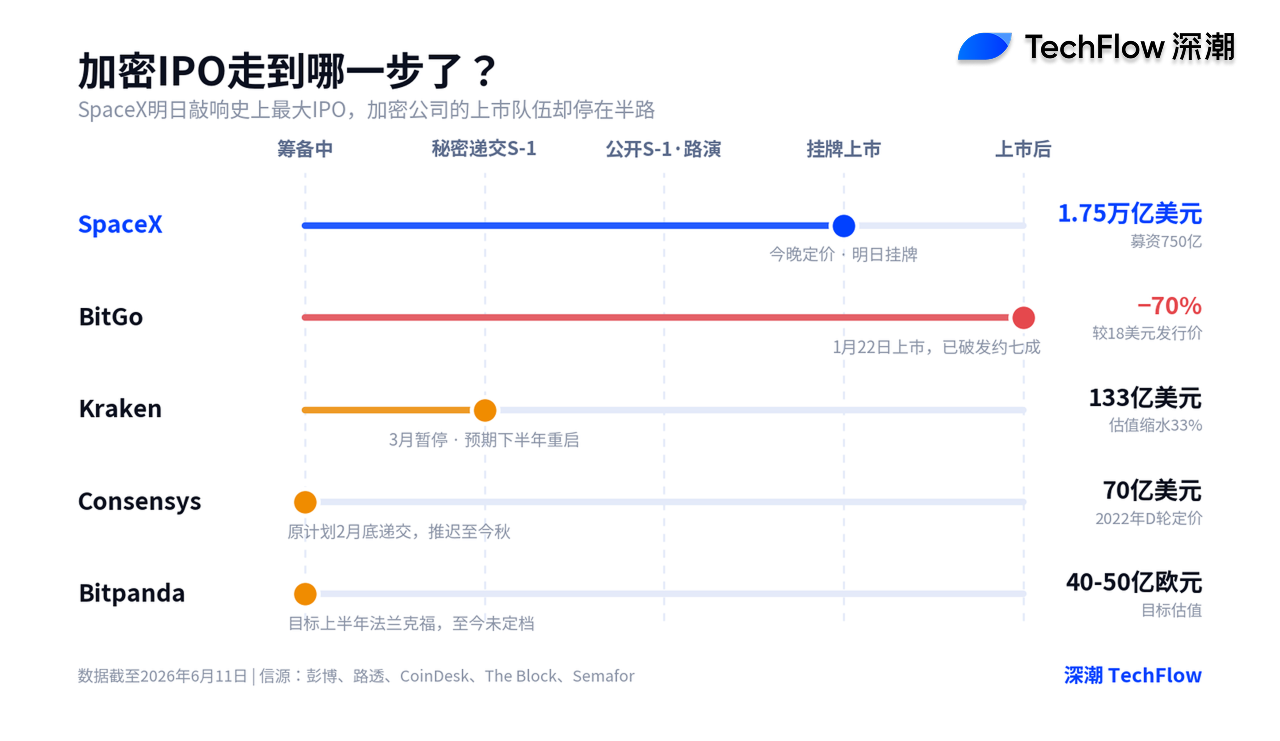
After the US stock market closes tonight, SpaceX will finalize its offering price. Tomorrow, the stock code SPCX will appear on Nasdaq. According to Reuters, the company plans to issue about 557 million shares at a price of $135 per share, raising $75 billion, corresponding to a valuation of $1.75 trillion. Whether measured by fundraising or valuation, this will be the largest IPO in history, with a fundraising scale more than twice that of the previous record holder, Saudi Aramco.
Meanwhile, outside the feast, the lineup of cryptocurrency companies going public is unraveling.
SpaceX Siphons Liquidity, Bitcoin Falls Below $60,000 Concurrently
SpaceX's listing pace is unusually fast. It secretly submitted registration documents on April 1, publicly issued the S-1 prospectus on May 20, and launched the roadshow on June 4, a few days ahead of schedule due to the SEC's faster-than-expected review process. It took just over two months from the secret submission to the bell-ringing.
The cryptocurrency market has moved in the opposite direction during this same window. According to CoinDesk data, Bitcoin was priced at about $61,500 on June 10, falling about 17% in a week, and briefly dipped below $60,000 for the first time since 2024. The fear and greed index reading is 9, in the "extreme fear" range. The total cryptocurrency market capitalization has shrunk to about $2.21 trillion. The explanation for the flow of funds is not complicated: Bitcoin ETFs have been continuously bleeding, compounded by funds rotating towards AI sectors and SpaceX's fundraising, with risk appetite being completely siphoned off by a $1.75 trillion behemoth.
For any company looking to go public, liquidity is oxygen. The $75 billion of subscription demand has been locked in by SpaceX alone, and submitting a prospectus at this moment is akin to flying a kite on a stormy day.
BitGo: The Only IPO Sample This Year, Stock Price Already Down About 70%
The cryptocurrency industry is not without attempts. BitGo went public on the New York Stock Exchange on January 22, with an offering price of $18, above the inquiry price range of $15 to $17, raising $213 million, making it the first and so far only native cryptocurrency company to complete an IPO in 2026.
The start looked promising. The first trading price was $22.43, up 24.6% from the offering price, reaching as high as $24.5 during the day. However, the increase was wiped out that very day, closing with just a 2.7% gain, and it has since trended downward. According to Benzinga data, on June 3, BTGO closed at $5.61, down about 69% from its offering price. Goldman Sachs lowered its target price from $10.5 to $9 on June 4, yet even this slashed target price remains 60% higher than the current price.
BitGo was originally expected to be a bellwether for cryptocurrency IPOs in 2026, but it has indeed become a bellwether, just pointing in the opposite direction. When Kraken paused its IPO in March, several media outlets cited BitGo's falling stock as a warning case for management. A custodian handling over $100 billion in assets, with a defensive business model, has faced such issues; what sort of valuation could a purely exchange story obtain in the secondary market, all firms in line have a clear understanding.
Kraken: 33% Valuation Evaporated in Five Months, Deutsche Börse Seizes the Opportunity
Kraken is the furthest along in the lineup. On November 19, 2025, its parent company Payward secretly submitted an S-1 draft to the SEC, having just completed a $800 million financing, with investors including Jane Street and Citadel Securities, putting its valuation at $20 billion. At that time, Reuters reported its goal was to go public in the first quarter of 2026.
Then the market changed. In March, numerous media outlets reported that Kraken had frozen its IPO plans. On April 14, Co-CEO Arjun Sethi confirmed at the Semafor World Economic Summit in Washington that the secretly submitted documents remain valid but refused to provide a timetable, issuance scale, and valuation range. According to Semafor, Kraken's valuation in a round of financing in April dropped to $13.3 billion, a 33% decrease from its peak in November.
A noteworthy undercurrent in this financing round: Deutsche Börse Group purchased approximately 1.5% of Kraken's fully diluted shares for $200 million, with the transaction expected to close in the second quarter. The operator of Frankfurt Stock Exchange entered the fray at a time when valuations at a US exchange were at their lowest. Considering the choice of Bitpanda below, it is quite evident that Germany's intent to seize business at this restrictive US window is significant.
Media generally expect Kraken's IPO restart to wait until the second half of the year.
Consensys Pushed to Autumn, Bitpanda Slipping Timeline
The script for Consensys, the parent company of MetaMask, is more straightforward. According to CoinDesk, on May 13, this company, led by Ethereum co-founder Joe Lubin, originally planned to secretly submit an S-1 to the SEC by the end of February, with underwriting led by JPMorgan and Goldman Sachs, but due to the continued weakening of the market, the IPO has been postponed to as early as this autumn. The last pricing for Consensys was during its Series D funding round in 2022, raising $450 million at a valuation of $7 billion. How much of this number can hold in the current market environment will only be known when the prospectus is opened.
Bitpanda's issue is the calendar. According to Bloomberg's January report, this Vienna-based company, backed by Peter Thiel, planned to go public in Frankfurt with a target valuation of 4 to 5 billion euros, with Goldman Sachs, Citigroup, and Deutsche Bank serving as underwriters, and the timetable set for the first half of the year, as early as the first quarter. Now it is June 11, with less than three weeks left in the first half, and the company has yet to officially announce a schedule. Unless it suddenly starts in the coming days, a timeline slip is practically guaranteed.
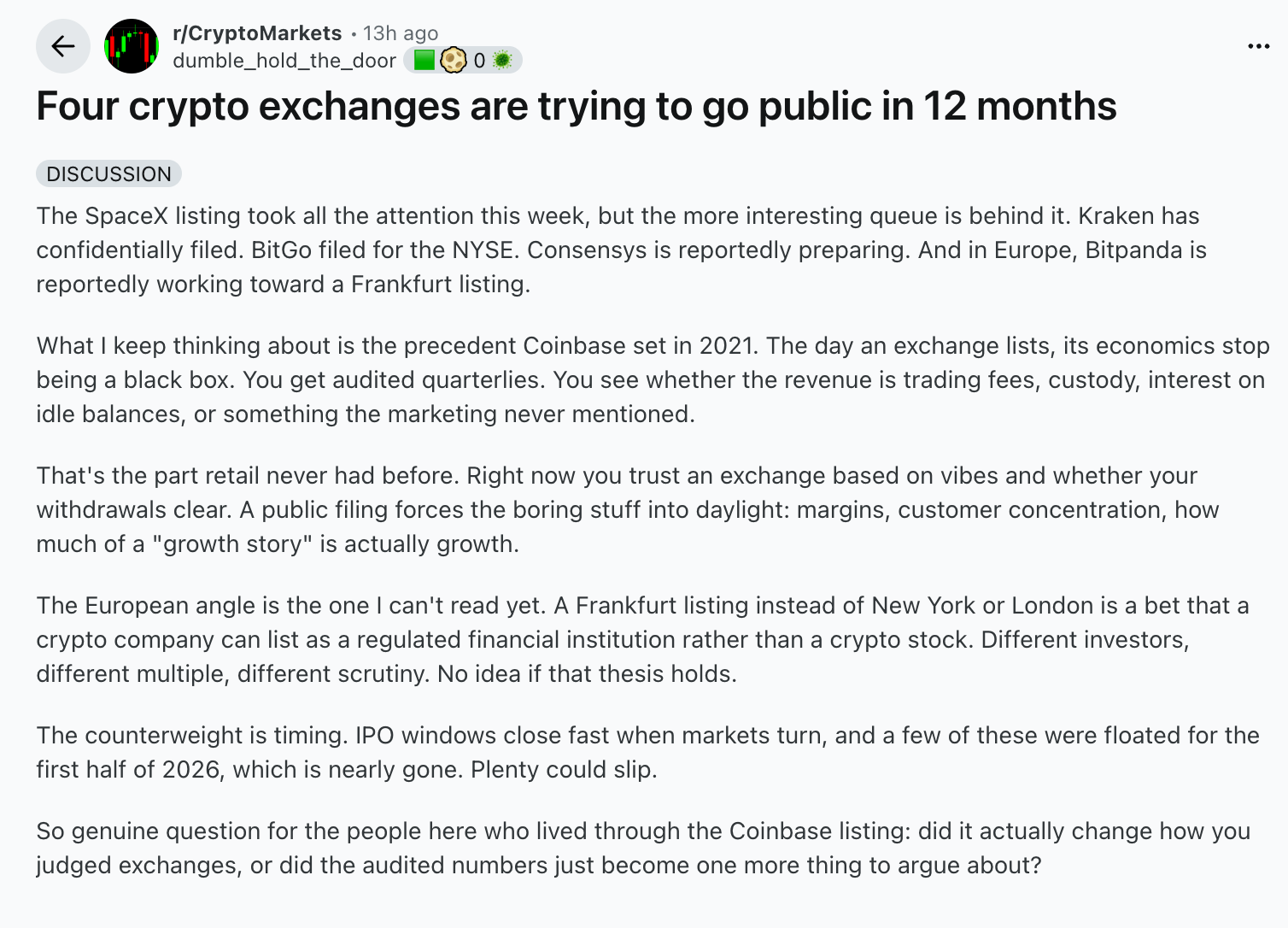
Putting the four companies together: one has gone public but lost 70% of its value, one has submitted but paused, one has been pushed to autumn, and one is about to miss its own set deadline. The original Reddit post described these four companies as "sprinting for an IPO within 12 months," which is not wrong in wording but misplaced in direction. This lineup is not sprinting; they are all looking for a way down.
Five Months Until the Midterm Elections
The surge of cryptocurrency companies aiming for a 2026 IPO has a common invisible deadline behind it.
This year, the regulatory environment has been relatively friendly towards the cryptocurrency industry, but the midterm elections in November could change the balance of power in Congress. Many companies originally had their timelines pressed before the elections, betting on the policy certainty of these five months.
Past examples are not encouraging. Among the cryptocurrency companies that went public in 2025, Gemini's stock price temporarily fell by more than 60% from the offering price (as of the end of January data), Bullish hovered around the offering price, and Coinbase, which went public in 2021, is still below its opening price. Circle is one of the few exceptions that has significantly outperformed its offering price. The pricing provided in the secondary market with real money is more honest than any roadshow PPT.
Returning to that Reddit post, the poster has a point that actually holds: once exchanges go public, the economic books are no longer a black box, and quarterly audit reports will lay bare where the revenues come from—whether from trading fees, custody fees, or interest on idle funds. Retail investors will finally have the chance to judge an exchange using numbers rather than "how smooth the withdrawals are."
The problem lies in the order. Transparency is the result of going public, not the motivation for going public. In a market where Bitcoin is at $61,500 and the only listed sample is down 70%, no company is in a hurry to reveal its hand.
In the next five months, there are three specific points worth watching: whether Kraken will restart in the second half, whether Consensys will indeed submit its S-1 in the autumn, and when Bitpanda will formally acknowledge its slipping timeline.
There’s also a variable that will be revealed tomorrow. If the funds raised by SpaceX return and market liquidity warms, this window might just reopen a crack. If even the largest IPO in history performs mediocrely, then this year's wave of cryptocurrency listings will likely have to wait until after the elections to be discussed.
免责声明:本文章仅代表作者个人观点,不代表本平台的立场和观点。本文章仅供信息分享,不构成对任何人的任何投资建议。用户与作者之间的任何争议,与本平台无关。如网页中刊载的文章或图片涉及侵权,请提供相关的权利证明和身份证明发送邮件到support@aicoin.com,本平台相关工作人员将会进行核查。


