When unprecedented deficits and systemic inflation reinforce each other, the myth of bonds as a safe haven shatters, and high interest rates are no longer short-term fluctuations, but a structural trend locked in for the next several years.
Written by: Zhao Ying
Source: Wall Street Journal
The triple pressure of debt, inflation, and populism is reshaping the interest rate landscape of the U.S. and even the global bond market, and this storm may have been due to arrive earlier.
The yield on the U.S. 30-year Treasury bond briefly reached a 19-year high of 5.18% this week, while the 10-year yield also rose to 4.67%. In his latest column, Wall Street Journal chief economics commentator Greg Ip points out that the real issue is not why yields rose sharply over the past week, but why this did not happen earlier. The dangerous combination of debt, inflation, and populism is locking in upward pressure on long-term rates as a structural trend for the coming years.
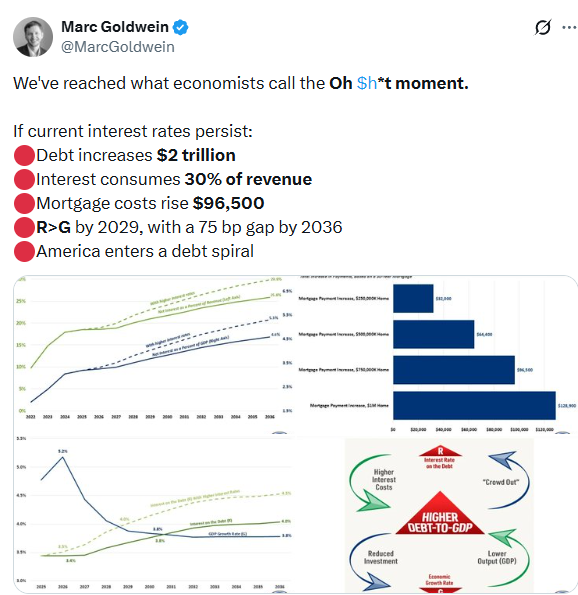
He shared on social media a warning from Marc Goldwein, an analyst at the Committee for a Responsible Federal Budget, who clearly stated: "We have reached what economists call an 'Oh Shit moment'."
If current interest rates persist, Goldwein estimates that U.S. debt will increase by $2 trillion, interest expenses will consume 30% of federal revenue, the cost of U.S. mortgages will rise by $96,500, and by 2029 rates will exceed economic growth (R>G), widening the gap to 75 basis points by 2036—this is a classic signal for the initiation of a debt spiral. This series of numbers is causing bond investors to reprice long-term risks.
Out of Control Debt: Unprecedented Scale of Deficits
Greg Ip points out that before 2020, governments around the world at least boasted of fiscal discipline in words. Since then, almost every economic shock has been responded to with large-scale borrowing.
After the Biden administration's fiscal stimulus in 2021, the Trump administration proposed massive tax cuts in 2025. The Trump administration expects the federal budget deficit to widen by 16% to $2.1 trillion this fiscal year, while requesting a record $1.5 trillion defense budget. Meanwhile, Trump proposed to suspend the federal gasoline tax, which the Committee for a Responsible Federal Budget estimates would cause a monthly fiscal loss of $3.5 billion.
From 2023 to 2026, the U.S. fiscal deficit as a percentage of GDP will average 6.2%—a level that has only appeared in U.S. history during wars, recessions, or states of emergency, far exceeding the 4.8% average between 2010 and 2019 and the 2.3% average between 2002 and 2007.
The U.S. is not alone. Japanese Prime Minister Fumio Kishida recently hinted at a possible new fiscal budget to subsidize households affected by rising energy prices, directly pushing up Japanese government bond yields. In the UK, the left wing of the Labour Party strongly resists Prime Minister Keir Starmer's spending cuts plan, and Manchester Mayor Andy Burnham publicly stated that the UK should not "be constrained by the bond market," a statement that is seen as a potential challenge to his party leadership, which has quietly pushed up UK government bond yields.
The Continued Accumulation of "One-Time Inflation Shocks"
Greg Ip outlines the starkly different inflation logic before and after 2020.
Before 2020, major economic events—China's entry into the WTO, the U.S. subprime crisis, the European debt crisis, the shale oil revolution, the early COVID-19 pandemic—generally suppressed inflation. During that era, major central banks were exhausted by the challenge of inflation consistently falling below the 2% target, maintaining near-zero interest rates and buying large amounts of bonds, causing bonds to serve as "insurance assets" during stock market declines.
After 2020, the situation completely reversed. Supply chain disruptions, the Russia-Ukraine conflict, Trump's tariffs, and the closure of the Strait of Hormuz—each shock pushed inflation higher. People are accustomed to viewing these events as "one-time factors," believing that inflation will naturally fall back to 2%.
But Greg Ip raises a more disturbing hypothesis: what if these shocks are not incidental, but systematic symptoms of a world made more susceptible to supply shocks due to war, geopolitical maneuvering, protectionism, populism, and extreme weather? Once the public forms long-term inflation expectations, central banks will be forced to repeatedly raise interest rates, and the "insurance" attribute of bonds will completely disappear, leading investors to naturally demand higher holding compensation.
The Vicious Cycle of Debt and Inflation
More worryingly, deficits and inflation are not independent of each other, but may form a mutually reinforcing closed loop.
Rising living costs are eroding the support of politicians in various countries, making them less willing to propose welfare cuts or tax increases, thus exacerbating deficits. If the Federal Reserve is forced to raise rates multiple times, the increase in interest expenses will further expand the deficit. According to estimates from the Committee for a Responsible Federal Budget, if recent interest rate levels persist for a year, it will add $200 billion in deficit burden over ten years. Moreover, politicians may pressure central banks to prevent them from raising rates, laying the groundwork for higher inflation.
The newly inaugurated Federal Reserve Chairman Kevin Warsh, who will officially take office this Friday, originally hoped that productivity gains driven by AI could open up room for interest rate cuts. Currently, there is indeed no apparent cost pressure in the labor market, providing some support for this judgment. Surprisingly, despite high debt levels, tariff impacts, rising oil prices, and Trump's ongoing pressure on the independence of the Federal Reserve, bond investors' expectations for medium- to long-term inflation remain relatively moderate, still expecting inflation to return to around 2% in the coming years.
This is a vote of confidence from the market towards Warsh. However, Greg Ip bluntly states that the cost of fulfilling this trust may mean keeping interest rates at levels higher than he and Trump expected. And this is precisely the price demanded by the dangerous combination of debt, populism, and inflation.
免责声明:本文章仅代表作者个人观点,不代表本平台的立场和观点。本文章仅供信息分享,不构成对任何人的任何投资建议。用户与作者之间的任何争议,与本平台无关。如网页中刊载的文章或图片涉及侵权,请提供相关的权利证明和身份证明发送邮件到support@aicoin.com,本平台相关工作人员将会进行核查。


