
Author: Nancy, PANews
Former star investor Andrew Kang, who was active in the cryptocurrency market, is shifting his focus to the AI and robotics sector. On May 20, Andrew Kang officially announced his appointment as CEO of RoboStrategy, responsible for the company's strategic direction and portfolio management.
Inspired by the capital model of the cryptocurrency DAT company Strategy, RoboStrategy recently officially launched on NASDAQ and secured up to $2 billion in equity financing commitments, quickly attracting market attention.
Transitioning from crypto to robotics, having invested in star companies like Figure
RoboStrategy is a publicly closed-end fund focused on robotics and physical AI, co-founded by Andrew Kang and Marc Weinstein in 2025, with the goal of opening early robotics investment opportunities, which were previously exclusive to a few institutions, to a wider range of regular investors.
Andrew Kang and Marc Weinstein are also co-founders of the cryptocurrency investment firm Mechanism Capital. Since its establishment in 2020, Mechanism Capital has invested in over a hundred cryptocurrency projects, including well-known protocols and platforms such as Arbitrum, Pendle, Near, Deribit, and 1inch. However, according to publicly available information, Mechanism Capital has rarely disclosed new cryptocurrency investment updates since October 2025. Recently, Andrew Kang acknowledged that he has not closely followed the cryptocurrency market in recent months.
In contrast, he has redirected more energy into the robotics field. According to Andrew Kang, he began researching the robotics industry two years ago, but at that time, most VCs advised against entering this sector. Under the market conditions at that time, it was generally difficult for robotics companies to secure financing, and the industry lacked mature large-scale success stories, leading to various doubts about its commercialization path, technological implementation capabilities, and potential market space.
However, he believes that the accelerating development of physical AI will completely change the industry. Humanoid robots are one of the few directions with the potential to "move from zero to a multi-trillion dollar market," with a development phase similar to that of Bitcoin in 2013 but having a larger long-term market space. Especially as manufacturing, logistics, and service industries continue to face labor shortages, physical AI and robotics technology are accelerating into real industrial scenarios.
Thus, in February 2024, Andrew Kang made his first significant investment in the robotics field, investing $19 million in Figure AI. Today, Figure AI has become one of the world's highest-valued humanoid robotics companies, with its latest valuation reaching $39 billion, whereas its pre-investment valuation in February 2024 was only about $2 billion. (Related reading:Entrepreneurs from farms: Building flying cars and betting on a $39 billion giant in robotics)
However, Andrew Kang also realizes that the future development of the robotics industry will heavily rely on substantial long-term capital, making it hard for personal or traditional funds to support it. At the same time, robotics startups need a capital platform that truly understands industry demands to help obtain sustained financing, industrial resources, and market recognition support. More importantly, current robotics innovations are mainly concentrated in the private equity market, making it difficult for most regular investors to participate.
Based on this, Andrew Kang co-founded RoboStrategy. Currently, RoboStrategy has invested in companies such as Figure AI, Apptronik, Dyna Robotics, Dexmate, Standard Bots, and Path Robotics, covering multiple areas including hardware, infrastructure, and software, with an average investment size of about $7 million per round.
In Andrew Kang's view, RoboStrategy has several differentiated advantages compared to traditional VCs. First, as a closed-end fund, its capital is considered permanent capital, free from traditional VC fund term limitations, thus allowing it to position itself in the robotics and physical AI industry from a very long-term perspective; secondly, the team gathers several senior practitioners from the robotics industry, including long-term founders or operators, which is why many startups regard it as one of the "most professional and knowledgeable about the robotics industry" investment institutions. Additionally, leveraging the team's strengths in digital marketing and social media, RoboStrategy not only has stronger fund distribution capabilities but is also better at expanding market influence and industry recognition, helping its portfolio companies gain more attention, talent, and resources.
Listed on NASDAQ, attempting to replicate the Strategy capital flywheel
As the first closed-end fund specifically designed for public market investors, RoboStrategy officially started trading on NASDAQ on May 11, with the stock code "BOT." As of now, the BOT stock price is approximately $28.2, having declined about 21.58% since its listing.
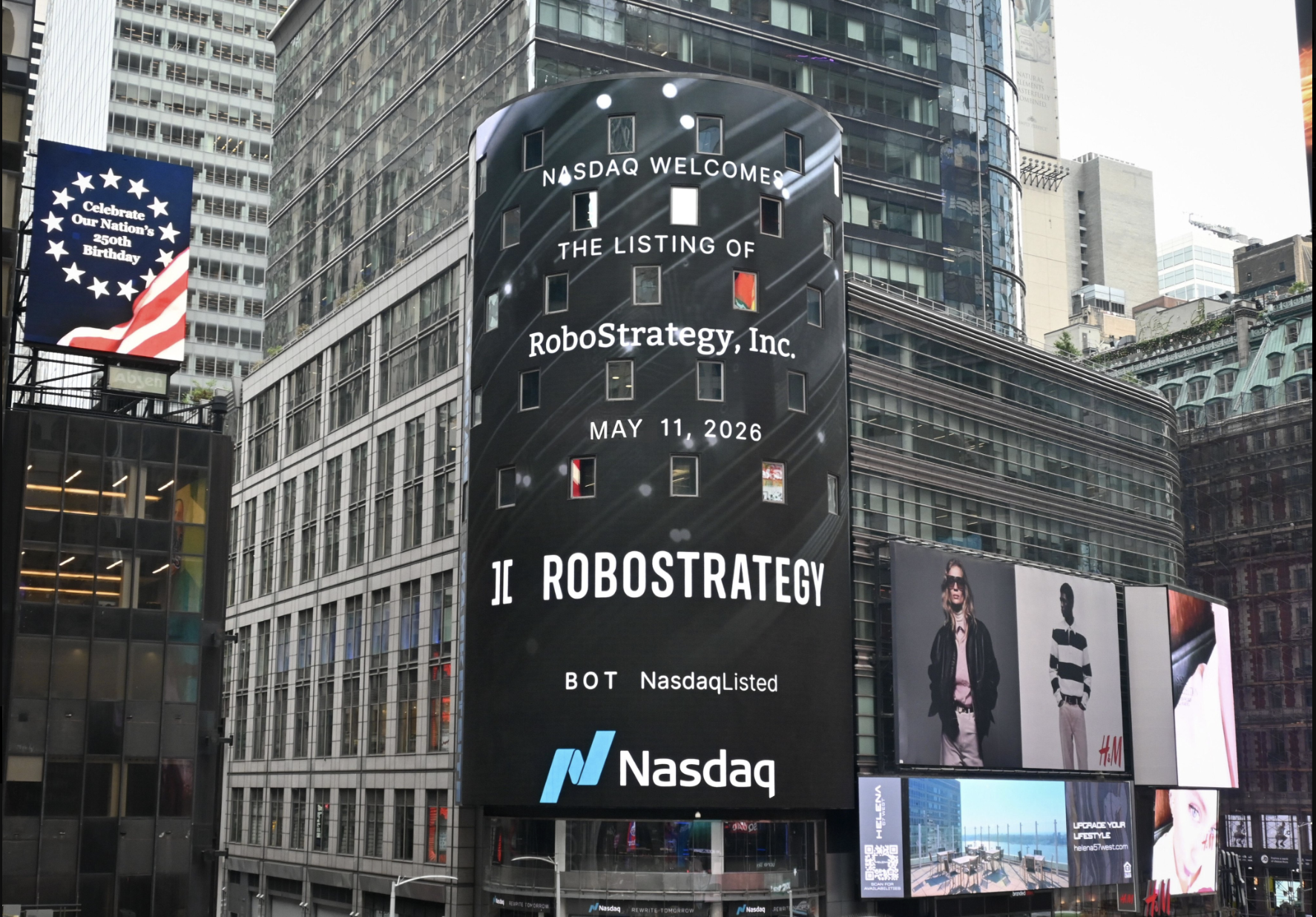
Public information shows that RoboStrategy board member Jason Zhao purchased 400,000 shares of the company last October at a price of $10 per share; subsequently, Andrew Kang also purchased 246,000 shares at the same price. Meanwhile, investment advisory firm FP Strategies LLC continued to increase its holdings by 290,000 shares at $10 per share this April, with a current total ownership of approximately 390,000 shares.
From the perspective of capital operation logic, RoboStrategy's inspiration comes from Strategy's Bitcoin treasury model, which continuously issues stocks and convertible bonds in the public capital market to increase investment in Bitcoin with low-cost funds, thereby forming a capital flywheel through stock price premiums; this model has been emulated by numerous companies.
RoboStrategy attempts to replicate this logic in the robotics field. The core idea of the fund is to continuously finance through three main fundraising tools: CEF, PIPE, and ATM, whenever the fund's stock price is at a premium relative to its net asset value (NAV), and then invest that capital into high-growth robotics and physical AI private companies, thus building a R.I.S.E capital compound interest flywheel.
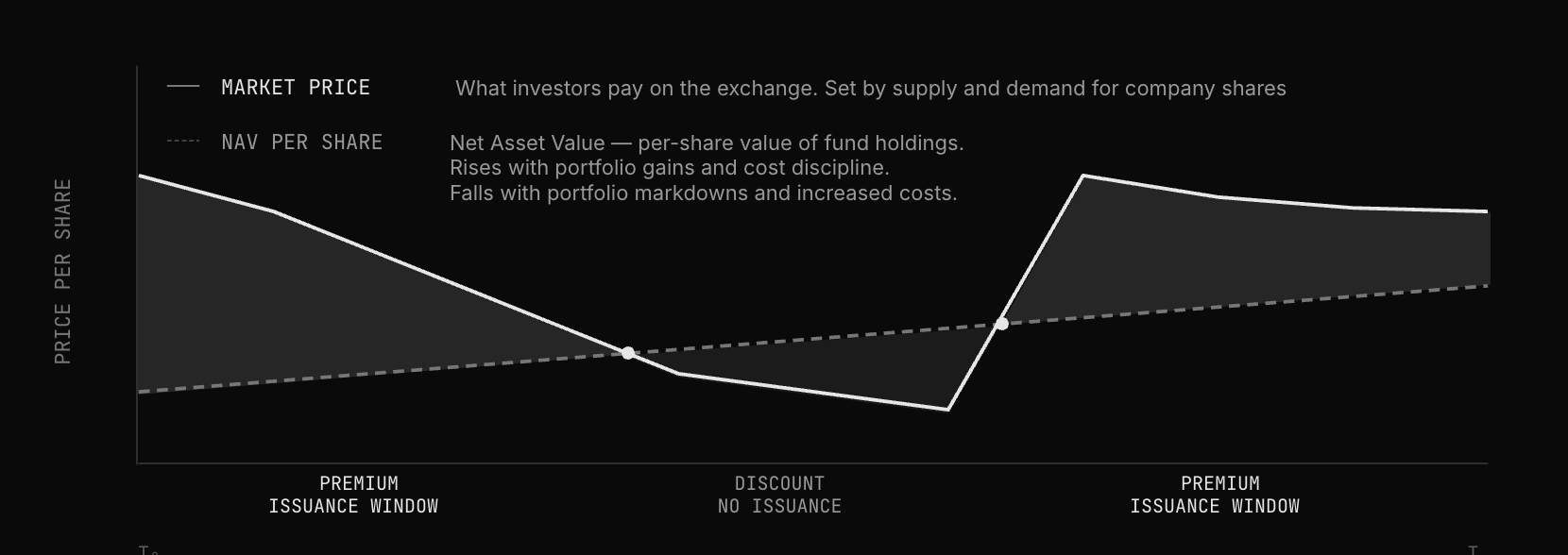
The so-called R.I.S.E represents four stages:
· Raise: issue shares at a premium when market prices exceed NAV to obtain more cash;
· Invest: allocate capital to highly credible robotics projects through deep due diligence;
· Scale: the invested enterprises accelerate expansion using the newly added capital, enhancing the fund's NAV;
· Expand: as NAV increases and industry interest rises, further attract investors and new capital, expanding fund size and influence.
This model essentially utilizes a dual pricing mechanism of market price and net asset value of closed-end funds, aiming for long-term compound growth of per-share NAV while replacing traditional multi-layer private fund fees with a single public fund structure.
Just this month, RoboStrategy signed a commitment equity financing agreement (CEF) of up to $2 billion with a subsidiary of Roth Capital Partners, Roth Principal Investments, to support its strategic growth plan.
However, just like the treasury stories of most cryptocurrency DAT companies are hard to sustain, RoboStrategy also faces significant risks.
As of March 31, 2026, RoboStrategy's NAV was approximately $7.31 per share, with a total net asset of about $145.5 million. Based on the current stock price, the market's valuation premium is close to three times. However, a high premium does not mean that the risk of discount will not arise. At the same time, as the fund primarily invests in unlisted robotics companies, the asset valuation itself has a strong subjectivity and limited liquidity, and the exit path heavily relies on the IPO or merger market. Once the capital environment cools, related assets may face valuation adjustment pressure.
Additionally, the closed-end fund structure also means that investors cannot redeem shares at any time as in an open-end fund but can only trade through the secondary market, leading to amplified price volatility.
Whether RoboStrategy can maintain a high premium and market enthusiasm for the long term remains to be further validated by the market.
免责声明:本文章仅代表作者个人观点,不代表本平台的立场和观点。本文章仅供信息分享,不构成对任何人的任何投资建议。用户与作者之间的任何争议,与本平台无关。如网页中刊载的文章或图片涉及侵权,请提供相关的权利证明和身份证明发送邮件到support@aicoin.com,本平台相关工作人员将会进行核查。


