How a traditional macro analyst gradually stepped into Web3 from changes in consumption and assets.
Written by: Changan, Biteye
Who is Fu Peng, who blocked a number of KOLs in the Chinese-speaking community?
Many people first noticed him, not because of a speech or a report, but because of the controversy on social media: some practitioners and KOLs in the Chinese-speaking region found themselves blocked by him.
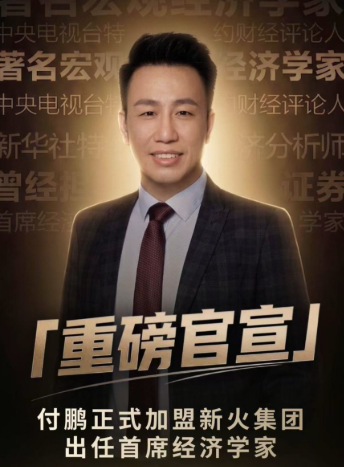
In April 2026, Fu Peng appeared on the stage of the Hong Kong Web3 Carnival, identifying himself as the Chief Economist of New Fire Group.
For many who have long been focused on traditional macroeconomics and asset allocation, this name is not unfamiliar; but for Web3 users, the questions were just beginning: Who is Fu Peng? Why is he stepping onto the Web3 stage at this moment?
1. Who is he: Twenty years from Lehman to Northeast Securities
Public sources regarding Fu Peng's early background are not entirely consistent. It can be confirmed that the turning point in his life was a recommendation in 2000: Xue Wenshi, then Chairman of the Northwest Securities Regulatory Commission of China, sent this young man to the UK.
First stop: London, 1999—2004
Upon arriving in the UK, Fu Peng entered the ISMA Institute at the University of Reading, majoring in International Securities and Banking. ISMA was a top research institution for the international securities market in Europe at that time, specializing in cultivating analytical talent directly serving capital markets.
There was an episode during this study abroad period, where Fu Peng came across some trading opportunities based on information asymmetry and attempted to find arbitrage space. This experience was later repeatedly mentioned by him as a starting point for his business awareness awakening.
Second stop: Lehman Brothers, 2004—2005
In 2004, recommended by ISMA Chairman Brian Scott-Quinn, Fu Peng successfully joined Lehman Brothers in the UK. During his time at Lehman, he systematically engaged with the real operations of investment banking, developed a true awareness of risk control, and understood how institutional capital thinks and bets.
He only worked at Lehman for about a year, before moving to Solomon International Investment Group in the City of London in 2005.
Third stop: Solomon, 2005—2008, and the crisis
At Solomon International Investment Group in the City of London, Fu Peng held the position of Global Macro Hedge Strategy Designer for event-driven strategy funds, responsible for the linkage analysis of financial derivatives, currencies, and commodity markets.
In his later reviews, he pointed out that unusual signals were already appearing in overseas markets around 2006, such as high-risk mortgage expansion: loans were still being issued in large quantities despite mismatches between income and credit conditions. Such phenomena were not fully priced by the market at the time, and the overall sentiment remained optimistic.
In September of that year, Lehman Brothers filed for bankruptcy, and the financial crisis exploded fully. He witnessed all of this as a firsthand observer and gained a recurring insight: positive feedback does not last forever, nor does negative feedback.
Fourth stop: Returning home, 2008—2011, the years of exploration
In November 2008, Fu Peng returned to China, serving as the Deputy General Manager of Shandong High-tech Venture Capital Co., Ltd. In August 2009, he transitioned to Zhongqi Group as the Chief Macro Strategy Analyst. This was his first public appearance in the domestic market as a chief analyst.
During those years, he was doing a more critical task: entering from the foreign exchange market, using commodities as a medium, and gradually linking various assets together in the practical operation of cross-border capital to form his own analysis system. In 2011, he moved to Galaxy Futures and began appearing in the media as a special commentator.
Fifth stop: Chonghe Investment, 2017—2019, returning to the buy side
From August 2017 to November 2019, Fu Peng served as a director at Hangzhou Chonghe Investment. This is a stage in his career that is often overlooked: he returned from a sell-side analyst to the buy side, starting to manage funds and perform asset allocation.
This experience later earned him the title of "the Chief Economist who understands the buy side best," as he knows what real institutional investors think, need, and where they face constraints, fundamentally differing from most sell-side economists who have never managed money.
Sixth stop: Northeast Securities, 2020—2025, becoming a public figure
At the end of 2019, Li Guanying, the director of the research institute at Northeast Securities, invited Fu Peng. In February 2020, Northeast Securities officially announced him as their Chief Economist. This timing coincided with the outbreak of the pandemic, where global markets were in turmoil and there was a surge in demand for macro judgment.
His way of expression is markedly different from that of most brokerage economists. He never writes scripts, speaks openly to the camera, and relies on colloquial language and the unique humor of Northerners to accumulate a large following of ordinary viewers.
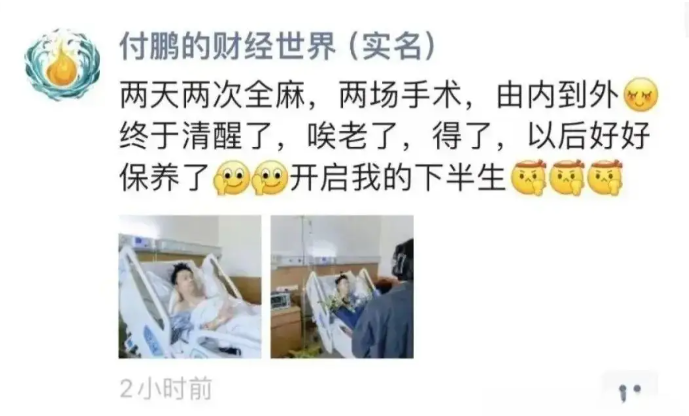
In March 2024, he published "Witnessing the Countercurrent: Reflections on the Major Changes in Global Asset Logic," and by the end of that year, he underwent two major surgeries, leaving a note in his social circle: "Two days with two general anesthetic surgeries, I'll take good care of myself from now on." On April 30, 2025, Fu Peng officially left Northeast Securities for health reasons, and his professional information was subsequently removed from the website of the China Securities Association.
Seventh stop: New Fire Group
In April 2026, right before the opening of the Hong Kong Web3 Carnival, Fu Peng appeared at the event as the Chief Economist of New Fire Group.
2. What has he said: A few validated judgments
He has made many public statements, here we only select a few with clear timeframes, relatively clear viewpoints, and that can later be compared with market performance.
September 2024, Phoenix Bay Area Financial Forum
In September 2024, Fu Peng gave a speech at the Phoenix Bay Area Financial Forum, which was hosted by Phoenix TV and Phoenix Online, held in the Hengqin Guangdong-Macao Deep Cooperation Zone.
Fu Peng publicly stated: One of the core issues facing the current economic operation is insufficient effective demand and declining investment returns. The continuous decline in interest rates reflects a downward shift in the central tendency of returns across society; the rising savings inclination of households and the fierce price competition faced by enterprises in the context of insufficient demand together form a negative feedback structure.
His core viewpoint can be summarized as: Economic issues are related not only to confidence levels but also to return rates and income expectations.
Fu Peng predicted: If government bond yields continue to decline, it will reflect a weaker expectation of returns. Regarding real estate, he believes that in the long term, the financial attributes of some housing may weaken and come closer to consumption attributes.
From the subsequent trends: The yield on 10-year government bonds continued to decline by the end of 2024, and his judgment on "declining returns" aligned with market performance in direction.
November 24, 2024, HSBC Closed-Door Meeting
The HSBC closed-door meeting was an event that allowed Fu Peng's views to spread widely; his speeches were subsequently circulated and rapidly spread on social media, allowing Fu Peng to transition from the macro research circle into the broader public view. The title of his speech was "2024 Review and 2025 Outlook—Hedging Risks vs. Soft Landing."
In this sharing, he pointed out: Some structural issues in the Chinese economy began to manifest before the pandemic and have not been completely repaired in recent years. Changes in residents' income expectations, balance sheets, and employment structure will all impact consumption and economic operations.
He discussed the Chinese issues within a broader macro framework, proposing an analysis path:
Ideology → Policy Choices → Economic Structure → Asset Pricing
He also noted that the global environment is undergoing structural changes, including factors such as geopolitical shifts and industrial chain restructuring, which could affect capital flows and asset pricing logic.
Fu Peng predicted: Economic recovery may face constraints in the near future, policy tools need to be balanced in use, and it will be difficult to rely on a single method to quickly resolve problems; global changes in the landscape may have a lasting impact on capital flows.
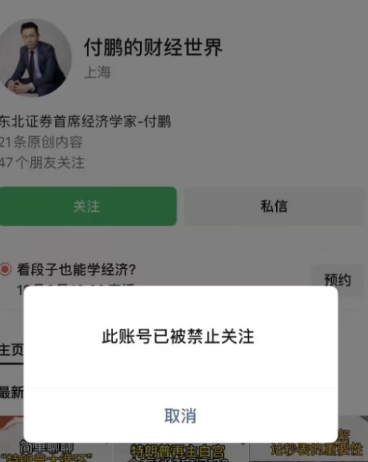
After the content of this closed-door meeting leaked, it rapidly spread on social media. According to public media reports, after this closed-door meeting, Fu Peng's short video platform account was reportedly blocked.
From the subsequent performance: Around 2025, the A-share market experienced a phase rebound, but the overall structure still showed significant divergence; his judgment on "complex environment, recovery constrained" correlates to a certain degree with market performance.
November 28, 2025, Bloomberg Businessweek The Year Ahead 2026 Outlook Summit
In the relevant annual outlook or roundtable discussions, Fu Peng discussed the relationship between productivity and institutions.
He proposed: Currently, there is a mismatch between productivity advancement (such as AI technology) and matching production relations and systems, and this imbalance will continue for some time; policies will play more of a hedging and bottom-line role rather than completely resolving issues.
In terms of asset allocation, he mentioned ideas similar to "structural allocation," for example:
One end representing future productivity tech assets (such as AI-related)
The other end representing assets with stable cash flow characteristics (such as high-dividend assets)
Fu Peng predicted: For gold, he analyzed its relationship with the global monetary system and institutional changes from a longer-term perspective, while also reminding of phase fluctuations and uncertainties.
From the subsequent trends: Between 2025 and 2026, gold prices remained strong overall and reached new highs, with various explanations for its driving factors (including central bank purchases, geopolitical risks, etc.). His analysis direction regarding the structural driving forces of gold has explanatory power, but there are deviations in the specific rhythm and price behavior.
December 20, 2025, Alpha Summit
In such conferences themed around AI and macro, he proposed:
A core issue currently in the AI industry is that infrastructure construction is relatively sufficient, but downstream applications and commercialization still need validation. The key in the upcoming phase is if applications can truly land and form profitable models.
He believes that the market is transitioning from "high-certainty narratives" to "phases that need validation," and valuations and volatility may rise simultaneously.
Fu Peng predicts:
- If AI applications land smoothly, it will lead to a new growth cycle
- If landings fall short of expectations, related assets may face significant volatility
- He emphasizes: In the macro environment, interest rates themselves are no longer the only core variable; what’s more important is whether the asset side can generate real returns.
- From subsequent trends: AI applications did indeed continue to advance around 2026, and some models significantly improved and gradually entered corporate application scenarios. However, the overall commercialization process remains in its early stages, and there is still a divergence in the market regarding its long-term value and short-term fulfillment.
April 23, 2026, Hong Kong Web3 Carnival
Fu Peng attended the relevant meeting as the Chief Economist of New Fire Group and discussed the evolutionary path of crypto assets.
He proposed: Crypto assets are evolving from being primarily "belief-driven" in their early stages to becoming more mature financial assets, and their development path is somewhat analogous to the evolution process of traditional financial derivatives:
Technological Innovation → Institutional Adaptation → Regulatory Follow-up → Inclusion in Mainstream Asset Allocation Systems
He placed crypto assets, stablecoins, and technologies like AI within a larger macro framework, believing these changes relate to the global monetary system and adjustments in financial structure.
He pointed out: The so-called decentralization does not mean the complete removal of centers, but rather a redistribution and reconstruction of the original central structure, which is also one reason why traditional finance is gradually changing its attitude toward crypto assets.
3. Why did he become popular? The spread effect brought by blocking
After he entered the Web3 circle, a wave of controversy over the interaction methods on social media objectively amplified his public exposure.
Discussions surrounding "blocking certain practitioners and KOLs" also prompted many outsiders to start searching for: who exactly is Fu Peng.
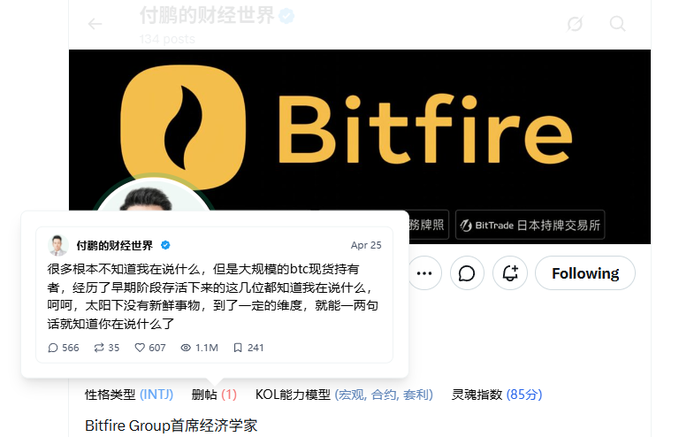
When he became active on X, he once posted a remark with a clear "show-off" tone, stating: "Many people do not understand what I am saying; only those who reach a certain cognitive dimension will understand." Subsequently, a batch of accounts related to the crypto space were blocked or blacklisted by him. This post has since been deleted.
The list of those blocked includes investors, KOLs, practitioners, and skeptics, among which are many influential accounts in the Chinese-speaking area. XHunt @XHuntCN summarized the list of the top 200 KOLs in the Chinese-speaking area that were blocked by Fu Peng.

This action evoked two distinctly different reactions in the Web3 circle.
- Supporters think: This is a macro analyst actively filtering information noise to maintain the independence of his analytical framework.
- Skeptics argue: This large-scale blocking behavior is obviously exclusive, especially in the initial stages of entering a new field, it can easily be interpreted as a display of strength or even arrogance.
However, this event objectively helped him achieve a large-scale exposure.
Those who were blocked posted discussions, while those who were not blocked observed; onlookers began to actively search for who Fu Peng is.
In the Web3 circle, this controversial entrance method proved to be more effective for self-introduction than a speech.
4. Why is he here
If we just look at the labels, Fu Peng seems to have made a significant leap from traditional macro researcher to Web3.
But if we return to the questions he has long been concerned about, we will find that the path is actually not so fragmented.
This issue may need to be traced back to earlier observations.
In reviewing Fu Peng's past public speeches, we can observe a relatively stable analytical habit: interpreting the behavior of young people as economic signals.
When Pop Mart exploded, he was concerned not just with the value of a single product, but rather its underlying consumption structure: in an environment of slowing growth and weakening expectations, why did young people reduce their allocation to large assets like real estate and cars, yet were willing to continuously pay for low-priced, high-emotional-value products.
During the emergence of the sneaker trading phenomenon, he also mentioned: Generation Y and Z are bypassing traditional stock and real estate markets to forge their own gaming methods in new trading scenarios. In his view, these behaviors are not simply speculative.
Web3, for him, seems more like a continuation of this observation path: led by young people, emotionally driven, and with a higher risk preference, these characteristics resurface at different stages, simply with changes in the medium.
As early as around 2021, he mentioned in some interviews: The traditional framework still lacks a sufficient understanding of Bitcoin, but its pricing logic can be observed from the perspective of liquidity; if the macro environment turns tight, high volatility and high valuation assets may face pressure. Subsequently, in 2022, the crypto market experienced deep adjustments, with Bitcoin significantly retreating from its peak; this logic was validated to some extent by the market.
In the following years, he did not directly engage in specific trading narratives, but continued to observe the development of this field from a macro perspective. From the initial high volatility and high uncertainty, gradually introducing regulation, expanding stablecoins into payment scenarios, to institutional funds beginning to enter, the attributes of crypto assets are also changing.
Based on these observations, he gradually formed a judgment: Crypto assets are evolving from an early marginalized market to financial instruments that can be included in asset allocation systems, hence he chose to enter this emerging industry.
Final thoughts
The controversies surrounding Fu Peng will not disappear.
Whether in the traditional finance circle or in today's Web3 context, he is not an easily agreeable figure.
But precisely because of this, he is worth observing independently.
Not because he provides standard answers, but because his path reflects a seam between the macro narrative in China over the past few years and the new asset narrative:
- From the impact of the Lehman crisis to changes in domestic household balance sheets;
- From consumption structure, real estate, and interest rates to gold, AI, and crypto assets;
From off-market observations to truly stepping onto the Web3 stage.
Rather than saying that Fu Peng "suddenly turned to Web3," it is more accurate to say that he merely arrived here along his original problem consciousness.
If in the coming years, traditional macro analysts increasingly appear in discussions around AI and Web3, Fu Peng may not be the last one.
免责声明:本文章仅代表作者个人观点,不代表本平台的立场和观点。本文章仅供信息分享,不构成对任何人的任何投资建议。用户与作者之间的任何争议,与本平台无关。如网页中刊载的文章或图片涉及侵权,请提供相关的权利证明和身份证明发送邮件到support@aicoin.com,本平台相关工作人员将会进行核查。


