Nikita is not simply a "racist"; he is just a person completely defined by the economic chain he is part of.
Written by: Black Mario
On April 26, X platform product head Nikita Bier characterized the rampant Chinese porn bots and spam on the platform as "Chinese state-level bot attacks," which caused extreme dissatisfaction among many Chinese-speaking users. Many accused him of racism and arrogance, saying he couldn't even distinguish basic facts.
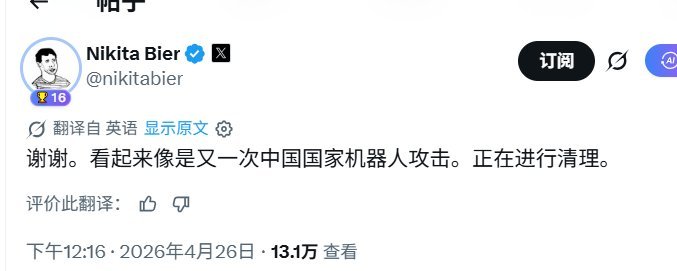
Of course, I think we shouldn’t rush to make moral judgments; we should first return to rationality. If we deconstruct this issue into several interest chains, you will actually find that Nikita's attitude towards this fact is not a result of thoughtlessness or brain overheating; rather, it is determined by his position, the resources he holds, and the understanding he has developed over time. Therefore, rather than blaming his personal moral issues, it would be more accurate to say it is a natural extension of the interest chain.
Who is Nikita Bier? A "Political Economist" Raised by American Growth Logic
If we want to understand why he said this, we first need to understand who he really is.
Actually, Nikita is a typical Silicon Valley elite.
He embodies three labels:
Political correctness, viral growth, and rapid monetization.
The so-called political correctness stems from Nikita being a top student at UC Berkeley, holding dual degrees in political economy and business. These two fields essentially teach you to view the world through the framework of national interests and power games, so from the day he started school, the ideology drilled into his brain has always been that one should think about everything in political terms. This has fundamentally shaped his underlying thought processes and, one might say, his values and worldview.
As for the labels of viral growth and rapid monetization, these are reflections of how he has pushed "American growth hacking" to its extreme during his entrepreneurial journey.
- In 2012, he created Politify, a policy simulation tool that became popular through viral spreading, honing his skills in "low-cost user acquisition."
- In 2017, he launched tbh, an anonymous compliment app that emphasized positivity for high school students, which was sold to Facebook/Meta for about $30 million within a few years, achieving his first bucket of gold.
- In 2022, he released Gas, an upgraded version of tbh with paid reveals and gamification, which was sold again to Discord, yielding another profit, making him a somewhat well-known "serial entrepreneur" in Silicon Valley.
- In July 2025, he rose to become the product head of X by "posting to gain position" while also serving as a partner at Lightspeed Venture Capital and an advisor to Solana.
Thus, all of Nikita's successes are based on the Western youth market, psychological drives, viral growth, and rapid monetization closed loops. This suggests that he has not deeply engaged with the Chinese market, nor had any positive interactions with China's gray and black industries.
For him, any user behavior that is large-scale and abnormal is not about commercial profit-seeking but rather is seen as external organizational behavior. This is a cognitive template formed over years of schooling and entrepreneurship, fundamentally ingrained in him. That is why when it comes to the Chinese promotion sector, even slightly frequent or odd interactions can lead to verifications, and at times mass bans on accounts.
The Three Interest Chains as I See Them
In fact, to understand the essence of the matter, we can break down Nikita's statements into three interest chains to analyze his choices.
The first interest chain is the KPI life-or-death chain of the X platform, which is his livelihood—it's easier to deflect blame.
X's core revenues currently consist of three categories: advertising (which is the bulk) + Premium subscriptions (this probably pays the salaries of Blue V users) + Grok AI monetization.
As the product head, Nikita essentially needs to drive platform growth, including user growth and revenue growth, which boils down to a single KPI: to ensure all three types of revenue increase, and do so impressively.
However, the Chinese spam bots happen to be X's "tumor," characterized by:
- Large scale: Nikita himself said there are 5-10 million accounts in circulation, sending out spam en masse every minute.
- Low cost: China’s gray industries utilize cheap servers + phone cards + VPNs, and the total cost can be a few yuan, allowing unlimited account registrations.
- Significant harm: These bots do not attack X but lurk on the platform harvesting traffic, leading users to Telegram groups, scams, and porn live streams, directly polluting timelines, search results, and recommendation algorithms, which causes many real users to defect, making advertisers hesitant to spend money.
If Nikita were to acknowledge that this problem reflects the failure of their risk control models, that the algorithm is unresponsive to non-English traffic, and that they have accumulated technical debt, he would surely have to take the blame, spend real money to upgrade the system, and perhaps affect growth metrics—when a large ship needs to change course, it impacts the entire vessel.
Think about it: can someone like Musk tolerate a product head saying, "Our technology is lacking"?
Thus, there is only one optimal solution: shift the blame to "Chinese state-level water armies," which has several advantages:
- Liability exemption: Not our technology being flawed, but the opponent being too strong; it's a state action.
- Establishing a persona: X is defending global free speech, aligning with Musk's narrative while gaining some goodwill.
- Appeasing: Showing goodwill to U.S. regulators and Congress by saying, look, we are combating foreign interference, perhaps we can face fewer troubles in future policies.
This deal seems like a guaranteed profit.
The second chain is the Silicon Valley venture capital and geopolitical interest chain, after all, his own backing relies on "picking sides."
Nikita is not just the product head of X; as mentioned earlier, he is also a partner at Lightspeed Venture Capital. Lightspeed is a typical Silicon Valley VC that has invested in American consumer internet products like BeReal and Flo Health, with almost no engagement with Chinese tech companies.
What is the mainstream narrative in Silicon Valley now?
China is a systemic adversary. The TikTok ban, data security reviews, and supply chain decoupling have all positioned China as the "enemy." In this atmosphere, any "abnormal behavior at scale" from China is default interpreted as a "state action." Thus, this issue is not merely a problem of bias but a question of survival rules.
The X platform itself is caught in the crossfire of the U.S.-China competition; it wants to be a "global digital square," profiting from global traffic while not wanting to be criticized by the U.S. Congress for "tolerating Chinese influence."
Thus, I believe Nikita’s deflection fits perfectly within the realm of political correctness: he helps Musk take a position, and this does not affect X's interactions with Chinese gray market traffic (since gray market users won't convert to Premium anyway, they won't earn money from them).
Of course, I think for him personally, saying this also has an invisible benefit: in the Silicon Valley VC circle, "standing up to China" is a plus point, boosting his reputation and making it easier to secure projects and funding in the future.
The third chain involves the traffic harvesting chain of China’s gray and black industries, which is the real world he cannot comprehend.
In fact, the gray industries of China's internet are no longer small-scale operations.
Last year, I found data indicating that by the first quarter of 2025, the domestic black and gray market had surpassed 280 billion yuan, with over 8 million workers, forming a complete interest chain involving intermediary traffic diversion, tec
免责声明:本文章仅代表作者个人观点,不代表本平台的立场和观点。本文章仅供信息分享,不构成对任何人的任何投资建议。用户与作者之间的任何争议,与本平台无关。如网页中刊载的文章或图片涉及侵权,请提供相关的权利证明和身份证明发送邮件到support@aicoin.com,本平台相关工作人员将会进行核查。


