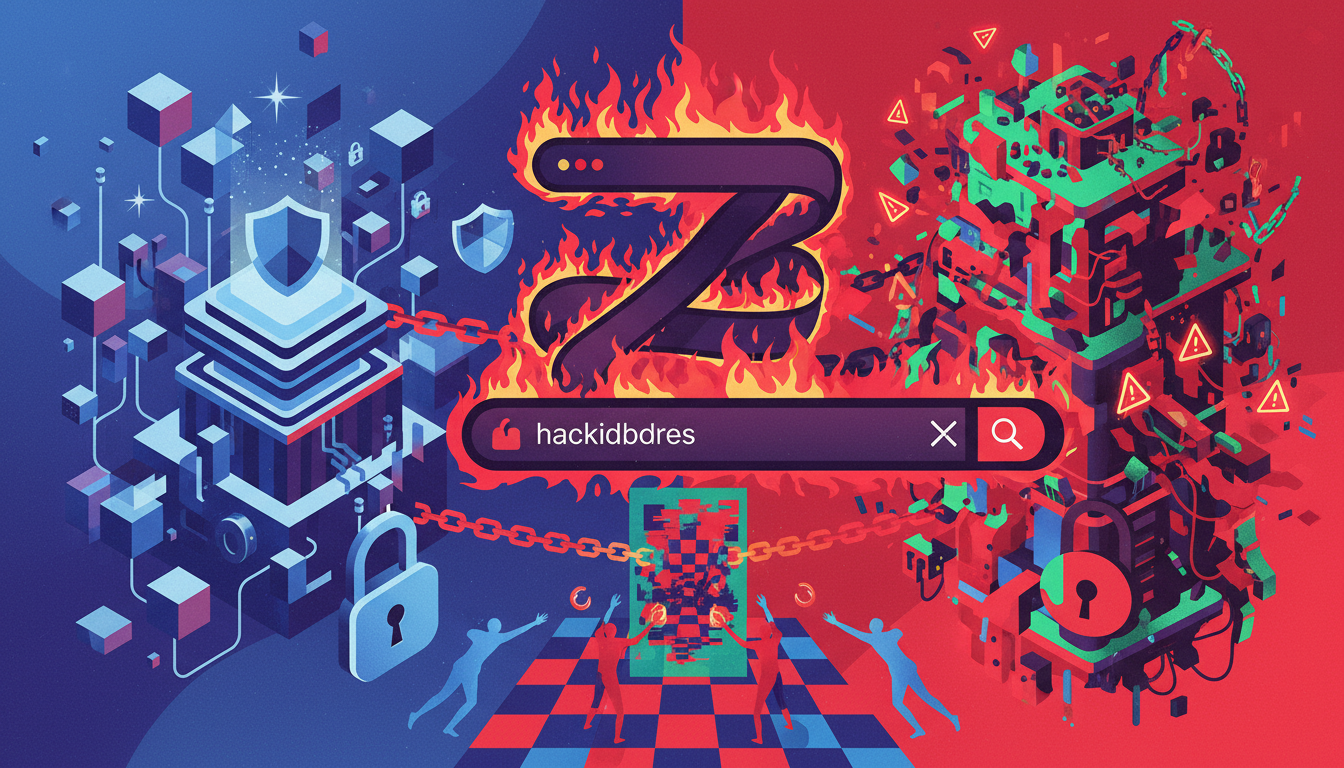
On April 14, 2026, the main domain name of the decentralized trading aggregator CoW Swap, cow.fi, was hijacked by attackers using social engineering tactics, redirecting traffic that originally pointed to the official front end to a counterfeit site without user awareness. CoW Swap subsequently emphasized repeatedly in an official statement that this incident only occurred at the DNS and front-end level, and the protocol contract itself was not compromised, nor were users' private keys directly leaked. However, for the industry, the more glaring issue is the structural paradox exposed by this incident: a decentralized protocol that claims to be "trustless" ultimately gets tripped up by a highly centralized domain name system, making the entry point the weakest link.
Forged documents staging a domain heist: How the attack chain closed
According to public information, the attackers first targeted the DNS registrar, a traditional internet element, rather than the on-chain contract itself. By forging identity or business-related documents and implementing precise social engineering on the registrar, the attackers successfully deceived the registrar, "transferring" the control of cow.fi from the project party. This process did not occur on-chain but took place through typical Web2 processes such as emails, tickets, and offline reviews, directly prying open the entry point of the Web3 protocol.
Once they gained control of the domain name, the attackers could modify the DNS resolution records and silently redirect the traffic originally destined for the CoW Swap official front end to their own deployed phishing site. For the vast majority of users accustomed to directly typing in cow.fi or clicking bookmarked links, the browser address bar appeared normal, and the HTTPS certificate and page layout were highly realistic; in this "senseless migration," users had almost no opportunity to visually discern that they had entered a false front end.
In this incident, both the official team and several media outlets deliberately did not disclose the specific name of the registrar when revealing the attack route, referring to it generically as "the registrar." On one hand, this reflects a compliance restraint regarding accountability; before the investigation of the incident is fully completed, there is a desire to avoid "labeling" a single institution without sufficient evidence. On the other hand, it illustrates the current boundaries of information disclosure—security incidents involving third-party infrastructure do not have all details suited for immediate public release.
Two-phase offensive: From malicious signatures to wallet pop-up traps
After gaining control of cow.fi, the attackers set up a two-phase attack process on the phishing site. According to technical breakdowns from sources like Foresight and Jinse Finance, the core of the first phase is to lure users into initiating and signing malicious transactions in a "seemingly normal" transaction interface. The interface could display common swap or authorization operations, with parameters packaged to seem "routine," thereby allowing habitual signers to unknowingly grant high-level authorizations and asset transfers to the attack contract.
Even more deceptive is the second phase: in some cases, the attackers integrated a forged wallet pop-up module, creating a highly realistic simulation of the browser wallet interface to deceive users into entering sensitive information such as mnemonic phrases, private keys, or export keys. From the user's perspective, the interactive processes, styles, and even error messages of these pop-ups are almost identical to mainstream wallets. For users lacking security education and who have not yet developed a muscle memory for the iron rule that "wallets should never ask for mnemonic phrases," such stealers are extremely difficult to detect in time.
Currently, community members and security teams are carrying out further on-chain analysis and cross-verification regarding the specific amount of losses and suspected hacker addresses related to this attack. Due to the currently public information being derived from limited sources and yet to be fully verified, precise loss figures cannot be provided, and it is not appropriate to name specific addresses to avoid misleading readers or adversely affecting innocent addresses. This incomplete information status serves as a reminder to the market: in sudden security incidents, the pursuit of numeric "accuracy" can sometimes interfere with our judgment of structural risks.
DNS as a single point vulnerability: The Web3 security paradox laid bare
This CoW Swap incident lays bare a long-overlooked structural contradiction: The security of the core assets of decentralized protocols often relies on a highly centralized domain name system. From the on-chain perspective, CoW Swap's smart contracts are still operating securely, with users' private keys held in their own wallets, and the entire "protocol layer" is almost intact; however, from the users' real operational pathways, all interactions with the protocol must first go through cow.fi as the "entry point"—once the entry point is hijacked, the subsequent decentralized guarantees are rendered nearly ineffective in a short timeframe.
This stark contrast is particularly extreme in this incident: the front end was hacked, but the contract remained intact. The attackers did not breach the multi-sig vault or defeat the contract logic; they were able to lead users step by step into their trap simply by controlling the DNS. For ordinary users, the gut trust of "I am accessing the CoW Swap official site" ultimately became a fatal psychological blind spot. The transparency and verifiability of the protocol did not automatically extend to the front end and domain level.
If we broaden the perspective to the entire DeFi industry, CoW Swap is just a typical example. Many protocols focus their efforts on auditing contracts, designing anti-MEV mechanisms, and optimizing liquidation logic, while continuing to apply "default trust" from the Web2 era in areas such as DNS configuration, domain locking, and registrar security policies. When the protocol's TVL continues to rise and the front end becomes an essential route for significant value, this kind of overtrust in traditional internet infrastructure is evolving into a source of systemic risk.
Emergency measures: Locking domain names, switching to backup front ends, and user self-help
After the incident was exposed, the immediate action from the CoW Swap team was to race against time to regain control of the cow.fi domain name from the registrar and, upon regaining control, to implement a stricter domain locking mechanism to reduce the chances of future social engineering tampering. Meanwhile, the team quickly redirected traffic to the backup domain swap.cow.finance to ensure that core trading services could continue to operate on a relatively safe front end, minimizing the chain reactions caused by disruptions to the protocol layer’s operations.
In a subsequent official statement, CoW Swap explicitly stated that this attack only affected the front end/DNS layer, and the protocol infrastructure and users' private keys have not been leaked. This statement serves, on one hand, to clarify the facts, helping the market distinguish between the seriousness of "front-end hijacking" and "contract hacking"; on the other hand, it is also an effort to stabilize user confidence and avoid large-scale chaotic withdrawals or misjudgments about the protocol itself due to panic.
Meanwhile, several security teams within the community began releasing self-help guides to users. They generally recommended that users who had interacted with suspected phishing front ends should immediately revoke authorizations to suspicious contracts using tools like Revoke.cash and migrate the remaining funds to new wallets or trusted front-end environments. Through this multi-party collaboration, the official emergency response and community security education formed a temporary "firewall," which managed to slow the spread of losses to some extent.
From CoW Swap to the entire industry: Entry defenses and trust reconstruction
From a defensive perspective, CoW Swap's experience is prompting more projects to re-evaluate their domain security strategies. In the future, stricter domain locking (such as registrar-level locks), multi-factor verification processes (requiring multiple confirmations for modifying key DNS records), and the introduction of hierarchical permission controls in domain management backends are expected to become "standard features" for leading projects, rather than optional add-ons. This approach that moves security to the registrar and DNS configuration layer may not completely eradicate social engineering attacks, but at least it can significantly raise the threshold for attacks.
On a longer technical evolutionary trajectory, the industry is also exploring various DNS alternatives and enhancements. On one end are attempts at decentralized domain systems and on-chain name services, hoping to bring the "entry" on-chain as well; on the other end are upgrades in security prompts from browsers and wallets, such as fingerprint recognition for commonly used Web3 sites, trusted front-end whitelist validation, and explicit alerts against suspicious certificates and resolution changes. Once these tools mature, even users without a background in security engineering will be able to quickly identify "something is wrong."
However, no matter how comprehensive the technical solutions, they cannot replace the reconstruction of team and user security habits. For project teams, front-end and domain management must be integrated into the same level of security processes as contracts, rather than continuing to be treated as outsourced IT operations issues; for users, forming rigid habits of "understanding signature contents" and "never entering mnemonic phrases in any pop-ups" is equally crucial in reducing losses. CoW Swap's DNS nightmare serves as a high-intensity reminder: the security of Web3 will not automatically arise just because it claims to be "decentralized."
The protocol is fine, yet the entry point is fast collapsing
Looking back at the entire incident, the most noteworthy signal is not a specific loss number, but rather that the main battlefield of attacks is shifting from the contract layer to the entry point layer. As contract audits, fund custody, and on-chain monitoring gradually mature, attackers will naturally turn their sights toward those weak links that still employ Web2 logic but carry enormous value—DNS, front ends, wallet pop-ups, and even users' clicking habits.
In the short term, the most practical response for ordinary users is to heighten their vigilance towards front-end environments and signature actions: confirm URLs, pay attention to certificate anomalies, never leak mnemonic phrases in any situations, and obtain front-end entry and risk alerts whenever possible through official channels. In the long run, the entire industry must start reconstructing its infrastructure trust model: incorporating DNS and front-end security into protocol design, introducing more verifiable and tamper-proof entry mechanisms, and ensuring that "decentralization" extends beyond the blockchain and permeates the entire path from the browser address bar to the final transaction.
Join our community for discussions and to become stronger together!
Official Telegram community: https://t.me/aicoincn
AiCoin Chinese Twitter: https://x.com/AiCoinzh
OKX benefits group: https://aicoin.com/link/chat?cid=l61eM4owQ
Binance benefits group: https://aicoin.com/link/chat?cid=ynr7d1P6Z
免责声明:本文章仅代表作者个人观点,不代表本平台的立场和观点。本文章仅供信息分享,不构成对任何人的任何投资建议。用户与作者之间的任何争议,与本平台无关。如网页中刊载的文章或图片涉及侵权,请提供相关的权利证明和身份证明发送邮件到support@aicoin.com,本平台相关工作人员将会进行核查。