Author: Kathy.xyz
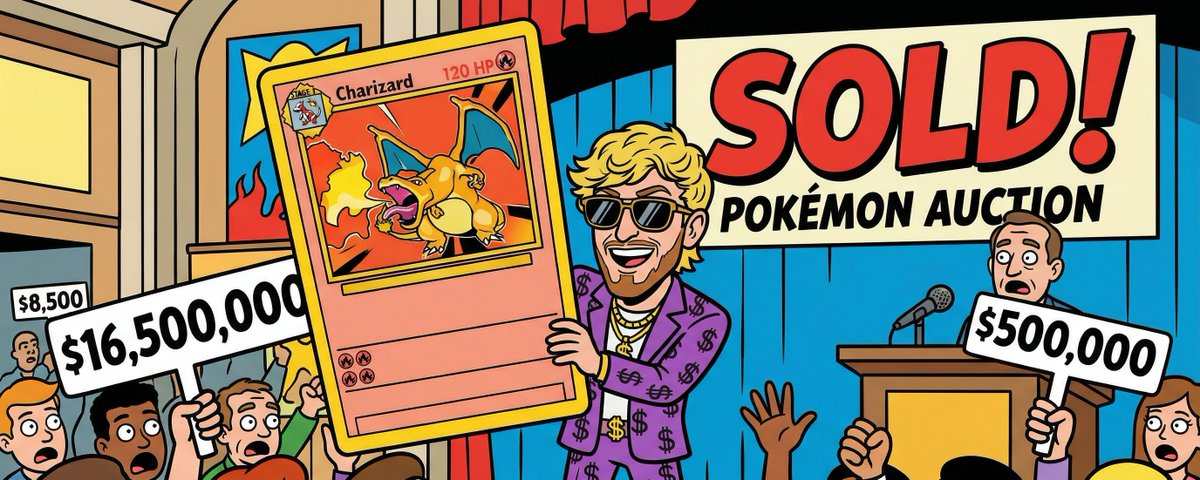
In February 2026, Logan Paul sold a Pokémon card for $16.5 million.
This "Pikachu Illustrator" card has only 41 copies in existence worldwide, and the one owned by Logan Paul is the only PSA perfect 10 version. He purchased it for $5.3 million in 2022, and four years later, it has increased in value by more than three times, yielding a paper profit of over $11 million.
What used to be something that made kids save their pocket money has transformed into a financial asset fetching eight-digit amounts in USD today.
Where does this business come from, and how big is it?
In 1993, mathematician Richard Garfield combined the collection mechanism of baseball cards with tabletop game strategies to create Magic: The Gathering.
The logic is simple: Random card packs → Different rarities → Create exchange value → Stimulate collection demand → Push up the secondary market.
This underlying mechanism has not changed in thirty years.
Current scale of the three major brands:
- Pokémon TCG has an annual sales of approximately $2 billion, with over 75 billion cards sold in total;
- Yu-Gi-Oh! follows closely with about $1.99 billion;
- Magic: The Gathering around $1.08 billion, with over 50 million players worldwide.
The combined total of just these three brands exceeds $5 billion.
The market for sports cards is even more extraordinary. PSA 10 graded rookie cards of star players have an average annual return rate of about 18.3% in 2024, outperforming mainstream stock indices.
The entire TCG market in 2024 is estimated to range from $6.6 billion to $8.4 billion, with projections to reach $16.9 billion by 2035.
Rules you must understand to play in this market
Card value is not defined solely by your perception of its worth—there must be endorsement from grading agencies.
PSA is the most authoritative, with a perfect score of 10. The price difference between PSA 10 and PSA 9 for the same card can be several times or even dozens of times. The reason why Logan Paul's Pikachu could sell for $16.5 million is primarily due to it being a PSA 10.
Scarcity itself is also designed. Taking Pokémon as an example, the rarity tiers are layered, and the Special Illustration Rare full-art cards have become the most sought after in recent years. Craftsmanship rarity + grade certification + IP popularity, when combined, can generate the highest premiums.
The card market also has cycles.
The period from 2002 to 2015 was the "sleeping period" of the Pokémon card market. Following the first Pokémon craze (1999-2001), the market cooled significantly, leading many to offload their childhood collections at low prices, resulting in a flood of high-condition first edition cards entering the second-hand market, with prices greatly reduced. This phase is the source of many top auction items today.
Before 2018, the sports card market was also relatively low. It wasn't until the pandemic in 2020, during which the home economy surged, liquidity was abundant, and Millennials collectively felt nostalgic that an epic bull market began. The period from 2020 to 2021 saw the peak pricing for the entire card market.
2020-2021 was the price peak: home economy, abundant liquidity, collective nostalgia among Millennials, leading to an epic bull market. In 2022, interest rate hikes caused an overall pullback. Starting in 2025, with the enthusiasm for Pokémon's 30th anniversary and a return of liquidity, the market became active again. The pattern is very clear: every bear market serves as an opportunity window to acquire high-condition rare cards.
Web3 has arrived, what has it brought?
Blockchain has not changed the essence of cards but has changed the method of circulation.
On-chain NFT cards are owned by your wallet, and you can transfer them even if the platform shuts down. Traditional physical card transactions require five days for settlement, while on-chain transactions are completed in five seconds. High-value cards can also be fragmented for ownership, staked, or lent.
The hottest trend is tokenizing physical cards (RWA tokenization).
@Courtyard_io is the largest on-chain card market, collaborating to secure physical cards, with over 500,000 collectibles tokenized on-chain. Monthly sales increased from $50,000 in January 2024 to $80 million in August 2025—a 1600-fold increase in 18 months. In July 2025, it completed a $30 million Series A round with Y Combinator participating.
Collector Crypt is deployed on Solana, with cumulative trading volume exceeding $150 million by 2025. The $CARDS token surged from a market cap of $67 million to over $600 million within a week of launch.
In the entire tokenized Pokémon card market, monthly transaction volume reached $124.5 million in August 2025.
From Richard Garfield designing Magic: The Gathering in 1993 to a single card selling for $16.5 million in 2026, only thirty years have passed.
The core of this business has never changed: Scarcity + Collecting Desire + Exchange Value.
Only the scale and the technology supporting it have evolved.
That pack of cards you bought with your pocket money as a kid might truly be the best asset you've ever purchased.
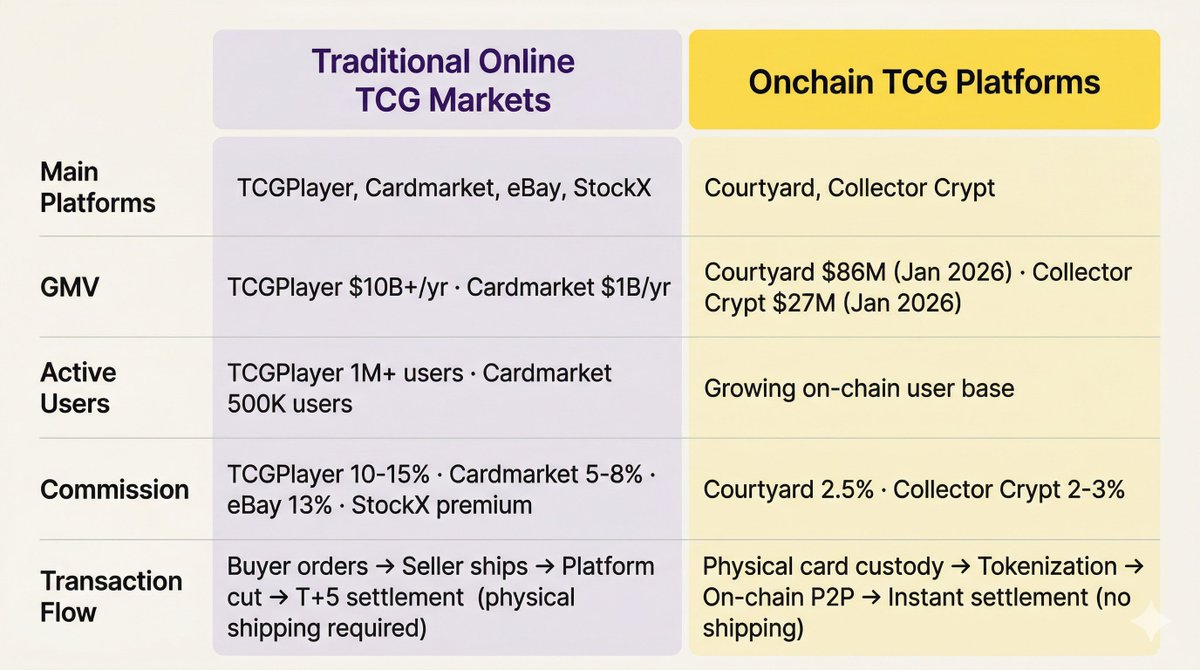
I compared the traditional online card market with the RWA card market and found that placing assets and transaction processes on-chain indeed enhances transaction efficiency.
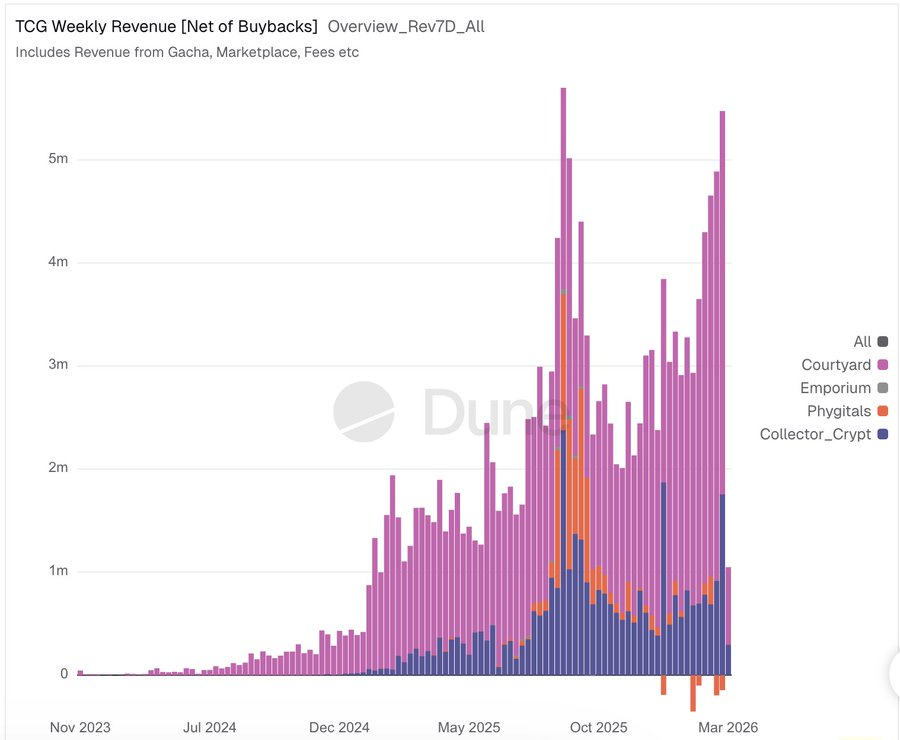
Somewhat counterintuitively, @courtyard_io and @Collector_Crypt have seen increases in transaction volume and revenue. This indicates that the business does not solely rely on crypto speculators focused only on trading.
Currently, the only assets on-chain for TCG are $CARDS and $BIRB, so keep an eye on them. Collector Crypt appears too concentrated from the perspective of active users and the $CARDS chip structure, with quite a few locked-up holders, so I'll continue to observe in the short term.
免责声明:本文章仅代表作者个人观点,不代表本平台的立场和观点。本文章仅供信息分享,不构成对任何人的任何投资建议。用户与作者之间的任何争议,与本平台无关。如网页中刊载的文章或图片涉及侵权,请提供相关的权利证明和身份证明发送邮件到support@aicoin.com,本平台相关工作人员将会进行核查。


