Written by: Suvashree Ghosh, Matt Haldane
Translated by: Saoirse, Foresight News
Not long ago, the crypto industry was loudly proclaiming "blockchain, not bitcoin," claiming that distributed ledger technology would surpass financial applications and completely reshape the internet. However, recent financing trends show that cash remains king in the real world.
Since the early 2020s, following the decline of the Web3 and NFT boom, investment enthusiasm in the crypto industry has noticeably cooled. Yet, one niche area in the market has been attracting increasing venture capital against the trend—stablecoin payments.
Stripe's acquisition of Bridge for $1.1 billion last year was an early signal of traditional financial institutions starting to position themselves in stablecoin payments. Subsequently, a number of startups like ARQ, KAST, and RedotPay secured new funding to build cross-border payment channels and stablecoin-based financial services. Mastercard's acquisition of BVNK for $1.8 billion last week further validated the market's strong interest in this sector.
"Startups related to stablecoins are almost the hottest area for venture capital financing right now," said Rob Hadick, General Partner at Dragonfly Capital. "Stablecoins have separated from the entire crypto industry, becoming one of the few truly groundbreaking applications that are widely being implemented in reality."
According to Architect Partners' annual report focused on crypto financing, the total financing for crypto payments companies soared to $2.6 billion in 2025, surpassing the total from the previous three years. Following Mastercard's acquisition of BVNK, this number is expected to continue rising this year.
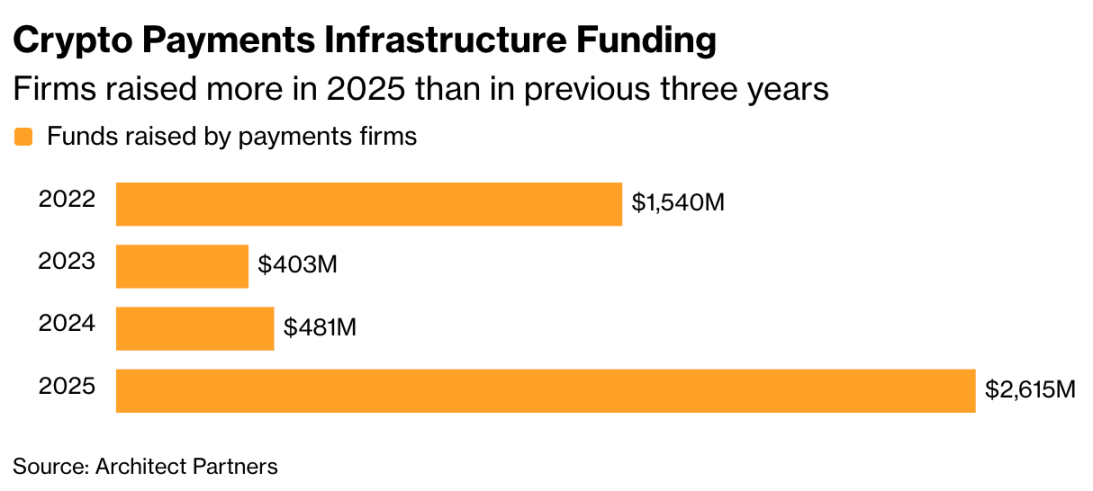
Financing of crypto payment infrastructure: Total financing in 2025 exceeds the total of the previous three years
Meanwhile, the overall private equity financing in the crypto industry increased from nearly $13 billion in 2024 to $20.4 billion in 2025, but still fell short of the peak of $27.6 billion in 2022.
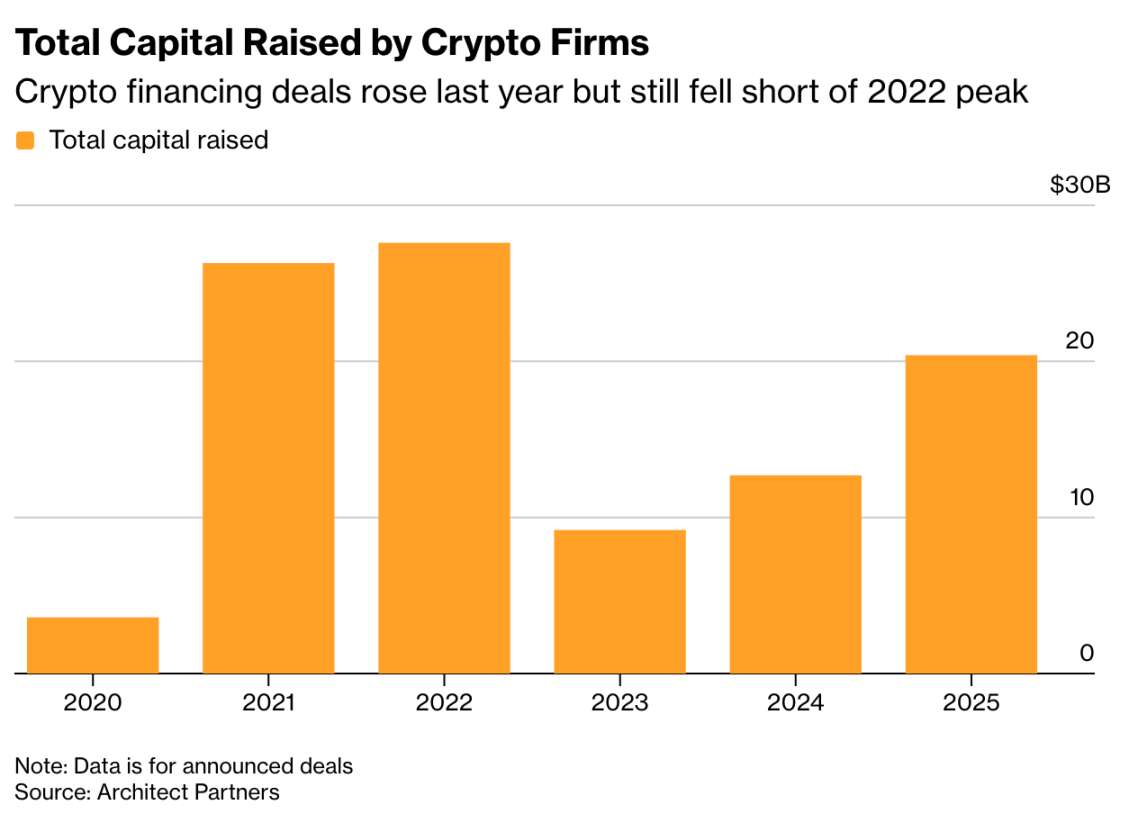
Total financing of cryptocurrency companies: The number of cryptocurrency financing transactions increased last year, yet did not reach the peak of 2022
Currently, the two most concentrated areas for private equity are "investment and trading infrastructure" and "brokers and exchanges," both of which are financial application businesses. Payment infrastructure holds a solid third place. In stark contrast, the gaming segment that once stood at the core of the Web3 and NFT boom saw its financing drop from $3.76 billion in 2022 (about 14% of total financing) to no longer being classified as an independent category in 2025.
In fact, various decentralized applications (Web3 functional layer) collectively raised $5.2 billion in 2022; however, the 2025 report retained only consumer DApps, with a financing amount of merely $864 million.
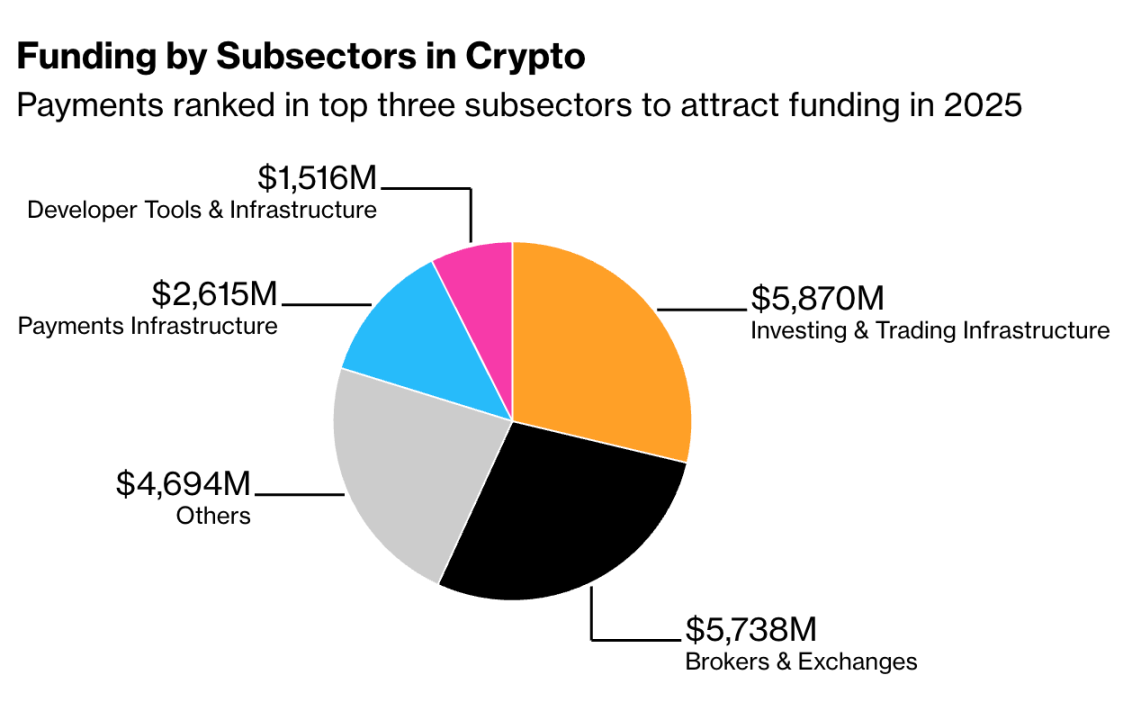
Financing situation across various cryptocurrency segments: The payments sector ranks among the three major sub-industries attracting financing in 2025
Stablecoins are building a more robust financial infrastructure for blockchain. These tokens are typically pegged 1:1 to the US dollar, with value linked to underlying assets. Driven by a pro-crypto policy under the Trump administration, market enthusiasm for stablecoins reached unprecedented heights last year.
According to Artemis Analytics, total trading volume of stablecoins skyrocketed by 72% in 2025, reaching $33 trillion. The two largest stablecoins by market size are Tether's USDT and Circle's USDC.
Circle's stock fell to its largest single-day drop on Tuesday as investors assessed the potential adjustments to US stablecoin regulations and the impact of intensified industry competition. Nonetheless, the core appeal of stablecoins remains clear: to transfer funds as efficiently as possible.
Cross-border payments still remain slow, expensive, and tied up with significant amounts of capital. Despite years of development in financial technology, cross-border transfers are still heavily reliant on pre-funding accounts set up in different jurisdictions.
"Stablecoins dramatically change this landscape," said Prajit Nanu, co-founder and CEO of cross-border payment company Nium. "They allow value to flow in real time globally without suffering equivalent levels of capital efficiency loss, which is why investors see them as the core infrastructure of next-generation payments."
This industry still has strong "gatekeepers." Major payment networks like Visa and Mastercard control access to payment terminals. Eric F. Risley, founder and managing partner of Architect Partners, noted in the report that the issue of distribution channels "is a major concern for every stablecoin and related payment company."
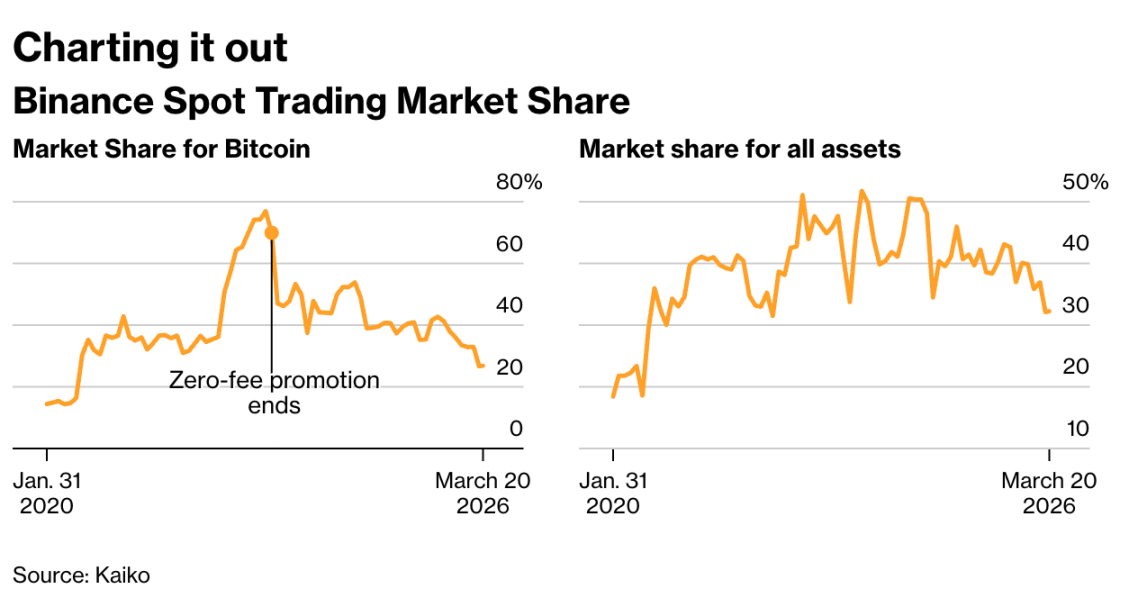
Trend chart of Binance spot trading market share
As of February this year, Binance's market share in Bitcoin spot trading has dropped to 27% (there may be some discrepancies in data due to statistical standards), and its market share across all cryptocurrencies has fallen from 52% to 32%. Its most profitable derivatives business share also significantly decreased to 34%.
Franklin Templeton has partnered with Ondo Finance to launch ETF tokenized products that can be traded around the clock through crypto wallets, bypassing the brokerage accounts and limited trading rules that funds have relied on for decades.
Voices from the Industry
"The irony of this event being held in Las Vegas is striking," said Ben Johnson, head of client solutions at Morningstar. "This industry has undoubtedly crossed the line between investment and gambling, with no room for retreat."
Originally designed to simplify investing, ETFs have now become vehicles for the latest financial gambling in the United States. Bloomberg Intelligence data shows that of the 1,000 new funds launched last year, 36% were leveraged products or crypto-related funds.
免责声明:本文章仅代表作者个人观点,不代表本平台的立场和观点。本文章仅供信息分享,不构成对任何人的任何投资建议。用户与作者之间的任何争议,与本平台无关。如网页中刊载的文章或图片涉及侵权,请提供相关的权利证明和身份证明发送邮件到support@aicoin.com,本平台相关工作人员将会进行核查。


