Author: David, Deep Tide TechFlow
While you are still figuring out how to install OpenClaw on your computer and worrying about whether it can run fully automatically, a company is already creating a 24/7 AI computer that sets everything up for you.
This company is called Perplexity, valued at 20 billion dollars. Yesterday, it held a launch event in San Francisco, rapidly igniting the tech circle on the internet. The product name is also quite grand:
Personal Computer, simply called a personal computer.
Buy a Mac mini, install its software, connect to the internet, and you will have an AI computer that never shuts down. No need to type command lines, configure environments, or find API keys yourself.
Perplexity has connected 20 AI models for you, from Claude to Gemini to GPT, deploying the one best suited for each task.
All you need to do is tell it what result you want.
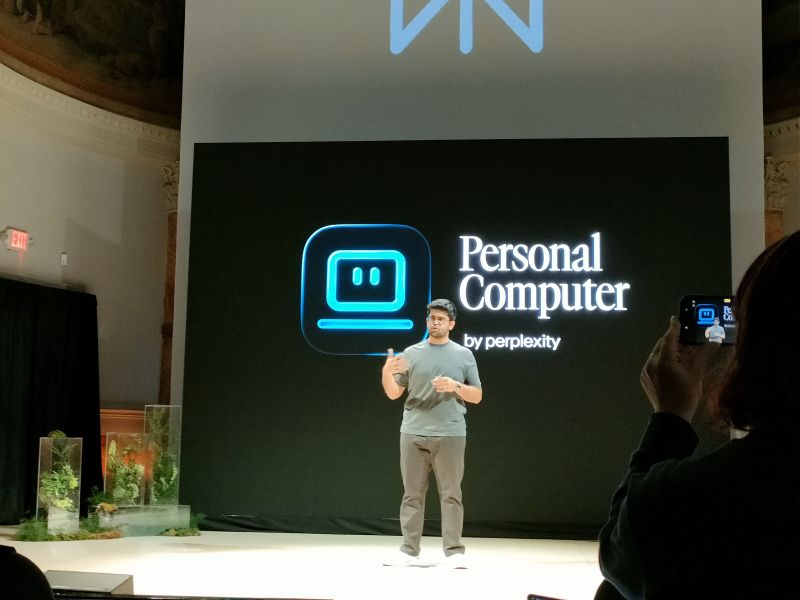
Image source: Perplexity Developer Conference site, CEO showcases Personal Computer
Embedding AI Experience into the Operating System
To be precise, Perplexity did not build a computer. What it has done is:
Directly integrated AI into the system of a Mac mini.
Buy a Mac mini, install Perplexity's software, connect to the internet, and this Mac will no longer be an ordinary computer. It works 24/7, connects to your various office software, and operates automatically according to the rules you set.
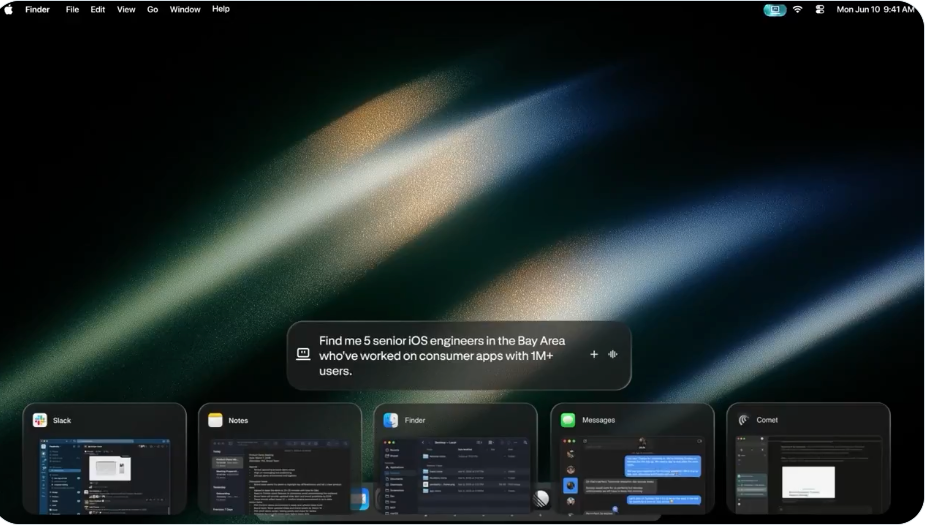
During the launch demo, someone gave it a directive: filter candidates with SwiftUI experience from the resume database while sending an email to investors with a project briefing link attached.
One instruction, two tasks completed simultaneously. When a client sends an inquiry email, it drafts a reply in your usual tone; when you are in a meeting, it updates sales data in the background; when you sleep, it keeps running.
I know your first reaction is: isn't this what OpenClaw does? What's the difference?
In the past two years, ordinary people have had two ways to engage with AI. One is cloud-based: open a browser, find ChatGPT or Claude, type, wait for a response, and copy the results for your own use. The other is local: install tools like OpenClaw, spend half a day configuring the environment, and let AI operate your computer.
Both paths have a common point: you have to actively seek out AI.
What Perplexity aims to do is different; you don't need to find AI, AI is already in your computer.
It directly operates your files, your emails, your calendar, your applications, and you don't need to switch to any "AI interface" to give instructions. You don’t have to know which model is running in the background, how tasks are disassembled, or how much computing power is allocated in the cloud.
You only see that tasks are being completed.
No one needs to sit in front of this Mac mini. Two weeks ago, Perplexity released a cloud system called "Perplexity Computer," with 20 AI models on standby, Claude handling reasoning, Gemini conducting research, and GPT managing long texts, each with its role.
And now the released Personal Computer takes all these capabilities and embeds them into the Mac on your desk, transforming it into a self-operating computer.
Shell as Justice
At the same time, the CEO of this company, Aravind Srinivas, said something at the launch that I think perfectly illustrates the product's characteristics:
"Traditional operating systems accept commands, AI operating systems accept goals."
This sentence actually explains why this event sparked conversation throughout half of the tech circle yesterday.
It’s not because yet another AI product was launched. This year, AI products are emerging at a rate of ten a week; people are already numb to it. It’s because it revived a term and provided a sexier narrative:
Personal Computer, a personal computer.
This term has not changed its meaning since IBM defined it in 1981. You buy a machine, install an operating system, and open software to get work done yourself. Perplexity now asserts that a personal computer should not be a machine you operate, but a machine that works for you. You are not the user; you are the boss.
This narrative naturally resonates with the hottest trend in 2026, AI Agents. OpenClaw lit the first fire in the open-source circle, and everyone is betting on the same thing: that AI must evolve from "answering questions" to "completing tasks."
Perplexity, as a company, also has the narrative capital.
It was initially founded in 2022, with founder Aravind Srinivas previously working at OpenAI, Google Brain, and DeepMind. The company initially did something very simple:
You ask a question, it uses AI to search for you, integrates answers, and provides sources. You can understand it as a Google for AI, but instead of giving you ten blue links, it directly gives you the answer.
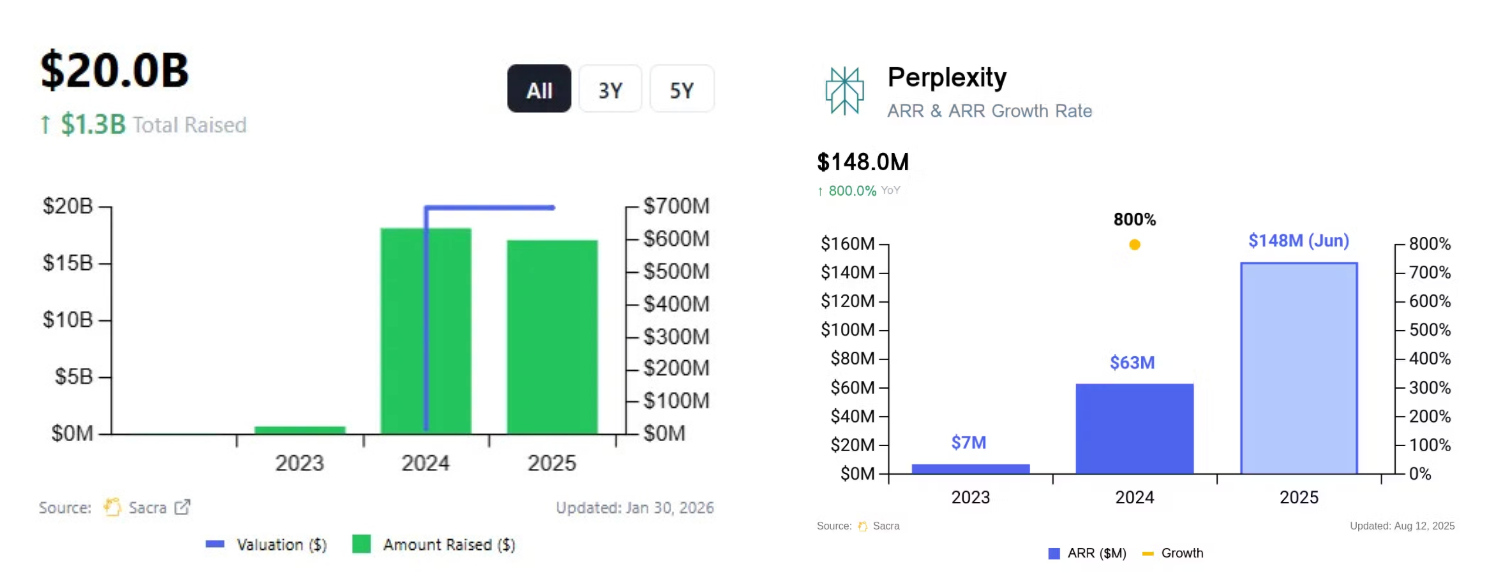
This product hit the timing just right. In less than two years, its valuation rose from 500 million dollars to 20 billion, raising over 1.5 billion dollars in total, with investors including NVIDIA, Bezos, and SoftBank. Its annual revenue increased from about 80 million at the end of 2024 to roughly 200 million now.
However, Perplexity has a characteristic that is also its biggest controversy: it does not create large models.
It orchestrates other people's models. Claude belongs to Anthropic, Gemini is Google's, and GPT is OpenAI’s. Perplexity acts as the middle layer—arranging these models, packaging them with its own product interface, and selling to users.
There is a term in the industry to describe such companies: shell company.
But looking at this term in 2026, its connotation has shifted. This year's largest AI acquisition involved Meta spending billions to buy Manus, which also used other people's models. OpenClaw boasts 140,000 stars on GitHub, yet relies on Claude or GPT's API at its core.
In the entire AI Agent space, hardly anyone is training their models from scratch. Everyone is using shells. The difference lies in how well the shell is made and how many people are willing to pay for it.
Perplexity's shell is currently priced at 200 dollars a month for its most expensive Max subscription tier.
In February of this year, it eliminated its advertising business and fully shifted to a subscription model, with executives stating that advertising would undermine user trust in search results. A shell company, betting entirely on product experience to entice users to pay, without relying on advertising subsidies.
Integrating this experience into the Mac mini is just the first step; future plans include expansion to more platforms.
The Contractor's Concerns
Shelling can be justifiable, provided that the underlying model vendors do not enter the same space.
Anthropic has released Cowork, Google is promoting Gemini Agents, and OpenAI's Operator follows the same direction. The owners of the models that Perplexity orchestrates are turning into its competitors.
This is akin to a contractor whose workers are all borrowed from other companies, now those companies say: we will also take on projects.
What's even more troubling are the legal implications surrounding the work.
Forbes, The New York Times, and Dow Jones have all sued Perplexity, accusing it of scraping copyrighted content. But these aren't the most serious allegations. Last week, Amazon obtained a temporary restraining order from a federal court, preventing Perplexity's Comet browser from automatically shopping for users on Amazon. The court’s conclusion was that Perplexity may have violated federal computer fraud laws.
What was the reason? When the Comet browser places orders on behalf of users, it does not inform Amazon that it is being operated by AI, rather than a real person.
Think about this matter in the context of its new Personal Computer: a company that has been ruled by the court to potentially impersonate humans using AI now wants you to open up your local files, emails, and calendar to it, operating 24/7.
There is another number that is not often discussed.
From February 2025 to February 2026, Perplexity's website traffic in the U.S. only increased by less than 4 million visitors. During the same period, Claude's web users quadrupled. Initially, it differentiated itself through AI search, but now ChatGPT, Gemini, and Claude can all do that.
I am not saying that Perplexity is doomed to fail.
Shelling out a 20 billion valuation is already an ability in itself. But the company is simultaneously engaged in search engines, browsers, email assistants, cloud agents, and local computer operating systems, facing direct competition from giants on every front...
However, the contractor's concern may not be about competition, but rather about when they will be acquired.
免责声明:本文章仅代表作者个人观点,不代表本平台的立场和观点。本文章仅供信息分享,不构成对任何人的任何投资建议。用户与作者之间的任何争议,与本平台无关。如网页中刊载的文章或图片涉及侵权,请提供相关的权利证明和身份证明发送邮件到support@aicoin.com,本平台相关工作人员将会进行核查。


