Author: Huobi Growth Academy
Abstract
The global financial market is undergoing a systemic reassessment triggered by geopolitical conflicts: the blockade of the Strait of Hormuz caused oil prices to surge by 30%, the increase narrowed after the G7 urgently released reserves, risks of stagflation replaced inflation as the core concern, the dollar became the "only safe haven" and approached the 100 mark, and stocks in Asia-Pacific and the U.S. experienced a "Black Monday" with a sharp decline; In the AI sector, there are extreme contrasts, the National Development and Reform Commission proposed a target of 10 trillion yuan by the end of the 14th Five-Year Plan, and the OpenClaw project has surged, driving speculative stocks skyrocketing; Bitcoin fell below the critical defense line of 70,000 dollars amidst the macro storm, with 75% of the volatility driven by macro factors, market sentiment is in extreme panic (Fear and Greed Index at 8), the proportion of put options is abnormally high, but ETFs still recorded a net inflow of 568 million dollars, with the long-short game focused on whether the "digital gold" narrative can be reborn amidst stagflation pressures.
1.Macroeconomic Abyss: The Specter of Stagflation and the Siphoning of the "Only Safe Haven"
The global financial market stands at a dangerous crossroads, with a perfect storm driven by geopolitics unfolding. The recently passed "Black Monday" is not an isolated correction but a profound reassessment of asset pricing logic. As the smoke of conflict in the Strait of Hormuz obscures the lifeline of global energy, market participants are terrified to find that the forgotten specter of "stagflation," cloaked in the garb of geopolitical conflict, is quietly returning.
The sharp decline of the Asia-Pacific stock market is merely an overture to this crisis. The plummet of the MSCI Asia-Pacific Index, along with the cliff-like drop of major stock indices in South Korea, Japan, and Taiwan, clearly outlines the extreme pessimism of capital regarding the economic outlook. This pessimism does not stem from short-term concerns about corporate profits but from the pre-pricing of a sustained global economic recession triggered by supply-side shocks. Energy is the blood of industry; when the blood faces the risk of a rupture, any economic body is inevitably numb or even necrotic. The simultaneous decline of U.S. stock futures, along with hedge funds accumulating short positions in ETFs at a rare speed over the past five years, confirms the global and institutional characteristics of this panic. Goldman Sachs strategist Ed Yardeni raised the probability of a U.S. stock market crash within the year to 35% and, unusually, listed the probability of a "stagflation" scenario separately, which itself serves as an alarm. The emergence of the "stagflation" option, beyond the "Roaring Twenties" (high growth, low inflation) and "collapse," signifies that the market is beginning to seriously consider a more destructive future: the coexistence of economic stagnation and inflation, which would completely destroy the theoretical foundation of the traditional 60/40 stock-bond investment portfolio.
In this extreme risk-averse sentiment, the flow of capital exhibits astonishing consistency: sell off all risk assets and flood into the dollar without regard for cost. The dollar index approaching the 100 mark is not primarily due to a robust U.S. economy, but because, at a time when the global credit system is wobbling, the dollar, as the world's primary reserve, payment, and pricing currency, has such depth of liquidity and the scale of the U.S. Treasury market makes it the only "deep sea" capable of accommodating massive safe-haven capital. Top global asset management companies like PIMCO have begun to hoard cash and prefer medium-term U.S. bonds, with Bloomberg strategists stating, "The dollar has become the only safe haven," marking a shift in market logic from "risk appetite" or "risk neutrality" to "risk aversion" or even "risk flight." The rise and fall of precious metals is particularly noteworthy. Spot gold briefly broke through the historic threshold of 5100 dollars but quickly fell back near 5000 dollars, revealing a harsh reality: on the edge of a liquidity crisis, even the ultimate safe-haven asset like gold may face pressure to liquidate profits to cover losses in other positions. The strength of the dollar is creating a powerful siphoning effect on non-dollar assets, including gold and Bitcoin. This macro tsunami triggered by geopolitics has ruthlessly shredded all psychological defenses of risk assets and swept digital assets like Bitcoin into the same vortex.
2.Oil Storm: Supply Cliff and the Frenzy of "On-Chain" Speculation
If macro sentiment is the market's "qi," then the abnormal shifts in oil prices are the "bones" that connect everything. The blockade of the Strait of Hormuz is not a mere supply interruption but a nuclear-level blow to the global energy order. The daily sudden loss of 20 million barrels of oil supply is a number that would make anyone who experienced the oil crisis of the 1970s shudder. It amounts to nearly 20% of global daily demand, and the magnitude of this supply disruption is comparable to any historical crisis, if not greater. The forced production cuts or even shutdowns of major oil-producing countries like Iraq, Kuwait, and the United Arab Emirates render the core production capacity of OPEC+ instantly scrap, and the elasticity of the global oil supply curve approaches zero.
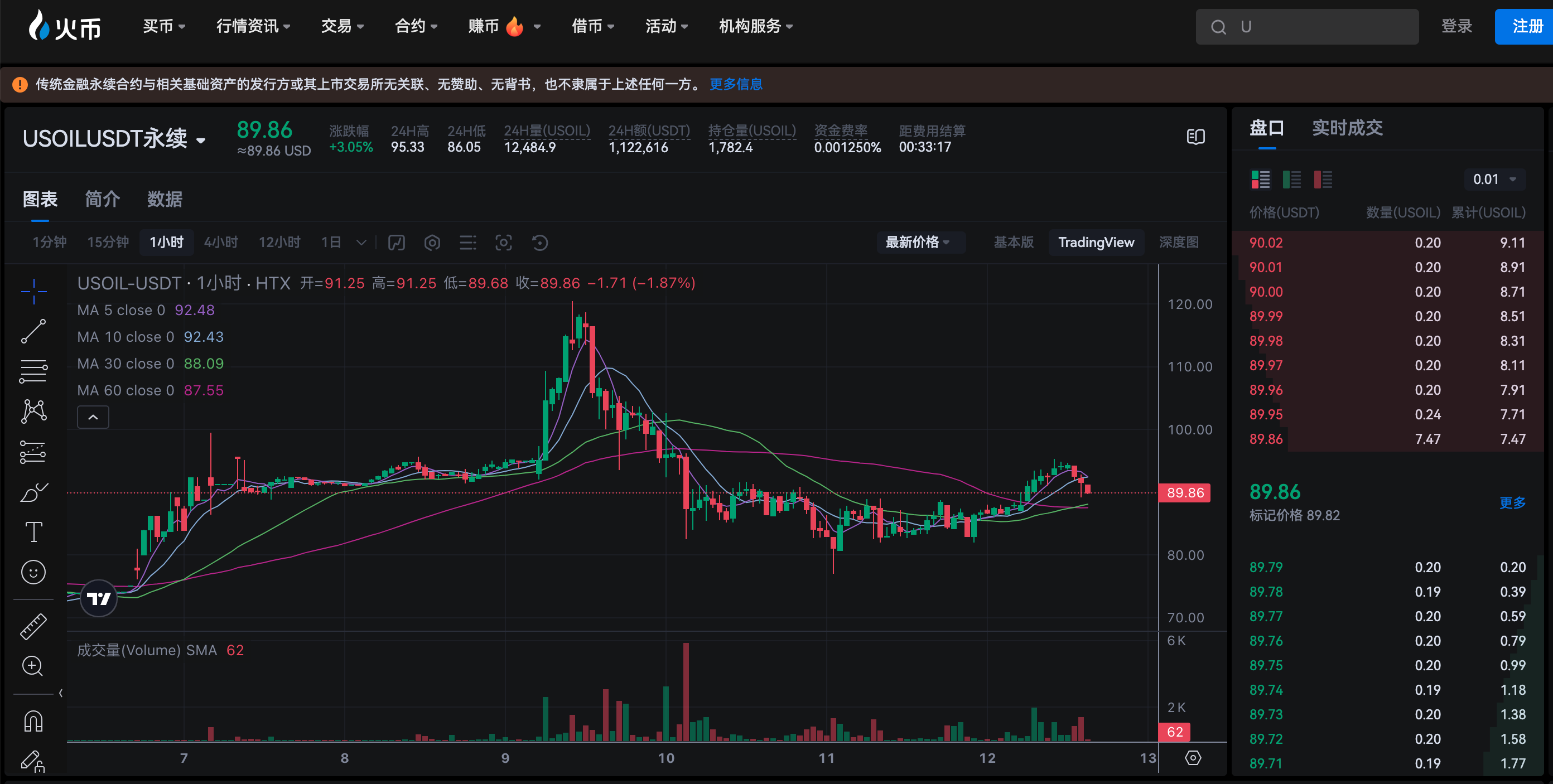
The market's initial reaction to this was extreme and violent. Oil prices surged by 30%, approaching 120 dollars per barrel; this momentary vertical rise reflects not an expectation for the future but an acute panic over the current "lack of available oil." Goldman Sachs warned that oil prices could break through the previous high of 140 dollars per barrel, with former traders bluntly stating, "There is practically no upper limit." In the context of extreme market conditions, these remarks are less about prediction than about an objective description of the potential for a non-linear market collapse. A rise exceeding 60% in seven trading days has pushed oil prices beyond the range of fundamental analysis into a purely geopolitical premium pricing model.
The G7 and the International Energy Agency (IEA) urgently discussed releasing strategic reserves, a necessary intervention in the market. The release of 300-400 million barrels, while appearing large, is but a drop in the bucket compared to the daily supply gap of 20 million barrels, with its effect more psychological, signaling to the market, "We are not sitting idly by." This successfully halved the oil price increase but merely pulled it back from "out-of-control madness" to "controllable madness." Former President Trump's statements about the "small cost" further highlight the cold reality that geopolitical objectives currently supersede economic stability, foretelling that the resolution of this energy crisis cannot be achieved merely through short-term oil releases.
This oil storm triggered by geopolitics has violently impacted the crypto world in an unexpected way. It is no longer a distant variable affecting the risk preference under macro narratives but has directly become the focus of speculation within the crypto market. The rise of on-chain oil trading is the most Web3-characteristic phenomenon in this crisis. The trading volume and prices of tokenized oil contracts (CL-USDC) on HyperLiquid soared, with nearly 40 million dollars of short positions being liquidated amidst the price surge, and Sky co-founder Rune even boldly spent 4 million USDC to go long with 20x leverage. This scene is a perfect replication of the traditional financial market's "spot short squeeze" in the decentralized derivatives market.
This phenomenon reveals several profound trends: first, the crypto market is no longer a closed casino; its derivatives market has begun to absorb and amplify the volatility of traditional assets. Second, in extreme market conditions, the 24/7 uninterrupted trading, permissionless access, and high leverage features of DeFi derivatives platforms showcase stronger flexibility and appeal than traditional exchanges. Finally, this has raised significant risk concerns. When the oil supply crisis in the real world combines with the on-chain virtual, highly leveraged speculation, once oil prices undergo a severe reversal or oracle data encounters issues, a chain reaction of liquidations could trigger "liquidity exhaustion" in the DeFi world, with destructive capacity potentially far exceeding that of traditional financial markets. On Polymarket, 76% of users bet that oil prices will reach 120 dollars by the end of the month, reflecting market expectations for oil prices and showcasing how crypto-native users participate in macro wagering through prediction markets. Crude oil, the blood of modern industry, is being injected into the capillaries of the crypto market in the form of "tokens," becoming another key variable determining its short-term fluctuations.
3.AI Tsunami: The Cold and Hot Beneath a Trillion-Dollar Tide
As traditional finance trembles due to the energy crisis, another torrent driven by technological innovation—Artificial Intelligence—transforms the narratives of capital markets and the strategic landscape of nations at an unprecedented speed. The National Development and Reform Commission's proposed target of exceeding 10 trillion yuan in AI industry scale by the end of the 14th Five-Year Plan, along with an investment plan exceeding 7 trillion directed toward "AI+" infrastructure, injects the strongest policy momentum into this field. This is no longer just conceptual speculation but a significant monetary investment in the industry. Data disclosed by the Ministry of Industry and Information Technology—core industry size exceeding 1.2 trillion, over 6200 companies, generative AI users surpassing 600 million—together outline a huge and rapidly growing real industry.
In this torrent, the popularity of the open-source agent project OpenClaw (little lobster) is a typical case of technological breakthroughs igniting market sentiment. Its GitHub stars surpass Linux, its founder has joined OpenAI, and NVIDIA's Jensen Huang has praised it; these halos combined are enough to ignite the imagination of any tech investor. The significance of OpenClaw lies in that it dramatically lowers the development and deployment threshold for AI agents. As Huang said, it will trigger a thousand-fold increase in Token consumption, ushering in an era of "computing power vacuum" that is nearly greedy for computation. This directly shifts the market focus from large model training to the more commercially viable AI agent track.

The rapid follow-up by giants like Tencent, as well as the swift launch of local government initiatives like "lobster ten measures" in Longgang District and Futian District in Shenzhen, perfectly exemplify the "top-down design - technological breakthrough - commercial application - policy support" acceleration path of Chinese-style innovation. The one-click deployment on both WeChat/QQ allows hundreds of millions of users to have zero-distance access to AI agents; the onboarding of government lobsters opens up the imaginative space for AI applications in public services. This top-down, dot-to-surface explosiveness is the fundamental driving force behind the surge of related concept stocks. The stock prices of companies like MiniMax, Ucloud, and Shunwang Technology skyrocketing reflect the market's optimistic expectations for the landing prospects of "AI+" in various industries. They are betting that OpenClaw will become the cornerstone of AI applications in the next decade, and any companies related to computation, deployment, or application development will share in this feast's cake.
However, amidst the frenzy, the high-risk warning issued by the Ministry of Industry and Information Technology acts as a splash of cold water, reminding rational thinkers within the market. The network security and information leakage risks triggered by OpenClaw's default configurations reveal the darker sides of rapidly spreading technologies. As millions of developers, enterprises, and government departments quickly deploy AI agents, the boundaries of cybersecurity will be infinitely blurred. An attacked "gov lobster" may pose threats far beyond that of a hacked server. The "double-edged sword" effect of AI becomes evident at this moment: it is a super engine for driving industrial upgrades, but it might also become Pandora's box for future cyberattacks and information leaks. For the capital market, this means that in the AI track, there's not only a need to focus on offensive targets like computation and applications but also significant investment opportunities lurking in defensive tracks like cybersecurity and data privacy. Investors need to make a sober trade-off between the "cold" risk awareness and the "hot" market sentiment.
4.Bitcoin Predicament: Crushed by the Macro Hand or Reborn from the Ashes?
When the "abyss" of macro markets gazes at all risk assets, when the oil "hurricane" stirs up a storm of speculation on-chain, and when the AI "tsunami" surges forth with trillions in capital, Bitcoin, once the "digital gold" and "safe-haven asset," finds itself in unprecedented embarrassment and predicament. Prices fell below the critical psychological defense line of 70,000 dollars and are struggling just above 65,000 dollars; this is not merely a price adjustment but a severe questioning of its core narrative.
Research data from NYDIG hits the mark: 75% of Bitcoin's recent volatility is driven by macro factors outside traditional stock indices. This means it is no longer purely digital gold, nor merely a tech stock; it has become a complex asset precisely "sniped" by geopolitical issues, inflation expectations, dollar liquidity, and other macro variables. Its synchronized rise with the U.S. software sector does not reflect "digital gold" properties but rather signifies that during capital flooding, all growth-type assets are bathed equally in the rain. When macro storms hit, safe-haven capital first opts for the dollar, while speculative funds flee risk assets, putting Bitcoin in a highly awkward pinch: it cannot provide the absolute liquidity safety of the dollar, nor does it possess the long-accumulated ultimate value storage consensus of gold.
Current market panic sentiment is obvious in the data. The Fear and Greed Index has dropped to 8 (extreme fear), and the options market is pricing urgently for extreme black swan events. The proportion of put option transactions is abnormally high, implied volatility (IV) has soared, and the skewness indicator has worsened drastically, all pointing to a strong expectation of imminent short-term drops. The logic of bears is clear and brutal: geopolitical conflicts raise oil prices, intensifying stagflation risk, leading to widespread deleveraging of risk assets, with Bitcoin being the first to bear the brunt. The breach of the 70,000 dollar mark and the fact that 75% of users on Polymarket are betting BTC will drop to 55,000 dollars indicate that market sentiment has completely tilted towards the bears.
However, the other side of the coin is a steadfast bullish belief. The logic of bulls is equally compelling. They believe that the current drop is merely a fierce washout within a macro bull market, a historical fractal of rebound following the deep drop of 2022. Key support levels (such as the 64k-65k area) still see strong buying interest, indicating that large funds are buying on dips. PlanB's S2F model continues to show that the current price is far below the cyclical average price (500,000 dollars); this ultimate faith based on code and mathematics supports a group of the most steadfast long-term holders. They perceive the current macro panic as noise and regard each drop as an excellent opportunity to accumulate more "digital sovereignty." The gap of 68.1k-68.2k left by the CME futures market also magnetically attracts a demand for technical rebounds.
Therefore, Bitcoin stands at a crossroads determining its fate. It may be utterly crushed by the macro "invisible hand," falling into a high-volatility, technology-correlated risk asset after the narrative of "digital gold" completely collapses, with its price being more deeply influenced by the Federal Reserve's interest rate policies, movements of the dollar index, and the intensity of global geopolitical conflicts. Alternatively, it could be reborn from the ashes in this pressure test. If it can prove its decentralized, borderless transfer value is rediscovered when the global payment system is threatened by sanctions and geopolitical fragmentation; if it can prove that when the fiat currency system reopens mass printing in response to stagflation, its total supply of 21 million coins will overcome all short-term fluctuations; then the current predicament will become its last trial before truly becoming "the ultimate safe-haven asset."
Furthermore, the continued net inflow of ETFs is the most eye-catching variable in this great test. The net inflow of 568 million dollars on March 9 sharply contrasts with the drop in price. This indicates that traditional capital has not fled but is accelerating its entry through compliant channels. They may not care about the short-term macro noise but are implementing an asset allocation strategy lasting several years or even decades. Their goal is to allocate a small portion of assets to "alternative assets" with low correlation to traditional markets to hedge against systemic risks in the fiat currency system. Hence, Bitcoin's future depends on this protracted game: one side involves macro traders using options and futures for high-frequency, high-leverage short-term attacks; the other side involves ETF investors performing long-term allocations through spot markets. In the short term, the winter of macro sentiment and the flames of the oil crisis will continue to test Bitcoin's narrative; but in the long run, the true game has just begun.
免责声明:本文章仅代表作者个人观点,不代表本平台的立场和观点。本文章仅供信息分享,不构成对任何人的任何投资建议。用户与作者之间的任何争议,与本平台无关。如网页中刊载的文章或图片涉及侵权,请提供相关的权利证明和身份证明发送邮件到support@aicoin.com,本平台相关工作人员将会进行核查。


