Source: Wall Street Journal
As the market focuses on geopolitical risks, a quietly spreading private credit crisis is accelerating within the U.S. financial system. Redemption waves, asset sell-offs, fund gates—this script was seen by investors in 2008.
This week, the world's largest asset management company, BlackRock, announced restrictions on investor redemptions for its $26 billion HPS Corporate Lending Fund (HLEND), becoming the most impactful signal to date.
Previously, Blackstone's private credit fund faced a record 7.9% redemption requests, while Blue Owl's stock price fell below its SPAC listing price.
Three private credit giants have sounded the alarm in succession; the gears of a vicious cycle have already engaged.
At the same time, Pacific Investment Management Company (PIMCO) warned in its latest client report that the direct lending industry is about to enter a "full default cycle," with stress testing being unavoidable. This judgment comes from long-time critics of private credit, whose weight cannot be ignored.
The spread of the private credit crisis is directly reflected in the stock price trends of related publicly listed companies. Blue Owl's stock price has fallen below the SPAC issuance price, and the valuations of private credit-related businesses of institutions like Blackstone and BlackRock are under pressure, leading the entire industry to face a systemic reassessment of investor confidence.
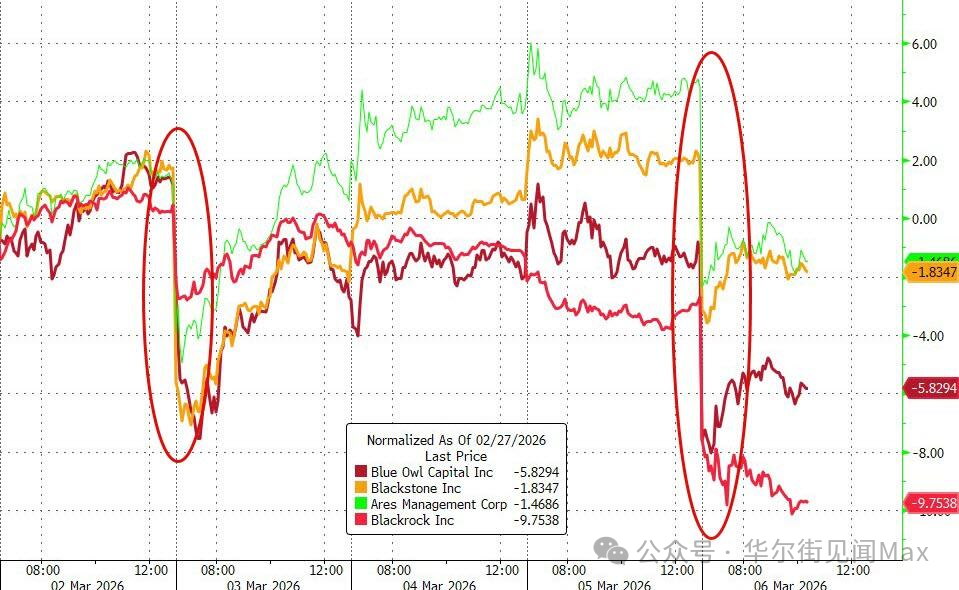
01 Fund Gates: BlackRock "Limits Redemptions" of its Private Credit Fund
According to an article in the Wall Street Journal, BlackRock announced on Friday that shareholders of its HPS Corporate Lending Fund (HLEND) collectively requested to redeem 9.3% of their shares, but the fund management decided to set the buyback limit at 5%, approximately $1.2 billion.
In its statement, BlackRock characterized this move as a "fundamental" arrangement for fund liquidity management, stating that without restrictions, there would be a "structural mismatch" between investors' capital and the duration of private credit loans.
This wording sounds calm, but the market understood its implications: if full redemptions are made, BlackRock would have to initiate a massive asset sell-off.
Previously, another private credit department under BlackRock had shown alarming signs—BlackRock TCP Capital Corp. in its fourth-quarter report wrote down the valuation of a $25 million loan to Infinite Commerce Holdings from $1 to zero, whereas just three months prior, the loan had been marked at par. From 100 to 0, in three months, with no warning.
02 Vicious Cycle: Sell-offs Triggered by Asset Disposals
BlackRock's fund gates are not an isolated event but the endpoint of a fuse that has already been lit—or a new starting point.
Three weeks ago, Blue Owl Capital took the lead.
Faced with a large number of redemption requests (mainly stemming from its heavy concentration in software loans, which are rapidly depreciating due to AI impacts), Blue Owl announced the sale of $1.4 billion in private credit loans to modernize its assets and restore its quarterly redemption mechanism, effectively freezing investor funds as well.
The company emphasized that the assets intended for sale are rated at the highest levels internally (level 1 or 2 in a five-level rating system).
However, this "priority sale of quality assets" strategy has accelerated the spread of the crisis. If secondary market buying is limited to high-quality assets, sales from the portfolios of other Business Development Companies (BDCs) will face thinner liquidity. It is reported that NMFC has stated it is moving forward with the sale of about $500 million of its portfolio (accounting for 17% of its total investments as of the end of Q3 2025).
Blackstone's situation is equally severe. Its private credit fund BCRED manages $82 billion, with redemption requests hitting a record 7.9% this quarter, exceeding the statutory limit of 7%. To avoid triggering the fund gate mechanism, Blackstone employees were asked to personally contribute $150 million to fill the gap.
Three institutions, three responses, but the logic is the same: fund gates or de facto fund gates, to avoid being forced to sell off assets that could trigger greater valuation collapses. Analysts point out that the very decision to impose fund gates by BlackRock has sent the strongest panic signal to the market, potentially triggering more investors to seek redemptions.
03 Blue Owl: Stock Price Falls Below Issuance Price, Risk Exposure Continues to Surface
As the "epicenter" of this crisis, Blue Owl Capital's situation continues to deteriorate. This week, its stock price fell below $10, the SPAC listing issuance price, hitting a three-year low.
According to Bloomberg citing insiders, Blue Owl has a £36 million (approximately $48 million) exposure to the London property loan firm Century Capital Partners Ltd.—this was indirectly formed through its 2024 acquisition of Atalaya Capital Management.
Century applied for bankruptcy management last month, with total liabilities of about £95 million, and NatWest Group and Hampshire Trust Bank are its priority creditors.
Blue Owl holds the highest-risk subordinated tranche of Century's loan portfolio. Century's manager RSM UK expects to fully recover the senior loans, but the fate of the subordinated share is another matter.
This event reveals another side of the private credit expansion period: asset-backed financing was once seen by industry leaders as a new frontier for growth, with executives from Pimco, Carlyle Group, Marathon, and Blackstone publicly optimistic about this sector. Now, the risks in this sector are surfacing in unexpected ways.
04 PIMCO Warns: Comprehensive Default Cycle is on the Way
As the private credit market whispers of danger, PIMCO analysts Lotfi Karoui and Gabriel Cazaubieilh issued the most direct warning to date in their latest client report. The two analysts wrote in the report:
"Like every mature segment of the leveraged finance market, direct lending will ultimately face a comprehensive default cycle—this cycle will simultaneously test its resilience to both industry-specific shocks and macroeconomic pressures."
PIMCO is one of the early critics of private credit. As the fundraising scale for direct lending strategies soared, the firm, managing about $2.3 trillion in assets, chose to position itself in the opposite direction, actively seeking potential issues among companies backed by private credit.
PIMCO's analysis pointed out several core risk factors:
First, the record fundraising scale after the 2008 financial crisis led to a continuous loosening of underwriting standards;
Second, the direct lending portfolio's high concentration exposure to the software industry will, under AI pressure, drag down relative performance;
Third, direct lending funds have long failed to provide sufficient risk premium compensation for investors' liquidity lock-up.
Regarding the liquidity dilemmas faced by BDC investors, PIMCO's wording was equally straightforward: "Semi-liquid does not equal fully liquid. Investors must assess their own liquidity needs and their tolerance for restricted funds."
However, PIMCO also differentiated between different segments within private credit, believing that subsectors like asset-backed financing still have investment value and can offer "investment-grade" risk levels. Last year, PIMCO raised over $7 billion for its asset-backed financing strategy.
05 Is a Subprime Crisis Repeating?
The structural logic of this crisis is not complicated: semi-liquid products promise quarterly redemptions, but the underlying assets are longer-duration private loans; when redemption requests exceed the threshold, managers either impose gates or sell off assets; sell-offs lower asset prices, triggering more valuation downward adjustments, thereby leading to more redemptions—thus forming a cycle.
This logic played out once in the subprime mortgage market of 2008. At that time, the initial crack also appeared in a market corner deemed "sufficiently diversified and sufficiently professional."
Now, the private credit market has reached a scale of $1.8 trillion, and the concentration of risks, valuation opacities, and liquidity mismatches are being tested in a similar manner.
免责声明:本文章仅代表作者个人观点,不代表本平台的立场和观点。本文章仅供信息分享,不构成对任何人的任何投资建议。用户与作者之间的任何争议,与本平台无关。如网页中刊载的文章或图片涉及侵权,请提供相关的权利证明和身份证明发送邮件到support@aicoin.com,本平台相关工作人员将会进行核查。


