According to a report by PCMag, Redmond-based space technology and artificial intelligence (AI) infrastructure company Starcloud is advancing plans to place data centers in low-Earth orbit, a move designed to harness continuous solar energy and the natural cooling properties of space while also teasing the possibility of mining bitcoin beyond Earth’s atmosphere.
The company first proved its concept in November 2025 when it launched Starcloud-1 aboard a SpaceX Falcon 9 rocket. The small, refrigerator-sized satellite carried five Nvidia H100 processors, marking the first time data-center-grade GPUs operated in orbit.
During that mission, Starcloud successfully trained a small large language model in space and ran inference from a version of Google Gemini. The test demonstrated that powerful computing workloads—traditionally housed in massive terrestrial facilities—can function in the vacuum of space.
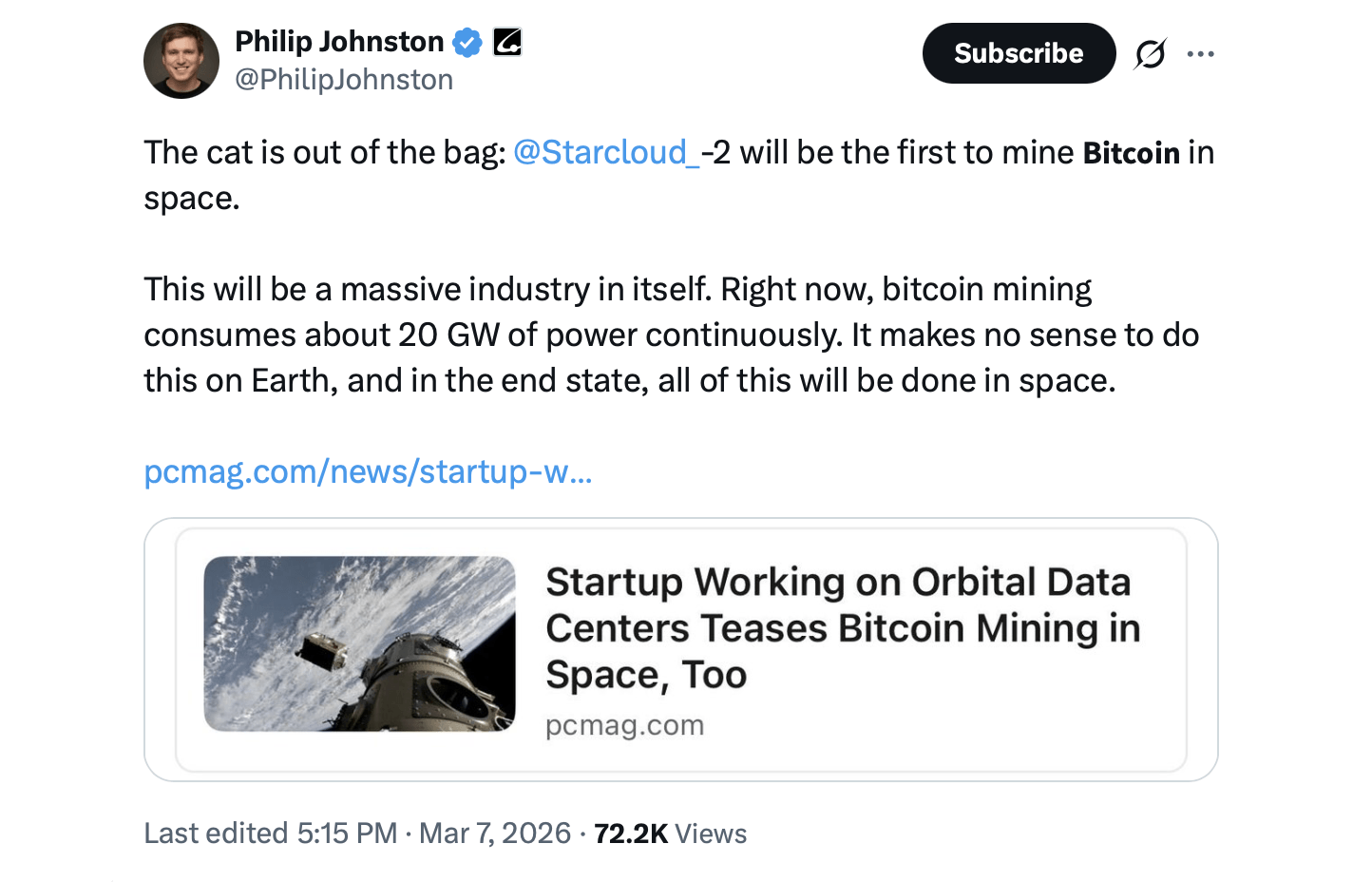
Image source: X
Now the company is preparing a larger follow-up satellite. CEO Philip Johnston said Starcloud-2, expected to launch later in 2026, will carry a much larger GPU cluster along with specialized bitcoin-mining hardware known as ASICs (Application-Specific Integrated Circuits).
“There’s also bitcoin mining… We’ll have some bitcoin mining ASICs on the second spacecraft launching later this year,” Johnston said during the PCMag interview. “We think we’ll be the first to mine a coin in space.”
The concept relies on two advantages unique to orbit. Satellites positioned in sun-synchronous trajectories can receive nearly constant sunlight, eliminating night cycles and most weather disruptions that affect solar power on Earth. At the same time, the vacuum of space acts as a massive heat sink, allowing radiators to release waste heat directly into space without water-intensive cooling systems.
Starcloud argues these conditions could dramatically lower energy costs. The company estimates orbital data centers could operate with energy costs roughly 10 times lower than traditional facilities while also delivering similar reductions in lifetime carbon emissions.
To support that vision, the startup has filed paperwork with the Federal Communications Commission (FCC) seeking approval for a constellation of as many as 88,000 satellites dedicated to orbital computing infrastructure. Johnston has outlined a long-term goal of constructing a 5-gigawatt orbital data center supported by massive solar arrays stretching several kilometers.
Bitcoin mining is being framed as an early test case for the energy model. Mining hardware is far cheaper than high-end AI processors and can monetize excess power generated by orbital solar arrays.
ASIC mining machines often cost hundreds or a few thousand dollars per unit, compared with tens of thousands for advanced AI GPUs. Because mining primarily converts electricity into cryptographic computations, the availability of constant solar energy makes it a natural fit for off-planet power generation.
The idea of mining bitcoin in space has circulated for years, but Starcloud’s plan represents one of the first publicly disclosed hardware deployments aimed at proving the concept. Another startup, Intercosmic Energy, has proposed a roadmap for orbital mining systems powered by solar energy, though it has not yet launched operational hardware.
Falling launch costs are helping revive interest in the concept. Modern rockets are steadily reducing the cost per kilogram of payload delivered to orbit, making it more feasible to deploy computing hardware and large solar arrays above Earth.
At the same time, improvements in mining hardware efficiency have slowed compared with earlier years. That longer replacement cycle means ASICs could remain useful for longer periods, potentially improving the economics of running them in space.
Despite the excitement, the approach faces significant hurdles. Space hardware must survive radiation exposure, temperature swings, and potential collisions with debris. Satellite reliability also remains a concern—one of Starcloud-1’s GPUs reportedly failed before launch.
Regulators and environmental groups are also watching closely. Large constellations raise questions about orbital congestion and the risk of cascading debris events, sometimes referred to as the Kessler syndrome.
Even within the technology sector, some observers remain skeptical about near-term feasibility. Critics argue that maintaining high-performance computing systems in orbit introduces logistical challenges that could outweigh the energy benefits, at least in the early years.
Still, interest in orbital computing is spreading quickly. Companies including SpaceX, Blue Origin, and Axiom Space have all outlined plans involving orbital infrastructure that could support computing workloads.
Market forecasts suggest orbital data-center services could grow rapidly over the next decade, potentially reaching tens of billions of dollars as satellite manufacturing and launch technology mature.
For Starcloud, bitcoin mining is less a destination than a demonstration. By running ASICs alongside AI hardware, the company hopes to show that constant solar power in orbit can support both emerging AI workloads and energy-intensive crypto operations.
If the Starcloud-2 mission succeeds later this year, the first bitcoin mined in space may arrive sooner than many expected—marking another milestone in the expanding intersection of space technology and digital infrastructure.
- What is Starcloud?
Starcloud is a Washington-based startup developing data centers in low-Earth orbit powered by solar energy. - Is bitcoin mining actually happening in space?
Starcloud says its Starcloud-2 satellite launching in 2026 will carry ASIC hardware designed to mine bitcoin. - Why mine bitcoin in space?
Constant solar energy and vacuum cooling could make orbital computing far cheaper and more energy efficient. - When could the first bitcoin be mined in orbit?
If the Starcloud-2 mission succeeds, the first space-mined bitcoin could occur as early as late 2026.
免责声明:本文章仅代表作者个人观点,不代表本平台的立场和观点。本文章仅供信息分享,不构成对任何人的任何投资建议。用户与作者之间的任何争议,与本平台无关。如网页中刊载的文章或图片涉及侵权,请提供相关的权利证明和身份证明发送邮件到support@aicoin.com,本平台相关工作人员将会进行核查。


