Brazil is taking measures to tighten its grip on rising volumes of crypto outflows, especially those involving stablecoins, by imposing penalties on undeclared cryptocurrency transactions.
Bill 746/2026, introduced by Federal Deputy Tabata Amaral, explicitly defines the crime of cryptocurrency tax evasion, getting stablecoin exchanges outside a gray zone classified as a loophole by some regulators and government officials.
The crime of foreign currency tax evasion is defined in Brazilian regulation as “carrying out an unauthorized exchange operation, with the purpose of promoting the evasion of foreign currency from the country.”
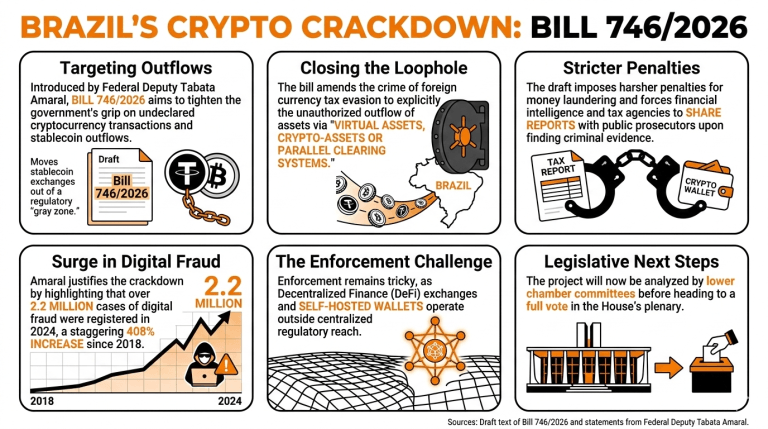
The new bill proposes to amend part of this definition, including a new paragraph that extends this crime to “anyone who, in any capacity, promotes, without legal authorization, the outflow of currency or foreign exchange abroad, or maintains undeclared deposits abroad, including through the use of virtual assets, crypto-assets or parallel clearing systems.”
The draft also imposes harsher penalties for money laundering involving crypto assets, forcing financial intelligence units and tax agencies to share reports with the public prosecution if they identify criminal evidence.
Amaral justifies these changes by stating that economic crime is transforming in Brazil, highlighting that during the last decade, crime has migrated to include digital and crypto assets, partnering with corporate structures to obfuscate money laundering and tax evasion crimes.
Over 2.2 million cases of digital fraud were registered in 2024, an increase of 408% since 2018. Amaral states that this growth has been “fueled by the feeling of anonymity and the difficulty of tracking virtual assets.”
As with other measures targeting crypto assets, its degree of applicability will be key, as decentralized finance exchanges and self-hosted wallets might be outside regulatory reach, given that they are not managed by centralized authorities that could deliver information about their owners.
The project will now be analyzed by the committees in the lower chamber. If approved, it will be directed for a full vote in the House’s plenary.
- What measures is Brazil taking to address crypto outflows?
Brazil is introducing Bill 746/2026 to impose penalties on undeclared cryptocurrency transactions, particularly focusing on stablecoins. - What does Bill 746/2026 define as tax evasion?
The bill specifies that crypto tax evasion includes unauthorized exchange operations aimed at evading foreign currency regulations, extending this to virtual assets. - What penalties does the new bill propose?
It introduces harsher penalties for money laundering involving crypto assets and mandates financial intelligence units to report findings to public prosecution. - Why are these regulations necessary, according to Deputy Amaral?
Amaral highlights a significant rise in digital fraud, with over 2.2 million cases reported in 2024, driven by the anonymity of virtual assets and their growing use in economic crimes.
免责声明:本文章仅代表作者个人观点,不代表本平台的立场和观点。本文章仅供信息分享,不构成对任何人的任何投资建议。用户与作者之间的任何争议,与本平台无关。如网页中刊载的文章或图片涉及侵权,请提供相关的权利证明和身份证明发送邮件到support@aicoin.com,本平台相关工作人员将会进行核查。


