Does the exchange manipulate BTC? Breaking down the AP system to understand the pricing power game behind the ETF subscription and redemption mechanism.

CN
Tyler
Follow
7 hours ago

It is not a question of a specific "villain," but rather that every AP has the ability to influence BTC liquidity through the redemption mechanism.

Written by: Eddie Xin, Chief Analyst of OSL Group

"They were fcking us the whole time."

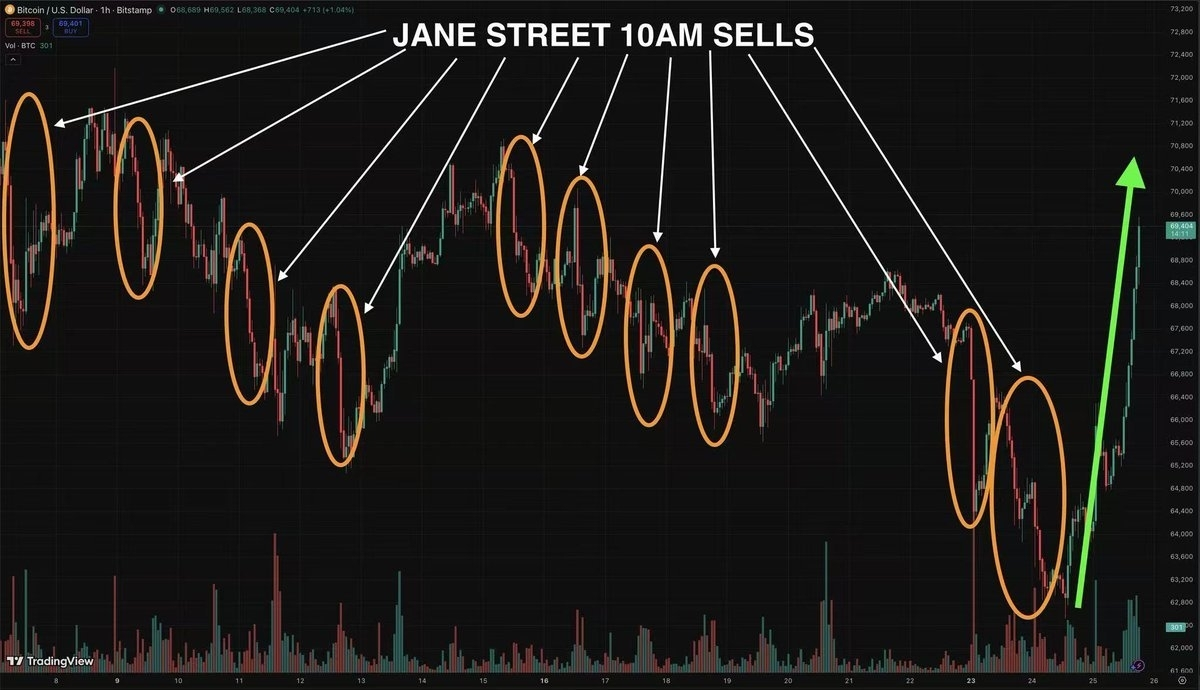
This phrase, which circulated on Reddit and Crypto Twitter after the lawsuit, coincided with an epic short squeeze with a liquidation scale exceeding $240 billion, directing the market's anger towards a single target: Jane Street Capital.

At 10 AM, the liquidity freeze in the Asian market over the past few months was finally revealed to be just the tip of the iceberg with the announcement from the U.S. Department of Justice. This matter stems from Jane Street Capital, a top Wall Street market maker founded in 2000, which has been accused of utilizing the redemption mechanism of spot ETFs to conduct a long-term "sleight of hand" between the spot and derivatives markets through directed arbitrage.

Until this lawsuit brought the controversy into public view, discussions around the ETF arbitrage mechanism and price discovery structure quickly heated up, resulting in a sharp market rebound and an epic short squeeze exceeding $240 billion in liquidation.

But is Jane Street really the culprit pressing the suppression button? This is a question worth at least $1 billion.

1. Did Jane Street really suppress BTC prices?

This question deserves an accurate answer, with the first and most important point to understand being that this is not just a question about Jane Street.

It is a question about the structural characteristics of Bitcoin ETF architecture, which equally applies to every Authorized Participant (AP) in the ecosystem. Just considering BlackRock's IBIT, this list includes Jane Street Capital, JPMorgan, Macquarie, Virtu Americas, Goldman Sachs, Citadel Securities, Citigroup, UBS, and the Dutch Bank.

The role of these institutions has indeed been deeply misunderstood by the public, even among experienced industry veterans, and this misunderstanding is worth correcting before drawing any conclusions.

Regarding APs, it is important to understand that they occupy a marginal exception within the Reg SHO (U.S. SEC's naked short sale regulation) framework. For example, Reg SHO requires short sellers to first borrow shares before shorting, but APs are exempt due to their contractual rights in the subscription and redemption process.

While this may sound procedural, the actual consequences are significant, indicating that any AP can freely create shares - without borrowing costs, without the capital tied to traditional short selling in the conventional sense, and with no hard deadlines for closing positions beyond commercially reasonable timeframes.

This is the gray area: a regulatory exemption designed for orderly ETF market making, which, structurally, is indistinguishable from regulatory arbitrage with an incomparable duration. This exemption is not unique to any single company. It is a prerequisite for becoming an AP club member.

2. What does this AP exemption mean?

Typically, if IBIT's trading price is below its net asset value (NAV), one would expect arbitrage buyers to step in, redeeming shares for Bitcoin and leveling the price difference. However, any AP is itself that arbitrage buyer; they control the pipeline, meaning their motivation to close that price difference is different from a third-party trading desk without redeeming rights.

It sounds complex, but this can be understood more easily through a simple analogy:

First Level: What is normal "closing the price difference"?

Imagine there is a blind box on the market (this is the IBIT ETF), and everyone knows that inside the blind box is a voucher for a real Bitcoin worth $100 (this is the net asset value or NAV). But today, due to panic in the market, the blind box is priced at $95.

Using normal logic, a savvy businessman (an arbitrage buyer) would surely rush to spend $95 to buy the blind box and then go to the official to exchange it for the $100 Bitcoin, earning a $5 profit easily.

Moreover, everyone's rush to buy the blind box to arbitrage would quickly push the price of the blind box back up to $100. This is called "closing the price difference."

Second Level: AP with "monopolized access"

However, in the real world of Bitcoin ETFs, ordinary trading firms and retail investors do not qualify to go to the official "unbox" (that is, do not have redeeming rights). The entire market only has a few privileged Wall Street investment banks (APs) that can do this, meaning that APs monopolize the only channel to convert ETFs into real Bitcoin (they control the pipeline).

Third Level: Why don't APs play by the arbitrage rules?

If it were a regular third-party trader seeing this $5 risk-free price difference, they would immediately take action. But APs are different; they calculate a more clever equation: "Since only I can unbox the blind box, why should I be in a hurry? If I deliberately keep the price from returning to $100 and instead take advantage of the current undervalued price of $95 to short or long in another casino (like the Bitcoin futures market), I might earn $20!"

In summary: There is an automatic error-correcting mechanism in the market (when prices drop too much, someone will buy to arbitrage the price up), but because the "only switch" for executing this error-correcting mechanism is in the hands of APs, and APs find that "not correcting, maintaining the price difference" allows them to earn more elsewhere, they have no motivation to pull prices back to normal levels.

Retail investors are waiting for the arbitrage army to rescue prices, unaware that the only arbitrage army (APs) is next to them, utilizing this price difference to profit in other markets.

3. The issue is not with Jane Street, but with the AP structure

The short risk exposure of IBIT can theoretically be hedged by going long on Bitcoin spot, but this is not mandatory as long as the chosen tool maintains a close correlation.

An obvious alternative is BTC futures, especially considering their capital efficiency. This actually means that if the hedging tool is futures rather than spots, then the spots were never bought, and since natural arbitrage buyers opt not to buy spots, this price difference cannot be closed through the natural arbitrage mechanism.

It is worth noting that the spot/futures basis itself is a theme for the entire basis trader community, which is dedicated to maintaining the closeness of this relationship. However, each separation between the hedging tool and the underlying asset introduces an impure basis risk, which accumulates throughout the entire structure - and under pressure, this basis risk is precisely where market misalignment occurs.

The final piece of the puzzle involves the SEC’s recent approval of physical subscriptions and redemptions (in-kind creation and redemption). Under the previous pure cash system, APs were required to deliver cash to the fund, and then custodians used that cash to purchase Bitcoin spot, a purchase action that served as a structural regulator — it enforced the buying of the spot as a mechanical consequence of the subscription.

In-kind redemption completely eliminates this requirement, allowing any AP to deliver Bitcoin directly, with the timing and counterparties of their acquisition chosen at their discretion: OTC desks, negotiated pricing, minimizing market impact.

The broadest interpretation of this flexibility is that APs can maintain derivative positions, aiming to earn funding rates or volatility profits in the window between establishing the short sale and completing the physical delivery — while ensuring that each individual step still conforms to the definition of legitimate AP activity.

And this is precisely the crux of the issue; it may appear normal as market-making behavior at the start, and may seem normal as market-making behavior at the end, but it is the middle process that is difficult to classify clearly. This is not an accusation against any single company. Every AP on the IBIT list, and by extension, every AP of every Bitcoin ETF, operates within the same structural framework, enjoys the same exemptions, and therefore possesses the same theoretical capabilities. Whether any of them exercised this capability in a manner that treads the line of collusion is entirely within the realm of the "monitoring sharing agreement" required by the SEC at the time of ETF approval.

Whether these agreements are sufficient to capture behavior that simultaneously spans the spot, futures, and ETF markets (even including cross offshore trading venues) remains a genuinely unresolved question.

In short, Jane Street has merely been thrust into the spotlight; the real problem lies buried deep within the underlying architecture of Bitcoin ETFs designed by Wall Street veterans. No AP is explicitly suppressing Bitcoin prices; what the AP structure can suppress is the integrity of the price discovery mechanism itself, which could be far more impactful than the former.

Thus, the truly worthy question to ask is not whether a specific company is the villain, but whether a regulatory framework established for 20th-century traditional finance is suitable for custodianship of a 21st-century emerging asset whose value relies on not being controlled by regulatory authorities?

This may be the tuition fee that the crypto market must pay to enter the "large institutional era." After all, while we crave the liquidity irrigation of Wall Street, we do not wish to passively accept their black-box games constructed using regulatory exemptions.

This is not just about the answer regarding Jane Street; it is the ultimate inquiry about the era of Bitcoin ETFs.

免责声明:本文章仅代表作者个人观点,不代表本平台的立场和观点。本文章仅供信息分享,不构成对任何人的任何投资建议。用户与作者之间的任何争议,与本平台无关。如网页中刊载的文章或图片涉及侵权,请提供相关的权利证明和身份证明发送邮件到support@aicoin.com,本平台相关工作人员将会进行核查。

Share To
APP

X

Telegram

Facebook

Reddit

CopyLink