Author: Curry, Shenchao TechFlow
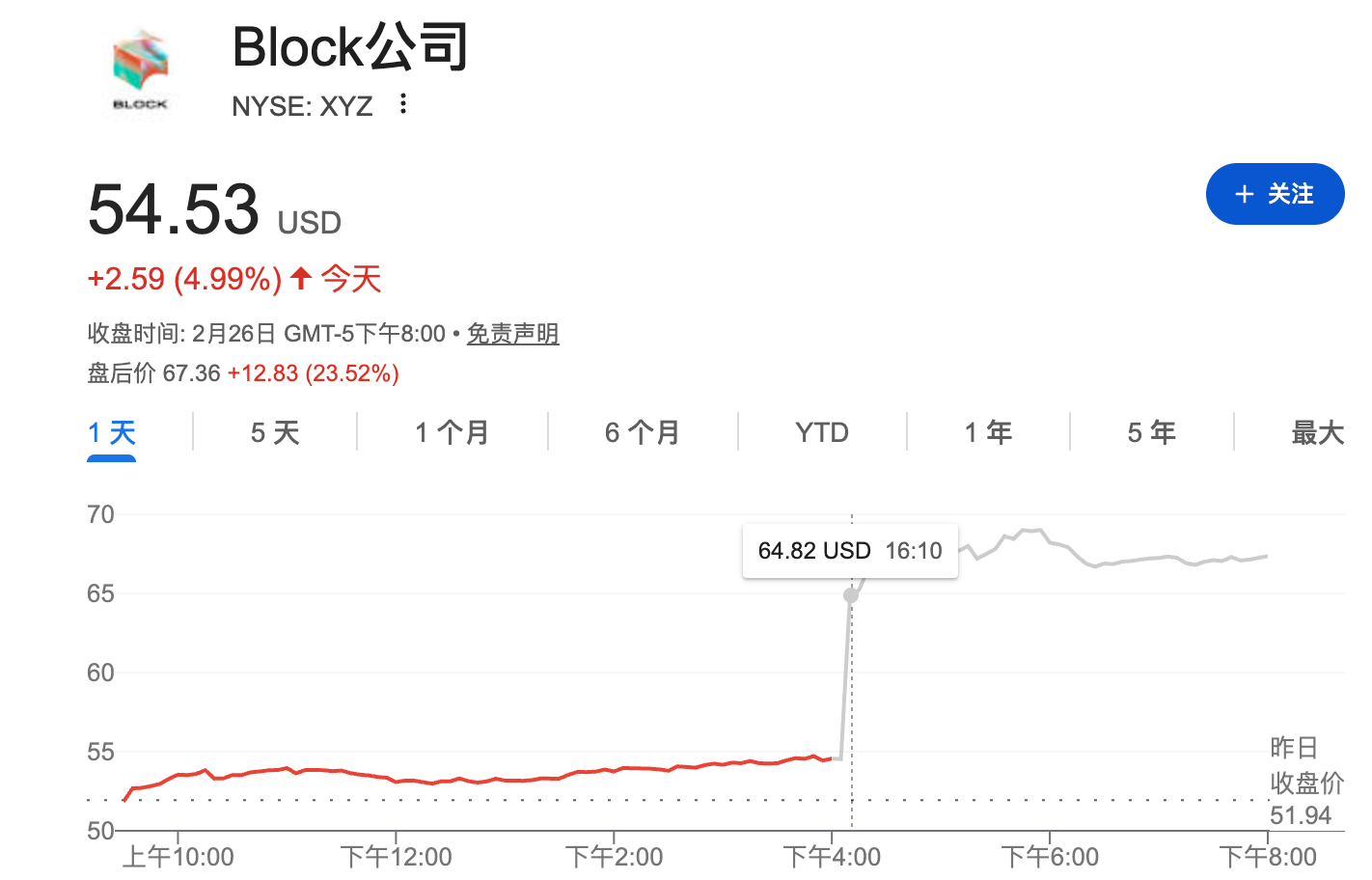
Last night, after-hours trading in the US saw a company called Block's stock price surge by 25%.
It wasn't because they released a new product, nor because they landed a big client. It was because the CEO announced layoffs affecting nearly half of the employees.
From over 10,000 people down to less than 6,000. More than 4,000 people left.
As soon as the news broke, investors cast their votes with real dollars. The closing price was $54, and in after-hours trading, it jumped directly to $67. In one night, Block's market value increased by nearly $3 billion.
Laid off 4,000 people, and gained $3 billion in market value.
By those calculations, each laid-off person was worth $750,000.
The name Block may not be familiar to many, but you have likely seen its products.
Square, that small white card reader used on American streets, is for small merchants to accept payments. Cash App, used by young Americans for transferring money, is somewhat like the American version of Alipay.
The company projects revenue of $24.2 billion for the full year of 2025, with gross profit exceeding $10 billion, and it is a financial technology giant listed on Nasdaq.
Its CEO is named Jack Dorsey. You may not have heard this name, but you definitely know about another thing he did—he is a co-founder of Twitter. He founded Twitter in 2006, served as CEO twice, and resigned in 2021.
A year later, his friend Musk bought Twitter and renamed it X.
Now, Dorsey is focusing all his energy on Block. He is also an extreme Bitcoin advocate, with Bitcoin on Block's balance sheet, and the company has invested in Bitcoin mining and self-custody tools.
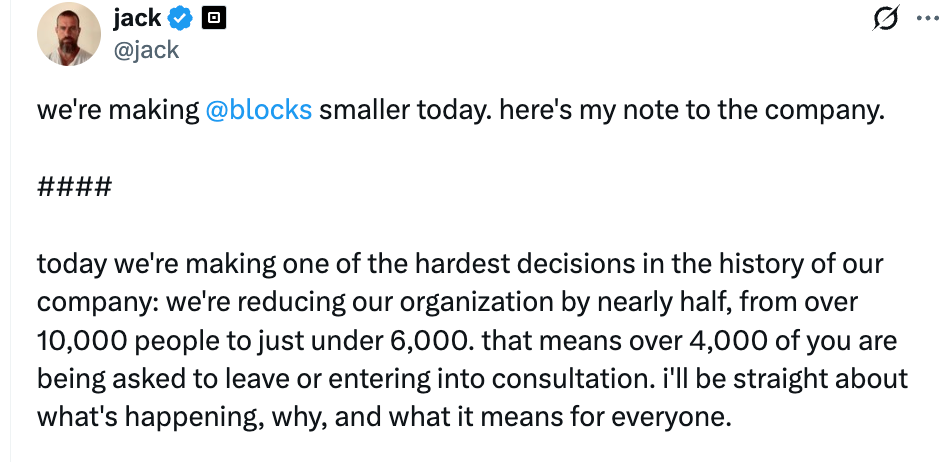
Most CEOs use similar rhetoric when it comes to layoffs.
Strategic adjustments, optimizing organizations, focusing on core businesses. Translated into plain language, it means you are laid off, but I don't want to say it too harshly.
Dorsey didn't do that.
In his letter to shareholders, he wrote directly: intelligence tools have changed the way we build and operate a company; a smaller team, using the tools we are building, can achieve more and do it better. And the capabilities of these tools are getting stronger every week.
To translate: AI can do your job, and is getting better at it.
He didn't even use the term "AI"; it sounds less harsh this way.
However, he added on X: he could have chosen to lay off slowly, cutting a batch every few months, dragging it out for years. But he believed that repeated layoffs destroy morale, so it was better to do it all at once.
"I would rather make a difficult but clear decision now, than slowly reduce numbers toward the same outcome."
This may be the first CEO during the AI boom who gives no excuses for layoffs. He doesn't blame the industry cycle, the macro environment, or strategic mistakes. He just states plainly: tools are better than people.
It’s hard to say he isn't sincere. But this kind of sincerity is more uncomfortable than the usual platitudes.
We also checked the changes in employee numbers at Block.
Public data shows that by the end of 2019, Block had a total of 3,835 employees. Then the pandemic hit, online payments surged, and Cash App users skyrocketed, leading the company to go on a hiring spree. By the end of 2025, the number reached 10,205.
In six years, it nearly tripled.
Now it’s back down to 6,000.
This means that the more than 6,000 new hires made during the pandemic, after a few years of work, are now all classified as "replaceable by intelligence tools."
Block is not an isolated case. During those pandemic years, nearly all tech companies were scrambling for talent. Meta doubled its staff in two years, then began three rounds of layoffs starting in 2022. Amazon and Google have gone through similar expansions and contractions.
But Block's situation is somewhat different this time. Other companies may find some other reasons for layoffs, while Dorsey pinned the blame directly on AI.
His public letter contained another statement:
I don't think we acted too early; I think most companies acted too late. Within a year, most companies will reach this same conclusion and make similar adjustments.
Moreover, his approach brings to mind someone else.
In October 2022, Musk spent $44 billion to buy Twitter, and within the first week laid off about 3,700 people, almost half the staff.
At that time, the entire Silicon Valley thought he was crazy. Advertisers left, the system crashed regularly, and public opinion overwhelmingly criticized him. Twitter's valuation shrank from $44 billion to less than $20 billion under his management.
Dorsey watched it all unfold. He not only co-founded Twitter, but he also publicly supported Musk's acquisition. The two have a good relationship.
Three years later, Dorsey did almost the same thing at his own company.
He laid off nearly half of the staff all at once, without dragging it out. Even the management methods were borrowed:
Musk required federal employees to report five major achievements via email each week at DOGE; Dorsey requires Block employees to send him an email listing five work results weekly.
Then, he uses AI to summarize these emails.
The difference lies in the results. After Musk cut Twitter, the market viewed him as destructive. After Dorsey cut Block, the market sees him as leading the future. The same action resulted in a loss of over $20 billion in valuation for one, while the other gained $3 billion in market value.
What accounts for the difference?
Dorsey did two more things. First, he paired his actions with a visually appealing earnings report: Q4 gross profit increased by 24%, Cash App's gross profit rose by 33%, and the 2026 profit guidance exceeded analysts' expectations. Second, he presented the layoff as today's best narrative:
It’s not a layoff; it’s an AI transformation.
In fact, before last night’s sweeping cuts, Block had been in turmoil for several weeks.
At the beginning of February this year, the company first initiated a round of layoffs, cutting about 10% of the workforce, around 1,100 positions. Meanwhile, Dorsey issued a directive: all employees must use AI tools in their daily work.
According to Wired, some employees expressed dissatisfaction internally: "If this tool is really so useful, we would have used it ourselves long ago."
Then there came the weekly email system. Everyone was required to send Dorsey an email each week, listing their five most recent work achievements. Dorsey used AI to summarize these emails.
Consider this process: you are asked to prove your value to the CEO every week, while the CEO may not even read what you wrote personally.
According to Wired, during an all-hands meeting, one employee directly stated: "This is my lowest morale moment in four years; the entire company's culture is collapsing." Another person said they were unsure if they would still have a job next week and could not make any life plans.
Dorsey's response at the meeting was: some of you have been slacking off.
On one side, employees are saying they don’t know if they will be here tomorrow, while the CEO says some of you have been slacking off. This dialogue took place in the same meeting room.
Block is not the first, and it won’t be the last.
This year, Shopify's CEO told employees that if they wanted to apply to hire more people, they first had to prove that AI couldn’t do the job. Klarna's CEO publicly celebrated that AI replaced 700 customer service positions. An internal memo from Amazon stated that the company needs "fewer layers" because AI is "the most transformative technology since the internet"...
But these companies somewhat mask their layoffs, packaging them as "efficiency improvements" or "organizational upgrades." Dorsey is the first to completely shatter the window paper—it's that AI can do your job, and the capital markets rewarded him with a 25% increase.
That’s the most frightening part.
CEOs now know: publicly stating "I replaced half of the staff with AI" will not lead to punishment; instead, it will be rewarded.
Lastly, after reading Dorsey’s shareholder letter and the full text on X last night, I had a feeling: this person is indeed not lying.
The company’s performance is good; he isn’t pretending to be suffering. The reason for the layoffs is AI; he did not seek other excuses. The severance package included 20 weeks of salary plus one week for each year worked, along with 6 months of health insurance and a $5,000 relocation fee, which is indeed more dignified than many companies provide.
He even arranged a live video broadcast to personally thank those being laid off. He himself said that this might come off as awkward.
We have reason to believe he is sincere.
But sincerity does not change anything. Those 4,000 people will still wake up tomorrow without a job, while Dorsey will wake up to a more valuable company.
There is a detail here worth noting for all workers.
Those employees at Block who were laid off were required to use AI every day in the past few weeks and to send weekly emails to the CEO to prove their value. They complied. Then they might still be laid off.
This means that being able to use AI does not guarantee your safety, nor does proving your value. When a company decides to do the same work with fewer people, your efforts only make that conclusion come sooner.
Dorsey said that most companies will do the same within a year.
I don't know if he is right, but one thing is certain:
When your boss starts to seriously investigate how many people AI can replace, you better also think seriously about whether your only source of income is this one salary.
免责声明:本文章仅代表作者个人观点,不代表本平台的立场和观点。本文章仅供信息分享,不构成对任何人的任何投资建议。用户与作者之间的任何争议,与本平台无关。如网页中刊载的文章或图片涉及侵权,请提供相关的权利证明和身份证明发送邮件到support@aicoin.com,本平台相关工作人员将会进行核查。


