At 12:15 p.m. on Jan. 31, BTC is trading at $78,993 on Bitstamp, extending a sharp intraday selloff that has pushed price to the lower end of the recent range. The decline followed repeated failures to hold above the low-$80,000s, with the latest hourly candles accelerating lower into the session low near $78,107. Price action reflects heavy downside momentum, with sellers maintaining control as price breaks beneath multiple short-term reference levels.
From a short-term structure standpoint, BTC has shifted decisively from consolidation into downside continuation. After spending much of the prior sessions rotating beneath resistance near $83,000, price rolled over sharply and sliced through interim support around $80,137. The breakdown was marked by a sequence of large red hourly candles that carried price from the $82,000–$83,000 area down toward the upper $78,000s in a compressed window. Volume expanded during this move and remained elevated as price pressed below $80,000, reinforcing that the decline was driven by active selling rather than a low- liquidity drift.
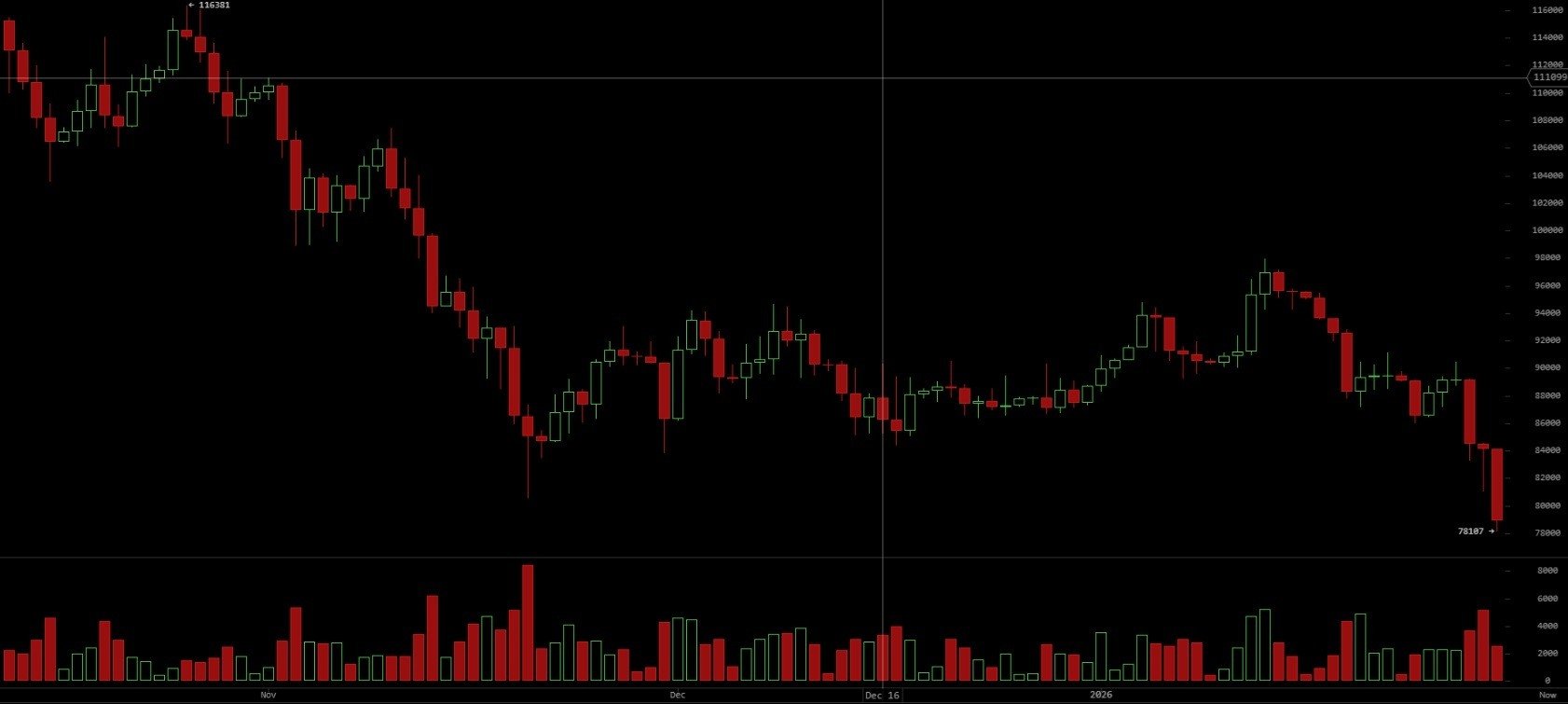
BTC/USD 1-day chart via Bitstamp on Jan. 31, 2026.
The sharp downside move is unfolding alongside a convergence of macroeconomic and institutional pressures that have rattled broader risk sentiment. The U.S. entered a partial government shutdown at midnight after the House failed to pass the Senate-approved funding bridge, injecting uncertainty into markets already sensitive to liquidity conditions. The absence of federal economic data and the prospect of frozen government spending have triggered a defensive shift, with investors raising cash and reducing exposure to speculative assets. That risk-off impulse has been compounded by policy concerns following President Trump’s nomination of Kevin Warsh to succeed Jerome Powell as Federal Reserve chair, a development widely viewed as reinforcing a higher for longer interest-rate outlook. The resulting surge in the U.S. Dollar Index has added mechanical pressure, as dollar strength weighs on dollar-denominated assets.
Institutional flows and derivatives activity have amplified the move. U.S. spot exchange-traded products tied to the asset recorded roughly $817 million in net outflows in the prior session, led by more than $317 million in redemptions from Blackrock’s IBIT, with additional withdrawals from Fidelity and Grayscale. The scale of those exits points to active portfolio reallocation by large managers, likely driven by losses in the technology sector and a shift toward defensive positioning in Treasurys. At the same time, the break below the $84,000 area triggered a liquidation cascade in derivatives markets, with more than $1.8 billion in leveraged positions force-closed over the past 24 hours. The majority of those liquidations were tied to long exposure, creating a self-reinforcing wave of selling that continues to search for a near-term floor.
Read more: $1.65 Trillion on Ice—Bitcoin Struggles to Shake off the Bears
Technical indicators underscore the severity of the current move. The Relative Strength Index ( RSI) has plunged to around 13.8, reflecting deeply oversold conditions and extreme downside momentum. The Moving Average Convergence Divergence ( MACD) is firmly bearish, with the MACD line near -870, the signal line around -469 and the histogram deeply negative, indicating accelerating downside pressure. From a Moving Average (MA) perspective, BTC is trading well below the 50-period simple moving average near $83,119 and the 200-period simple moving average around $87,207, leaving a wide band of overhead resistance. Bollinger Bands are stretched, with price pushing beneath the lower band near $80,137 after failing to reclaim the midline around $82,868, a configuration consistent with strong trend expansion to the downside.
If price can stabilize above the $78,000–$79,000 zone and begin reclaiming the lower Bollinger Band, conditions could emerge for a short-term relief bounce as selling pressure cools from extreme levels. Failure to hold that area, however, would keep the market vulnerable to continued downside extension, particularly if elevated volume and negative momentum persist. Until momentum indicators begin to recover and price can work back above broken support near $80,000, the technical bias remains firmly skewed toward further weakness.
- Why has bitcoin’s market structure shifted decisively to the downside?
Repeated failures to hold key resistance triggered a breakdown from consolidation, confirming downside continuation driven by strong selling pressure and deteriorating short-term momentum. - How are macroeconomic developments influencing bitcoin sentiment?
A partial U.S. government shutdown, expectations of tighter monetary policy, and a stronger dollar have pushed investors into risk-off positioning, reducing appetite for speculative assets. - What role are institutional flows and derivatives playing in the selloff?
Large institutional outflows from spot exchange-traded products and widespread long-position liquidations have amplified downside momentum through forced selling and portfolio rebalancing. - What should investors watch for to assess near-term stabilization or further downside?
Investors should monitor whether selling pressure and volume begin to ease alongside recovering momentum indicators, as failure to stabilize would keep downside risks elevated.
免责声明:本文章仅代表作者个人观点,不代表本平台的立场和观点。本文章仅供信息分享,不构成对任何人的任何投资建议。用户与作者之间的任何争议,与本平台无关。如网页中刊载的文章或图片涉及侵权,请提供相关的权利证明和身份证明发送邮件到support@aicoin.com,本平台相关工作人员将会进行核查。


