Written by: FinTax
1 Introduction
On December 24, 2025, the Hong Kong Financial Services and the Treasury Bureau (FSTB) and the Securities and Futures Commission (SFC) jointly published a consultation summary regarding legislative proposals to regulate virtual asset trading and custody services, and simultaneously launched a one-month public consultation on the licensing system for service providers offering advice on virtual assets and virtual asset management service providers.
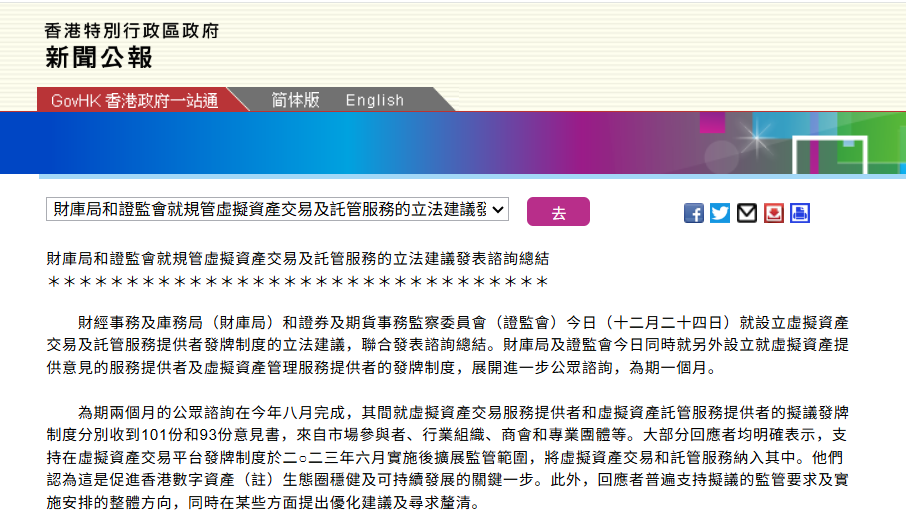
In 2023, Hong Kong revised the Anti-Money Laundering and Counter-Terrorist Financing Ordinance (AMLO), establishing a statutory licensing system for virtual asset trading platforms. To fill the regulatory gap, the FSTB, under the AMLO framework, initiated a consultation on legislative proposals to regulate virtual asset trading and custody services in June 2025 in collaboration with the SFC. The two policy documents released this time summarize and respond to the legislative consultation from June last year, clearly incorporating virtual asset trading and custody services into the licensing regulatory framework, proposing preliminary regulatory ideas, and innovatively including "advisory services on virtual assets" and "virtual asset management services" into a new licensing system. This means that the trading, custody, consulting, and asset management of virtual assets in Hong Kong will achieve a complete licensing regulatory closed loop.
This article will interpret the new regulatory requirements based on the two documents: "Consultation Summary on Legislative Proposals to Regulate Virtual Asset Trading and Further Public Consultation" and "Consultation Summary on Legislative Proposals to Regulate Virtual Asset Custody Services," analyze the core impacts on the market, and propose response suggestions based on this.
2 Policy Content Interpretation
The two policy documents not only systematically summarize the feedback from last June's consultation on regulating virtual asset trading and custody services but also propose to expand the scope of licensing regulation to include investment consulting and asset management activities. The regulatory system involved is still in the legislative process and will only take effect after the legal amendments are passed.
2.1 "Consultation Summary on Legislative Proposals to Regulate Virtual Asset Trading and Further Public Consultation"
This document summarizes the consultation on virtual asset trading services and simultaneously proposes two new regulatory suggestions. First, it finalizes the regulatory details for virtual asset trading services, clarifying the scope, financial requirements, and transitional arrangements.
Scope Definition: It clearly defines the scope of virtual asset trading services in line with the "Regulated Activity 1 (Securities Trading)" under the Securities and Futures Ordinance. Any business that conducts virtual asset buying and selling for clients or induces such activities must obtain a license, such as operating a virtual asset trading matching platform, providing over-the-counter (OTC) intermediary services, acting as a virtual asset broker for client transactions, and providing virtual asset market-making services.
Capital Requirements: It specifies that the financial resource requirements for virtual asset traders are consistent with those for Regulated Activity 1 licensees, with a minimum paid-up capital of HKD 5 million and a minimum liquid capital of HKD 3 million. This somewhat filters out smaller service platforms with insufficient strength, enhancing the overall safety and stability of the industry.
Mandatory Custody: Licensed traders must employ SFC-regulated virtual asset custodians to safeguard clients' virtual assets, ensuring the separation of trading and custody, and prohibiting self-custody of client assets. This initially excludes the option of using overseas custodians, aiming to establish a closed-loop, controllable local custody ecosystem.
Second, it further expands the scope of regulatory targets under the AMLO framework, proposing new licensing requirements for "providing advice on virtual assets" and "virtual asset management services."
Providing advice on virtual assets refers to offering investment advice on whether to acquire or dispose of virtual assets, which virtual assets to acquire or dispose of, and how to acquire or dispose of virtual assets, or issuing decision-making analytical reports, similar to investment advisors. Specific scenarios include recommending specific timing for buying and selling virtual assets and providing virtual asset portfolio allocation plans. For such entities, the regulatory authority intends to establish specific regulatory requirements from dimensions such as financial resources, professional personnel, compliance obligations, and business restrictions. Activities related to internal services, trading, or professional services will refer to traditional financial models to set up exemption systems.
Virtual asset management refers to providing services for managing virtual asset investment portfolios, requiring the acquisition of client authorization for investment decision-making rights and providing portfolio management services as a professional entity. The regulatory authority states that asset management services will not set a minimum investment ratio exemption; any entity providing asset management services for investment portfolios in virtual assets, regardless of the amount of virtual assets, must apply for a license or registration. This regulation aims to prevent related risks from being transmitted to the market through unregulated consulting or asset management activities and to reduce the arbitrage space for evading specialized regulation of virtual assets through traditional financial products.
2.2 "Consultation Summary on Legislative Proposals to Regulate Virtual Asset Custody Services"
The "Consultation Summary on Legislative Proposals to Regulate Virtual Asset Custody Services" constructs a regulatory system for virtual asset custody, viewing custody as the last line of defense for client asset security, and sets higher capital requirements.
Scope: The regulatory targets are entities that can transfer clients' virtual assets through private keys or similar tools. Independent third-party custodians must apply for a specialized license, while custody services affiliated with trading platforms may receive exemption arrangements to avoid duplicate licensing. Additionally, it further clarifies the responsibilities along the custody chain. For example, if an affiliated entity of a licensed trading platform engages in custody, it must apply for a separate custody license; existing financial institutions like banks that provide virtual asset custody services must also be included in this framework.
Capital Requirements: Licensed custodians are subject to higher capital requirements than traders. The minimum paid-up capital is HKD 10 million, and the minimum liquid capital is HKD 3 million. This requirement aims to ensure that licensed custodians have the operational maintenance and risk response capabilities commensurate with their business, reflecting the special nature of custody services.
Other Regulations: The operational standards for licensed custodians will be formulated with reference to traditional financial regulatory rules or existing custodial guidelines for licensed trading platforms, involving various aspects such as online/offline asset storage ratios, private key management, insurance protection, and independent audits. For instance, it requires establishing a high ratio of cold wallet storage and allowing flexible adjustments based on business needs to balance rapid withdrawal demands with security; it mandates strict multi-signature and tiered permission controls, regular penetration testing, and stress testing.
3 Impact on Hong Kong's Crypto Industry
3.1 Comprehensive Upgrade of the Licensing System
The licensing system for virtual asset regulation in Hong Kong has undergone a fundamental transformation, evolving from a single license issued only to centralized trading platforms (VATP) to a comprehensive licensing system covering four core businesses: trading, custody, consulting, and asset management. The VATP licensing system proposed comprehensive requirements, including capital, custody, and anti-money laundering, focused primarily on the "trading venue" itself. However, for widespread business activities outside the trading venue, such as OTC trading, independent asset custody, investment consulting, and specialized asset management, the regulatory focus was either vague or in a regulatory gray area, creating risks and opportunities for regulatory arbitrage. The independent trading license, custody license, and the proposed new consulting and asset management licensing system are systematic responses to these limitations, conducive to cultivating a professional and stable virtual asset service market ecosystem.
3.2 Building Institutional Trust in the Crypto Market
The new regulations establish institutional trust in the crypto market through a series of quantifiable and auditable hard constraints. First, they set capital and operational thresholds comparable to traditional financial institutions (e.g., HKD 5 million for traders and HKD 10 million for custodians), which somewhat filters out institutions with weak risk resistance, building capital-based institutional credit; second, they form a complete regulatory closed loop for virtual asset trading, custody, consulting, and asset management, shifting asset security from a single license and institutional self-discipline to comprehensive regulation. For individual and institutional investors, this framework provides legal and regulatory guarantees that are easy to understand and trust, similar to traditional financial businesses.
3.3 Challenges and Uncertainties After Regulatory Implementation
The update of the regulatory system inevitably comes with challenges. At the market level, some small and medium-sized service providers may face significant compliance transformation challenges, while risk-seeking global crypto capital may flow to regions with more flexible regulations due to the strict regulatory framework. At the regulatory level, this regulatory model places high demands on its professionalism; regulatory authorities will need to handle a massive number of license applications in the short term, and if the review speed lags, it will lead to a compliance vacuum in market services, stifling the development of legitimate businesses. Additionally, regulatory authorities must possess sufficient technical capabilities to identify and assess risks in custody solutions, blockchain analysis tools, and new trading models.
4. Responses from Crypto Market Practitioners
In the short term, "proactive compliance for survival, transformation and positioning for development" is the primary strategy for practitioners in Hong Kong's crypto market. The virtual asset regulation in Hong Kong is about to enter an era of comprehensive licensed operations, and market practitioners must immediately legally qualify their businesses in terms of trading, custody, consulting, or asset management and initiate the corresponding license application process. Some licenses do not have a transitional period, and any delays may lead to illegal operation risks after the regulations take effect.
In the medium to long term, market practitioners can gradually shift from responding to regulatory upgrades to building their core competitiveness through compliance advantages. This requires internalizing anti-money laundering monitoring, asset custody security, financial audit transparency, and other requirements into operational norms that exceed regulatory thresholds, providing trustworthy, stable, and auditable financial-grade services.
The institutionalization driven by the new regulations may have tax implications, requiring market practitioners to prepare for potential changes in tax burdens. For example, it is necessary to clarify the qualification of business income according to the regulatory framework and determine the types of taxable income. The addition of compliance operating costs (such as licensing fees and audit fees) may also bring tax deduction opportunities, necessitating policy tracking and accounting voucher management. More importantly, as institutional clients enter the market, providing transaction records and tax reports that meet audit requirements will become a basic service capability, and market practitioners can proactively improve their financial and tax systems to meet business growth needs.
Against the backdrop of the licensing system upgrade, the market may form a competitive landscape where a few fully licensed comprehensive service groups coexist with numerous specialized service providers in segmented fields. In addition to obtaining licenses, practitioners who proactively build compliance technology capabilities or seek specific ecological niches for deep cooperation may find good opportunities to establish their advantages in the next stage.
免责声明:本文章仅代表作者个人观点,不代表本平台的立场和观点。本文章仅供信息分享,不构成对任何人的任何投资建议。用户与作者之间的任何争议,与本平台无关。如网页中刊载的文章或图片涉及侵权,请提供相关的权利证明和身份证明发送邮件到support@aicoin.com,本平台相关工作人员将会进行核查。


